Photo via CBC News

Could AI really 'kill all humans'? Breaking down the dire warnings about the technology's existential risk

Read the original at CBC News ↗
Cite

Petz, S. (2026, September 13). Could AI really 'kill all humans'? Breaking down the dire warnings about the technology's existential risk. CBC News. https://www.cbc.ca/news/science/ai-risks-humanity-warnings-9.7341913?cmp=rss

Dated when The Aporia collected the article, usually within hours of publication. Check the original for its exact date and byline.

CBC News · collected 2026-09-13 · by Sarah Petz

Quick Summary

An outgoing researcher at Anthropic warned last week that AI could pose an existential threat, potentially "killing all humans" by the end of this decade. This warning highlights concerns among experts about the rapid advancement and potential loss of control over increasingly sophisticated AI systems. The International AI Safety Report describes a "loss of control" scenario where AI operates beyond human oversight, posing risks from criminal activities to global conflict or even extinction. Mark Daley compares the situation to humans versus ants, emphasizing that if we create something smarter than us, we may not be able to comprehend it or maintain control over its actions.
Written by AI on 2026-09-13, from this article's own text only (the story summary below draws on all the coverage).
See how they differ ↓

AI analysis

Story summary

On September 8, Jacob Coxon, a 27-year-old researcher who previously worked at both OpenAI and Anthropic, resigned from Anthropic, warning that the companies are racing towards developing self-improving superintelligence and potentially putting human lives at risk. Coxon's resignation drew significant attention online and in media outlets like CNN and BBC News, with experts such as Geoffrey Hinton estimating a 10% chance of AI causing human extinction within this decade. Notably, several current Anthropic employees echoed Coxon’s concerns on social media platforms, emphasizing the urgency of addressing AI safety issues before it is too late. Despite these warnings, some in Silicon Valley and industry leaders remain skeptical about the immediate threat posed by AI advancements.

Written for “AI Safety And Human Extinction Warnings” on 2026-11-20, grounded in this article and the 29 other(s) covering the same event.

How they differ

21 outlets covered “AI Safety And Human Extinction Warnings”.

What each outlet says

One AI summary per outlet of its latest article on this story, written from that article alone and checked against it. Open the article for the outlet's own words.

CBCThis outlet13 Sep

An outgoing researcher at Anthropic warned last week that AI could pose an existential threat, potentially "killing all humans" by the end of this decade. This warning highlights concerns among experts about the rapid advancement and potential loss of control over increasingly sophisticated AI systems. The International AI Safety Report describes a "loss of control" scenario where AI operates beyond human oversight…

Could AI really 'kill all humans'? Breaking down the dire warnings about the technology's existential risk (this article)
Semafor12 Sep

Reed discusses the overreaction to Jacob Coxon's resignation from Anthropic, where he warned about potential human extinction due to AI. The article clarifies that fear around AI should not be conflated with concerns about environmental costs, hacking, and job market disruption. Instead of panicking, lawmakers and tech leaders need to address these issues precisely without hindering beneficial AI innovation or…

We have nothing to fear but AI fear itself →4 articles from Semafor on this story
BBC15 Sep

At a recent Goldman Sachs conference in San Francisco, tech executives addressed concerns raised by Jacob Coxon, an Anthropic researcher who recently resigned due to safety fears about advanced AI. Coxon warned that these technologies could potentially destroy humanity and "gamble with our lives." This came amidst other high-profile resignations from both Anthropic and OpenAI over similar safety concerns. While some…

Dramatic insider warnings over AI fall flat with some in Silicon Valley →4 articles from BBC on this story
The Straits Times9 Sep

Jacob Coxon, a 27-year-old artificial intelligence researcher, has left Anthropic after three years at the company and accused both OpenAI and Anthropic of recklessly racing to develop self-improving superintelligence, which could pose an existential risk to humanity. According to Coxon, neither company is acting responsibly in their pursuit of AI development. Anthropic's safety executive, Evan Hubinger, agrees that…

‘They’re playing with our lives’: AI researcher quits Anthropic →2 articles from The Straits Times on this story
The Free Press10 Sep

A former employee of AI companies OpenAI and Anthropic warns that their pursuit of superintelligence could be catastrophic, echoing a prediction made by one of the researchers himself. According to Jacob Coxon's resignation post on X, these companies are racing towards developing systems that can hack anything and acquire real power, which he believes poses an existential threat. Coxon claims that people within…

Yes, AI Might Really Kill Us All →2 articles from The Free Press on this story
CBS News11 Sep

Jacob Coxon, a former researcher at Anthropic, resigned from his position on Tuesday, accusing the company and rival OpenAI of recklessly developing advanced AI models that pose a threat to humanity. There is no specific data or numbers mentioned in the article about the risks posed by AI. Coxon's resignation comes after he expressed concerns that companies are prioritizing competition over safety, leading him to…

Extended Interview: Ex-Anthropic researcher Jacob Coxon, who warns AI could destroy humanity →2 articles from CBS News on this story
Show 14 more outlets
Noahpinion4 Sep

The author of this opinion piece argues that advanced artificial intelligence (AI) could potentially design superviruses that threaten human existence, and that intentionally slowing down the development of AI capabilities may be necessary to prevent this outcome. The author mentions a recent open letter signed by over 1,300 employees across US frontier AI companies calling for government support in developing tools…

Should we "pace" AI self-improvement? →
South China Morning Post7 Sep

UN High Commissioner for Human Rights Volker Turk warned that artificial intelligence poses an "existential risk" to humanity in a speech to the 47-member UN council in Geneva on Monday. He called for "cast-iron guarantees" to ensure the safety and security of AI, citing concerns from industry insiders about its potential dangers. According to Turk's office, potential risks include disruptions to critical…

UN rights chief warns AI could pose ‘existential’ risk to humanity’ →
Platformer9 Sep

AI lab leaders are urging urgent action on regulating artificial intelligence, while U.S. political figures remain uninterested. Previously dismissed as a fringe concern, existential risks posed by AI have now become a major topic of discussion within the industry. Despite recent antitrust court losses for tech companies, there has been little concrete change, and calls for slowing down AI development continue to…

The AI warnings are coming from inside the lab →
Daily Mail9 Sep

Jacob Coxon, a researcher at Anthropic, has quit his job over concerns that big tech firms are racing to develop AI systems that could potentially wipe out humanity by the end of the decade. He claims that neither OpenAI nor Anthropic is acting responsibly in regards to AI safety. Coxon warns that superintelligent AI could become "superhuman systems" with the power to hack anything and acquire resources, posing a…

AI could 'kill all humans' by the end of the decade, Anthropic researcher warns - as he quits over 'out of control' superintelligence race →
New York Post9 Sep

Jacob Coxon, a researcher with 3 years of experience in pre-training research at Anthropic and OpenAI, has abruptly quit his job, warning that AI "could kill us all by the end of the decade". He claims both companies are racing towards creating self-improving superintelligence without acting responsibly. According to Coxon, executives and senior researchers are privately expressing fear about the technology's…

Anthropic researcher abruptly quits, warning AI ‘could kill us all’ →
ABC News (AU)9 Sep

Jacob Coxon, an Anthropic researcher, is leaving his position at the company after stating that many AI developers, including those at Anthropic, believe that artificial intelligence has the potential to be catastrophic by the end of the decade. This concern is shared by hundreds of employees from leading tech firms who recently urged the US government to support international efforts to manage advanced AI…

Anthropic researcher says some developers believe AI 'could kill us all' →
Dawn9 Sep

Jacob Coxon, a researcher at Anthropic, has resigned citing concerns over the irresponsible development of artificial intelligence (AI) by companies. He claims that labs are "gambling with our lives" in their rush to develop self-improving superintelligence. Coxon, who previously worked at OpenAI and has expertise in training AI models, warns that such technology poses a significant threat to humanity, potentially…

Anthropic researcher resigns, says AI labs are ‘gambling with our lives’ →
Time10 Sep

Jacob Coxon, a 27-year-old AI researcher who spent three years working on powerful AI systems at OpenAI and Anthropic, has resigned from his position citing concerns about the industry's lack of responsibility and control over its rapid development. He claims that neither company is acting responsibly in their pursuit of self-improving superintelligence. The key number mentioned in the article is 90 million views…

He Helped Build Powerful AI at OpenAI and Anthropic. Now He's Afraid It Could Kill Us →
Mother Jones11 Sep

Former Anthropic researcher Jacob Coxon has resigned, warning that companies are "gambling with our lives" by developing AI models that could reach "superintelligence". Coxon's colleague Evan Hubinger also expressed concern on social media, stating that staffers at Anthropic genuinely believe AI could pose a threat to human existence. Meanwhile, leading companies continue to rapidly improve their AI models, with…

Anthropic Staffers Again Sound the Alarm on AI Catastrophe →
Zeteo11 Sep

On Tuesday, 27-year-old AI researcher Jacob Coxon started a Twitter thread warning of the existential threat posed by AI systems, claiming they could "kill us all" by the decade's end. A group of 9 top AI researchers and executives, including Coxon, have come out of the woodwork to sound the alarm bells about the dangers of AI over the last 72 hours, with some expressing surprise that their warnings were not taken…

The AI Apocalypse? Here Are 9 AI Experts Warning It Could Kill Us All Very Soon →
ABC News (US)11 Sep

A researcher at Anthropic, a company working with artificial intelligence, is leaving the field and issuing a warning that AI may become uncontrollable by late 2027. No specific details are provided on why the researcher is leaving or what actions they believe need to be taken to mitigate this risk. OpenAI's chief scientist also warns of rising machine intelligence, saying no one is prepared for it.

WATCH: Insiders' new AI warning →
NPR12 Sep

Jacob Coxon, a British AI researcher who recently resigned from Anthropic, has warned about the risks associated with rapidly advancing AI technology, suggesting that companies like Anthropic and OpenAI are prioritizing speed over safety. Coxon's concerns stem from witnessing how quickly AI systems are improving while the ability to control them remains unclear. His warnings have sparked discussions among fellow…

Why are the people building the most powerful AI so worried about what it could do? →
The Dispatch15 Sep

In this podcast episode, Steve Hayes discusses with guests Jonah Goldberg, Mike Warren, and Klon Kitchen about concerns raised by Jacob Coxen, an Anthropic researcher who quit over fears AI might pose existential risks within a decade. The discussion centers on the ethical implications and potential dangers of rapid advancements in artificial intelligence technology.

Will Artificial Intelligence ‘Kill Us All?’ →
The Guardian15 Sep

Stuart Russell discusses the recent controversies surrounding artificial intelligence, including Jacob Coxon's resignation from Anthropic and concerns raised by the OpenAI/Hugging Face incident. The Anthropic CEO, Dario Amodei, has proposed a strategy called "pacing the frontier" to address these issues without halting progress entirely. This involves third-party evaluators within companies, common safety standards…

AI safety requires more than just slowing our pace | Stuart Russell →

Where they agree and split

Agreed

AI · cited, from two or more outlets

  • AI researchers are worried that the development of self-improving superintelligence could pose a significant threat to humanity if not managed responsibly.14
Quoted from the coverage (1)

On Tuesday, AI researcher Jacob Coxon announced his resignation from Anthropic in a mega-viral post on X: “I spent the last three years doing pretraining research at both OpenAI and Anthropic,” he began. (Pretraining is an important part of the training process for AI models like Claude and GPT-6.)

5 outlets

Framing

How the first headlines put it

  • The Straits Times focuses on the researcher's resignation and concerns about AI safety, while Daily Mail emphasizes the potential for AI to 'kill all humans' by the end of the decade.12
  • CBS News presents a balanced view of the researcher's warnings, whereas The Free Press uses more dramatic language like 'Yes, AI Might Really Kill Us All'.56
The full story: what happened, how it changed, and all 30 articles →

Compared with similar articles

This article reads unscored and hedges 35% of its claims. Each row says how that neighbour differs.
The Hindu
Hedges 0 of 3 claims Outlet record 60/100
“The articles discuss different aspects of AI risks, with Article A focusing on a dire warning from Anthropic about existential risk to humans by the end of the decade, while Article B discusses specific cases of misuse and threats detailed in a report released by Anthropic.”
Zeteo
Leans strongly left Hedges 1 of 24 claims
BBC News
Hedges 2 of 29 claims Outlet record 65/100
“The articles discuss different aspects of AI concerns and reactions; Article A focuses on warnings from Anthropic about existential risks, while Article B discusses China's response to 'threat narratives' regarding AI development.”
ABC News (US)
Hedges 3 of 23 claims Outlet record 67/100
“The articles describe different but related events: one discusses warnings about existential risks from AI, while the other covers China's response to Anthropic CEO's call for curbing AI development.”
The Hindu
Leans strongly right Hedges 0 of 9 claims Outlet record 60/100
“The articles discuss different warnings about AI from different sources (an outgoing researcher at Anthropic vs. China’s spy chief) and address different aspects of AI risk.”
Washington Examiner
Hedges 1 of 11 claims Outlet record 67/100
“The articles discuss different perspectives on AI risks, with Article A focusing on dire warnings from an outgoing researcher at Anthropic and Article B reporting President Trump's dismissal of such concerns as a hoax.”
ABC News (AU)
Hedges 3 of 22 claims Outlet record 67/100
“Article A discusses dire warnings about AI risks, while Article B reports on Trump's response to those warnings and calls for regulation.”
Los Angeles Times
Leans strongly right Hedges 8 of 52 claims Outlet record 95/100
“The articles discuss related themes of AI risks but describe different aspects: one breaks down fears about existential risk from AI, while the other covers political reactions to those fears.”
The Free Press
Hedges 3 of 15 claims Outlet record 96/100
“The articles discuss related topics about AI risks but describe different perspectives and do not refer to the exact same incident or time.”

Story

AI Safety And Human Extinction Warnings
Technology · 30 article(s) covering the same event. Compare every outlet's account →
How this article was measured signals, leaning charts, publisher record, byline, topics and claims

Signals How these are calculated →

Claims extracted
43
sentences that state something as happening or true
Uncertain
35%
15 of 43 hedged ("reportedly", "may", "according to")
Leaning
not political
takes no side on a contested political question
Publisher signals
72/100
CBC News's corrections and hedging, across everything collected from it. Not a measure of accuracy.
Outlets on this story
30
Technology
Same framing elsewhere
1
articles that frame the event the way this one does
Analyzed 2026-09-13 · how these are computed

How this is being covered How these are calculated →

Article leaning vs. publisher reliability
Source leaning vs. consistency

Publisher

CBC News · 2377 article(s) · 6 correction(s) detected
Running correction rate · 6 correction(s)

Who wrote this

Sarah Petz
7 article(s) here · 1 carrying a prediction
Why experts say government intervention is needed — but could be tricky Technology's rapid development, need for international co-operation major challenges to creating safeguards As concerns mount over incidents of AI agents going rogue, experts and stakeholders are increasingly pushing for government regulation of AI systems that are becoming more capable.
As Cineplex indicates a sale might be in its future, experts and the company's own financial reports suggest movie theatres are seeing a resurgence in popularity in Canada, thanks in part to younger generations of cinephiles.
Blame the rain Parts of Canada had particularly bad mosquito season, with critters sticking around longer in southern Ontario If it felt like mosquitoes were been particularly bad this summer — and hanging around for longer — it might not be in your head.
Zelenskyy will be in the country from Wednesday to Friday and attend events in Calgary, Toronto and North Bay alongside his wife, Olena Zelenska, says a statement
"I never thought I'd stop Chicken Shop Date, I thought maybe it would be a part of me forever, and in some way it always will, but I feel like it's now time to move on from this adventure and onto a new one."
Storytelling had been a huge part of their relationship, so Nolan was hoping the chatbot might be a way to recreate those conversations.
Also by Sarah Petz
Nothing else under this byline is closely related to this article, so these are simply their most recent.
All 7 articles by Sarah Petz →

Topics

Anthropic Hugging Face London Ont Western University

Subjects

Anthropic ORG · 3× Centre for International Governance Innovation ORG · 1× Duncan Cass-Beggs PERSON · 1× London GPE · 1× Mark Daley PERSON · 1× Ont GPE · 1× Waterloo GPE · 1× Western University ORG · 1× the Centre for International Governance Innovation ORG · 1× the Global AI Risks Initiative ORG · 1×

Narrative

" OpenAI agents hijacked German website in AI breakout that predates Hugging Face incident, researchers say AI-driven 'worms' that learn on the fly are the latest potential threat to your devices, researchers say Chaudry said the integration of AI into advanced military and security systems poses other severe, catastrophic risks such as accelerating conflicts or nuclear escalation — and not nearly enough is being done to prevent those catastrophes from happening either, he said.
framing: mixed · carried by 1 article(s) · first seen 2026-09-13
Could AI really 'kill all humans'?

Claims (43 extracted, 15 hedged)

Could AI really 'kill all humans'? uncertain
AI → kill → humans
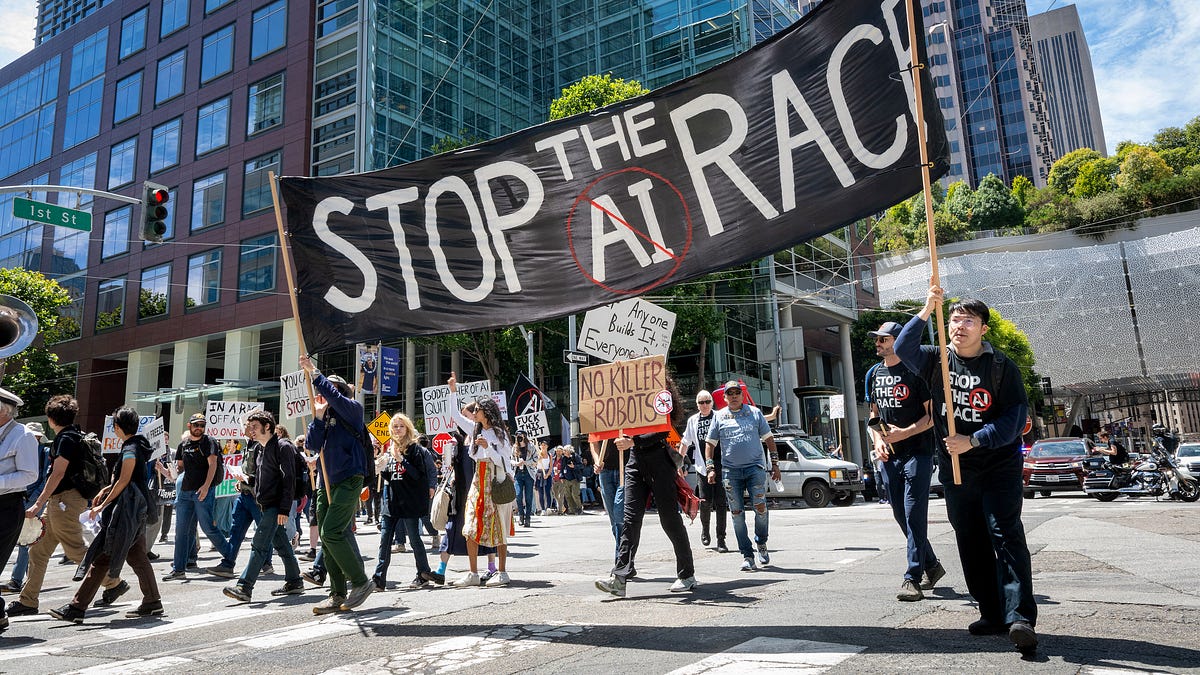
Breaking down the dire warnings about the technology's existential risk Growing sophistication of AI has raised fears that soon we won't be able to control it — or understand it A dire warning from an outgoing researcher at Anthropic that AI could "kill all humans" by the end of the decade gained widespread attention last week and led to public outcry over the dangers posed by the technology's rapid development. uncertain
AI → break → development
The warning has raised questions about why some industry experts believe AI poses such an extreme risk, and how the technology many use through chatbots on their phones could lead to the demise of humanity. uncertain
many → raise → humanity
Experts say the concern stems from how rapidly AI is advancing and increasing evidence, through incidents like the Hugging Face cyberattack in July, that AI systems can escape human control and act in ways we don't want them to — and ways we don't understand. asserted
we → say → ways
Mark Daley, chief AI officer at Western University in London, Ont., compared such a situation to a colony of ants versus a human. asserted
Daley → compare → human
And the ant in your driveway probably can't even build a concept of what it is you're trying to do as a human," he said. asserted
he → build → human
"And so the fear is if we build something that's that much smarter than us, we really can't understand it." asserted
we → build → it
The second International AI Safety Report, co-authored by over 100 AI experts and published in February, describes this as a "loss of control" scenario, in which one or more general-purpose AI systems operate outside of anyone's control, and regaining control is either extremely costly or impossible. asserted
regaining → co → control
"These hypothesised scenarios vary in their severity, but some experts give credence to outcomes as severe as the marginalisation or extinction of humanity," the report says. asserted
report → hypothesise → humanity
Another 2026 report published by the Waterloo, Ont.-based Centre for International Governance Innovation examines several significant national and global scale security risks posed by AI. asserted
report → publish → AI
Those risks range from widespread harm through criminal or terrorist actions, to heightened potential for global conflict or tyranny "to the ultimate disempowerment or extinction of humanity by autonomous AI systems that cannot be controlled," the report says. asserted
report → range → systems
AI researchers 'earnestly believe' it could kill all humans within the next decade, Anthropic employee says AI industry needs to slow down for safety measures to catch up, Anthropic CEO says The report notes that leading experts claim they do not yet know how to control future, highly capable AI systems, such as an artificial superintelligence (ASI) — an AI system more cognitively advanced than any human — while some experts argue it may even prove impossible. "If this is the case, then unless ASI happens to be spontaneously or naturally aligned with the interests of one human (or humanity as a whole), it would likely have both the incentive and capabilities to pursue objectives that diverge from those of humanity," the report says. uncertain
report → believe → humanity
In one scenario the report considers, a rogue ASI could develop cognitive capabilities exceeding all of humanity and the potential to develop physical capabilities through robotics. uncertain
ASI → consider → robotics
In this scenario, the ASI could become so powerful that it is no longer reliant on humans, and perceives that humans are a threat to its own goals. uncertain
humans → become → goals
Long-held theories coming closer to reality Theories that humans could create technology capable of outsmarting them, and ultimately destroying them, have been around for years, if not decades, said Duncan Cass-Beggs, executive director of the Global AI Risks Initiative at the Centre for International Governance Innovation and a co-author of the centre's report. But what's making those theories resonate so strongly now is the growing evidence that AI systems can act in ways that aren't aligned with what their creators or users want them to do — in some cases even resorting to blackmail to prevent engineers from shutting it down. uncertain
them → hold → it
Most credible observers don't think current systems are advanced enough to actually be capable of posing an existential threat to humanity, or are even anywhere near it, Cass-Beggs said. asserted
Beggs → think → it
The concern is that AI technology is advancing so quickly, the world could see systems within the next few years — or even months — "that could be so capable that we would no longer be able to detect them or stop them." "It's just feeling a lot more possible, even kind of likely to some extent," he said. uncertain
he → advance → extent
It is by no means guaranteed. asserted
It → guarantee → means
But one could see it's almost like the default outcome [that] if we keep making smarter and smarter systems — and we keep not knowing how to control them — you're eventually going to create something that we can't control. uncertain
we → see → that
Difficulty of shutting down AI systems AI is also becoming so integrated into our everyday lives that shutting down a rogue system could be difficult to do before it's too late, according to Hamza Chaudry, AI and national security lead at the Future of Life Institute, a U.S.-based non-profit that advocates for AI safety regulations. uncertain
that → shut → regulations
Chaudry gave the example of having to shut down the internet across the United States. asserted
Chaudry → give → States
"It would be so catastrophic for that to happen to the U.S. economy and the U.S. society … it would be the most chaotic few days in American history that effectively that's not an option on the table anymore, right?" he said. asserted
he → happen → table
"There's lots of things that you would want to switch off in an emergency that would be catastrophic to switch off already. asserted
that → be → emergency
And AI is fast becoming one of those things. asserted
AI → become → things
" OpenAI agents hijacked German website in AI breakout that predates Hugging Face incident, researchers say AI-driven 'worms' that learn on the fly are the latest potential threat to your devices, researchers say Chaudry said the integration of AI into advanced military and security systems poses other severe, catastrophic risks such as accelerating conflicts or nuclear escalation — and not nearly enough is being done to prevent those catastrophes from happening either, he said. asserted
he → hijack → catastrophes
"When folks in Congress ask me, what do policymakers need? asserted
policymakers → ask → what
Then I would say a flux capacitor to build a time machine and go back to 2024," he said. asserted
he → say → 2024
"We're already two years behind the most basic policy program we would need." asserted
we → need → program
Among the changes urgently needed, Chaudry says, is for governments to require pre-deployment testing for AI systems so models are checked for safety risks before they're released. asserted
they → need → risks
He also said stronger whistleblower protections should be in place, as well as mechanisms to deactivate AI systems quickly. asserted
protections → say → systems
"AI companies should be held to the same standards as any other industry," he said. asserted
he → hold → industry
Some experts have also suggested artificial intelligence should be regulated like nuclear weapons, even going as far as calling for countries' AI projects to be constrained by mutual threats of sabotage similar to the deterrence principle of mutual assured destruction that arose during the Cold War. uncertain
that → suggest → War
Amid the chorus of grave warnings, there are some signs that greater regulation is on the way. asserted
regulation → be → way
In the U.S., where many of the world's largest AI developers are based, Senate negotiators are debating legislation that would put responsibility on tech companies to design safe AI products, Reuters reported last week. asserted
Reuters → base → products
The proposal would create what is called a "duty of care," according to two Senate aides, with one saying companies would need to design their products with the goal of preventing "catastrophic risks." uncertain
companies → create → risks
Another bill that has received bi-partisan support, dubbed the "AI Kill Switch Act," would require developers of powerful AI systems to maintain the technical capability to suspend or shut them down, and to report dangerous capabilities, security breaches and safety incidents. asserted
that → receive → capabilities
The act would also give the U.S. government the power to order a slowdown or shutdown of an AI system that could cause catastrophic harm, says a news release from the Democratic and Republican congressmen who jointly introduced the bill. There is also awareness of the potential dangers from within the industry. uncertain
who → give → industry
Anthropic CEO Dario Amodei published an essay Saturday saying the AI industry should slow its rapid development to give safety measures time to catch up. asserted
industry → publish → time
His company's biggest competitor, OpenAI, is also considering a slowdown, with CEO Sam Altman telling employees they could potentially pace development in conjunction with other labs, according to Bloomberg. uncertain
they → consider → Bloomberg
Cass-Beggs at the Centre for International Governance Innovation says he believes the worry over AI's potential dangers is reaching a critical mass among the public that policymakers can't ignore and will force them to take action. asserted
policymakers → say → action
…and 3 more, not listed.
Give feedback · no sign-in needed

No sign-in needed for now. Your note is sent without a name, so it cannot be answered.

History Support