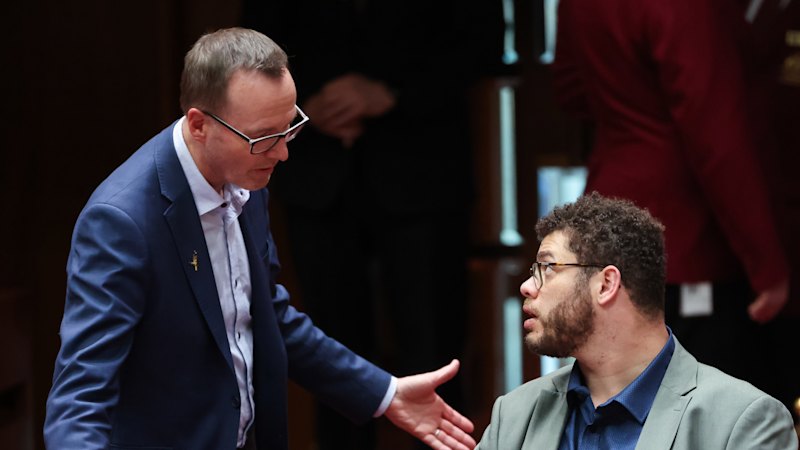
Photo via The Guardian

‘Manosphere’ podcasts and moon-landing conspiracy theories to remain online under new laws, Wells says

Read the original at The Guardian ↗
Cite

Butler, J. (2026, October 15). ‘Manosphere’ podcasts and moon-landing conspiracy theories to remain online under new laws, Wells says. The Guardian. https://www.theguardian.com/australia-news/2026/oct/15/anika-wells-dismisses-gov-censorship-claims-online-safety-national-press-club-ntwnfb

Dated from the outlet's own feed. Check the original for its byline.

The Guardian · collected 2026-10-15 · by Josh Butler

Quick Summary

Communications Minister Anika Wells clarified at the National Press Club that proposed online safety laws would not censor Australians from listening to manosphere podcasts or expressing views like moon-landing conspiracy theories. The laws aim to hold tech platforms responsible for harmful content and provide users with protections against it, without infringing on free speech. Platforms could face fines exceeding $100 million if they fail to comply with the new digital duty of care requirements intended to create a safer online environment.
Written by AI on 2026-10-15, from this article's own text only (the story summary below draws on all the coverage).
See how they differ ↓

AI analysis

Story summary

Anika Wells, Australia's communications minister, clarified that under new online safety laws being proposed by Labor, Australians can still listen to manosphere podcasts or voice conspiracy theories like doubting the moon landing without restrictions. She emphasized these laws are not about censorship but rather about ensuring tech companies take responsibility for harmful content targeting vulnerable groups, such as minors exposed to extremist material or eating disorder content.

Wells also mentioned considering updates to digital duty of care laws that would allow individual Australians to sue big tech companies if they violate the new rules. This move is seen as a compromise to gain support from the Greens and address concerns raised by critics who fear government overreach. A Senate inquiry will further scrutinize the legislation, with the Greens pushing for even stricter penalties against tech firms that fail to uphold digital safety standards.

Written for “Anika Wells On Tech Companies And Speech Laws” on 2026-11-21, grounded in this article and the 1 other(s) covering the same event.

How they differ

2 outlets covered “Anika Wells On Tech Companies And Speech Laws”.

What each outlet says

One AI summary per outlet of its latest article on this story, written from that article alone and checked against it. Open the article for the outlet's own words.

The GuardianThis outlet15 Oct

Communications Minister Anika Wells clarified at the National Press Club that proposed online safety laws would not censor Australians from listening to manosphere podcasts or expressing views like moon-landing conspiracy theories. The laws aim to hold tech platforms responsible for harmful content and provide users with protections against it, without infringing on free speech. Platforms could face fines exceeding…

‘Manosphere’ podcasts and moon-landing conspiracy theories to remain online under new laws, Wells says (this article)
ABC News (AU)15 Oct

Communications Minister Anika Wells announced that the Labor government is considering allowing individuals to sue tech companies for online harms under proposed digital safety laws. Despite concessions made to address concerns about censorship, the Coalition remains opposed to the legislation. A Senate inquiry will review the bill, which includes measures like protecting minors from harmful content and giving…

Anika Wells opens door to lawsuits against big tech companies →

Compared with similar articles

This article reads unscored and hedges 6% of its claims. Each row says how that neighbour differs.
ABC News (AU)
Leans left Hedges 2 of 33 claims Outlet record 67/100
“The articles cover different aspects and updates related to online safety laws but describe distinct discussions and policy decisions rather than a single identical incident.”
ABC News (AU)
Leans left Hedges 5 of 43 claims Outlet record 67/100
The Guardian
Leans strongly left Hedges 2 of 25 claims Outlet record 64/100
“The articles discuss different aspects of the proposed online safety laws and negotiations, rather than the same specific incident or occurrence.”
The Sydney Morning Herald
Hedges 1 of 12 claims Outlet record 61/100
“While both articles discuss Anika Wells' proposed online safety laws, Article A focuses on the content that would remain legal under the new laws, whereas Article B covers a broader range of announcements and does not specifically mention the same details or quotes.”
ABC News (AU)
Leans left Hedges 1 of 31 claims Outlet record 67/100
“The articles discuss different aspects of the proposed online safety laws and their implications, rather than a single specific incident.”

Story

Anika Wells On Tech Companies And Speech Laws
Technology · 2 article(s) covering the same event. See how they differ ↑
How this article was measured signals, leaning charts, publisher record, byline, topics and claims

Signals How these are calculated →

Claims extracted
32
sentences that state something as happening or true
Uncertain
6%
2 of 32 hedged ("reportedly", "may", "according to")
Leaning
withheld
no quote in the article backed the model's score
Publisher signals
64/100
The Guardian's corrections and hedging, across everything collected from it. Not a measure of accuracy.
Outlets on this story
2
Technology
Same framing elsewhere
1
articles that frame the event the way this one does
Analyzed 2026-10-15 · how these are computed

How this is being covered How these are calculated →

Article leaning vs. publisher reliability
Source leaning vs. consistency

Publisher

The Guardian · 3749 article(s) · 8 correction(s) detected
Running correction rate · 8 correction(s)

Who wrote this

Josh Butler
32 article(s) here · 1 carrying a prediction
The music industry has declared it will not accept an AI carveout deal that leaves other creative sectors behind, rejecting a reported proposal to give musicians special treatment while allowing big tech to train on other copyrighted material – described by David Pocock as a “divide and conquer strategy”.
While the government maintains it will not undermine copyright law, the industry minister, Tim Ayres, said on Tuesday “the status quo is no good” for the creative sector, ahead of a package of AI legislation expected by early 2027.
As Labor considers copyright changes in an AI policy suite including datacentres, online safety, energy resources and economic benefits, the South Australian backbencher added weight to mooted constitutional challenges as to whether watering down copyright law would be an illegal acquisition of property.
Australian concerns In Australia, a former intelligence officer said they expected Australian security agencies would have sought briefings from overseas counterparts about Megaspeed or undertaken their own assessments of the local subsidiary this week.
A Microsoft spokesperson said the company “had no indication of a cyber-attack” and suggested the issue could be related to a configuration change to its servers that was causing some to become overloaded and taken offline.
Entry-level jobs will be the first to be automated due to AI, but it could mean fewer hours and higher wages for ordinary workers – or make jobs tougher with more burnout and workplace surveillance – the government has warned employers.
“The embassy of Finland in Canberra will be temporarily closed on Tuesday, 10 November 2026.
A key recommendation is for the attorney general’s department, the Australian federal police and home affairs to consider reforming the law to introduce “penalties for egregious regulatory non-compliance” and a “failure to prevent” offence which would criminalise developing an AI model that engaged in harmful conduct while failing “to take reasonable steps to prevent that harm”.
Australia weakening copyright protections to aid AI companies would be “ridiculous and dangerous”, the global peak body for the music recording industry has warned as it watches with concern how the Albanese government responds to big tech’s demands.
When will Australia see the benefits of the AI and datacentre boom?
Also by Josh Butler
Nothing else under this byline is closely related to this article, so these are simply their most recent.
All 32 articles by Josh Butler →

Topics

Australians Coalition Greens Labor manosphere

Subjects

Wells PERSON · 6× Australian NORP · 3× Australians NORP · 3× Coalition ORG · 2× Labor NORP · 2× manosphere ORG · 2× Anika Wells PERSON · 1× Australia GPE · 1× Greens ORG · 1× the National Press Club ORG · 1×

Narrative

Wells said: “The idea that any capacity would be spent as an independent regulator trying to spread government propaganda, rather than trying to shut down pro-terror content going to 13-year-old boys in Western Sydney or eating disorder content going to 14-year-old girls in Western Australia, is not a tenable argument.”
framing: assertive · carried by 1 article(s) · first seen 2026-10-15
Australians could still “listen to manosphere podcasts” or “say the moon landing was fake” under proposed new online safety laws, Anika Wells has stressed as she rubbished claims they would lead to government censorship The communications minister also said she was considering updates to the digital duty of care laws to allow individual Australians to directly sue big tech companies flouting the new rules.

Claims (32 extracted, 2 hedged)

Australians could still “listen to manosphere podcasts” or “say the moon landing was fake” under proposed new online safety laws, Anika Wells has stressed as she rubbished claims they would lead to government censorship The communications minister also said she was considering updates to the digital duty of care laws to allow individual Australians to directly sue big tech companies flouting the new rules. uncertain
Australians → listen → rules
This has been a key demand from the Greens for their support for the laws, while the Coalition accuses Labor of plans to “secretly control Australian speech”. asserted
Coalition → accuse → speech
“This is not about what people say on the internet,” Wells told the National Press Club on Thursday. asserted
Wells → say → Thursday
“It’s about what platforms do on the internet, and your right to disagree with me or the government or believe whatever you want to believe will not be impinged by a digital duty of care. asserted
you → ’ → care
“Your right to be free from harm, hopefully, will be improved.” asserted
right → improve → harm
Wells said that “if adults listen to manosphere podcasts, or people post their views about the government, or make memes, or want to say the moon landing was fake – they can continue to do so without restriction”. asserted
they → say → restriction
“We are not controlling free speech, and we are not conducting covert surveillance,” Wells said. asserted
Wells → control → surveillance
The digital duty of care laws, introduced into parliament on Thursday after months of discussion and consultation, would add several planks to Australia’s online safety regime. asserted
laws → introduce → regime
The government said it would place “an overarching obligation” for tech platforms “to provide a safe online environment for all Australians”, and replacing an existing range of online codes and standards with a broader duty-of-care requirement to protect users from certain “harmful” content. asserted
platforms → say → content
Wells has suggested misogynistic, pro-terror, suicide and self-harm, or eating disorder content would be captured by the laws, which will apply to platforms such as social media, online games, apps and chatbots. uncertain
which → suggest → media
“If you build it, you are responsible for its risks,” Wells said, likening the reforms to having seatbelts in cars. “We must shift the burden from the shoulders of victims to the companies that are creating the environments where harms occur.” asserted
harms → build → environments
The changes also provide for what the government has dubbed “my feed my way”, allowing social media users to opt-out of algorithmic content feeds and instead see content only from pages they have actively chosen to follow. asserted
they → provide → pages
Platforms face fines of more than $100m for non-compliance. asserted
Platforms → face → compliance
But the reforms have been met with ferocious opposition from conservative campaign groups and politicians, who have claimed the ability to class content as “harmful” would create a framework for government censorship. asserted
ability → meet → censorship
The campaign group, Advance, has dubbed it a “Big Brother bill”, likening it to Labor’s dumped misinformation bill and collecting nearly 75,000 signatures on a petition calling for it to be scrapped. asserted
it → dub → petition
Liberal frontbencher James Paterson claimed the bill was a bid “to secretly control Australian speech, to censor Australian speech”. asserted
bill → claim → speech
The shadow communications minister, Sarah Henderson, said the Coalition was vehemently opposed to the bill. asserted
Coalition → say → bill
One key criticism is the ability of regulators and researchers to create so-called “sockpuppets”, or pseudonymous accounts on various networks, which the government argues is critical to test how platforms are complying with legislation. asserted
platforms → create → legislation
But rightwing media personalities, podcasters and politicians have railed against this provision. asserted
personalities → rail → provision
Pauline Hanson claimed it would lead to “swarms of AI-powered government bots to feed you propaganda and record what you do online”. asserted
you → claim → what
Wells dismissed these suggestions, saying “sockpuppets” would only be used for research and enforcement purposes. asserted
sockpuppets → dismiss → purposes
The eSafety commissioner must report annually on its use of sockpuppets, and such accounts can engage with other users of an online service “only to the extent necessary to prevent closure of an account”. asserted
accounts → report → account
Wells said: “The idea that any capacity would be spent as an independent regulator trying to spread government propaganda, rather than trying to shut down pro-terror content going to 13-year-old boys in Western Sydney or eating disorder content going to 14-year-old girls in Western Australia, is not a tenable argument.” asserted
capacity → say → Australia
Greens senator Sarah Hanson-Young claimed the campaigns against the legislation were “running cover for big tech”. asserted
campaigns → claim → tech
“To suggest this is about censorship or about shutting down anything is absolute rubbish. asserted
this → suggest → anything
It is a fake debate, it’s got nothing to do with it, and it is purely the radical right running the speaking points of big tech asserted
it → get → tech
,” she said. asserted
she → say → ?
The Greens are broadly supportive of the bill, but want Labor to strengthen rules, including adding the ability for ordinary Australians to take private action against tech companies for breaches, and for fines to be dramatically increased. asserted
fines → want → breaches
Wells said it was “something we would contemplate”, noting such schemes had been successful in the United States. asserted
schemes → say → States
But she also urged the Coalition to reopen negotiations. asserted
she → urge → negotiations
The bill will be go to a Senate inquiry, to report back in late November. asserted
bill → go → November
Labor hopes to pass it this year. asserted
Labor → hop → it
Give feedback · no sign-in needed

No sign-in needed for now. Your note is sent without a name, so it cannot be answered.

History Support