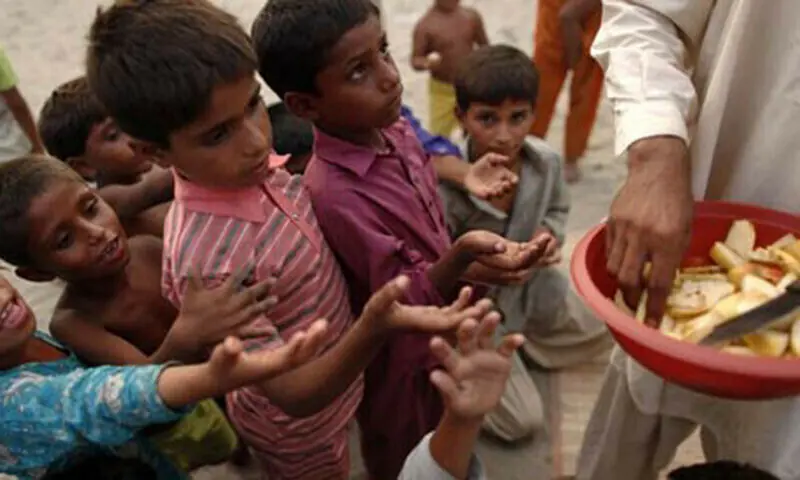
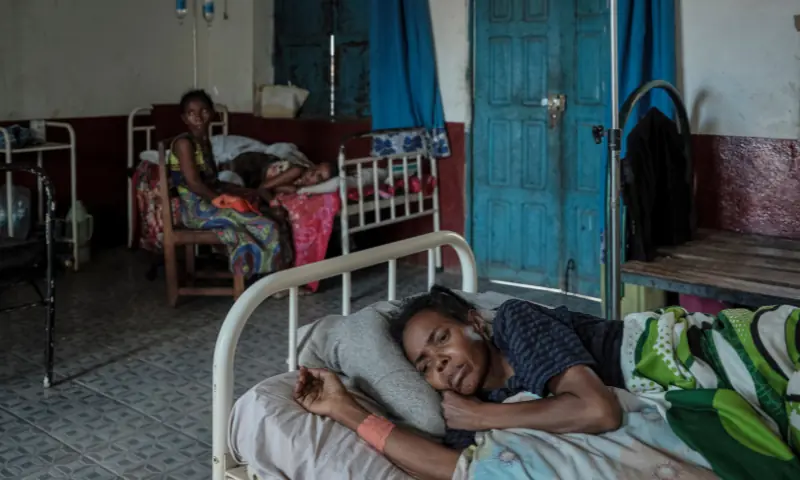
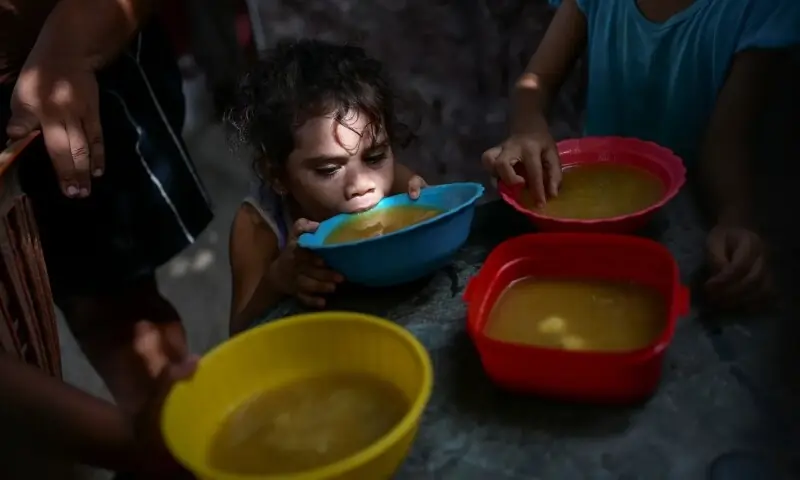
Photo via Dawn

Pakistan worst hit by hunger in South Asia

Read the original at Dawn ↗
Cite

Ahmed, A. (2026, October 15). Pakistan worst hit by hunger in South Asia. Dawn. https://www.dawn.com/news/2037222/pakistan-worst-hit-by-hunger-in-south-asia

Dated from the outlet's own feed. Check the original for its byline.

Dawn · collected 2026-10-15 · by Amin Ahmed

Quick Summary

The 2026 Global Hunger Index reports that Pakistan has the highest score among South Asian countries, indicating severe food security issues driven by economic instability, climate shocks like heavy rains and floods, and global conflicts. The report shows that undernourishment in Pakistan has increased since 2018, with child wasting rates nearing a high threshold. Across South Asia, the situation remains serious, with about one-third of globally undernourished people living there, totaling 218 million.
Written by AI on 2026-10-15, from this article's own text only (the story summary below draws on all the coverage).

AI analysis

Story summary

Pakistan recorded the highest score in South Asia on the 2026 Global Hunger Index, reflecting a worsening food security crisis driven by economic instability and climate shocks. Published jointly by Welthungerhilfe, Ruhr University Bochum’s Institute for International Law of Peace and Armed Conflict, and Helvetas under the theme “No Security Without Food Security,” the report reveals that South Asia's progress has largely stagnated since 2018, with conditions in Pakistan deteriorating. In Pakistan, economic instability and sharp food price inflation have eroded households' purchasing power, causing a rise in undernourishment from low to medium levels and an increase in child wasting toward high thresholds. Across the region, South Asia remains in the ‘serious’ category, with a regional score of 23.5, down from an alarming 37.5 previously. The report warns that high levels of acute food insecurity will persist across South Asia due to economic instability and climate-related crop losses.

Written for “Hunger In Pakistan” on 2026-11-21, grounded in this article and the 0 other(s) covering the same event.

Compared with similar articles

This article reads leans left and hedges 5% of its claims. Each row says how that neighbour differs.
Dawn
Hedges 0 of 14 claims Outlet record 67/100
“Article A covers a global increase in poverty reported by the UNDP, while Article B focuses on Pakistan's specific situation regarding hunger within South Asia.”
Dawn
Leans left Hedges 3 of 19 claims Outlet record 67/100
“The articles discuss different reports released on distinct dates with varying focuses.”
Dawn
Leans left Hedges 3 of 22 claims Outlet record 67/100
“LLM unavailable”

Story

Hunger In Pakistan
World · 1 article(s) covering the same event.
How this article was measured signals, leaning charts, publisher record, byline, topics and claims

Signals How these are calculated →

Claims extracted
21
sentences that state something as happening or true
Uncertain
5%
1 of 21 hedged ("reportedly", "may", "according to")
Leaning
Leans left
of the writing, not the subject · beta estimate
Publisher signals
67/100
Dawn's corrections and hedging, across everything collected from it. Not a measure of accuracy.
Outlets on this story
1
World
Same framing elsewhere
1
articles that frame the event the way this one does
Analyzed 2026-10-15 · how these are computed

How this is being covered How these are calculated →

Article leaning vs. publisher reliability
Source leaning vs. consistency

Publisher

Dawn · 3487 article(s) · 5 correction(s) detected
Running correction rate · 5 correction(s)

Who wrote this

Amin Ahmed
16 article(s) here · 1 carrying a prediction
The commission’s tasks would include ensuring coherence between national and inter-provincial policies and water initiatives, and establishing an integrated mechanism to assess the impact of transboundary water projects and other interventions.
2026-11-16 · assertive framing · Water demand outstrips supply in Punjab: UN agency
The financing will support the Sindh Transformational Accelerated Rural Water Supply, Sanitation, and Hygiene Services Phase 1 Project (STAR WASH-1), the World Bank’s resident mission in Islamabad announced on Saturday.
The minister termed Pakistan’s three major seaports — Karachi Port, Port Qasim and Gwadar Port — “strategic gateways that could facilitate regional trade, strengthen transportation links and provide alternative routes for the movement of goods”, according to a press release by the BoI. Sheikh particularly underscored Karachi’s importance as Pakistan’s major industrial and commercial hub, noting that its established industrial base, business infrastructure, financial institutions and port facilities offered significant opportunities for trade, industrial partnerships and foreign investment.
The Sindh Property Revenues Enhancement Programme (Sindh PREP) approved by the World Bank board of executive directors, will benefit Karachi’s 25 local councils.
The WIPO report identified that the near-term environment was more demanding than the previous year: “Global growth of about 3.4pc in 2025 is expected to ease to around 3pc in 2026, held back by higher energy prices and elevated uncertainty, before recovering modestly in 2027.”
In theory, a more multipolar world could strengthen multilateralism, compared to a world order dominated by two competing countries or one superpower.
2026-10-25 · assertive framing · Veto power hinders efforts to end conflicts: UN
Pakistan’s incomes could triple by 2050 if the country ensures faster implementation of structural reforms, according to the World Bank Group’s latest Pakistan Development Update, titled Attaining Escape Velocity.
The report, Ten Largest Global Food Crises, released on Friday in connection with World Food Day, warns that an estimated 10.6 million people in Pakistan will require humanitarian assistance in 2026, despite ongoing recovery efforts and improvements in some macroeconomic indicators.
The report warned that high levels of acute food insecurity will persist across the region.
2026-10-15 · assertive framing · Pakistan worst hit by hunger in South Asia
Also by Amin Ahmed
Nothing else under this byline is closely related to this article, so these are simply their most recent.
All 16 articles by Amin Ahmed →

Topics

Afghanistan ISLAMABAD Iran Pakistan Welthungerhilfe

Subjects

Pakistan GPE · 6× Afghanistan GPE · 4× Iran GPE · 2× Bochum GPE · 1× Helvetas ORG · 1× ISLAMABAD GPE · 1× Ruhr University ORG · 1× Swiss NORP · 1× Welthungerhilfe ORG · 1× the Institute for International Law of Peace and Armed Conflict ORG · 1×

Narrative

Published jointly by Welthungerhilfe, the Institute for International Law of Peace and Armed Conflict at Ruhr University Bochum, and the Swiss organisation Helvetas under the theme “No Security Without Food Security”, the report reveals that progress in South Asia has largely stagnated, with conditions in Pakistan and Afghanistan deteriorating since 2018.
framing: assertive · carried by 1 article(s) · first seen 2026-10-15
The report warned that high levels of acute food insecurity will persist across the region.
2026-10-15 · Dawn
Pakistan worst hit by hunger in South Asia · assertive framing

Claims (21 extracted, 1 hedged)

• Economic instability erodes household purchasing power; heavy rains, floods trigger acute crop losses • South Asia remains in the ‘serious’ category; global hunger rises after two decades ISLAMABAD: asserted
hunger → erode → decades
Pakistan recorded the highest score in South Asia on the 2026 Global Hunger Index released on Wednesday, reflecting a worsening food security crisis driven by economic instability, climate shocks and global conflicts. asserted
Pakistan → record → instability
Published jointly by Welthungerhilfe, the Institute for International Law of Peace and Armed Conflict at Ruhr University Bochum, and the Swiss organisation Helvetas under the theme “No Security Without Food Security”, the report reveals that progress in South Asia has largely stagnated, with conditions in Pakistan and Afghanistan deteriorating since 2018. asserted
conditions → publish → 2018
In Pakistan, economic instability and sharp food price inflation have eroded households’ purchasing power and constrained access to food. asserted
instability → erode → food
Undernourishment in the country has climbed from low in 2018 to medium, while child wasting has risen toward the high threshold. asserted
wasting → climb → threshold
Across South Asia, the situation remains serious with a regional score of 23.5. asserted
situation → remain → 23.5
Although the region’s score has fallen substantially from an alarming 37.5 in 2000, most of that progress occurred before 2018. asserted
most → fall → 2018
While Pakistan and Afghanistan have moved from the alarming to the serious category since 2000, child stunting remains very high. asserted
stunting → move → 2000
Pakistan’s stunting rate continues to fall, whereas Afghanistan’s has edged up since 2018. asserted
Afghanistan → continue → 2018
Child mortality rates in both nations have declined from very high levels in 2000 to medium levels today. asserted
rates → decline → levels
The report warned that high levels of acute food insecurity will persist across the region. asserted
levels → warn → region
Heavy rains and flooding caused localised crop losses in parts of Pakistan and Bangladesh, while below-average rainfall and above-average temperatures negatively affected Afghanistan’s 2026 cereal-growing season. asserted
rainfall → cause → season
According to Food and Agriculture Organisation estimates, 218 million people in South Asia, including Iran, were undernourished between 2023 and 2025, representing roughly one-third of the global total. uncertain
people → accord → total
Globally, hunger is rising again after nearly two decades of progress. asserted
hunger → rise → progress
The 2026 global score stands at 18.1, worsening from 17.6 in 2018. asserted
score → stand → 2018
Hunger has increased in 32 countries since 2018, and 57 countries are on track to miss achieving even low hunger levels by 2030. asserted
countries → increase → 2030
Three of the index’s four indicators — undernourishment, child stunting and child wasting — have worsened, while only child mortality has continued to decline slightly. asserted
mortality → worsen → indicators
State-based armed conflicts, now at their highest level since World War II, alongside frequent extreme weather events, are major drivers of this reversal. asserted
conflicts → base → reversal
The war in Iran and shipping disruptions in the Strait of Hormuz and the Bab al-Mandab Strait are driving up fuel, transportation and fertiliser costs. Meanwhile, Russia’s war in Ukraine and Black Sea export restrictions threaten higher wheat prices, making basic supplies unaffordable in the Global South. asserted
supplies → drive → South
Compounding the crisis, international spending on food security has fallen to 2016-2017 levels, forcing cuts to aid programmes and emergency rations. asserted
spending → compound → programmes
The report urged governments to reverse funding cuts for humanitarian assistance and data collection to prevent and manage future crises. asserted
report → urge → crises

Give feedback · no sign-in needed

No sign-in needed for now. Your note is sent without a name, so it cannot be answered.

History Support