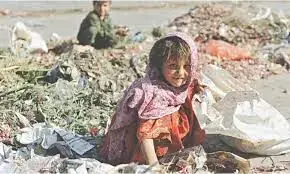
Photo via Dawn

Deeper poverty

Read the original at Dawn ↗
Cite

Deeper poverty. (2026, October 14). Dawn. https://www.dawn.com/news/2037049/deeper-poverty

Dated from the outlet's own feed. Check the original for its byline.

Dawn · collected 2026-10-14 · by Editorial

Quick Summary

Pakistan's multidimensional poverty rate, according to UNDP figures, is at 38.3%, significantly higher than the South Asian average of 19.3%. This means nearly four out of ten Pakistanis face severe deprivation in health, education, and living standards, lagging behind neighboring countries like India (16.4%) and Bangladesh (14.9%). The article highlights that economic stability measures such as controlling inflation are insufficient without addressing the basic needs of the population, emphasizing the need for development-focused policies to combat poverty effectively.
Written by AI on 2026-10-14, from this article's own text only (the story summary below draws on all the coverage).

AI analysis

Story summary

As of recent reports, PAKISTAN faces a severe poverty crisis that goes beyond official indicators, with nearly four in ten Pakistanis suffering from deprivation in health, education, and living standards. The latest UNDP figures reveal that 38.3% of Pakistan's population is multidimensionally poor compared to 19.3% for South Asia overall. This places Pakistan significantly worse off than its neighbors, such as India (where poverty affects 16.4% of the population) and Bangladesh (with 14.9% in poverty). The multidimensional poverty index includes factors like nutrition, child health, schooling, sanitation, drinking water, electricity, housing, and other necessities, indicating that many families earn enough to be above an income-based poverty line but still lack access to these essentials. The intensity of deprivation for the multidimensionally poor is 51.7%, with another 12.9% of Pakistan's population vulnerable to such conditions.
Written for “Deeper Poverty” on 2026-11-21, grounded in this article and the 0 other(s) covering the same event.

Compared with similar articles

This article reads leans strongly left and hedges 8% of its claims. Each row says how that neighbour differs.
Dawn
Leans left further right than this Hedges 3 of 19 claims Outlet record 67/100
“The articles discuss different aspects of poverty and hunger in Pakistan but do not describe the same specific incident or occurrence.”
Dawn
Hedges 0 of 14 claims Outlet record 67/100
“Article A discusses the overall global rise in poverty according to UNDP's report, while Article B focuses specifically on Pakistan's poverty crisis and compares it with other countries.”

Story

Deeper Poverty
Economy/Business · 1 article(s) covering the same event.
How this article was measured signals, leaning charts, publisher record, byline, topics and claims

Signals How these are calculated →

Claims extracted
13
sentences that state something as happening or true
Uncertain
8%
1 of 13 hedged ("reportedly", "may", "according to")
Leaning
Leans strongly left
of the writing, not the subject · beta estimate
Publisher signals
67/100
Dawn's corrections and hedging, across everything collected from it. Not a measure of accuracy.
Outlets on this story
1
Economy/Business
Same framing elsewhere
1
articles that frame the event the way this one does
Analyzed 2026-10-14 · how these are computed

How this is being covered How these are calculated →

Article leaning vs. publisher reliability
Source leaning vs. consistency

Publisher

Dawn · 3487 article(s) · 5 correction(s) detected
Running correction rate · 5 correction(s)

Who wrote this

No reporter is named on this article, beyond the feed's “Editorial”.

Topics

Bangladesh India PAKISTAN Pakistanis UNDP

Subjects

PAKISTAN GPE · 3× Bangladesh GPE · 2× India GPE · 2× Dawn ORG · 1× Pakistanis NORP · 1× UNDP ORG · 1×

Narrative

An economy cannot sustain higher productivity when children miss school, malnutrition damages their development, and poor healthcare pushes households into financial distress.
framing: assertive · carried by 1 article(s) · first seen 2026-10-14
A family may earn enough to remain above an income-based poverty line and still lack access to these essentials.
2026-10-14 · Dawn
Deeper poverty · assertive framing

Claims (13 extracted, 1 hedged)

PAKISTAN’S poverty crisis is far deeper than official indicators suggest. asserted
indicators → suggest → ?
While the government celebrates economic stabilisation, almost four in every 10 Pakistanis suffer from deprivation in health, education, and living standards. asserted
Pakistanis → celebrate → health
The latest UNDP figures put multidimensional poverty at 38.3pc of the population against 19.3pc for South Asia. asserted
figures → put → Asia
We are worse off than nearby countries — poverty affects 16.4pc of India’s and 14.9pc of Bangladesh’s population. asserted
poverty → affect → population
These estimates are based on surveys from different years, however, and should not be treated as a strictly contemporaneous ranking. asserted
estimates → base → ranking
The index captures deficiencies in nutrition, child health, schooling, sanitation, drinking water, electricity, housing, and other necessities. asserted
index → capture → nutrition
A family may earn enough to remain above an income-based poverty line and still lack access to these essentials. uncertain
family → earn → essentials
This means millions more risk falling into acute deprivation when faced with illness, joblessness, rising food prices, or climate-related disasters. asserted
millions → mean → illness
Our poor performance exposes the limits of an economic strategy focused primarily on containing inflation, accumulating foreign exchange reserves and meeting fiscal targets. asserted
performance → expose → targets
Though necessary, they cannot substitute for growth and development. asserted
they → substitute → growth
An economy cannot sustain higher productivity when children miss school, malnutrition damages their development, and poor healthcare pushes households into financial distress. asserted
healthcare → sustain → distress
Economic stability should be judged by whether it improves people’s lives, not merely by whether the balance-of-payments holds or the budget deficit narrows. asserted
deficit → judge → payments
Pakistan’s widening development gap with India and Bangladesh is a warning that stability without investment in people will leave poverty entrenched. asserted
stability → widen → poverty
Give feedback · no sign-in needed

No sign-in needed for now. Your note is sent without a name, so it cannot be answered.

History Support