Photo via The Straits Times

After election triumph, German far-right seeks allies to form state government

Read the original at The Straits Times ↗
Cite

The Straits Times. (2026, September 11). After election triumph, German far-right seeks allies to form state government. The Straits Times. https://www.straitstimes.com/world/europe/after-election-triumph-german-far-right-seeks-allies-to-form-state-government

Dated when The Aporia collected the article, usually within hours of publication. Check the original for its exact date and byline.

The Straits Times · collected 2026-09-11 · by The Straits Times

Quick Summary

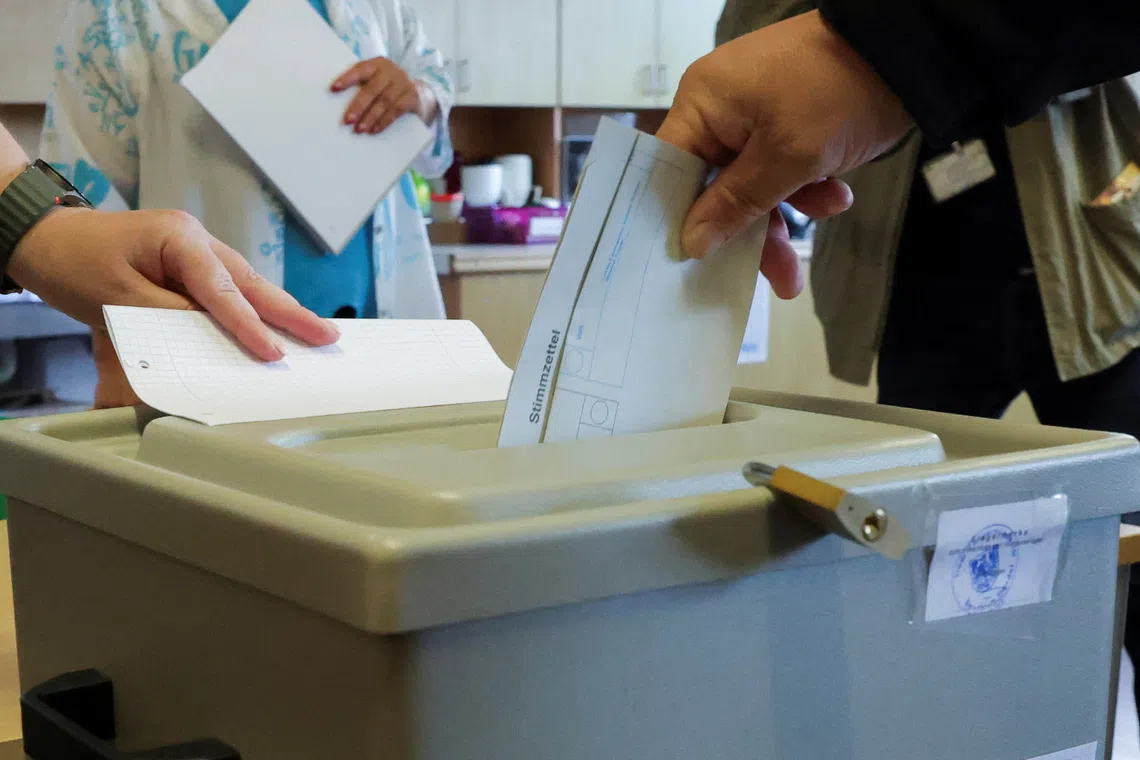
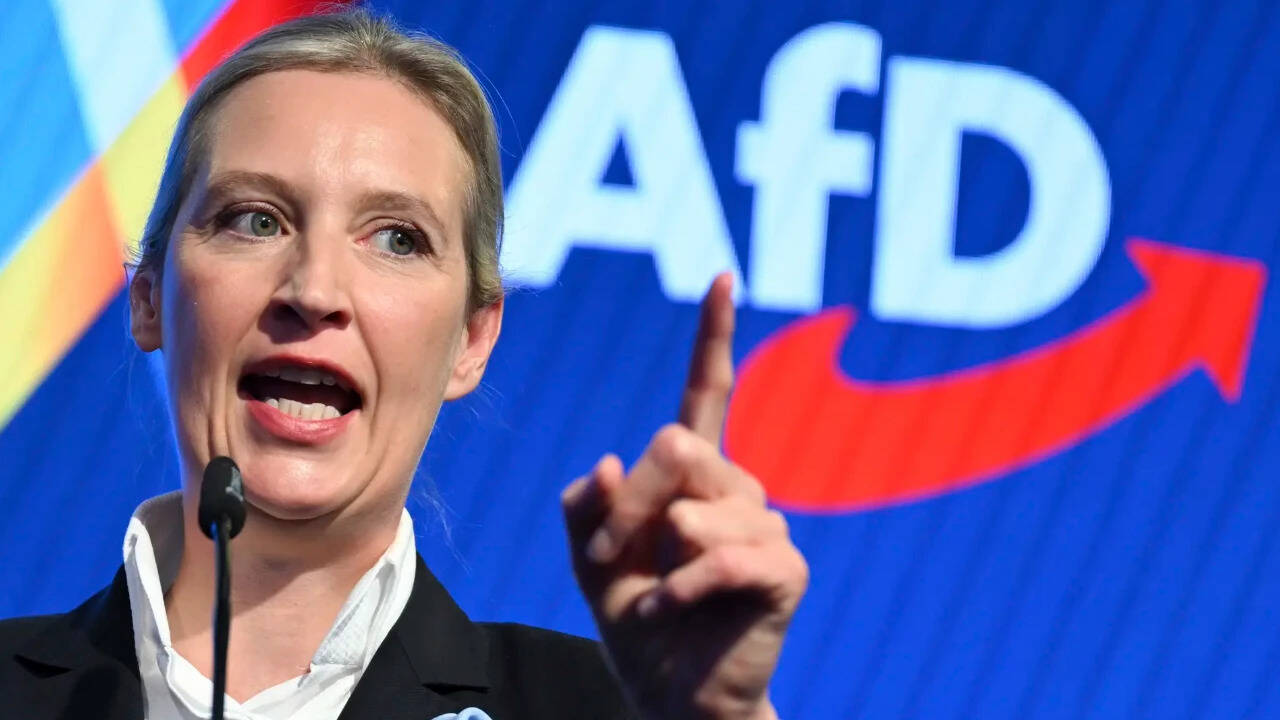
After its victory in Sunday's Saxony-Anhalt state election, Germany's far-right Alternative for Germany (AfD) party is seeking allies to form a state government, led by 35-year-old leader Ulrich Siegmund who won 39 seats out of 83. The AfD is looking to either attract defectors from other parties or reach an agreement with the small far-left BSW party, which has set difficult conditions for its support. According to Siegmund, discussions are underway with both the BSW and individual members of other parties to secure a stable majority. Despite winning almost 44% of the vote, the AfD is likely to have a slim majority if it secures an agreement.
Written by AI on 2026-09-11, from this article's own text only (the story summary below draws on all the coverage).
See how they differ ↓

AI analysis

Story summary

In an upcoming Sunday election, Germany's far-right party, Alternative for Germany (AFD), is poised to win control of the eastern state of Saxony-Anhalt, a position it hasn't held since World War II. AFD’s lead candidate, Ulrich Siegmund, has gained significant traction by addressing concerns like immigration and Russia normalization through social media platforms such as TikTok. Polls suggest AFD could secure around 44% of the vote, more than double its previous performance in 2016. Should AFD achieve an outright victory, it would control state resources, aiming to implement policies including separate classrooms for refugees and a reduced focus on Germany's Nazi past. This historic shift raises concerns about emboldening far-right influence across Germany, with implications for national politics beyond the regional level.

Written for “German Far Right Election Gains” on 2026-11-20, grounded in this article and the 63 other(s) covering the same event.

How they differ

29 outlets covered “German Far Right Election Gains”.

What each outlet says

One AI summary per outlet of its latest article on this story, written from that article alone and checked against it. Open the article for the outlet's own words.

The Straits TimesThis outlet11 Sep

After its victory in Sunday's Saxony-Anhalt state election, Germany's far-right Alternative for Germany (AfD) party is seeking allies to form a state government, led by 35-year-old leader Ulrich Siegmund who won 39 seats out of 83. The AfD is looking to either attract defectors from other parties or reach an agreement with the small far-left BSW party, which has set difficult conditions for its support. According to…

After election triumph, German far-right seeks allies to form state government (this article)5 articles from The Straits Times on this story
BBC9 Sep

German Chancellor Friedrich Merz clashed with AfD leader Alice Weidel in parliament, calling her party's migration policy "ethnic cleansing" for skilled workers. In the aftermath of the AfD's election win in Saxony-Anhalt, where they won 44% of the vote, Merz accused the party of harming German interests and putting millions at risk through its remigration policy. Weidel responded by saying voters had rejected…

Germany's Merz attacks AfD in stormy debate after far-right election win →6 articles from BBC on this story
Al Jazeera7 Sep

AfD politician Ulrich Siegmund is reported to have potentially formed the first far-right state government in post-World War II Germany, following his party's win in the Saxony-Anhalt election. The article makes no mention of specific numbers or details about the election. Siegmund has been referred to as "Germany's 'most dangerous man'" without further explanation or context.

Is the AfD’s Ulrich Siegmund Germany’s ‘most dangerous man’? →5 articles from Al Jazeera on this story
The Independent9 Sep

German Chancellor Friedrich Merz accused the far-right Alternative for Germany (AfD) party of advocating "ethnic cleansing" through its anti-migration policies and support for Russia. The AfD surged to victory in an eastern state election, and Merz's criticism comes after his own party suffered a bruising defeat. According to the article, the AfD wants to speed up deportations of rejected asylum seekers and foreign…

Germany’s Merz accuses far-right AfD of calling for ‘ethnic cleansing’ after bruising defeat →5 articles from The Independent on this story
Semafor15 Sep

The Alternative für Deutschland (AfD) won significant gains in recent German state elections, nearly doubling their national support compared to 2024 levels. This success challenges Chancellor Friedrich Merz's government, which has seen a decrease in polling numbers. The AfD’s skepticism towards the EU and perceived closeness to Russia are concerning for European unity and defense cooperation, particularly given…

The AfD's weekend victory roils Germany's politics →4 articles from Semafor on this story
The Guardian7 Sep

Ulrich Siegmund, the lead candidate of Germany's far-right Alternative für Deutschland (AfD) party, has thanked Elon Musk for his support after the party won a state election in Saxony-Anhalt. The AfD secured 39 lawmakers in an 83-member legislature, falling just three seats short of a majority to form a government alone. Russian presidential envoy Kirill Dmitriev praised the "historic win" for the pro-Kremlin AfD…

Elon Musk thanked by German far-right leader after landmark election win praised by Russia | First Thing →4 articles from The Guardian on this story
Show 23 more outlets
CBC7 Sep

The far-right Alternative for Germany (AfD) party secured a historic win in Saxony-Anhalt, an eastern German state, with voters choosing to run the government led by this right-wing extremist party designated as such by local domestic intelligence agencies. The AfD's victory has been hailed by its politicians, including federal co-leader Alice Weidel, who promises to improve relations with Russia and implement…

Far-right victory in German state expected to send shockwaves throughout the world →3 articles from CBC on this story
NPR7 Sep

Germany's far-right Alternative for Germany (AfD) party has declared victory in the state of Saxony-Anhalt, with preliminary final results showing they won 43.8% of the vote, their strongest performance in any German state election. This outcome could potentially give them power to govern the state for the first time since Nazi Germany, although it's not yet clear if they can form a coalition without partnering with…

Germany's far-right achieves an electoral breakthrough in key state election →3 articles from NPR on this story
Daily Mail7 Sep

Germany is on the brink of a political earthquake as an exit poll shows that the hard-Right nationalist party Alternative for Germany (AfD) may win control of Saxony-Anhalt regional parliament, with 44.5% of voters backing them. The AfD's victory would be the first time a far-Right party has taken power in the region since the end of Nazi rule eight decades ago. If successful, the AfD plans to deport all illegal…

SUE REID: Germany in shock as hard-Right party stands on the brink of power →3 articles from Daily Mail on this story
Time13 Sep

The Alternative for Germany (AfD), a far-right party, won 43.8% of the vote in Saxony-Anhalt, emphasizing its nationalist platform through a 258-page manifesto that calls for deportations of immigrants, changes to school curriculums, and reduced support for LGBTQ+ families. The AfD also opposes military aid to Ukraine and advocates for improved relations with Russia. Despite being classified as right-wing extremist…

The AfD's Dark Agenda for Germany →3 articles from Time on this story
CBS News7 Sep

The far-right Alternative for Germany (AfD) party won a significant victory in the regional election in Saxony-Anhalt, securing 39 lawmakers in an 83-member parliament, but fell short of winning a majority. The party's candidate, Ulrich Siegmund, claimed that voters had sent a signal for change and that AfD has a clear mandate to govern. AfD won 43.8% of the vote, more than double its showing five years ago in the…

Far-right AfD wins big in German regional election, falls short of majority →2 articles from CBS News on this story
Fox News7 Sep

The far-right Alternative for Germany (AfD) party is projected to win a significant victory in the state election in Saxony-Anhalt, potentially forming its first state government since World War II. According to preliminary results, AfD's candidate Ulrich Siegmund said his party had "written history" and that voters were sending a message of discontent with the national government. This would be the largest victory…

Germany’s far-right party AfD surges to historic victory in state election →2 articles from Fox News on this story
Washington Examiner7 Sep

German Chancellor Friedrich Merz is facing pressure after the far-right Alternative Germany (AfD) party won a landslide victory in Saxony-Anhalt's regional election. The AfD fell just short of a majority with 31% of the vote, while Merz's Christian Democrats (CDU) lost half their support, dropping to 21%. This is the first time since World War II that a far-right or right-wing populist party has had a chance to lead…

Landslide victory for Germany’s far-right AfD in state election piles pressure on Chancellor Merz →2 articles from Washington Examiner on this story
Deutsche Welle11 Sep

The nationalist Alternative for Germany (AfD) party won 43.8% of the vote in Saxony-Anhalt state election, prompting nationwide alarm and concerns among people of Turkish origin. Gökay Sofuoglu, co-chair of the Turkish Community in Germany, said some business owners are considering leaving Germany due to fears of a rise in nationalist violence. The AfD's victory is seen as a threat to democracy in Germany, with…

Turks in Germany anxious after AfD wins in Saxony-Anhalt →2 articles from Deutsche Welle on this story
Los Angeles Times5 Sep

The Alternative for Germany (AfD) party's leader, Tino Chrupalla, has adopted tactics from President Trump's playbook to cast doubt on the integrity of absentee voting in Germany's upcoming state election. Like Trump, Chrupalla has made unsubstantiated claims that mail-in ballots are susceptible to corruption and manipulation, specifically targeting senior citizens in nursing homes. The AfD party is gaining momentum…

Trumpism's shadow looms over German election as far right eyes historic power →
Times of India6 Sep

The Alternative for Germany (AfD) party is competing in a closely watched state election in Saxony-Anhalt, where around 1.7 million voters are casting ballots on Sunday. Recent polls indicate the AfD could secure over 40% of the vote, with lead candidate Ulrich Siegmund declaring "the rise can no longer be stopped." The election is being seen as a test of Chancellor Friedrich Merz's strategy to counter the AfD by…

‘Can no longer be stopped’: AfD races towards historic win in Germany state vote →
Euronews6 Sep

AfD candidate Ulrich Siegmund cast his vote in Saxony-Anhalt's state election on Sunday, arriving at the polling station with his wife Julia. Supporters gathered outside, cheering him as he arrived on a motorcycle and taking selfies with the crowd. The election has drawn national attention as the AfD seeks its strongest result yet. Siegmund expressed optimism about the outcome and called for overcoming political…

AfD’s Ulrich Siegmund casts vote in key German state election →
National Post6 Sep

The far-right Alternative for Germany (AfD) party won 44% of the vote in Saxony-Anhalt's state election on Sunday, more than doubling its previous support and putting it ahead of the Christian Democratic Union (CDU). The AfD secured 44% of the vote while the CDU collapsed to 17.5%, according to a projection by ARD. This victory is seen as one of the biggest challenges yet to Germany's political establishment, with…

Far-right AfD wins German state election: ‘This is democracy’ →
ABC News (US)6 Sep

The Alternative for Germany (AfD) party is projected to win a regional election in Saxony-Anhalt with over 44% of the vote, nearly double its previous showing in the region. This could potentially make it the first far-right party to form a state government in post-war Germany. AfD's candidate for governor, Ulrich Siegmund, said that voters have sent a "signal toward Berlin" and that the party's leader, Chancellor…

German far-right party set for regional election win but uncertain of governing →
Dawn6 Sep

Germany's far-right Alternative for Germany (AfD) party won a landslide victory in Saxony-Anhalt state, taking at least 44% of the vote according to exit polls. The AfD's lead candidate, Ulrich Siegmund, claimed "we have made history today" and hinted at ambitions to lead the party to national victory in 2029. According to exit polls, the centre-right CDU won around 18.5% of the vote, while the AfD's radical agenda…

Germany's far-right AfD emerges as landslide winner in eastern state vote →
South China Morning Post6 Sep

Germany's far-right Alternative for Germany (AfD) party won 44% of the vote in the regional election in Saxony-Anhalt, more than doubling its support from previous elections. This victory puts the AfD within reach of power at the state level for the first time since World War II. The centre-right CDU party, led by Chancellor Friedrich Merz, received around 18% of the vote, a significant loss for the party. The AfD's…

Germany’s far-right AfD claims historic win in regional election →
New York Post6 Sep

The right-wing Alternative for Germany (AfD) party won a historic victory in the Saxony-Anhalt state election on Sunday, securing 44.5% of the vote and leaving Chancellor Friedrich Merz's Christian Democratic Union party with 18.5%. The AfD's co-leader Alice Weidel predicted "explosive growth" for her party across East Germany and at the federal level. According to projections, the AfD would win between 39 and 41…

Right-wing AfD party notches historic win in Germany: ‘We are going to see explosive growth’ →
Sydney Morning Herald6 Sep

Ulrich Siegmund, leader of the far-right Alternative für Deutschland (AfD) party, won a significant majority of votes in Saxony-Anhalt's state election, securing 44% of the vote and potentially 39 seats in the 83-seat parliament. If successful, this would be the first time the AfD has gained power in Germany. Siegmund's campaign focused on nostalgic appeals to return to "good old" times before the fall of the Berlin…

Election shockwave: Meet the smiling new leader set to bring hard-right upheaval to Germany →
ABC News (AU)6 Sep

The Alternative for Germany (AfD) party has won more than 44% of the vote in Saxony-Anhalt's regional election, making it the largest party in the state and marking a far-right win in Germany since World War II. The AfD gained 20 percentage points compared to its performance in the last regional election in 2021, but still fell short of a majority with 39 potential seats out of 83. With most parties vowing not to…

Far-right party wins German state election for first time since WWII →
The Hindu7 Sep

The far-right Alternative for Germany (AfD) party won a significant victory in the regional election in Saxony-Anhalt on September 6, 2026, but fell short of winning an absolute majority. The AfD secured 39 seats, just three shy of the required number to govern alone, with 43.8% of the vote. Chancellor Friedrich Merz's Christian Democratic Union party slumped to a disastrous result, losing about half its support and…

Far-right Alternative for Germany party wins big in regional election but falls short of majority →
Letters from an American9 Sep

The far-right Alternative for Germany (AfD) party won 43.8% of the vote in Saxony-Anhalt's legislative election on Sunday. The party has received support from Vice President J.D. Vance and billionaire Elon Musk, who donated $290 million to Republican candidates in the 2024 U.S. elections. AfD leaders have expressed interest in collaborating with Musk, citing his potential investments as a positive development for…

September 8, 2026 →
Noahpinion9 Sep

The article argues that liberalism needs a new philosophy of immigration, citing the recent landslide election victory of Germany's far-right party, AfD, in the eastern state of Saxony-Anhalt. According to experts, including Adam Tooze and Robin Brooks, immigration is the key issue driving AfD popularity, with voters prioritizing security and anti-foreigner sentiment over economic concerns. Data from a 2024 study…

Liberalism needs a new philosophy of immigration →
Mother Jones11 Sep

The article reports that the German far-right party Alternative für Deutschland (AfD) won a significant victory in the state of Saxony-Anhalt, but its supporters are more outraged by being called "far right" than the election itself. Key figures such as Elon Musk, Alice Weidel, and Donald Trump Jr. have tweeted to delegitimize the term, claiming it is a "propaganda term" or a "codeword for ordinary decent citizens."…

The Far Right Can’t Stand Being Called “Far Right” →
The Free Press11 Sep

Douglas Murray argues that describing the Alternative for Germany (AfD) party as "far-right" is misleading and oversimplified. The AfD won almost 44 percent of the vote in Saxony-Anhalt's election, which has led to widespread media characterizations of it as a far-right party on the rise. However, Murray suggests that this label does not accurately capture the complexity of the party. He notes that while some…

Douglas Murray: Who’s Afraid of the ‘Far Right’? →

Where they agree and split

Agreed

AI · cited, from two or more outlets

  • No far-right party has won control of a German state since World War II, and governing at state level would mean powers over policing, local education, and culture.25
Quoted from the coverage (4)

"No matter the outcome of tomorrow's election, we have already made history," said Siegmund.

8 outlets

Victory for the AfD is also a symbolic blow to Mr Merz, whose centre-right party has led Saxony-Anhalt for 24 years.

8 outlets

Other parties won't go into coalition with the AfD, as part of what is known as the Brandmauer or firewall that keeps the far right from government.

7 outlets

Under Germany’s federal system, state governments sit in the upper house of parliament, the Bundesrat, and also have wide powers in education, domestic security and culture.

7 outlets

Disputed

Picked by our model, which is sometimes wrong

  • The AfD claims it has won a mandate to govern despite falling short of an outright majority, while other sources suggest forming a government will be difficult due to other parties ruling out working with the AfD.26

Framing

How the first headlines put it

  • 'Germany's AFD could become 1st far-right party to hold state power since WWII. What could that mean?' vs 'Can AfD form Germany’s first far-right state government since World War II?'.46
  • 'Germany's AFD could become 1st far-right party to hold state power since WWII. What could that mean?' vs 'Can no longer be stopped': AfD races towards historic win in Germany state vote.41
Stated as fact3
The headlines (3)

Germany's AFD could become 1st far-right party to hold state power since WWII. What could that mean? CBC · stated as fact

Germany's far-right AfD party is poised for power in a state election NPR · stated as fact

German far-right set for gains in key elections Semafor · stated as fact

Words to watch (2)

After election triumph, German far-right seeks allies to form state government The Straits Times

Right-wing AfD party notches historic win in Germany: ‘We are going to see explosive growth’ New York Post

The full story: what happened, how it changed, and all 64 articles →

Compared with similar articles

This article reads leans right and hedges 18% of its claims. Each row says how that neighbour differs.
The Independent
Leans left further left than this Hedges 7 of 31 claims Outlet record 59/100
The Straits Times
Leans left further left than this Hedges 3 of 10 claims Outlet record 64/100
Times of India
Leans right Hedges 9 of 26 claims Outlet record 59/100
The Guardian
Leans left further left than this Hedges 4 of 34 claims Outlet record 64/100
CBC News
Leans left further left than this Hedges 5 of 35 claims Outlet record 60/100
BBC News
Leans right Hedges 2 of 47 claims Outlet record 65/100
NPR
Leans left further left than this Hedges 3 of 27 claims Outlet record 60/100
National Post
Hedges 2 of 28 claims Outlet record 60/100
The Independent
Leans strongly right further right than this Hedges 6 of 37 claims Outlet record 59/100
South China Morning Post
Leans right Hedges 3 of 6 claims Outlet record 62/100

Story

German Far Right Election Gains
Politics · 64 article(s) covering the same event. Compare every outlet's account →
How this article was measured signals, leaning charts, publisher record, byline, topics and claims

Signals How these are calculated →

Claims extracted
17
sentences that state something as happening or true
Uncertain
18%
3 of 17 hedged ("reportedly", "may", "according to")
Leaning
Leans right
of the writing, not the subject · beta estimate
Publisher signals
64/100
The Straits Times's corrections and hedging, across everything collected from it. Not a measure of accuracy.
Outlets on this story
64
Politics
Same framing elsewhere
1
articles that frame the event the way this one does
Analyzed 2026-09-11 · how these are computed

How this is being covered How these are calculated →

Article leaning vs. publisher reliability
Source leaning vs. consistency

Publisher

The Straits Times · 5570 article(s) · 7 correction(s) detected
Running correction rate · 7 correction(s)

Who wrote this

The Straits Times
3829 article(s) here · 1 carrying a prediction
The European leaders were meeting as part of the so-called coalition of the willing, which regularly gathers to discuss ways to protect a postwar Ukraine from future Russian aggression.
US peace negotiator Jared Kushner, at the same event, also said that he and fellow negotiator Steve Witkoff had “gotten the Russians comfortable with the concept that any security guarantee for Ukraine would be based on Article 5”.
Takaichi’s China trip this week was her first since suggesting in 2025 that Japan might intervene militarily if China attempted to take Taiwan by force.
But while some believe the success of the meeting could have a stabilising effect on an international order in turmoil, the broad consensus among analysts is that this first-of-its-kind meeting worked more as a confidence-building exercise between the rival nations rather than an immediate, concrete cure to the world’s ills.
Iraqi security forces will deploy in Jurf al-Sakhar, a stronghold of the Kataib Hezbollah armed group, on Friday, security officials told a press conference, under a compromise deal designed to ease tensions with Iran's most powerful Shi'ite militia ally in the country.
Some analysts said the outcome of the Shenzhen summit may actually diminish Trump’s stature on the world stage as he enters the lame-duck phase of his presidency, while bolstering two of Washington’s main adversaries.
Whether or not the allegation is true, “just the news will definitely influence people’s opinions of women who have broken the ceiling or are trying to.” Asian American women working in tech, civil rights advocacy and academia have felt a sense of dread that this ordeal will diminish how their peers are viewed and treated in their workplaces. It is a reminder that no accomplishments will completely dispel centuries-old stereotypes.
Three killed in missile strikes on Kyiv, mayor says, in biggest attack on bridges
The Bill is backed by both the oil and gas industry and clean energy groups, but opposed by many major environmental organisations. The measure now proceeds to the House of Representatives, where Speaker Mike Johnson, a supporter of the initiative, has predicted he has the votes to pass it. But members on both sides of the aisle, including Minority Leader Hakeem Jeffries, have said they want to make changes to the Bill. Some Republicans, including Representative Chip Roy, policy chair of the ultraconservative House Freedom Caucus, have wavered in their support, saying they have concerns about the legislation’s electric transmission provisions. Some progressive Democrats, meanwhile, have said they oppose the Senate version of the Bill, contending it would weaken environmental laws. Representative Bruce Westerman, the chairman of the House Natural Resources Committee, said on Nov 19 he doubted there would be time to make changes to the Bill before Congress’s term expires at the end of December. “If the Senate gets it done then I think that’s what we’ll have to pass in the House,” Westerman said in an interview before the vote.
Their complaint alleged that supervisors had warned that objections would result in “trouble.”
Also by The Straits Times
Nothing else under this byline is closely related to this article, so these are simply their most recent.
All 3829 articles by The Straits Times →

Topics

AfD BSW German Germany Saxony-Anhalt

Subjects

AfD ORG · 7× BSW ORG · 6× Germany GPE · 4× Siegmund PERSON · 4× German NORP · 3× Saxony-Anhalt GPE · 3× CDU ORG · 2× MAGDEBURG GPE · 2× Russia GPE · 2× Ulrich Siegmund PERSON · 1×

Narrative

AFD SHUNNED BY GERMANY'S MAINSTREAM PARTIES The Alternative for Germany (AfD) is already the country's most popular party at the national level and is seeking to secure a foothold for advancing its agenda, which includes heavy restrictions on immigration, restoring ties with Russia, cutting support to Ukraine and quitting the euro.
framing: assertive · carried by 1 article(s) · first seen 2026-09-11
Ulrich Siegmund, the 35-year-old AfD leader who is expected to become state premier, said there were discussions with both the BSW and individual members of other parties "to see if there is any common ground that could help secure a stable majority".
2026-09-11 · The Straits Times
After election triumph, German far-right seeks allies to form state government · assertive framing

Claims (17 extracted, 3 hedged)

After election triumph, German far-right seeks allies to form state government MAGDEBURG, Germany, Sept 11 - asserted
right → seek → government
After its triumph in Sunday's state election in Saxony-Anhalt, Germany's far-right AfD needs to attract defectors from other parties or reach an agreement with the small far-left BSW party that is setting difficult conditions in return for its support. asserted
that → need → support
Ulrich Siegmund, the 35-year-old AfD leader who is expected to become state premier, said there were discussions with both the BSW and individual members of other parties "to see if there is any common ground that could help secure a stable majority". uncertain
that → expect → majority
He said he wanted to form such a majority in the state legislature "as soon as possible". asserted
he → say → legislature
However, there is nothing unusual in German politics about coalition negotiations that last for weeks or even months before a government can be formed. asserted
government → be → weeks
The discussions underline the political realities now facing Siegmund, who said repeatedly during the campaign that he wanted an absolute majority to be able to govern alone, only to fall just short, winning 39 seats in the 83-seat parliament. asserted
majority → underline → parliament
Even if he secures an agreement with another party that would allow him to become premier, his majority is likely to be a slim one, making governing more complicated than his record score in the election might suggest. uncertain
score → secure → election
AFD SHUNNED BY GERMANY'S MAINSTREAM PARTIES The Alternative for Germany (AfD) is already the country's most popular party at the national level and is seeking to secure a foothold for advancing its agenda, which includes heavy restrictions on immigration, restoring ties with Russia, cutting support to Ukraine and quitting the euro. asserted
which → shun → euro
However, all the other parties in Saxony-Anhalt's state parliament - as at the national level - have refused to join forces with the far-right party, with the exception of the BSW, a small far-left party that, like the AfD, wants to restrict immigration and restore ties with Russia. asserted
that → refuse → Russia
The BSW, which won five seats in the state parliament, has said it is interested in working with the AfD, which the Saxony-Anhalt office of Germany's domestic security agency classifies as extremist far-right. asserted
office → win → right
But so far the BSW has said it does not want to enter a formal coalition and wants an independent state premier, a condition that Siegmund rejects. asserted
Siegmund → say → that
"Just under 44% of people in Saxony-Anhalt voted for Alternative for Germany," Siegmund told reporters in Magdeburg, the state capital, on Thursday. asserted
Siegmund → vote → Thursday
"Naturally, our aim should be to be able to name the Minister-President." asserted
aim → name → President
If an agreement with the BSW cannot be reached, the most likely alternative would be to persuade some of the 15 members of Chancellor Friedrich Merz's conservative Christian Democrats (CDU) in the state parliament to switch sides and back the AfD. Opinion within the CDU is divided over the German mainstream parties' so-called "firewall" strategy to isolate the AfD and it may be possible to induce some to switch parties. uncertain
it → reach → parties
But so far, no confirmed defectors have been identified. asserted
defectors → confirm → ?
If no agreement can be reached, Siegmund has even aired the prospect of calling a new election, saying it was "something we do not, in principle, shy away from". asserted
we → reach → principle
"It would result from a situation where no one else is prepared to take on responsibility," he said. asserted
he → result → responsibility
Give feedback · no sign-in needed

No sign-in needed for now. Your note is sent without a name, so it cannot be answered.

History Support