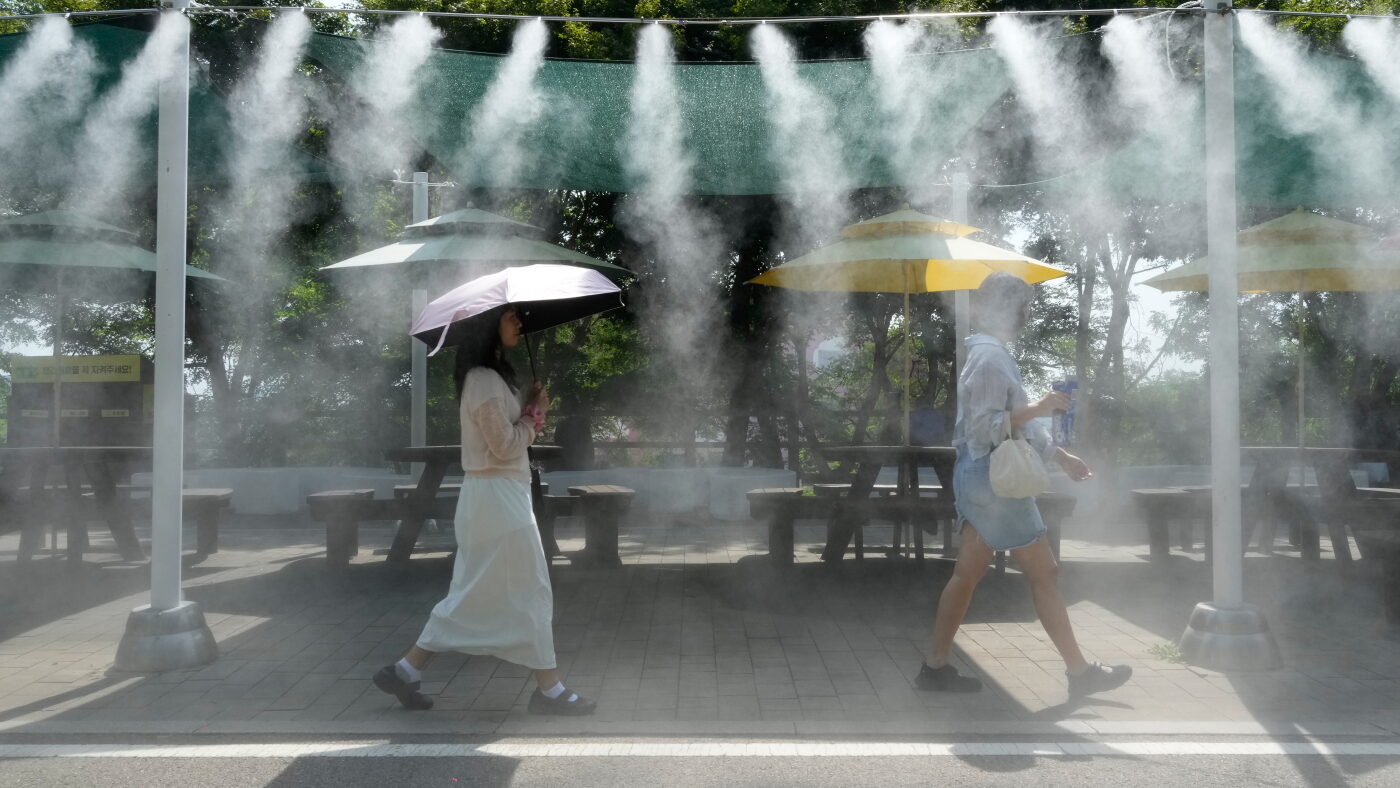
Photo via NPR

Scientists say August was Earth's hottest month they've measured

Read the original at NPR ↗
Cite

The Associated Press. (2026, September 10). Scientists say August was Earth's hottest month they've measured. NPR. https://www.npr.org/2026/09/10/nx-s1-5964676/scientists-august-hottest

Dated when The Aporia collected the article, usually within hours of publication. Check the original for its exact date and byline.

NPR · collected 2026-09-10 · by The Associated Press

Quick Summary

According to the European climate service Copernicus, Earth's average temperature in August was 62.53 degrees Fahrenheit (16.96 degrees Celsius), which is technically tied with July 2023 due to measurement uncertainty. This ties the previous record and marks the eighth consecutive month of record-breaking heat since July 2023. Global temperatures are now 1.65 degrees Celsius above pre-industrial levels, far exceeding the 1.5 degree threshold set by the Paris climate agreement in 2015. Scientists say this extreme heat is a result of human-caused climate change and a strong El Nino event.
Written by AI on 2026-09-10, from this article's own text only (the story summary below draws on all the coverage).
See how they differ ↓

AI analysis

Story summary

Global temperatures reached a new record high in August, with an average surface air temperature of 62.5 degrees Fahrenheit, surpassing previous highs set in 2023 and 2024. This is the first month since January 2025 that global temperatures have exceeded 1.5 degrees Celsius warmer than the pre-industrial average, reaching a level of 1.65 degrees Celsius above the 1850-1900 mark. The record-breaking month was due to the combined effects of El Niño and human-caused climate change, which has been driving extreme temperatures globally. This marks the joint-warmest month for the planet across all calendar months, tied with July 2023. Climate scientists are warning that these conditions are a sign of the devastating impacts of climate change, including record-breaking heatwaves, severe droughts, and wildfires. The world's ocean temperatures also hit a record high in August, with scientists predicting they will continue to rise as El Niño reaches its peak.

Written for “Global Temperature Records Broken” on 2026-11-20, grounded in this article and the 3 other(s) covering the same event.

How they differ

3 outlets covered “Global Temperature Records Broken”.

What each outlet says

One AI summary per outlet of its latest article on this story, written from that article alone and checked against it. Open the article for the outlet's own words.

NPRThis outlet10 Sep

According to the European climate service Copernicus, Earth's average temperature in August was 62.53 degrees Fahrenheit (16.96 degrees Celsius), which is technically tied with July 2023 due to measurement uncertainty. This ties the previous record and marks the eighth consecutive month of record-breaking heat since July 2023. Global temperatures are now 1.65 degrees Celsius above pre-industrial levels, far…

Scientists say August was Earth's hottest month they've measured (this article)
ABC News (US)11 Sep

A report by ABC News' Jaclyn Lee states that August 2026 was the warmest month on record globally. According to the report, there are no specific temperature numbers mentioned. The article focuses on the extreme temperatures and their impact on various regions worldwide, particularly in the US.

WATCH: August was the warmest on record worldwide →2 articles from ABC News (US) on this story
ABC News (AU)10 Sep

Climate scientists have confirmed August 2026 as the hottest month on record globally, with a recorded surface air temperature 1.65 degrees Celsius above the estimated pre-industrial average. The extreme heat led to severe drought in Western Europe and intense wildfires in Indonesia, while ocean temperatures also reached a record high. Experts predict that ocean temperatures will continue to rise until an El Niño…

Extreme heat, fires and floods mark record hot month →

Where they agree and split

Framing

How the first headlines put it

Attributed to a source2
Stated as fact1
The headlines (3)

Global temperatures hit record highs as El Niño strengthens: Report ABC News · attributed to a source

Scientists say August was Earth's hottest month they've measured NPR · attributed to a source

Extreme heat, fires and floods mark record hot month ABC News (Australia) · stated as fact

The full story: what happened, how it changed, and all 4 articles →

Compared with similar articles

This article reads unscored and hedges 18% of its claims. Each row says how that neighbour differs.
ABC News (US)
Hedges 4 of 19 claims Outlet record 67/100
ABC News (AU)
Hedges 1 of 22 claims Outlet record 67/100
ABC News (US)
Hedges 0 of 1 claims Outlet record 67/100

Story

Global Temperature Records Broken
Environment · 4 article(s) covering the same event. Compare every outlet's account →
How this article was measured signals, leaning charts, publisher record, byline, topics and claims

Signals How these are calculated →

Claims extracted
33
sentences that state something as happening or true
Uncertain
18%
6 of 33 hedged ("reportedly", "may", "according to")
Leaning
withheld
no quote in the article backed the model's score
Publisher signals
60/100
NPR's corrections and hedging, across everything collected from it. Not a measure of accuracy.
Outlets on this story
4
Environment
Same framing elsewhere
1
articles that frame the event the way this one does
Analyzed 2026-09-10 · how these are computed

How this is being covered How these are calculated →

Article leaning vs. publisher reliability
Source leaning vs. consistency

Publisher

NPR · 1357 article(s) · 4 correction(s) detected
Running correction rate · 4 correction(s)

Who wrote this

The Associated Press
2189 article(s) here · 1 carrying a prediction
Hernandez also suggested that Dennes may have been exaggerating the pain, saying he began complaining before the drugs began to flow and also of pain in places where there was no IV.
It would need the backing not just of British voters, but the unanimous support of a mistrustful EU.
2026-11-20 · assertive framing · The U.K. and EU hold a rare summit to strengthen ties
The post said no sensitive information had been revealed with regard to how struggling United would line up at fourth-place Liverpool in the Premier League on Sunday.
The pardon comes after Manfred issued a sweeping decision last May that opened a pathway for Rose to be considered for baseball's Hall of Fame.
Before the trip, Trump's aides had told reporters that the war in Ukraine would not be on the agenda.
The head of Myanmar’s military-backed government on Wednesday said his government will review its future relationship with the Association of Southeast Asian Nations and slammed the regional bloc for what he called unfair treatment.
"What I would say to the White House is: transparency is key," Leavitt said on Fox News.
HOBART, Australia (AP) — Cricket Australia said Wednesday it will establish an independent forum in a bid to clear up some of the conflicting reports of the Australian test team’s Sandpapergate ball-tampering scandal at Cape Town, South Africa, in 2018.
The Nov. 29 game has been moved to NBC’s “Sunday Night Football” and will kick off at 8:20 p.m. EST.
Wire or desk byline, not an individual reporter.
Also by The Associated Press
Nothing else under this byline is closely related to this article, so these are simply their most recent.
All 2189 articles by The Associated Press →

Topics

Copernicus El Nino European U.S. WASHINGTON

Subjects

Copernicus ORG · 7× U.S. GPE · 3× Burgess PERSON · 2× the United States GPE · 2× Andrew Dessler PERSON · 1× European NORP · 1× Paris GPE · 1× Samantha Burgess PERSON · 1× Texas A&M University ORG · 1× WASHINGTON GPE · 1×

Narrative

"Until humanity stops burning colossal amount of coal, oil and gas, the pollution this causes will keep baking our planet, and extreme heat will keep smashing all-time records, killing millions and costing trillions, hitting transport and health systems, and pushing up prices for household basics like food," United Nations climate chief Simon Stiell said.
framing: assertive · carried by 1 article(s) · first seen 2026-09-10
This is occurring exactly as forecast by scientists literally decades ago," Texas A&M University climate scientist Andrew Dessler said in an email.

Claims (33 extracted, 6 hedged)

Scientists say August was Earth's hottest month they've measured asserted
they → say → ?
Earth cooked to its hottest month on record in August, blowing far past a key climate threshold, due to the dangerous double whammy of human-caused climate change and a supersized El Nino, according to the European climate service Copernicus. uncertain
Earth → cook → service
August's sizzle also helped push the globe and the United States to swelter through the hottest Northern Hemisphere summer scientists have measured. asserted
scientists → help → summer
Last month the world averaged 62.53 degrees Fahrenheit (16.96 degrees Celsius), which technically was one-hundredth of a degree Celsius more than the all-time global mark set in July 2023, but because that's also the uncertainty level, it's considered a tie, said Samantha Burgess, strategic climate lead for Copernicus. asserted
Burgess → average → Copernicus
"It is now time to stop acting surprised that our warming planet keeps getting warmer. asserted
planet → stop → ?
This is occurring exactly as forecast by scientists literally decades ago," Texas A&M University climate scientist Andrew Dessler said in an email. asserted
Dessler → occur → email
"The interesting question is not whether we will keep breaking heat records (we will), but whether we're going to do anything about it or just stand there while the climate train runs us over. asserted
train → keep → us
Globally, August was 1.65 degrees Celsius (nearly 3 degrees Fahrenheit) above pre-industrial levels, far exceeding the longer term 1.5 degrees Celsius (2.7 degrees Fahrenheit) threshold set by the 2015 Paris climate agreement. asserted
August → exceed → agreement
The eight hottest months on record have all been from July 2023 on, according to Copernicus data. uncertain
months → accord → data
"Our climate system is really operating well outside the range we would have expected just a decade ago," Burgess said Wednesday from a United Kingdom that has been beset with heat waves. asserted
that → operate → waves
"We've transitioned from climate being very abstract and perhaps impacting the global South or far away places to climate impacting and disrupting our daily lives with schools closing, hospitals being overwhelmed, roads melting, train lines buckling. asserted
lines → transition → lives
And the reality is we will get more of these conditions that we've seen this summer." asserted
we → get → that
Global monthly ocean temperatures in August tied a March 2024 all-time record for warmest month recorded, while Aug. 22 set a record for hottest day recorded in the world's seas, according to Copernicus. uncertain
Aug. → tie → Copernicus
An extra hot summer hits asserted
summer → hit → ?
We've seen records that existed for close to 100 years be broken, in the U.S. in particular," Burgess said. asserted
Burgess → see → U.S.
The U.S. National Oceanic and Atmospheric Administration on Wednesday announced that for the first time, summer in the Lower 48 states was hotter than during the peak of the devastating Dust Bowl in 1936. asserted
summer → announce → 1936
June through August of 2026 in the contiguous United States averaged 74.37 degrees (23.54 degrees Celsius), nearly four tenths of a degree warmer than the mark set 90 years earlier. asserted
June → average → mark
Globally, this past summer also tied, with 2024, for the hottest on record, according to Copernicus. uncertain
summer → tie → Copernicus
In the U.S., August smashed heat records by more than half a degree Fahrenheit, averaging 75.58 degrees (24.21 degrees Celsius) and the average daytime high was a blistering 88.56 degrees (31.42 degrees Celsius), also a record. asserted
high → smash → degrees
July was similarly record hot in the U.S., erasing another long-standing Dust Bowl mark. asserted
July → erase → mark
That records are regularly getting broken, and that August and not July which is traditionally warmer set an all-time record, are signs that human-caused climate change is accelerating, Berkeley Earth climate scientist Zeke Hausfather said. asserted
Hausfather → break → record
Copernicus data goes back to 1940. asserted
data → go → 1940
NOAA data for the United States goes back to 1895 and global data, which generally matches Copernicus data but takes longer to calculate, dates back to 1880. asserted
which → go → 1880
Fossil fuels, El Nino blamed Several scientists said while El Nino is a factor, this natural and temporary warming of parts of the Pacific that warps and warms weather globally is nowhere as big a cause as the heat-trapping gases emitted as humans burn coal, oil and natural gas. asserted
humans → blame → coal
"While El Nino is starting to ramp up the heat, the underlying driver remains our relentless burning of fossil fuels. asserted
driver → start → fuels
Climate change makes every El Nino hotter, and until we stop burning coal, oil, and gas these record-shattering months will simply keep on coming," said Friederike Otto, a climate scientist at Imperial College London. asserted
Otto → make → London
Burgess said El Nino generally adds only one or two tenths of a degree Celsius (two to four tenths Fahrenheit) to the global temperature with the overwhelming rest of the heat coming from the burning of fossil fuels. asserted
rest → say → fuels
This El Nino is forecast, however, to break records for strength in the coming months. asserted
Nino → forecast → months
And as temperatures continue to rise, heat waves, storms, floods and wildfires will get more frequent and more dangerous, said Texas Tech climate scientist Katharine Hayhoe. asserted
Hayhoe → continue → ?
According to Hausfather, "it is increasingly likely that 2026 ends up beating 2024 as the warmest year on record, and almost certain that 2027 beats both, potentially reaching as high as 1.8 degrees Celsius (3.2 degrees Fahrenheit) above preindustrial levels on the back of an unprecedentedly-strong El Nino event. uncertain
2027 → accord → event
" Some days may hit an even higher climate threshold, 2 degrees Celsius (3.6 degrees Fahrenheit) above mid 1800s, Burgess said. uncertain
Burgess → hit → 1800s
"Until humanity stops burning colossal amount of coal, oil and gas, the pollution this causes will keep baking our planet, and extreme heat will keep smashing all-time records, killing millions and costing trillions, hitting transport and health systems, and pushing up prices for household basics like food," United Nations climate chief Simon Stiell said. asserted
Stiell → stop → food
"This is the spiraling price of humanity's fossil fuel addiction, and the global climate crisis it is fueling." asserted
it → spiral → addiction
Give feedback · no sign-in needed

No sign-in needed for now. Your note is sent without a name, so it cannot be answered.

History Support