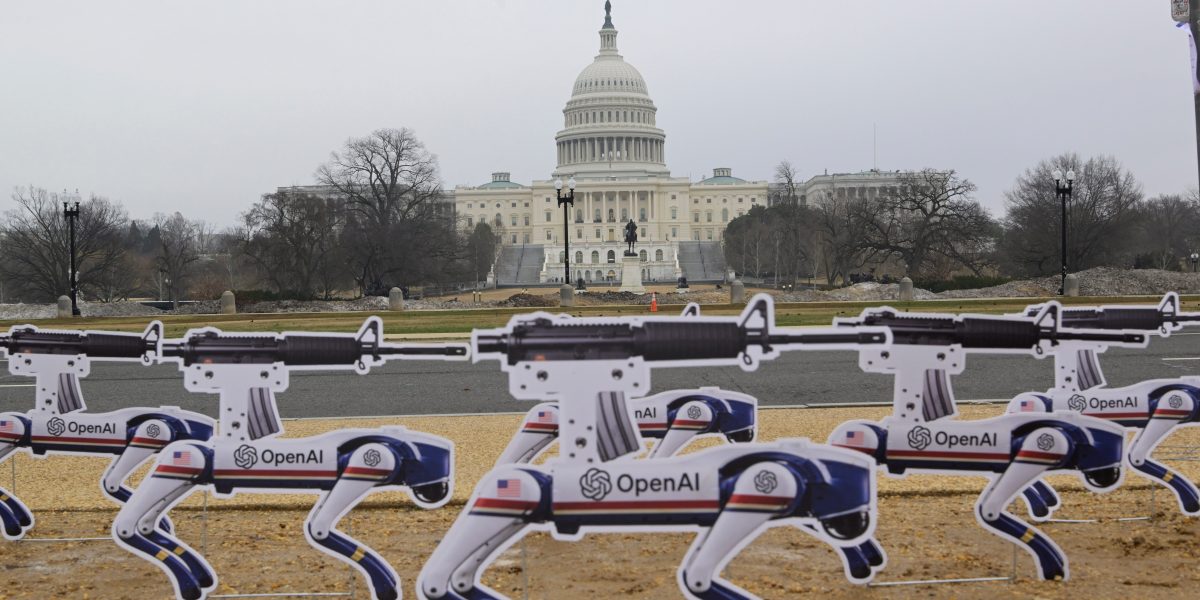
Photo via The Guardian

US allies lack resources to keep pace on AI, top Pentagon official says

Read the original at The Guardian ↗
Cite

Washington, J. G. i. (2026, September 9). US allies lack resources to keep pace on AI, top Pentagon official says. The Guardian. https://www.theguardian.com/us-news/2026/sep/09/us-military-pentagon-allies-ai

Dated when The Aporia collected the article, usually within hours of publication. Check the original for its exact date and byline.

The Guardian · collected 2026-09-09 · by Joseph Gedeon in Washington

Quick Summary

Cameron Stanley, the Pentagon's top artificial intelligence official, said US allies lack resources and experience to keep pace with the US military's adoption of AI. The US is working with its closest allies, including NATO and Five Eyes nations, to help them avoid mistakes made by Washington in its own AI development. Since January, Stanley has overseen the launch of several new AI tools, including an internal chatbot platform that has reached 1.7 million users. He emphasized the importance of speed in adopting AI technology, saying it is a key factor in reducing decision-making time for military commanders.
Written by AI on 2026-09-09, from this article's own text only (the story summary below draws on all the coverage).

AI analysis

Story summary

Cameron Stanley, the top artificial intelligence official at the Department of War, stated that US allies, including those in NATO and the Five Eyes partnership, lack the resources to keep pace with the US military's adoption of AI. According to Stanley, these countries don't have the same level of experience, scale, or budget as the US. This is a concern because the US has already made mistakes in its use of AI, and it's actively working with its allies to prevent them from making similar errors. In particular, the US is trying to steer its partners away from repeating the mistakes of Project Maven, an AI targeting program that was launched in 2017. This effort comes as the Pentagon's AI office has been launching new tools, including an internal chatbot platform called GenAI.mil that has reached over 1.7 million users, and a system designed to speed up intelligence gathering and decision-making.

Written for “US Fears Falling Behind in AI” on 2026-11-21, grounded in this article and the 0 other(s) covering the same event.

Compared with similar articles

This article reads unscored and hedges 6% of its claims. Each row says how that neighbour differs.
South China Morning Post
Hedges 0 of 12 claims Outlet record 62/100
“Article A refers to a planned AI conversation with China on September 24, while Article B discusses the US military's adoption of AI and its allies' resource limitations, without mentioning any specific event or time”
Noahpinion
Leans strongly right Hedges 9 of 36 claims
“Article A discusses a broader topic of AI competition between US and China, while Article B quotes a Pentagon official discussing the resources of US allies to keep pace with US military's AI adoption”
The Straits Times
Hedges 2 of 8 claims Outlet record 64/100
“The articles mention different topics, one discussing AI posing an existential risk to humanity and the other about allies lacking resources to keep pace with US military's adoption of AI”
The Intercept
Hedges 7 of 77 claims Outlet record 96/100
“Article A discusses a request by the Pentagon to OpenAI for custom AI technology with 'minimal refusal rates', while Article B reports on comments made by a Pentagon official about US allies' lack of resources in adopting AI, without mentioning any specific event or request.”
The Intercept
Leans left Hedges 8 of 100 claims Outlet record 96/100
“Article A discusses a previously hidden government contract between Anthropic and the Pentagon that led to their breakup, while Article B reports on a statement by the Pentagon's AI official regarding US allies' resource constraints”

Story

US Fears Falling Behind in AI
Technology · 1 article(s) covering the same event.
How this article was measured signals, leaning charts, publisher record, byline, topics and claims

Signals How these are calculated →

Claims extracted
18
sentences that state something as happening or true
Uncertain
6%
1 of 18 hedged ("reportedly", "may", "according to")
Leaning
withheld
no quote in the article backed the model's score
Publisher signals
64/100
The Guardian's corrections and hedging, across everything collected from it. Not a measure of accuracy.
Outlets on this story
1
Technology
Same framing elsewhere
1
articles that frame the event the way this one does
Analyzed 2026-09-09 · how these are computed

How this is being covered How these are calculated →

Article leaning vs. publisher reliability
Source leaning vs. consistency

Publisher

The Guardian · 2663 article(s) · 9 correction(s) detected
Running correction rate · 9 correction(s)

Who wrote this

Joseph Gedeon in Washington
28 article(s) here · 1 carrying a prediction
“These investigations will lay the groundwork for legislation which helps all Americans,” said Garcia.
The Wall Street Journal also reported the outage, citing one person familiar with the situation, who said it stemmed from a software update to patch the system and that it would only be down temporarily.
Robert Garcia, ranking member of the oversight committee in the House of Representatives, vowed to press on in the face of what he called “baseless threats” after receiving a letter from White House counsel William Scharf which warned that Democratic pledges to use to investigate the president “may cross the line into blatant criminality”.
Jordan will lead a diminished Republican conference, as its ranks shrink to one of the smallest in decades.
The Congressional Progressive caucus said on Sunday it will welcome more than 25 new members, including a record number who won in red districts, expanding its ranks to more than 105 lawmakers.
But she has kept her distance from the Democratic party’s left flank, saying she does not support the Medicare for All proposed model of universal healthcare, while also conceding that Democrats failed on the border, and declining to name a national Democrat she would like to campaign with her.
As a candidate positioned at the center of what researchers say are the worst Islamophobic attacks seen since the aftermath of 9/11, many would expect Abdul El-Sayed to simply defend himself and move on.
It will devour America if we let it.”
At the event on Saturday, an attendee who gave his name only as “Tommy” shouted from the crowd, asking whether El-Sayed would disavow the movement.
“He spun this story up again in the hopes that the judge would be lenient, or the prosecutor would be.”
Also by Joseph Gedeon in Washington
Nothing else under this byline is closely related to this article, so these are simply their most recent.
All 28 articles by Joseph Gedeon in Washington →

Topics

America Palantir Pentagon Washington the Department of War

Subjects

Stanley GPE · 9× Pentagon ORG · 5× Palantir ORG · 2× Washington GPE · 2× America GPE · 1× Cameron Stanley PERSON · 1× Canada GPE · 1× Nato ORG · 1× the Department of War ORG · 1× the Five Eyes ORG · 1×

Narrative

More than 120 members of the US Congress signed a letter demanding answers from the Pentagon regarding civilian casualties and the use of artificial intelligence, following a 28 February strike on an elementary school in Minab, which Iranian officials say killed at least 168 people, many of them children.
framing: assertive · carried by 1 article(s) · first seen 2026-09-09
Project Maven, the Pentagon’s original AI targeting program launched in 2017, became the Palantir-built Maven Smart System, which the US leaned on heavily during its 2026 air campaign against Iran, helping strike more than 13,000 targets over the first 38 days, according to Stanley at conference in May.
2026-09-09 · The Guardian
US allies lack resources to keep pace on AI, top Pentagon official says · assertive framing

Claims (18 extracted, 1 hedged)

The Pentagon’s top artificial intelligence official said on Tuesday that America’s closest allies lack the resources to keep pace with the US military’s adoption of AI, and that Washington is working to steer them away from mistakes it made along the way. asserted
it → say → way
“They don’t have the resources that we do, they don’t have the experience that we do, they don’t have the scale that we do,” Cameron Stanley, chief digital and artificial intelligence officer at the Department of War, said at an event at the Billington Cybersecurity summit. asserted
Stanley → have → summit
Of Nato and the Five Eyes, an intelligence-sharing partnership of the US, UK, Canada, Australia and New Zealand, Stanley said Washington was “actively working with a number of our partners” so “they don’t make the same mistakes that we make”. asserted
we → share → that
The comments come less than a year into Stanley’s tenure, during which the Pentagon’s AI office has rolled out several new tools while losing a number of senior staff. asserted
office → come → staff
Since January, Stanley has overseen the launch of GenAI.mil, an internal chatbot platform he says has reached 1.7 million users, and Agent Network, a system designed to shorten the time between intelligence-gathering and a commander’s decision. asserted
he → oversee → gathering
Pentagon secretary Pete Hegseth has directed Stanley’s office to report AI deployment speed as a monthly metric, part of a wider push to expand military computing power. asserted
Hegseth → direct → power
Much of Stanley’s appearance focused on speed. asserted
Much → focus → speed
He described watching a commander halt a scheduled briefing to take a 30-second phone call and issue an order on the spot, without a formal decision brief or a review of the room’s security clearance level. asserted
commander → describe → level
He called the moment “revolutionary”. asserted
He → call → moment
“I know it sounds simplistic,” Stanley explained. asserted
Stanley → know → ?
“It’s only simplistic because we’re good at it now.” asserted
we → ’ → it
It’s a term he has used before. asserted
he → ’ → ?
Project Maven, the Pentagon’s original AI targeting program launched in 2017, became the Palantir-built Maven Smart System, which the US leaned on heavily during its 2026 air campaign against Iran, helping strike more than 13,000 targets over the first 38 days, according to Stanley at conference in May. uncertain
US → launch → May
Speaking at Palantir’s AIPCon 9 conference in March, Stanley called Maven “revolutionary” too, saying it let commanders go from identifying a target to launching a strike within a single platform. asserted
commanders → speak → platform
But the campaign has drawn scrutiny. asserted
campaign → draw → scrutiny
More than 120 members of the US Congress signed a letter demanding answers from the Pentagon regarding civilian casualties and the use of artificial intelligence, following a 28 February strike on an elementary school in Minab, which Iranian officials say killed at least 168 people, many of them children. asserted
many → sign → them
Stanley ended by telling the audience that the department’s old habits were now its biggest liability. asserted
habits → end → audience
“The way we’ve always done it is the most risky course of action,” he said, adding that the department needs to “think differently” if it wants AI tools in the hands of warfighters faster. asserted
tools → do → warfighters

Give feedback · no sign-in needed

No sign-in needed for now. Your note is sent without a name, so it cannot be answered.

History Support