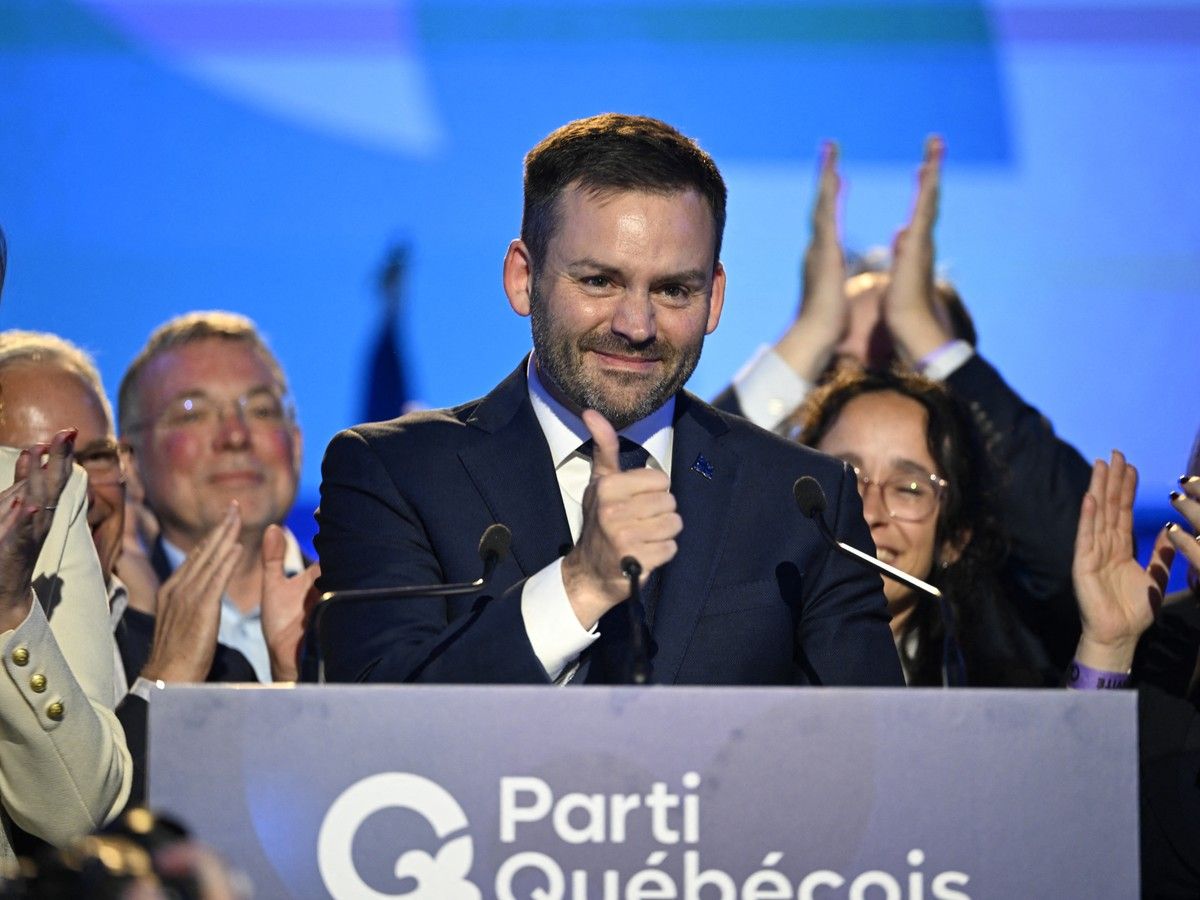
Photo via CBC News

Parti Québécois win with record-low vote share revives calls for electoral reform

Read the original at CBC News ↗
Cite

Shingler, B. (2026, October 8). Parti Québécois win with record-low vote share revives calls for electoral reform. CBC News. https://www.cbc.ca/news/canada/montreal/quebec-parti-quebecois-electoral-reform-9.7373016?cmp=rss

Dated when The Aporia collected the article, usually within hours of publication. Check the original for its exact date and byline.

CBC News · collected 2026-10-08 · by Benjamin Shingler

Quick Summary

The Parti Québécois won a minority government in Quebec with just 28% of the vote, marking the lowest percentage ever for a governing party in the province. This outcome has sparked renewed calls for electoral reform due to the discrepancy between popular support and seat distribution. Advocates argue that the first-past-the-post system no longer accurately represents voter intentions and propose proportional representation as an alternative.
Written by AI on 2026-10-08, from this article's own text only (the story summary below draws on all the coverage).
See how they differ ↓

AI analysis

Story summary

The leaders of Quebec’s five main political parties, including the separatist Parti Québécois (PQ) and Coalition Avenir Québec (CAQ), made their final pitches to undecided voters over the weekend ahead of a provincial election on October 5, 2026. PQ leader Paul St-Pierre Plamondon has been leading in polls throughout the campaign and promised a sovereignty referendum by 2029. Despite skepticism from opponents who argue that referendums cause political instability and harm the economy, St-Pierre Plamondon urges voters to support his party for a majority government to implement change after eight years of CAQ rule. About one quarter of eligible voters had already cast ballots in advance polls.

Written for “Quebec Election Vote” on 2026-11-20, grounded in this article and the 41 other(s) covering the same event.

How they differ

13 outlets covered “Quebec Election Vote”.

What each outlet says

One AI summary per outlet of its latest article on this story, written from that article alone and checked against it. Open the article for the outlet's own words.

CBCThis outlet8 Oct

The Parti Québécois won a minority government in Quebec with just 28% of the vote, marking the lowest percentage ever for a governing party in the province. This outcome has sparked renewed calls for electoral reform due to the discrepancy between popular support and seat distribution. Advocates argue that the first-past-the-post system no longer accurately represents voter intentions and propose proportional…

Parti Québécois win with record-low vote share revives calls for electoral reform (this article)7 articles from CBC on this story
Toronto Star6 Oct

Quebec voters elected a Parti Québécois (PQ) minority government in Monday's election, potentially setting the stage for future discussions on sovereignty. The PQ leader, Paul St-Pierre Plamondon, emphasized that Quebec desires to exist independently like other nations and hinted at a referendum post-2029 when U.S. President Donald Trump is out of office. Meanwhile, outgoing Premier Christine Fréchette's Coalition…

Here is the latest news from the Quebec election →8 articles from Toronto Star on this story
Global News6 Oct

Quebec’s newly elected Parti Québécois (PQ) minority government has raised mixed reactions among Quebec’s English-speaking community. Premier-designate Paul St-Pierre Plamondon made several promises during the election campaign regarding support for anglophones, including bilingual voter information and changes to language laws like Bill 96. However, advocates such as Sylvia Martin-Laforge from TALQ express…

Quebec’s anglophones approach PQ win with optimism, skepticism →5 articles from Global News on this story
The Globe and Mail6 Oct

Quebec has elected Paul St-Pierre Plamondon’s Parti Québécois (PQ) to a minority government, ending Coalition Avenir Québec's rule. The PQ secured 59 seats out of the National Assembly's total number needed for a majority being 64. With this result, there is uncertainty about Quebec’s political future due to potential plans for an independence referendum and strained relations with the federal government under Prime…

Morning Update: Quebec elects the PQ →5 articles from The Globe and Mail on this story
National Post11 Oct

Columnist Kelly McParland argues that the Parti Québécois (PQ) should feel embarrassed by its recent election victory in Quebec, having secured only 28% of the vote despite extensive campaigning efforts. He notes that over 70% of voters oppose a potential third referendum on independence and highlights that PQ leader Paul St-Pierre Plamondon leads a minority government with limited control over his mandate’s…

Kelly McParland: The PQ should be embarrassed by election outcome →5 articles from National Post on this story
The Straits Times5 Oct

Quebec held an election on October 5 where separatist sentiment was on the rise, potentially challenging Prime Minister Mark Carney’s message of unity. The Parti Québécois (PQ), led by Paul Saint-Pierre Plamondon, could win a majority despite pre-election polls showing around 30% support, due to expected vote-splitting among federalist parties. Voters like Francis Chalifour and first-time voter Alexia Gomez…

Quebec votes as separatist surge poses test for Canada PM →3 articles from The Straits Times on this story
Show 7 more outlets
The Guardian7 Oct

In Quebec's recent election, the Parti Québécois (PQ) won but fell short of a majority with five seats less than needed, despite doubling its vote share and winning 56 additional seats compared to the previous election. While PQ leader Paul St-Pierre Plamondon promised to hold a referendum after Trump leaves office in 2028, he faces significant opposition as only 28% of voters supported his party, marking the lowest…

Separatists win in Quebec – but does that bring separation from Canada any closer? →2 articles from The Guardian on this story
Al Jazeera6 Oct

Paul St-Pierre Plamondon, leader of the Parti Québécois, has promised a future referendum on independence from Canada following his party's victory in the recent Quebec provincial election. This marks the return of the separatist party to power after a hiatus since 2014.

Quebec separatists win election reviving push for independence →2 articles from Al Jazeera on this story
South China Morning Post5 Oct

Quebec holds a provincial election where the separatist Parti Québécois (PQ) aims to regain power by promising an independence referendum if elected. The PQ’s resurgence is linked to concerns about rising costs and preserving the French language in Quebec, rather than opposition to Prime Minister Mark Carney's stance on U.S. President Donald Trump's policies. Voters like Francis Chalifour express a desire for…

Quebec votes in provincial election as separatist surge poses test for Canada’s PM Carney →
BBC6 Oct

Canadian media projects that the sovereigntist Parti Québécois (PQ) will win a minority government in Quebec's provincial election, making Paul St-Pierre Plamondon the new premier. This marks the PQ’s return to power since 2014 and could challenge Prime Minister Mark Carney on issues like immigration and the monarchy. The PQ has pledged to hold an independence referendum after US President Donald Trump leaves…

Separatist party projected to win Quebec election, adding new test to Canada's unity →
The Hindu6 Oct

In the 2026 Quebec provincial election, separatists led by Paul Saint-Pierre Plamondon won with a promise to seek an independence referendum after U.S. President Donald Trump leaves office, despite securing only about 30% of the vote due to federalist party vote-splitting. The result challenges Prime Minister Mark Carney's efforts to maintain national unity amid Canadian-U.S. tensions and Alberta’s potential…

Separatists win Quebec election in test for Canada PM →
Euronews6 Oct

In Quebec's recent provincial election, the separatist Parti Québécois (PQ) won but fell short of a majority in the 127-member National Assembly, securing around 60 seats out of 127. Paul St-Pierre Plamondon’s party plans to hold another referendum on independence from Canada, though they must now work with opposition parties due to their minority status. Despite this victory, support for Quebec's independence…

Quebec separatists vow independence referendum after winning local elections but falling short of majority →
Washington Examiner6 Oct

In recent elections, Quebec’s Parti Québécois won the largest share of votes for the first time in 12 years but fell short of an outright majority with only 59 out of 127 seats. The PQ leader Paul St-Pierre Plamondon cautiously hinted at a possible future referendum on independence, emphasizing democratic rights. However, the movement faces significant challenges due to recent demographic shifts caused by mass…

Quebec could see another independence referendum after separatist party’s victory →

Where they agree and split

Agreed

AI · cited, from two or more outlets

  • The Parti Québécois won the provincial election and returned to power after being nearly wiped out four years ago, but fell short of a majority government.35
  • Support for an independent Quebec remains at roughly 30% according to recent surveys.26
Quoted from the coverage (2)

Voters in Quebec’s 127 ridings are heading to the polls today to choose a new provincial government.

5 outlets

“Building a stronger Québec is core to our mission of building a stronger Canada,” Carney said.

4 outlets

Framing

How the first headlines put it

  • The Toronto Star focuses on the final pitches by political leaders before the election, while The Straits Times frames the event as a test for Prime Minister Carney and his message of national unity.12
  • Al Jazeera headlines emphasize the PQ's win reviving the push for independence, whereas CBC highlights the CAQ fatigue leading to the PQ’s historic victory.36
Stated as fact2
The headlines (2)

Quebec political leaders make final pitch as election campaign nears end Toronto Star · stated as fact

Last weekend for Quebec election campaign Global News · stated as fact

The full story: what happened, how it changed, and all 42 articles →

Compared with similar articles

This article reads leans left and hedges 5% of its claims. Each row says how that neighbour differs.
The Straits Times
Leans right further right than this Hedges 2 of 26 claims Outlet record 64/100
Global News
Leans left Hedges 8 of 53 claims Outlet record 63/100
National Post
Leans left Hedges 7 of 92 claims Outlet record 60/100
The Globe and Mail
Leans right further right than this Hedges 4 of 38 claims Outlet record 51/100
Al Jazeera
Leans left Hedges 2 of 15 claims Outlet record 60/100
Toronto Star
Hedges 2 of 31 claims Outlet record 64/100
National Post
Leans strongly right further right than this Hedges 6 of 51 claims Outlet record 60/100
The Globe and Mail
Leans left Hedges 7 of 42 claims Outlet record 51/100
The Globe and Mail
Leans left Hedges 3 of 41 claims Outlet record 51/100
Global News
Leans right further right than this Hedges 1 of 25 claims Outlet record 63/100

Story

Quebec Election Vote
Politics · 42 article(s) covering the same event. Compare every outlet's account →
How this article was measured signals, leaning charts, publisher record, byline, topics and claims

Signals How these are calculated →

Claims extracted
19
sentences that state something as happening or true
Uncertain
5%
1 of 19 hedged ("reportedly", "may", "according to")
Leaning
Leans left
of the writing, not the subject · beta estimate
Publisher signals
72/100
CBC News's corrections and hedging, across everything collected from it. Not a measure of accuracy.
Outlets on this story
42
Politics
Same framing elsewhere
1
articles that frame the event the way this one does
Analyzed 2026-10-08 · how these are computed

How this is being covered How these are calculated →

Article leaning vs. publisher reliability
Source leaning vs. consistency

Publisher

CBC News · 2377 article(s) · 6 correction(s) detected
Running correction rate · 6 correction(s)

Who wrote this

Benjamin Shingler
13 article(s) here · 1 carrying a prediction
It is also meant to ensure that police officers "safeguard rights and freedoms, respect victims and co-operate with the community while respecting cultural pluralism." The ENPQ did not provide details about its racial profiling training as part of the access-to-information request, saying it could not share teaching material used to evaluate students.
The students want the university to form a committee that would include both students and experts on the rehabilitation of violent offenders in order to develop guidelines for next steps.
"You never know what someone has been a victim to in their life and how that might impact their reaction, especially after having experienced such violence firsthand."
Montreal police suspend 2 officers following report officer urinated on unhoused person Allegations 'undermine the dignity every person deserves,' says Montreal mayor
Quebec's next premier promises to hit the ground running as PQ takes power Electoral reform keeps stalling in Canada, but advocate says it isn't dead Whether those promises will lead to action remains uncertain. Both former prime minister Justin Trudeau and former Quebec premier François Legault campaigned on electoral reform, only to abandon those commitments after being elected under the existing system.
The lawsuit warns that any laws passed by an illegally assembled body — especially a law attempting to abolish the lieutenant governor — would be void, creating an "unprecedented legal crisis."
Immigration, high-speed rail and Bill 21: Where new PQ government could test Ottawa
What to expect from a Parti Québécois government A tighter budget, cuts to immigrations levels, fights with Ottawa — and maybe a referendum The sovereigntist Parti Québécois is back in power, securing enough seats to form a majority government.
2026-10-06 · assertive framing · What to expect from a Parti Québécois government
A little later, St-Pierre Plamondon was asked if he would hold a referendum after Trump leaves office even if the polls suggest the No side will win again.
On the whole, if Nova Scotia's tax system were applied to Quebecers, they would actually pay more.
Also by Benjamin Shingler
Nothing else under this byline is closely related to this article, so these are simply their most recent.
All 13 articles by Benjamin Shingler →

Topics

Fair Vote Canada Parti Québécois Quebec Québec Solidaire The Parti Québécois

Subjects

Quebec GPE · 8× Cragg PERSON · 2× Québec Solidaire ORG · 2× Fair Vote Canada ORG · 1× Jean-Pierre Charbonneau PERSON · 1× Mouvement démocratie nouvelle ORG · 1× Parti Québécois ORG · 1× Ted Cragg PERSON · 1× The Parti Québécois ORG · 1× the Coalition Avenir Québec ORG · 1×

Narrative

With only 28% of the popular vote, party secured 59 seats — enough for a minority government A record-low vote share for Quebec's incoming government has reignited a long-standing debate over how the province elects its leaders. The Parti Québécois secured enough seats to form a minority government despite getting only 28 per cent of the popular vote — the lowest vote share for a governing party in Quebec history. Advocates say the result is proof the province's first-past-the-post electoral system needs to change.
framing: assertive · carried by 1 article(s) · first seen 2026-10-08
Quebec's next premier promises to hit the ground running as PQ takes power Electoral reform keeps stalling in Canada, but advocate says it isn't dead Whether those promises will lead to action remains uncertain. Both former prime minister Justin Trudeau and former Quebec premier François Legault campaigned on electoral reform, only to abandon those commitments after being elected under the existing system.

Claims (19 extracted, 1 hedged)

Parti Québécois win with record-low vote share revives calls for electoral reform asserted
win → revive → reform
With only 28% of the popular vote, party secured 59 seats — enough for a minority government A record-low vote share for Quebec's incoming government has reignited a long-standing debate over how the province elects its leaders. The Parti Québécois secured enough seats to form a minority government despite getting only 28 per cent of the popular vote — the lowest vote share for a governing party in Quebec history. Advocates say the result is proof the province's first-past-the-post electoral system needs to change. asserted
system → secure → post
Ted Cragg, a spokesperson for the national advocacy group Fair Vote Canada, said the current model is outdated, particularly in an era of multi-party elections. asserted
model → say → elections
The group advocates for some form of proportional representation as an alternative. asserted
group → advocate → alternative
"We have elections to choose representatives that reflect our wishes, but the system is not reflecting those wishes," Cragg said in an interview. " asserted
Cragg → have → interview
It's set up in such a skewed way that people win seats with less than 30 per cent of the vote. asserted
people → set → vote
Governments now are formed with 30 per cent of the popular vote. asserted
Governments → form → vote
All five of Quebec's major parties received more than 10 per cent of the vote on Monday, but those results were not reflected in the seat count. asserted
results → receive → count
The PQ won 59 of 127 seats, while the Coalition Avenir Québec was wiped off the electoral map entirely despite capturing 13 per cent of the vote. asserted
Québec → win → vote
Québec Solidaire, for its part, won just nine seats with a 12 per cent vote share. asserted
Solidaire → win → share
Jean-Pierre Charbonneau, president of Mouvement démocratie nouvelle, a Quebec organization advocating for democratic reform, said many voters feel disenfranchised by the current system. " asserted
voters → advocate → system
People saw the result. asserted
People → see → result
We have a National Assembly that doesn't reflect the votes that were cast," Charbonneau told Radio-Canada. asserted
Charbonneau → have → Canada
During the election campaign, PQ Leader Paul St-Pierre Plamondon said he was committed to electoral reform. asserted
he → say → reform
Québec Solidaire and the Conservative Party of Quebec have also backed reform. asserted
Solidaire → back → reform
Quebec's next premier promises to hit the ground running as PQ takes power Electoral reform keeps stalling in Canada, but advocate says it isn't dead Whether those promises will lead to action remains uncertain. Both former prime minister Justin Trudeau and former Quebec premier François Legault campaigned on electoral reform, only to abandon those commitments after being elected under the existing system. asserted
Trudeau → promise → system
Cragg, however, remains optimistic that this outcome could mark a turning point, citing a decade of growing public support for electoral reform in Quebec. "We take any kind of promise with a grain of salt," he said. uncertain
he → remain → salt
He pointed out that in 2018, all the parties at Quebec's National Assembly, led by Legault, committed to moving forward with some form of proportional representation. asserted
parties → point → representation
"It does show that there's interest," he noted, "and there's some precedent for the parties to work together." asserted
parties → show → ?
Give feedback · no sign-in needed

No sign-in needed for now. Your note is sent without a name, so it cannot be answered.

History Support