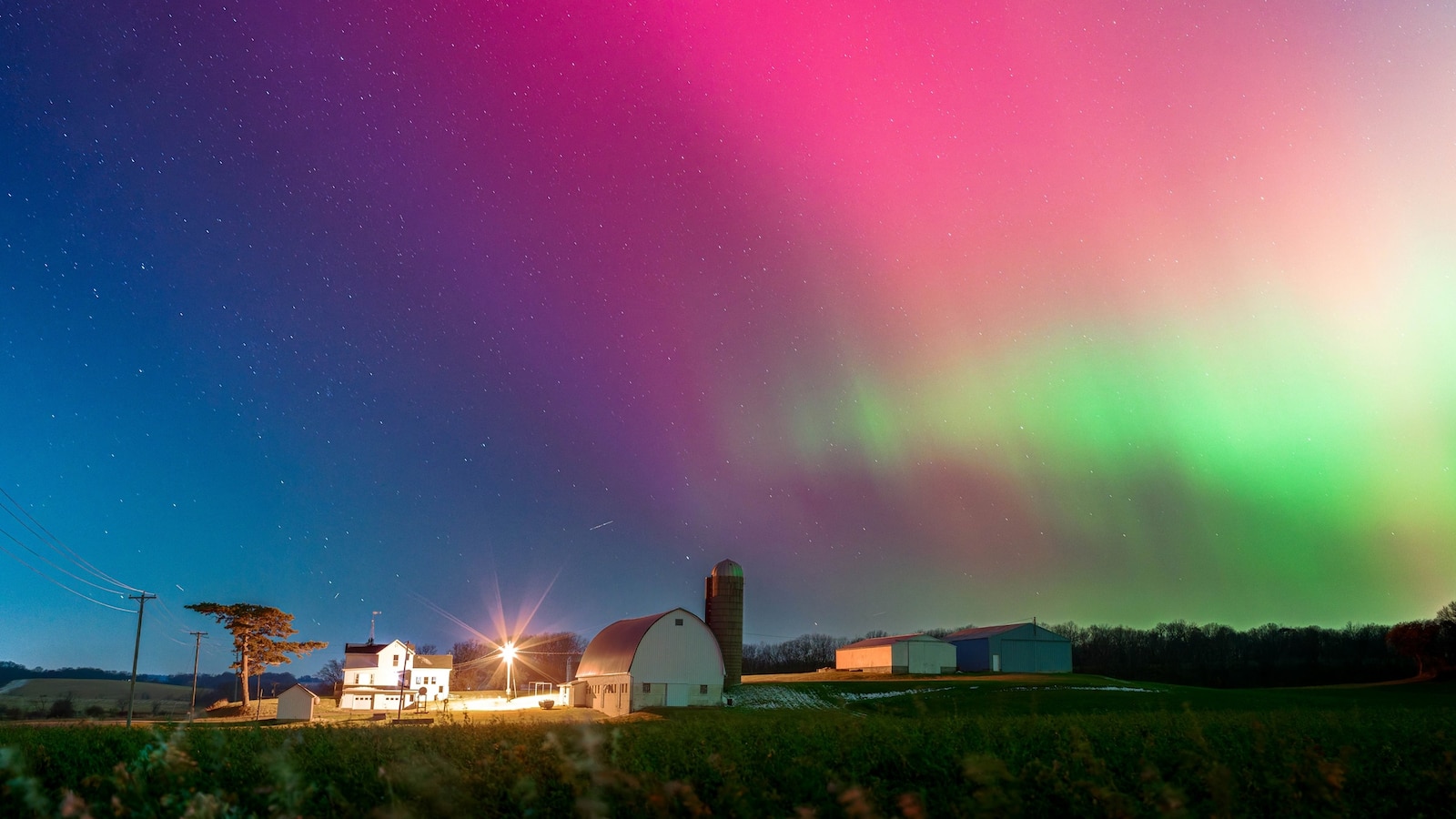
Photo via Times of India

Northern lights may return to US, Canada October 8-9: Where and when to watch the aurora show

Read the original at Times of India ↗
Cite

TOI World Desk. (2026, October 8). Northern lights may return to US, Canada October 8-9: Where and when to watch the aurora show. Times of India. https://timesofindia.indiatimes.com/world/us/northern-lights-may-return-to-us-and-canada-tonight-where-and-when-to-watch-the-october-8-9-aurora-sky-show-as-cme-nears-earth-and-triggers-possible-g1-g2-geomagnetic-storm/articleshow/134776874.cms

Dated when The Aporia collected the article, usually within hours of publication. Check the original for its exact date and byline.

Times of India · collected 2026-10-08 · by TOI World Desk

Quick Summary

A coronal mass ejection (CME) linked to a solar flare is heading toward Earth and could cause northern lights sightings across parts of Canada and the United States on October 8-9. NOAA’s Space Weather Prediction Center has issued a G2 (moderate) geomagnetic storm watch for October 9, with conditions potentially reaching G1 levels around 11 p.m. ET Thursday and possibly G2 levels by 5 a.m. ET Friday. Under weaker G1 conditions, the northern lights are expected to be visible in Alaska and northern U.S. states like Washington, Idaho, Montana, North Dakota, South Dakota, Minnesota, Wisconsin, Michigan, Maine, Vermont, and New Hampshire. If activity reaches G2 levels, visibility could extend further south into Oregon, Wyoming, Nebraska, Iowa, Illinois, Indiana, Ohio, Colorado, Pennsylvania, and New York.
Written by AI on 2026-10-08, from this article's own text only (the story summary below draws on all the coverage).
See how they differ ↓

AI analysis

Story summary

A coronal mass ejection (CME) linked to an M1.4-class solar flare from active region AR4549 on the Sun is heading toward Earth, potentially causing auroras across parts of the United States and Canada around October 8-9. NOAA’s Space Weather Prediction Center has issued a G2 (moderate) geomagnetic storm watch for October 9, with G1 (minor) to G2 conditions expected as the CME reaches Earth at about 560 km/s. The best viewing opportunities are forecasted across Alaska and northern-tier states such as Washington, Idaho, Montana, North Dakota, South Dakota, Minnesota, Wisconsin, Michigan, Maine, Vermont, and New Hampshire, depending on local weather and darkness.

Written for “Northern Lights Forecast” on 2026-11-21, grounded in this article and the 1 other(s) covering the same event.

How they differ

2 outlets covered “Northern Lights Forecast”.

What each outlet says

One AI summary per outlet of its latest article on this story, written from that article alone and checked against it. Open the article for the outlet's own words.

Times of IndiaThis outlet8 Oct

A coronal mass ejection (CME) linked to a solar flare is heading toward Earth and could cause northern lights sightings across parts of Canada and the United States on October 8-9. NOAA’s Space Weather Prediction Center has issued a G2 (moderate) geomagnetic storm watch for October 9, with conditions potentially reaching G1 levels around 11 p.m. ET Thursday and possibly G2 levels by 5 a.m. ET Friday. Under weaker G1…

Northern lights may return to US, Canada October 8-9: Where and when to watch the aurora show (this article)
ABC News (US)8 Oct

Solar eruptions associated with a moderate solar flare are expected to cause auroras visible in northern parts of the United States starting Thursday night into Friday morning, October 9. The National Oceanic and Atmospheric Administration's Space Weather Prediction Center has issued a moderate Geomagnetic Storm Watch due to a coronal mass ejection (CME) departing the sun on Tuesday. While the impacts are mainly…

Solar eruptions moving toward earth could cause auroras over US tonight →

Compared with similar articles

This article reads unscored and hedges 21% of its claims. Each row says how that neighbour differs.
ABC News (US)
Hedges 7 of 14 claims Outlet record 66/100
BBC News
Hedges 3 of 17 claims Outlet record 65/100
“The articles describe different time periods and locations for aurora borealis sightings, with Article A predicting a possible show on October 8-9 mainly in northern parts of the US and Canada, while Article B reports actual sightings from across the UK on October 10.”
Daily Mail
Hedges 3 of 11 claims Outlet record 69/100
“The articles describe sightings of the Northern Lights on different dates in different locations, indicating separate occurrences.”
The Guardian
Hedges 2 of 12 claims Outlet record 64/100
“Article A describes a forecast for northern lights in North America from October 8-9, while Article B reports on actual sightings of the aurora borealis in the UK on October 10.”

Story

Northern Lights Forecast
Science · 2 article(s) covering the same event. See how they differ ↑
How this article was measured signals, leaning charts, publisher record, byline, topics and claims

Signals How these are calculated →

Claims extracted
38
sentences that state something as happening or true
Uncertain
21%
8 of 38 hedged ("reportedly", "may", "according to")
Leaning
not political
takes no side on a contested political question
Publisher signals
59/100
Times of India's corrections and hedging, across everything collected from it. Not a measure of accuracy.
Outlets on this story
2
Science
Same framing elsewhere
1
articles that frame the event the way this one does
Analyzed 2026-10-08 · how these are computed

How this is being covered How these are calculated →

Article leaning vs. publisher reliability
Source leaning vs. consistency

Publisher

Times of India · 5491 article(s) · 6 correction(s) detected
Running correction rate · 6 correction(s)

Who wrote this

TOI World Desk
1564 article(s) here · 1 carrying a prediction
She indicated that she would issue a preliminary injunction blocking construction while the legal challenge continues.
US District Judge Mary McElroy ruled on Friday that the Department of Housing and Urban Development (HUD) could not introduce new grant conditions that effectively bypassed requirements established by Congress.
“I will make it a home again,” she said, recalling that her previous time there had been “very beautiful” and “very comfortable”.
The proposed Western Downs Digital Park, about 250 kilometres west of Brisbane, is expected to become one of Australia's largest computing facilities, with artificial intelligence company Anthropic signed as its anchor tenant.
He added that the FBI would hunt down anyone found responsible for malicious cyber activity.
He also warned that authorities would pursue not only those allegedly stealing the goods but also those knowingly making money by reselling stolen cargo.
Huang, who resigned as Nvidia's chief executive on November 12 following revelations about multiple extramarital relationships including with a suspected Chinese spy, allegedly used public humiliation as a management tool, because he believed that his employees became so rich that he could no more motivate them with money.
In an email sent to then pardon attorney Ed Martin in the fall of 2025, Mitchell argued that delaying the pardons would increase the financial and emotional burden on Trump supporters facing criminal cases in Georgia, Michigan, Arizona, Nevada and Wisconsin.
Trump supports bill to slash electricity prices President Donald Trump had pushed senators to vote for the measure, which he described as a critical step toward boosting American energy independence and reducing household costs. Trump called it a big win for U.S. energy production, saying that faster approvals would help the country build pipelines, mines and power plants without lengthy regulatory delays, the Associated Press reported.
The senator-elect also explained the motivation behind his suggestion, saying the shoes could encourage students to keep studying for the remainder of the academic year.
Wire or desk byline, not an individual reporter.
Also by TOI World Desk
Nothing else under this byline is closely related to this article, so these are simply their most recent.
All 1564 articles by TOI World Desk →

Topics

Canada M1.4 NOAA Space Weather Prediction Center the United States

Subjects

NOAA ORG · 5× Canada GPE · 3× Alaska GPE · 1× Idaho GPE · 1× Montana GPE · 1× North Dakota GPE · 1× Space Weather Prediction Center ORG · 1× The Solar Influences Data Analysis Center ORG · 1× Washington GPE · 1× the United States GPE · 1×

Narrative

Under weaker G1 conditions, the best opportunities are expected across Alaska, Canada and the northern tier of the US, including states such as Washington, Idaho, Montana, North Dakota, South Dakota, Minnesota, Wisconsin, Michigan, Maine, Vermont and New Hampshire.
framing: mixed · carried by 1 article(s) · first seen 2026-10-08
The northern lights could put on another show across parts of the United States and Canada this week as a coronal mass ejection (CME) linked to a long-duration M1.4 solar flare heads toward Earth.

Claims (38 extracted, 8 hedged)

The northern lights could put on another show across parts of the United States and Canada this week as a coronal mass ejection (CME) linked to a long-duration M1.4 solar flare heads toward Earth. uncertain
ejection → put → Earth
NOAA’s Space Weather Prediction Center has issued a G2 (moderate) geomagnetic storm watch for October 9, forecasting G1 (minor) to G2 conditions as the CME reaches Earth. asserted
CME → issue → Earth
The eruption originated from active region AR4549 on the Sun on October 6. asserted
eruption → originate → October
The forecast could give skywatchers another opportunity to see the aurora borealis, particularly across northern parts of the US and Canada. uncertain
forecast → give → US
However, visibility will depend on the strength and timing of the storm, local weather and darkness. asserted
visibility → depend → storm
CME from M1.4 solar flare heads toward Earth asserted
CME → head → Earth
The solar activity began with a long-duration M1.4-class flare from AR4549 on October 6. asserted
activity → begin → October
NOAA's forecast discussion said the flare was accompanied by a Type II radio sweep and a CME first observed in imagery from the Solar and Heliospheric Observatory. asserted
flare → say → Observatory
The Solar Influences Data Analysis Center said the CME was detected as a faint, almost full-halo eruption and estimated its projected speed at about 560 kilometres per second. asserted
CME → say → second
The centre said preliminary analysis indicated an Earth-directed component, with an expected arrival on October 9. asserted
analysis → say → October
NOAA subsequently issued its G2 storm watch, saying G1 to G2 geomagnetic storms were likely on October 9 because of the CME associated with the M1.4 flare. asserted
storms → issue → flare
When could the northern lights appear? uncertain
lights → appear → ?
Current forecasts point to the most promising period being overnight Thursday, October 8, into Friday, October 9. asserted
period → point → Friday
NOAA's forecast indicates geomagnetic activity could begin increasing around 11 p.m. ET Thursday, with conditions potentially reaching G2 levels around 5 a.m. ET Friday. uncertain
conditions → indicate → ET
The exact arrival time of a CME can change as scientists receive additional solar-wind observations, so the forecast should be treated as a window rather than a guaranteed schedule. asserted
forecast → change → window
A G1 storm generally favours higher-latitude regions, while a G2 storm can push the auroral oval farther south. asserted
storm → favour → oval
Which US states could see the aurora? uncertain
states → see → aurora
Under weaker G1 conditions, the best opportunities are expected across Alaska, Canada and the northern tier of the US, including states such as Washington, Idaho, Montana, North Dakota, South Dakota, Minnesota, Wisconsin, Michigan, Maine, Vermont and New Hampshire. asserted
opportunities → expect → Washington
If geomagnetic activity reaches G2 levels, the aurora could potentially become visible farther south, with forecasts including areas of Oregon, Wyoming, Nebraska, Iowa, Illinois, Indiana, Ohio, Colorado, Pennsylvania and New York among the possible viewing regions. uncertain
forecasts → reach → regions
The farther south the auroral oval expands, however, the more important darkness and clear skies become. asserted
darkness → expand → ?
Why does a solar storm create the northern lights? asserted
storm → create → lights
The aurora borealis occurs when charged particles from the Sun interact with Earth's magnetic field and upper atmosphere. asserted
particles → occur → field
As these energetic particles collide with gases in the atmosphere, they transfer energy to atmospheric atoms and molecules. asserted
they → collide → atoms
When that energy is released, it produces the glowing colours associated with the northern lights. asserted
it → release → lights
Green is the most commonly observed colour, although stronger displays can produce red, pink, purple and other hues. asserted
displays → observe → hues
Whether those colours are visible from a particular location depends on the storm's strength, the position of the auroral oval, cloud cover, light pollution and the darkness of the sky. asserted
are → depend → sky
For anyone hoping to catch the display, the best strategy is to get away from city lights and find a location with a clear view toward the northern horizon. asserted
strategy → hop → horizon
A dark location is especially important because weaker auroras can be difficult to see with the naked eye even when they are present. asserted
they → see → eye
Skywatchers should also monitor NOAA's real-time aurora forecasts and local weather conditions before heading outside. asserted
Skywatchers → monitor → forecasts
The forecast can change as the CME approaches and interacts with Earth's magnetic field. asserted
CME → change → field
The Weather Network also noted that the timing of the predicted storm could favour parts of Canada, although cloud cover will ultimately determine whether observers can see anything. uncertain
observers → note → anything
Your smartphone could capture what your eyes miss You do not need professional photography equipment to photograph the aurora. uncertain
You → capture → aurora
A smartphone's Night Mode can sometimes capture colours that are difficult to distinguish with the naked eye, particularly during weaker geomagnetic storms. asserted
that → capture → storms
A tripod or other stable surface can help because night photography often uses longer exposures. asserted
photography → help → exposures
For cameras with manual controls, increasing exposure time and keeping the device steady can improve the chances of recording faint auroral activity. asserted
increasing → increase → activity
Still, the most important ingredient is location: a dark sky with a clear northern horizon gives observers the best chance of seeing and photographing the show. asserted
sky → give → show
For the latest conditions, skywatchers should continue checking NOAA's aurora and space-weather forecasts as the October 8-9 CME encounter approaches. asserted
encounter → continue → forecasts
The CME's precise arrival and the resulting geomagnetic response remain subject to change. asserted
arrival → result → change
Give feedback · no sign-in needed

No sign-in needed for now. Your note is sent without a name, so it cannot be answered.

History Support