Photo via Times of India

UK neighbours fought over a hedge boundary; appeal loss leaves homeowner facing £108,402 upfront

Read the original at Times of India ↗
Cite

TOI World Desk. (2026, October 7). UK neighbours fought over a hedge boundary; appeal loss leaves homeowner facing £108,402 upfront. Times of India. https://timesofindia.indiatimes.com/world/uk/two-uk-neighbours-fought-over-whether-a-hedge-boundary-ran-through-the-middle-or-outer-edge-after-losing-her-appeal-one-must-pay-108402-upfront-toward-70-of-the-others-costs/articleshow/134768504.cms

Dated when The Aporia collected the article, usually within hours of publication. Check the original for its exact date and byline.

Times of India · collected 2026-10-07 · by TOI World Desk

Quick Summary

A homeowner in Torquay, England, lost an appeal over the precise position of a hedge boundary between her property and that of her neighbor, resulting in a legal battle costing £108,402 upfront. The dispute began when Ms Douglas argued for the boundary to run along the outer edge of the hedge rather than through where it stood. After considering evidence from surveyors and visiting the properties himself, Judge Mitchell ruled in favor of Mr Channon based on the principle that minor differences are insignificant under law, leading to a court decision against Ms Douglas.
Written by AI on 2026-10-07, from this article's own text only (the story summary below draws on all the coverage).
See how they differ ↓

AI analysis

Story summary

In Torquay, England, a legal dispute over a few millimeters of land between two neighbors turned into a costly court battle. The case involved estate agent Sarah Douglas and wealthy former rally driver Ronald Channon, who owns the house next door to hers in Devon. Ms Douglas claimed that the boundary should run along the outer edge of the hedge that had been removed, while Mr Channon argued it should follow the line where the stems of the original hedge stood. After a trial at Plymouth County Court from August 18-26 last year and an appeal to The Court of Appeal, Ms Douglas lost her case. She was ordered to pay £108,402 upfront for 70% of Mr Channon's legal costs. This decision reflects the court's ruling that the boundary should follow where the hedge once stood rather than along its outer edge.

Written for “Estate Agent Loses Hedge Battle” on 2026-11-22, grounded in this article and the 1 other(s) covering the same event.

How they differ

2 outlets covered “Estate Agent Loses Hedge Battle”.

What each outlet says

One AI summary per outlet of its latest article on this story, written from that article alone and checked against it. Open the article for the outlet's own words.

Times of IndiaThis outlet7 Oct

A homeowner in Torquay, England, lost an appeal over the precise position of a hedge boundary between her property and that of her neighbor, resulting in a legal battle costing £108,402 upfront. The dispute began when Ms Douglas argued for the boundary to run along the outer edge of the hedge rather than through where it stood. After considering evidence from surveyors and visiting the properties himself, Judge…

UK neighbours fought over a hedge boundary; appeal loss leaves homeowner facing £108,402 upfront (this article)
Daily Mail8 Oct

Estate agent Sarah Douglas is facing a £200,000 court bill after losing a boundary dispute over a hedge with her wealthy neighbor Ronald Channon in Torquay, Devon. The legal battle started when Channon, an ex-rally driver and insurance executive who paid £1.4 million for his property, erected a fence on land Douglas believed was hers. Despite claiming that the hedge's southernmost leaf marked their boundary, she…

Estate agent left with £200,000 court bill after losing battle with millionaire former rally driver neighbour over hedge →

Compared with similar articles

This article reads unscored and hedges 17% of its claims. Each row says how that neighbour differs.

Story

Estate Agent Loses Hedge Battle
Crime & Law · 2 article(s) covering the same event. See how they differ ↑
How this article was measured signals, leaning charts, publisher record, byline, topics and claims

Signals How these are calculated →

Claims extracted
36
sentences that state something as happening or true
Uncertain
17%
6 of 36 hedged ("reportedly", "may", "according to")
Leaning
not political
takes no side on a contested political question
Publisher signals
58/100
Times of India's corrections and hedging, across everything collected from it. Not a measure of accuracy.
Outlets on this story
2
Crime & Law
Same framing elsewhere
1
articles that frame the event the way this one does
Analyzed 2026-10-07 · how these are computed

How this is being covered How these are calculated →

Article leaning vs. publisher reliability
Source leaning vs. consistency

Publisher

Times of India · 5589 article(s) · 7 correction(s) detected
Running correction rate · 7 correction(s)

Who wrote this

TOI World Desk
1611 article(s) here · 1 carrying a prediction
We were Adam and Eve, and let's be honest, we would have committed the sin way before Eve if we had been in a paradise like a chocolate factory.
That decision will depend on how he and his legal team view the chances of getting a higher award in a second trial.
A common man always wonders what it would have felt like to be the Princes and Princesses who used to live in palaces.
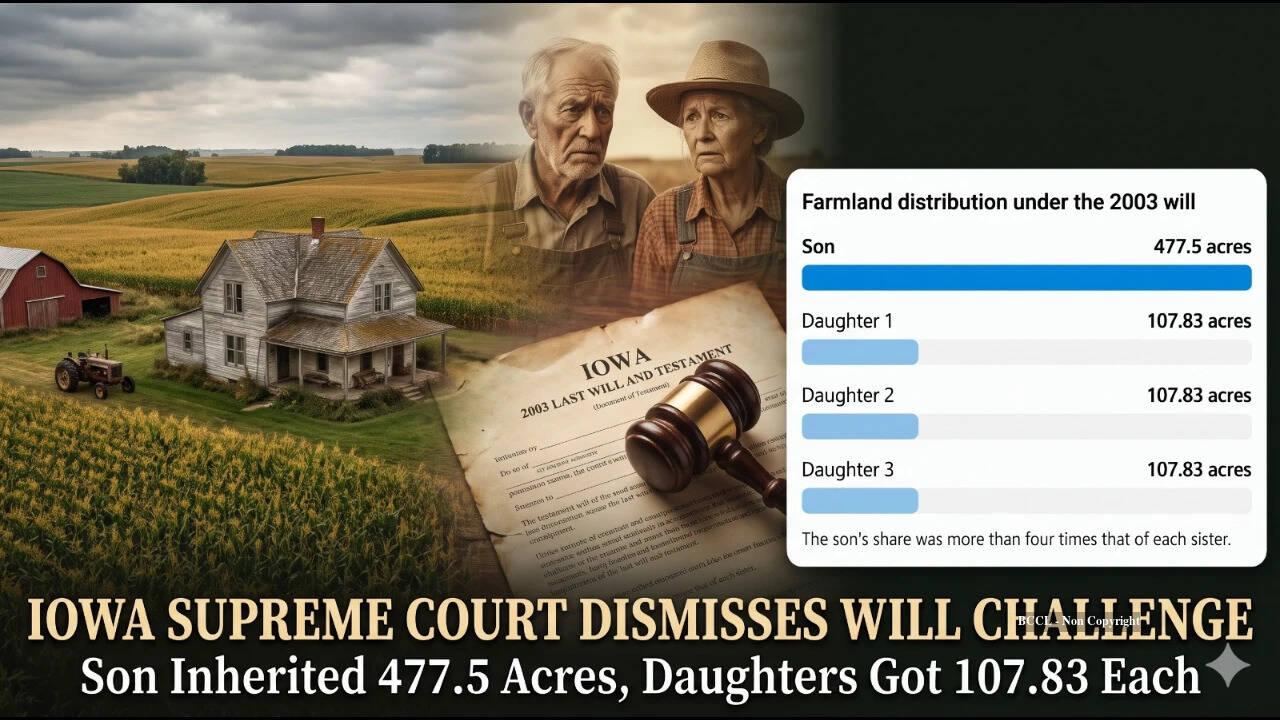
An Iowa couple planned to divide their farms equally among their four children, but a 2003 will gave their son 477.5 acres and each daughter 107.83 acres.
A painting may represent a particular memory, an emotional connection or a lifetime spent appreciating the work of an artist.
She recalled reminding her children on gloomy mornings that the sun was still shining above the clouds, even when they could not see it.
PVHP subsequently discovered the notice during a title search and became concerned that it could prevent the sellers from providing clear title.
They travel through generations, pass from one owner to another and find themselves in places far removed from the galleries and collections where one might expect to find them.
One property was described as a home Guntzelman and his wife would build on, the other as an investment for the trust.
In Atlanta, an abandoned prison farm that once stood as a site of confinement could soon take on a very different identity.
Wire or desk byline, not an individual reporter.
Also by TOI World Desk
Nothing else under this byline is closely related to this article, so these are simply their most recent.
All 1611 articles by TOI World Desk →

Topics

England Plymouth County Court The Court of Appeal Torquay

Subjects

Douglas PERSON · 8× Channon PERSON · 6× Barber PERSON · 2× The Court of Appeal ORG · 2× England GPE · 1× Mitchell PERSON · 1× Plymouth County Court ORG · 1× Torquay GPE · 1×

Narrative

Homeowner challenges the decision Ms Douglas appealed, arguing that the trial judge had identified one boundary under the applicable legal principle but then adopted a slightly different line as the property's actual boundary.
framing: assertive · carried by 1 article(s) · first seen 2026-10-07
He found that where a hedge belongs to one property, the boundary would generally follow the outer edge of its stems or trunks, rather than the furthest point reached by its leaves.

Claims (36 extracted, 6 hedged)

The legal dispute centred on a hedge separating two homes in Torquay, England, with a disagreement over a few millimetres of land eventually turning into a costly court battle. asserted
disagreement → centre → battle
A homeowner who lost an appeal over the precise position of the boundary between her property and her neighbour’s has been ordered to pay £108,402 upfront towards 70% of his legal costs, as per court documents. asserted
who → lose → documents
The case involved Ms Douglas, owner of 43 Mead Road, and Mr Channon, who owns the neighbouring No. 41. asserted
who → involve → No
Their disagreement concerned whether the boundary ran along the outer edge of a hedge or through the area where the hedge stood. asserted
hedge → concern → area
Court rules on hedge boundary The dispute reached Plymouth County Court, where a trial was held from August 18 to 26 last year. asserted
trial → rule → year
Judge Mitchell considered evidence from surveyors, photographs and other material before determining the boundary. asserted
Mitchell → consider → boundary
Mr Channon’s expert, civil engineer Mr Barber, had identified a line known as A-H-B as the boundary between the properties. asserted
expert → identify → properties
Ms Douglas argued that the boundary should instead run along the hedge’s outer edge because she maintained that the hedge belonged to her property. asserted
hedge → argue → property
The hedge had already been removed, making it impossible for the court to examine its exact position. asserted
court → remove → position
The judge considered the legal principles governing boundaries formed by hedges. asserted
judge → consider → hedges
He found that where a hedge belongs to one property, the boundary would generally follow the outer edge of its stems or trunks, rather than the furthest point reached by its leaves. asserted
boundary → find → leaves
However, the judge found that the difference between that position and Mr Barber’s A-H-B line was only a matter of millimetres. asserted
difference → find → millimetres
He therefore applied the legal principle of de minimis, which means a difference is so small that the law treats it as insignificant, and declared A-H-B to be the boundary. asserted
B → apply → it
Homeowner challenges the decision Ms Douglas appealed, arguing that the trial judge had identified one boundary under the applicable legal principle but then adopted a slightly different line as the property's actual boundary. asserted
judge → challenge → boundary
Her lawyers also argued that experts should first have been required to establish the precise legal boundary. asserted
experts → argue → boundary
If they could not agree, they said, the court could then have considered the issue at another hearing. uncertain
court → agree → hearing
The Court of Appeal rejected those arguments. asserted
Court → reject → arguments
The appeal court noted that the trial judge had considered the expert evidence, photographs and other material and had personally visited the properties. asserted
judge → note → properties
It found that he was entitled to conclude that the difference between the competing lines was only a few millimetres. asserted
difference → find → lines
The court also rejected the argument that the ruling effectively deprived Ms Douglas of part of her property. asserted
ruling → reject → property
Any difference in the amount of land involved was considered too small to have legal significance. asserted
difference → involve → significance
Other claims added to the dispute The boundary was only one part of the wider case. uncertain
boundary → add → case
Ms Douglas had also brought allegations involving trespass and nuisance against Mr Channon and a previous owner. asserted
Douglas → bring → Channon
She sought damages and other remedies, including claims related to work that she said had destabilised her land. uncertain
she → seek → land
Mr Channon denied the allegations and filed counterclaims of his own. asserted
Channon → deny → own
They included claims involving nuisance, trespass, alleged harassment and the value of his property. uncertain
They → include → property
His counterclaim was worth more than £200,000, although much of it was unsuccessful. The judge also found that Ms Douglas's main claim had failed, including her allegations concerning stabilisation work. uncertain
claim → find → work
Appeal court upholds £108,402 costs order asserted
court → uphold → order
Ms Douglas argued that she should not have to pay such a large share of Mr Channon's legal expenses because she had successfully defeated most of his counterclaim. asserted
she → argue → counterclaim
The Court of Appeal disagreed. asserted
Court → disagree → Appeal
It said judges can consider which party succeeded on the main issues, how much those issues contributed to the overall case and how the litigation was conducted. asserted
litigation → say → case
The trial judge had already taken Mr Channon's unsuccessful counterclaims into account when deciding the costs. asserted
judge → take → costs
Instead of making Ms Douglas responsible for all of Mr Channon's costs, the judge ordered her to pay 70%. asserted
her → make → %
The Court of Appeal dismissed her appeal, leaving both the boundary ruling and the costs order in place. asserted
Court → dismiss → place
Ms Douglas must therefore pay £108,402 upfront towards Mr Channon's costs, with the final amount to be determined under the 70% order. asserted
amount → pay → order
The court battle ultimately turned on a boundary difference measured in millimetres, but the wider litigation involved expert evidence, multiple claims and substantial legal costs. uncertain
litigation → turn → evidence

Give feedback · no sign-in needed

No sign-in needed for now. Your note is sent without a name, so it cannot be answered.

History Support