Photo via Al Jazeera

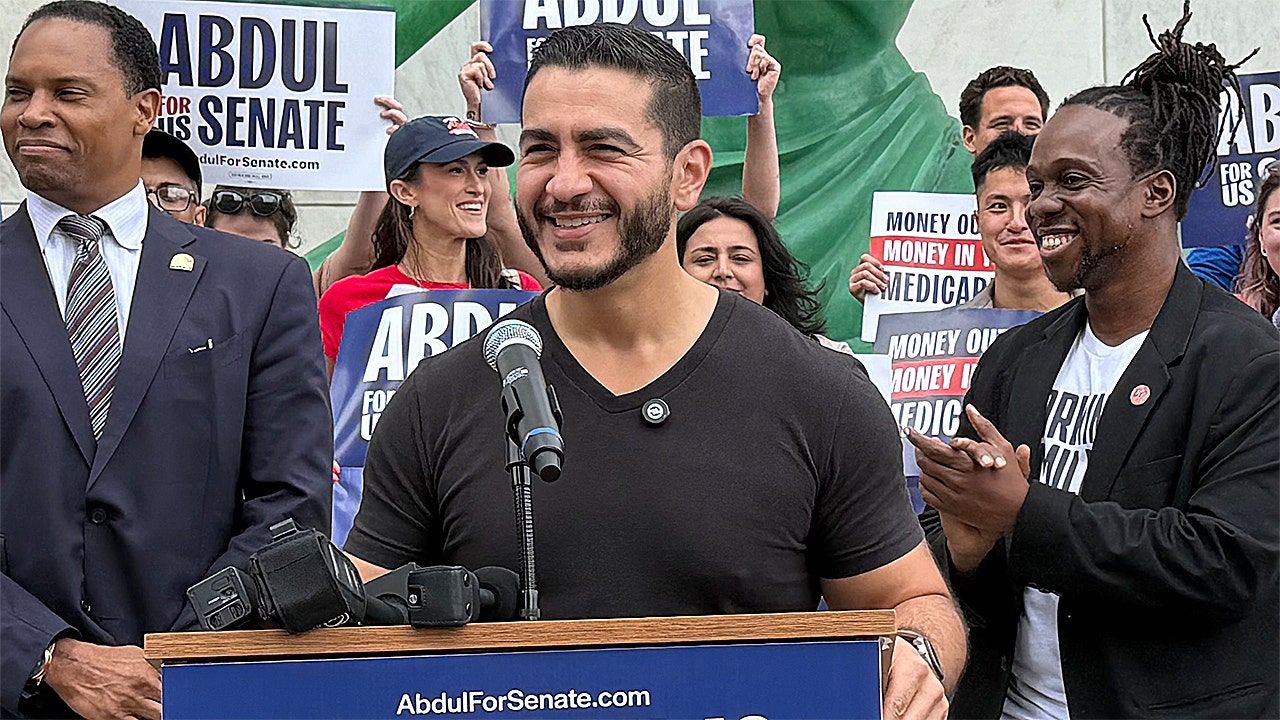
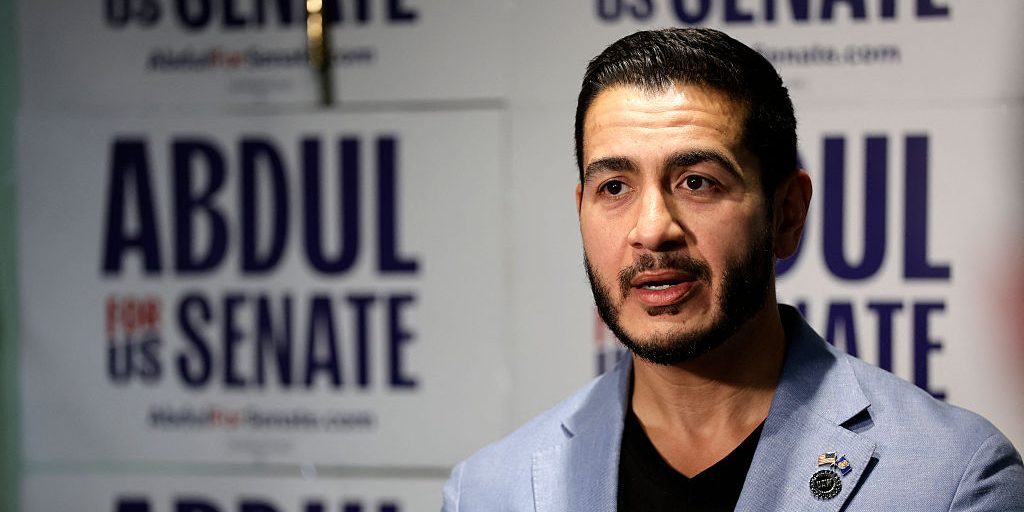
Abdul El-Sayed uses speech to talk about Muslim faith and American identity

Read the original at Al Jazeera ↗
Cite

Sherif, H. (2026, September 6). Abdul El-Sayed uses speech to talk about Muslim faith and American identity. Al Jazeera. https://www.aljazeera.com/news/2026/9/6/abdul-el-sayed-uses-speech-to-talk-about-muslim-faith-and-american-identity?traffic_source=rss

Dated when The Aporia collected the article, usually within hours of publication. Check the original for its exact date and byline.

Al Jazeera · collected 2026-09-06 · by Hoda Sherif

Quick Summary

Abdul El-Sayed, a Democratic Senate candidate from Michigan, used a speech at the Annual Islamic Society Conference to discuss Muslim American identity and criticize US foreign policy. He argued that being Muslim does not make someone less of an American, but rather can enhance their values as Americans. The speech comes ahead of a potential general election battle against Republican Mike Rogers, who is backed by President Donald Trump. El-Sayed criticized the US government's spending priorities under Trump, questioning how it can afford military escalations when basic needs like infrastructure and education are unaddressed.
Written by AI on 2026-09-07, from this article's own text only (the story summary below draws on all the coverage).
See how they differ ↓

AI analysis

Story summary

Abdul El-Sayed, a Democratic nominee for the U.S. Senate in Michigan, is facing scrutiny over his past remarks on the September 11 attacks. The controversy began when it was reported that Hasan Piker, a popular Twitch streamer who has endorsed El-Sayed, had made statements suggesting that "America deserved 9/11". Although Piker later retracted these comments, El-Sayed's own deleted social media posts from 2020 have resurfaced, where he compared the outrage over COVID-19 deaths to the reaction after 9/11. This has sparked a debate about Islamophobia in politics and whether attacks on Muslim politicians are backfiring.

El-Sayed, who is of Egyptian descent, has been accused by some Republicans of being an "anti-American extremist" due to his name and faith. However, he has used speeches to address Islamophobia and assert that Muslim Americans contribute to the country's identity. His campaign will face a high-stakes general election battle against Republican Mike Rogers.

The controversy has led to accusations that the media is perpetuating Islamophobic attacks on El-Sayed, with some outlets criticized for their framing of the story. The debate highlights the challenges faced by Muslim politicians in the U.S., who often face scrutiny and attack due to their faith.

Written for “Muslim Politicians Face Backlash” on 2026-11-20, grounded in this article and the 5 other(s) covering the same event.

How they differ

5 outlets covered “Muslim Politicians Face Backlash”.

What each outlet says

One AI summary per outlet of its latest article on this story, written from that article alone and checked against it. Open the article for the outlet's own words.

Al JazeeraThis outlet6 Sep

Abdul El-Sayed, a Democratic Senate candidate from Michigan, used a speech at the Annual Islamic Society Conference to discuss Muslim American identity and criticize US foreign policy. He argued that being Muslim does not make someone less of an American, but rather can enhance their values as Americans. The speech comes ahead of a potential general election battle against Republican Mike Rogers, who is backed by…

Abdul El-Sayed uses speech to talk about Muslim faith and American identity (this article)
Zeteo9 Sep

New York City Mayor Zohran Mamdani has released over 170,000 pages of documents showing that previous city leaders may have lied about toxic air caused by the World Trade Center's destruction on September 11, 2001. The Republican Party is criticizing Mamdani for his role in releasing these documents and has been accused of Islamophobic attacks against him. 9/11 family members and outer-borough Republican politicians…

Why Are Democrats Allowing Republicans to Smear Their Most Popular Politician? Because He’s Muslim →2 articles from Zeteo on this story
CBS News31 Aug

Abdul El-Sayed, the Democratic nominee for U.S. Senate in Michigan, is facing renewed scrutiny over past statements related to 9/11 as the nation prepares to mark its 25th anniversary. The issue centers on two deleted social media posts from 2020 and 2021, where El-Sayed compared the COVID-19 death toll to the number of Americans killed on 9/11 and suggested a similar response to terrorism could be applied to public…

For Abdul El-Sayed, Sept. 11 commemoration invites scrutiny of past remarks →
The Intercept3 Sep

Bari Weiss, a CBS News executive, was reportedly involved in promoting an article tying Michigan Democratic Senate nominee Abdul El-Sayed to the 9/11 attacks after he deleted several old tweets. The article, written by CBS reporter Zak Hudak, sparked harsh criticism from even those who share similar views on Muslims. Two of El-Sayed's deleted posts were actually asking Americans to compare the death toll of the…

CBS News Spins El-Sayed’s 9/11 Tweets Into a Manufactured Anti-Muslim Scandal →
Los Angeles Times6 Sep

The article reports on the resurgence of bigoted rhetoric against Muslim American politicians, specifically targeting Michigan Democratic U.S. Senate candidate Abdul El-Sayed. The right's strategy to defeat El-Sayed is to portray him as an anti-American extremist, but this approach may be backfiring. There are over 255 Muslim elected officials serving across 26 states and at nearly every level of government…

Commentary: The bigoted rhetoric against Muslim American politicians is backfiring. Next up: Abdul El-Sayed →

Where they agree and split

The full story: what happened, how it changed, and all 6 articles →

Compared with similar articles

This article reads leans left and hedges 0% of its claims. Each row says how that neighbour differs.
Los Angeles Times
Leans strongly left further left than this Hedges 3 of 42 claims Outlet record 95/100
Fox News
Leans right further right than this Hedges 2 of 50 claims Outlet record 67/100
“Article A discusses Abdul El-Sayed's Senate campaign and his efforts to appear moderate, while Article B reports on a speech he gave at the Annual Islamic Society Conference where he discussed Muslim American identity and criticized US and Israel's war on Iran”
The Intercept
Leans strongly left further left than this Hedges 4 of 81 claims Outlet record 96/100
“Article A reports on a CBS News article about Abdul El-Sayed's tweets being tied to 9/11, while Article B reports on a speech given by El-Sayed at the Annual Islamic Society Conference where he talks about Muslim American identity and blasts US and Israel's war on Iran”
Washington Examiner
Leans strongly left further left than this Hedges 4 of 55 claims Outlet record 67/100
“Article A describes Abdul El-Sayed's speech at the Annual Islamic Society Conference on Saturday, while Article B does not mention any specific event or date and instead discusses a broader trend in the pro-Israel movement”

Story

Muslim Politicians Face Backlash
Politics · 6 article(s) covering the same event. Compare every outlet's account →
How this article was measured signals, leaning charts, publisher record, byline, topics and claims

Signals How these are calculated →

Claims extracted
20
sentences that state something as happening or true
Uncertain
0%
0 of 20 hedged ("reportedly", "may", "according to")
Leaning
Leans left
of the writing, not the subject · beta estimate
Publisher signals
60/100
Al Jazeera's corrections and hedging, across everything collected from it. Not a measure of accuracy.
Outlets on this story
6
Politics
Same framing elsewhere
1
articles that frame the event the way this one does
Analyzed 2026-09-07 · how these are computed

How this is being covered How these are calculated →

Article leaning vs. publisher reliability
Source leaning vs. consistency

Publisher

Al Jazeera · 6131 article(s) · 4 correction(s) detected
Running correction rate · 4 correction(s)

Who wrote this

Hoda Sherif
10 article(s) here · 1 carrying a prediction
The civil complaint, filed Thursday in San Francisco Superior Court by the Irreplaceable Education Fund, Public Citizen, Heat Initiative and the Alliance for Secure AI, comes on the heels of a sweeping Democratic midterm victory that many analysts note could reshape, and ultimately tighten the regulatory framework for Silicon Valley.
- list 3 of 4Five key takeaways from Trump-Netanyahu meeting in Florida - list 4 of 4US-Israel ties: What Netanyahu and Trump will discuss in Florida
As Americans head to the polls on Tuesday in the much-anticipated midterms, the record number of voters identifying as independent could prove decisive for control of the US Congress and state legislatures.
On November 3, about 210 million registered voters will decide how much power Donald Trump has for the rest of his US presidency.
2026-10-26 · assertive framing · US midterm elections 2026 in maps and charts
Pro-Palestine activist Mahmoud Khalil has petitioned the United States Supreme Court to review a court ruling that could pave the way for his re-arrest and deportation.
Under pressure by New York Governor Kathy Hochul and Attorney General Letitia James, the university announced this week it would be appointing a law firm to conduct an independent internal review of how it initially handled the case.
Voting across Brazil will open at 8am (11:00 GMT) and will close at 5pm local time (20:00 GMT), with nearly 160 million citizens eligible to vote for president, governors and federal legislators.
A senior official in Cuba has warned that any prospective United States military action taken against the island nation would constitute a serious international crime, and has rejected claims made by US President Donald Trump that Cuba is a failed state.
Although the pandas’ transfer had been finalised back in April, Xi officially announced the arrival timeline on Thursday at the White House, noting that the black and white mammals could reach Zoo Atlanta from the Chengdu Research Base, China’s premier hub for giant panda conservation, breeding and research, within the next few days.
El-Sayed, who is seeking the Democratic nomination for the US Senate seat in November’s midterms, will face a high-stakes general election battle against Republican Mike Rogers.
Also by Hoda Sherif
Nothing else under this byline is closely related to this article, so these are simply their most recent.
All 10 articles by Hoda Sherif →

Topics

Democratic Detroit Iran Israel Muslim

Subjects

El-Sayed PERSON · 4× Israel GPE · 3× Muslim NORP · 3× American NORP · 2× Americans NORP · 2× Democratic NORP · 2× Democrats NORP · 2× Detroit GPE · 2× Iran GPE · 2× Senate ORG · 1×

Narrative

At the Annual Islamic Society Conference on Saturday, the 41-year-old Democrat and public health advocate, who has been on the receiving end of Islamophobic remarks during this election cycle, addressed Islamophobia in the US.
framing: assertive · carried by 1 article(s) · first seen 2026-09-07
El-Sayed, who is seeking the Democratic nomination for the US Senate seat in November’s midterms, will face a high-stakes general election battle against Republican Mike Rogers.

Claims (20 extracted, 0 hedged)

The Democratic Senate candidate for the US state of Michigan, Abdul El-Sayed, has used a speech in Detroit to discuss Muslim American identity, while also blasting the US and Israel’s war on Iran. asserted
candidate → use → Iran
At the Annual Islamic Society Conference on Saturday, the 41-year-old Democrat and public health advocate, who has been on the receiving end of Islamophobic remarks during this election cycle, addressed Islamophobia in the US. asserted
who → receive → US
Recommended Stories list of 3 items- list 1 of 3Is AIPAC’s political standing declining in the US? - list 2 of 3US Democrats finalise major shakeup to 2028 presidential primary calendar - list 3 of 3Most asserted
Democrats → decline → calendar
US Democrats in early 2028 primary states oppose aid to Israel: asserted
Democrats → oppose → Israel
“We find ourselves in a moment now, where as people point to us, Muslim Americans, they want to tell us that we don’t belong,” he told the crowd. asserted
he → find → crowd
“They want to tell us that this country is not ours. asserted
country → want → us
They want to tell us that because of our names and how we pray, somehow we are less than. asserted
we → want → names
But as I look in front of me, I see people who contribute to that big America every single day. asserted
who → look → America
El-Sayed, who is seeking the Democratic nomination for the US Senate seat in November’s midterms, will face a high-stakes general election battle against Republican Mike Rogers. asserted
who → seek → Rogers
The former US Representative is backed by President Donald Trump. asserted
Representative → back → Trump
After weeks of trading barbs online, the two candidates have finally agreed to hold two televised debates, the first on October 8 at Wood TV8 in Grand Rapids, the second on October 21 at WXYZ-TV in Detroit. asserted
candidates → trade → Detroit
Addressing the state of Muslim American belonging, El-Sayed said that “at their best, being Muslim makes us better Americans … and being American enables us to be better Muslims,” he said. asserted
he → address → best
He added that the two sets of ideals are “not mutually exclusive.” asserted
sets → add → ideals
During his speech, El-Sayed also questioned the US government’s spending priorities under Trump against the backdrop of continuing military escalations and overseas quagmires. asserted
Sayed → question → escalations
“How are you gonna pay for that [war in Iran] while we know our infrastructure is crumbling and our literacy rates are tumbling?” he asked the crowd. asserted
he → go → crowd
“It’s time for us to focus on addressing the problems that people in our country need solved.” asserted
people → ’ → country
Travelling across the Midwestern state in recent weeks, El-Sayed said that he found residents’ concerns transcended religious, racial and geographic divides. asserted
concerns → travel → divides
He said they were “basic needs” like paying for groceries and gas “instead of dropping bombs or doing apartheid or genocide against somebody else and their kids”, referring to Israel’s genocidal war in Gaza. asserted
they → say → Gaza
“Michiganders don’t care how you pray,” he said. asserted
he → care → ?
“They care what you pray for and what you hope for.” asserted
you → care → what
Give feedback · no sign-in needed

No sign-in needed for now. Your note is sent without a name, so it cannot be answered.

History Support