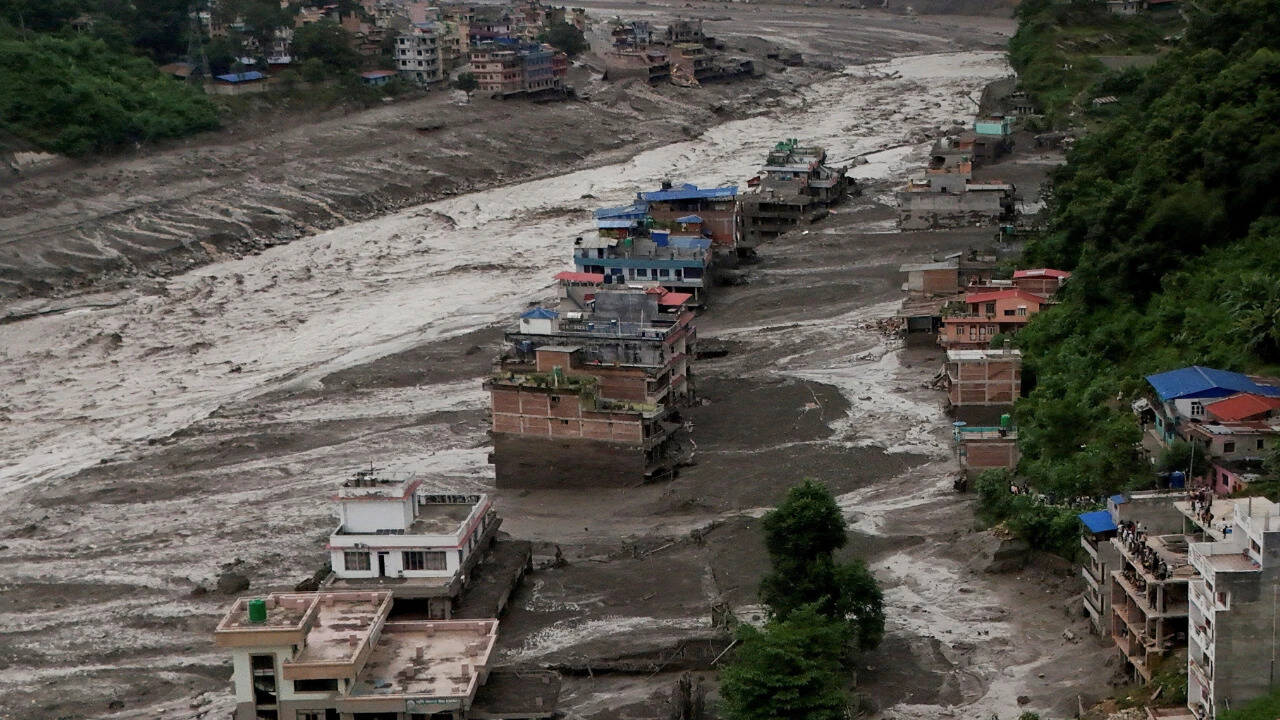
Photo via The Hindu

Nepal plans to drain four glacial lakes after deadly floods

Read the original at The Hindu ↗
Cite

Reuters. (2026, October 2). Nepal plans to drain four glacial lakes after deadly floods. The Hindu. https://www.thehindu.com/news/international/nepal-plans-to-drain-four-glacial-lakes-after-deadly-floods/article71538382.ece

Dated when The Aporia collected the article, usually within hours of publication. Check the original for its exact date and byline.

The Hindu · collected 2026-10-02 · by Reuters

Quick Summary

Nepal plans to start draining four glacial lakes this fiscal year in an effort to reduce flood risks following a recent disaster that killed over 1,400 people and left more than 5,000 missing. The project, costing $50 million, will focus on the Thulagi, Lower Barun, Lumding Tsho, and Hongu II lakes, which range in height from 4,050 m to 5,483 m. Officials aim to lower water levels through canals leading into nearby rivers and anticipate the project could take up to six years to complete.
Written by AI on 2026-10-02, from this article's own text only (the story summary below draws on all the coverage).
See how they differ ↓

AI analysis

Story summary

Nepal plans to drain four glacial lakes perched high in the mountains to reduce flood risks after a recent disaster that killed over 1,400 people and left more than 5,000 missing. The lakes—Thulagi, Lower Barun, Lumding Tsho, and Hongu II—are located at heights ranging from 4,050 m to 5,483 m (13,280 ft to 18,000 ft) and are considered among the most dangerous in Nepal. Design work and detailed studies targeting these lakes will commence during the fiscal year ending mid-July 2027. The plan involves draining water through canals into nearby rivers in a regulated manner to prevent downstream flooding risks. Subash Tuladhar, an expert from a government research center, noted that workers face significant health risks due to high-altitude work and flood dangers.

Written for “Nepal Glacial Lake Drainage Plan” on 2026-11-22, grounded in this article and the 1 other(s) covering the same event.

How they differ

2 outlets covered “Nepal Glacial Lake Drainage Plan”.

What each outlet says

One AI summary per outlet of its latest article on this story, written from that article alone and checked against it. Open the article for the outlet's own words.

The HinduThis outlet2 Oct

Nepal plans to start draining four glacial lakes this fiscal year in an effort to reduce flood risks following a recent disaster that killed over 1,400 people and left more than 5,000 missing. The project, costing $50 million, will focus on the Thulagi, Lower Barun, Lumding Tsho, and Hongu II lakes, which range in height from 4,050 m to 5,483 m. Officials aim to lower water levels through canals leading into nearby…

Nepal plans to drain four glacial lakes after deadly floods (this article)
ABC News (AU)2 Oct

Nepal plans to drain four glacial lakes to reduce flood risks following a glacier collapse in August that killed over 1,400 people and left more than 5,000 missing. The project, expected to cost $50 million and take up to six years to complete, aims to lower water levels through gated structures and includes installing sensors and developing a flood warning system. Authorities will begin detailed studies on the…

Nepal plans to drain four glacial lakes after flooding disaster →

Compared with similar articles

This article reads unscored and hedges 16% of its claims. Each row says how that neighbour differs.
ABC News (AU)
Hedges 6 of 22 claims Outlet record 67/100
Al Jazeera
Hedges 1 of 2 claims Outlet record 60/100
“Article A describes the immediate impacts of deadly floods and landslides in Nepal on a specific date, while Article B discusses subsequent plans to drain glacial lakes after a more extensive disaster with higher death tolls and missing persons reported later.”
Times of India
Hedges 0 of 10 claims Outlet record 58/100
“The articles describe different stages of a larger situation: Article A discusses Nepal's plans to drain glacial lakes after recent deadly floods, while Article B reports on Nepal ending search operations for the same flood event and shifting focus to reconstruction.”
New York Post
Hedges 0 of 7 claims Outlet record 66/100
“The articles describe different phases of an ongoing situation — Article A discusses plans to prevent future floods, while Article B reports on ending search and rescue efforts for a past disaster.”
The Hindu
Leans left Hedges 8 of 92 claims Outlet record 60/100
“Article A discusses the need for regional disaster preparedness and data sharing after recent floods in Nepal, while Article B reports on specific plans by Nepal to drain glacial lakes following a deadly flood event. They cover related topics but describe different aspects of the situation.”
Al Jazeera
Hedges 4 of 53 claims Outlet record 60/100
“Article A describes the aftermath of floods in Nepal and their impact on tourism, while Article B discusses Nepal's plan to drain glacial lakes as a response to recent deadly floods. They refer to related issues but describe different specific events.”
ABC News (AU)
Hedges 0 of 3 claims Outlet record 67/100
“Article A describes Nepal's plan to start draining glacial lakes this fiscal year after a deadly flood, while Article B reports on Nepal ending search and rescue operations and beginning planning for future flood risk reduction. These are different phases of the response.”

Story

Nepal Glacial Lake Drainage Plan
Environment · 2 article(s) covering the same event. See how they differ ↑
How this article was measured signals, leaning charts, publisher record, byline, topics and claims

Signals How these are calculated →

Claims extracted
19
sentences that state something as happening or true
Uncertain
16%
3 of 19 hedged ("reportedly", "may", "according to")
Leaning
not political
takes no side on a contested political question
Publisher signals
60/100
The Hindu's corrections and hedging, across everything collected from it. Not a measure of accuracy.
Outlets on this story
2
Environment
Same framing elsewhere
1
articles that frame the event the way this one does
Analyzed 2026-10-02 · how these are computed

How this is being covered How these are calculated →

Article leaning vs. publisher reliability
Source leaning vs. consistency

Publisher

The Hindu · 907 article(s) · 2 correction(s) detected
Running correction rate · 2 correction(s)

Who wrote this

Reuters
1234 article(s) here · 1 carrying a prediction
Published Nov. 22, 2026, 10:45 a.m. ET KYIV – At least 2 people were killed and about 10 may still be trapped under the rubble of a residential building that was struck by a Russian drone on Sunday morning in Ukraine’s Kyiv region, President Volodymyr Zelenskiy and local officials said.
After more than two weeks of negotiations that spilled two days into overtime — making it the longest COP on record — Turkiye’s conference president Murat Kurum said at the closing plenary that he could see there was no agreement and confirmed he would not advance any new text. “There is nothing to do, we did all that we could,” he said.
We will provide an update when appropriate.” The accident occurred in Tampa, Harrell’s hometown.
At the same press conference, Wahyu Hidayati, a police disaster victim identification official, said the intensity of the fire had rendered the recovered victims unidentifiable via visual inspection, prompting efforts to collect DNA samples from relatives and the personal belongings of the missing workers, a process that could take two to three weeks.
United Nations climate talks in Turkiye looked set to collapse without a political agreement after COP31 summit president Murat Kurum said there would be no new draft of the deal.
If I wanted more money, I wouldn’t be here.
At least 14 people may still be trapped under the rubble of a residential building that was struck by a Russian drone on Sunday (November 22, 2026) morning in Ukraine's Kyiv region, President Volodymyr Zelenskyy said.
One body bag might contain body parts from several people, police said.
Piastri, who started 17th, could only agree.
The former president is clinically stable and conscious, but there is no forecasted discharge at this time.
Wire or desk byline, not an individual reporter.
Also by Reuters
Nothing else under this byline is closely related to this article, so these are simply their most recent.
All 1234 articles by Reuters →

Topics

China ICIMOD Nepal the International Centre for Integrated Mountain Development the United Nations Development Programme

Subjects

Nepal GPE · 9× ICIMOD ORG · 2× Centre for Hydrology and Water Resources Research ORG · 1× China GPE · 1× Subash Tuladhar PERSON · 1× Tuladhar PERSON · 1× UNDP ORG · 1× the Green Climate Fund ORG · 1× the International Centre for Integrated Mountain Development ORG · 1× the United Nations Development Programme ORG · 1×

Narrative

The lakes, at heights ranging from 4,050 m to 5,483 m (13,280 ft to 18,000 ft), rank among Nepal’s most potentially dangerous, the United Nations Development Programme and the International Centre for Integrated Mountain Development (ICIMOD) said in a 2020 report.
framing: assertive · carried by 1 article(s) · first seen 2026-10-02
Nepal will kick off a high-stakes effort this fiscal year to drain four glacial lakes perched high in the mountains, as it scrambles to reduce flood risks, officials said, after a recent disaster that killed more than 1,400.
2026-10-02 · The Hindu
Nepal plans to drain four glacial lakes after deadly floods · assertive framing

Claims (19 extracted, 3 hedged)

Nepal will kick off a high-stakes effort this fiscal year to drain four glacial lakes perched high in the mountains, as it scrambles to reduce flood risks, officials said, after a recent disaster that killed more than 1,400. asserted
that → kick → 1,400
Rescuers are still searching for more than 5,000 people missing in the border region with China after August’s glacier collapse unleashed landslides and a flash flood that tore through valleys. asserted
that → search → valleys
“Our aim is to lower the risk of the lakes breaching their natural dams and reduce the risk of downstream floods,” said Subash Tuladhar, an expert with a government research centre tasked with overseeing the new project. asserted
Tuladhar → lower → project
Canals will drain water into nearby rivers in a regulated way, he said, adding that workers faced health risks as a result of the lengthy periods of high-altitude work required, in addition to the dangers of sudden flooding. asserted
workers → drain → flooding
Design work and detailed studies targeting the central and eastern lakes of Thulagi, Lower Barun, Lumding Tsho and Hongu II, will begin in the fiscal year that runs until mid-July 2027, authorities said. asserted
authorities → target → July
The lakes, at heights ranging from 4,050 m to 5,483 m (13,280 ft to 18,000 ft), rank among Nepal’s most potentially dangerous, the United Nations Development Programme and the International Centre for Integrated Mountain Development (ICIMOD) said in a 2020 report. asserted
Programme → range → report
Nepal had the skills and experience required for the $50-million project to be funded by the Green Climate Fund, the UNDP and the government, added Tuladhar, of Nepal’s Centre for Hydrology and Water Resources Research. asserted
Tuladhar → have → Research
Draining project could take six years uncertain
project → drain → years
The work of draining “through gated structures” will start after a detailed study, and could take up to six years to complete, said Sanjeeb Baral, the Centre’s executive director. uncertain
Baral → drain → years
It will encompass installation of sensors, a flood forecasting and warning system, and efforts to build downstream resilience and prepare communities for the risks. asserted
It → encompass → risks
In similar previous efforts, Nepal lowered by 3 m (10 ft) the level of the central Himalayan glacial lake of Tsho Rolpa by in 2000 and that of Imja in the vicinity of Mount Everest, the world’s tallest peak, 10 years ago. asserted
Nepal → lower → Everest
Urgency after recent floods Nepal’s disaster served as a warning to the world, Prime Minister Balendra Shah, 36, told the United Nations in an impassioned speech last month that blamed climate change despite his country’s negligible emissions. asserted
that → serve → emissions
Retreating glaciers, unstable mountain slopes and increasingly unpredictable rivers showed Nepal was paying a heavy price, he added. asserted
he → retreat → price
Nepal, which has reported about 26 Glacial Lake Outburst Flood events in the past four decades, loses more than 300 lives and property worth millions of dollars to extreme climate events annually on average. asserted
which → report → events
The latest floods devastated a dozen hydroelectric plants, roads, bridges, farms and settlements. asserted
floods → devastate → plants
Cash-strapped Nepal would need nearly $5 billion for early recovery, officials have said. asserted
officials → strap → recovery
Climate scientists say as temperatures rise glaciers in the Himalayas retreat, leaving behind unstable glacial lakes held back by little more than loose rock and ice, above valleys home to millions. asserted
glaciers → say → millions
Lowering the lakes by 3 m (10 ft) would significantly reduce the threat, said Samjwal Ratna Bajracharya, a retired ICIMOD expert on glaciers, glacial lakes and outburst floods. asserted
Bajracharya → lower → glaciers
“They are growing fast, are high up in the Himalayas and could cause outbursts any time, due to earthquakes, avalanches, climatic conditions and unplanned human-induced activity,” he told Reuters. uncertain
he → grow → Reuters
Give feedback · no sign-in needed

No sign-in needed for now. Your note is sent without a name, so it cannot be answered.

History Support