Photo via Dawn

Indonesia haze chokes neighbours, but little legal recourse

Read the original at Dawn ↗
Cite

AFP. (2026, October 1). Indonesia haze chokes neighbours, but little legal recourse. Dawn. https://www.dawn.com/news/2033947/indonesia-haze-chokes-neighbours-but-little-legal-recourse

Dated when The Aporia collected the article, usually within hours of publication. Check the original for its exact date and byline.

Dawn · collected 2026-10-01 · by AFP

Quick Summary

Haze from Indonesian wildfires has affected neighboring countries like Malaysia and Singapore for over a month, causing school closures and increased respiratory issues. While these nations consider legal action against Indonesia through the International Court of Justice (ICJ) or under ASEAN’s Haze Pollution Agreement, obstacles such as jurisdictional consent and enforcement limitations hinder effective recourse. Experts suggest that regional cooperation and stronger preventive measures might be more practical approaches to addressing the issue.
Written by AI on 2026-10-01, from this article's own text only (the story summary below draws on all the coverage).

AI analysis

Story summary

Haze from wildfires in Indonesia has been affecting Malaysia and Singapore for over a month, closing schools and causing an increase in respiratory complaints. This is not the first time such pollution crises have occurred due to Indonesian fires. However, neighboring countries like Malaysia and Singapore face limited legal options as Indonesia rarely consents to international court jurisdiction. Professor Mohd Hazmi Mohd Rusli of Universiti Sains Islam Malaysia noted that for the International Court of Justice (ICJ) in The Hague to hear cases between nations, both states must agree to its authority beforehand. Since Indonesia, Malaysia, and Singapore are not part of the 1979 Convention on Long-range Transboundary Air Pollution, they lack an existing framework to address cross-border air pollution legally.

Written for “Indonesian Haze Issue” on 2026-11-20, grounded in this article and the 0 other(s) covering the same event.

Compared with similar articles

This article reads unscored and hedges 12% of its claims. Each row says how that neighbour differs.
South China Morning Post
Leans left Hedges 1 of 5 claims Outlet record 62/100
“Article A discusses regional haze affecting Malaysia and Singapore with legal implications, while Article B covers Indonesian citizens suing their president over haze in West Kalimantan.”
The Sydney Morning Herald
Hedges 6 of 54 claims Outlet record 61/100
“While both articles discuss wildfires in Indonesia and their impact on neighboring countries, Article A focuses on a specific community's experience with a wildfire near Pontianak, while Article B discusses the broader regional haze issue affecting Malaysia and Singapore.”

Story

Indonesian Haze Issue
Environment · 1 article(s) covering the same event.
How this article was measured signals, leaning charts, publisher record, byline, topics and claims

Signals How these are calculated →

Claims extracted
25
sentences that state something as happening or true
Uncertain
12%
3 of 25 hedged ("reportedly", "may", "according to")
Leaning
not political
takes no side on a contested political question
Publisher signals
67/100
Dawn's corrections and hedging, across everything collected from it. Not a measure of accuracy.
Outlets on this story
1
Environment
Same framing elsewhere
1
articles that frame the event the way this one does
Analyzed 2026-10-01 · how these are computed

How this is being covered How these are calculated →

Article leaning vs. publisher reliability
Source leaning vs. consistency

Publisher

Dawn · 3487 article(s) · 5 correction(s) detected
Running correction rate · 5 correction(s)

Who wrote this

AFP
1297 article(s) here · 1 carrying a prediction
“I would love to see him be back.
US federal prosecutors alleged that an Indian intelligence officer, who remains at large, directed the plot and recruited Gupta in May 2023 to hire a hitman to carry out the murder.
Huang resigned as chief of the chip giant at the centre of the artificial intelligence (AI) revolution after revelations of extramarital affairs, including one with an alleged Chinese spy who may have funnelled restricted chips to that country.
Mr. Kobir said Dhaka would deal with attacks "very firmly".
They were referring to recursive self-improvement (RSI) — a term the industry uses to describe building advanced AI models that can autonomously create newer versions of themselves, which critics worry will hasten doomsday scenarios.
And Ukraine fears this winter could be the worst yet.
World champions Spain will face France while England will play Norway in the quarterfinals of the UEFA Nations League after the draw took place on Friday.
In March, South Korea’s then-prime minister Kim Min-seok said that Trump thought a meeting with Kim would be “good”.
Rohingya refugees will undergo a Technical and Vocational Education and Training (TVET) programme in Turkiye which would last three to six months.
2026-11-20 · assertive framing · Malaysia plans to resettle 10,000 Rohingya in Turkiye
Russian attacks damaged two of Kyiv's bridges, the mayor of the Ukrainian capital said on Friday (November 20, 2026), as Moscow launched a fresh wave of missiles and drones. "
2026-11-20 · assertive framing · Russian strikes damage two bridges in Kyiv: Mayor
Wire or desk byline, not an individual reporter.
Also by AFP
Nothing else under this byline is closely related to this article, so these are simply their most recent.
All 1297 articles by AFP →

Topics

ICJ Indonesia Indonesian Malaysia Singapore

Subjects

Singapore GPE · 10× Indonesia GPE · 6× ICJ ORG · 5× Indonesian NORP · 4× Malaysia GPE · 4× Asean ORG · 3× Hazmi PERSON · 3× Mohd Hazmi Mohd Rusli PERSON · 1× The Hague GPE · 1× the International Court of Justice ORG · 1×

Narrative

It is not the first time Indonesian haze has caused a regional pollution crisis, but neighbouring countries have few options for legal recourse, experts say: Case at the ICJ Suggestions that Malaysia and Singapore take Indonesia to the UN’s highest judicial organ, the International Court of Justice in The Hague, face a basic obstacle: “The main issue is jurisdiction, as the ICJ generally requires the consent of both states,” said Professor Mohd Hazmi Mohd Rusli of Universiti Sains Islam Malaysia.
framing: assertive · carried by 1 article(s) · first seen 2026-10-01
And experts agree Indonesia would be unlikely to willingly accept ICJ jurisdiction on the issue.
2026-10-01 · Dawn
Indonesia haze chokes neighbours, but little legal recourse · assertive framing

Claims (25 extracted, 3 hedged)

Haze from Indonesian wildfires has blanketed neighbouring Malaysia and Singapore for more than a month, closing schools and sending respiratory complaints skyrocketing. asserted
complaints → blanket → schools
It is not the first time Indonesian haze has caused a regional pollution crisis, but neighbouring countries have few options for legal recourse, experts say: Case at the ICJ Suggestions that Malaysia and Singapore take Indonesia to the UN’s highest judicial organ, the International Court of Justice in The Hague, face a basic obstacle: “The main issue is jurisdiction, as the ICJ generally requires the consent of both states,” said Professor Mohd Hazmi Mohd Rusli of Universiti Sains Islam Malaysia. asserted
Rusli → cause → Malaysia
The ICJ can only hear a dispute where states have accepted its jurisdiction, for example through a special agreement, compatible declarations recognising the court’s compulsory jurisdiction, or a treaty clause referring disputes to it. asserted
states → hear → it
Indonesia, Malaysia and Singapore are neither signatories nor parties to the 1979 Convention on Long-range Transboundary Air Pollution, a European-centred treaty framework intended to curb cross-border air pollution. asserted
Indonesia → intend → pollution
And experts agree Indonesia would be unlikely to willingly accept ICJ jurisdiction on the issue. asserted
Indonesia → agree → issue
All three countries are parties to the Asean Agreement on Transboundary Haze Pollution, but the 2002 deal has no clause on litigation before the ICJ. asserted
deal → have → ICJ
The Asean Agreement on Transboundary Haze Pollution is a legally binding regional treaty, intended to prevent and monitor cross-border haze from land and forest fires, and to mitigate its effects. asserted
Agreement → intend → effects
But its enforcement provisions are limited. asserted
provisions → limit → ?
“It is legally binding, but it does not provide a mechanism for one member state to simply sue another,” said Hazmi. asserted
Hazmi → provide → another
Instead, it seeks to solve the problem through “national action and regional cooperation”. asserted
it → seek → action
Legal analysts say Asean’s emphasis on consensus, sovereignty and non-interference puts the brakes on how much diplomatic pressure can be applied to member states over domestic land management and fire enforcement. “For now, I think the more practical approach is stronger Asean cooperation, including hotspot monitoring, information sharing, prevention and stronger enforcement against illegal burning,” Hazmi said. asserted
Hazmi → say → burning
Civil action One option could be for Malaysians or Singaporeans to try to sue companies linked to the fires in an Indonesian court, said Azam Hawari, a legal expert at the environmental law charity, ClientEarth. uncertain
Hawari → try → charity
However, “claimants would need to show a link between the company’s activities, the haze that reached them, and their losses,” Azam said, adding he was not aware of such a case having been brought successfully. asserted
case → need → them
Hazmi added, “Transboundary haze does not automatically mean Indonesia is internationally responsible.” asserted
Indonesia → add → ?
“There must still be sufficient evidence to establish the link between activities in Indonesia and the harm suffered in Malaysia or Singapore,” he said. asserted
he → establish → Malaysia
Previous attempts Singapore enacted its own Transboundary haze Pollution Act in 2014, after pollution levels spiked into hazardous territory the year before, followed by another episode in 2015. asserted
levels → enact → 2015
The law aimed to punish companies whose activities outside Singapore caused or contributed to unhealthy levels of haze in Singapore. asserted
activities → aim → Singapore
Enforcement proved a major weakness because it relied heavily on cooperation from foreign authorities. asserted
it → prove → authorities
Establishing responsibility was also challenging because it required authorities to share maps pinpointing fire hotspots, and conflicting or overlapping land rights could further complicate matters. uncertain
rights → establish → matters
Bringing a case against some companies with no presence in Singapore also made collecting fines or damages hard. asserted
collecting → bring → fines
Singapore’s investigations into four Indonesian companies over their alleged role in the 2015 transboundary haze remain open and proved a source of diplomatic tensions with Jakarta at the time. asserted
investigations → allege → time
Singapore will now most likely “wait for Indonesia to finger certain companies first before we take action against these same companies under the Act”, said Professor Alan Tan, an environmental law expert at the National University of Singapore. asserted
Tan → wait → Singapore
“Otherwise, any action that Singapore takes would appear to the Indonesians to be unilateral, and could be politically controversial.” uncertain
Singapore → take → Indonesians
Tan said, “Regrettably, not much has changed by way of how the root causes of fires remain unaddressed in Indonesia”. asserted
causes → say → Indonesia
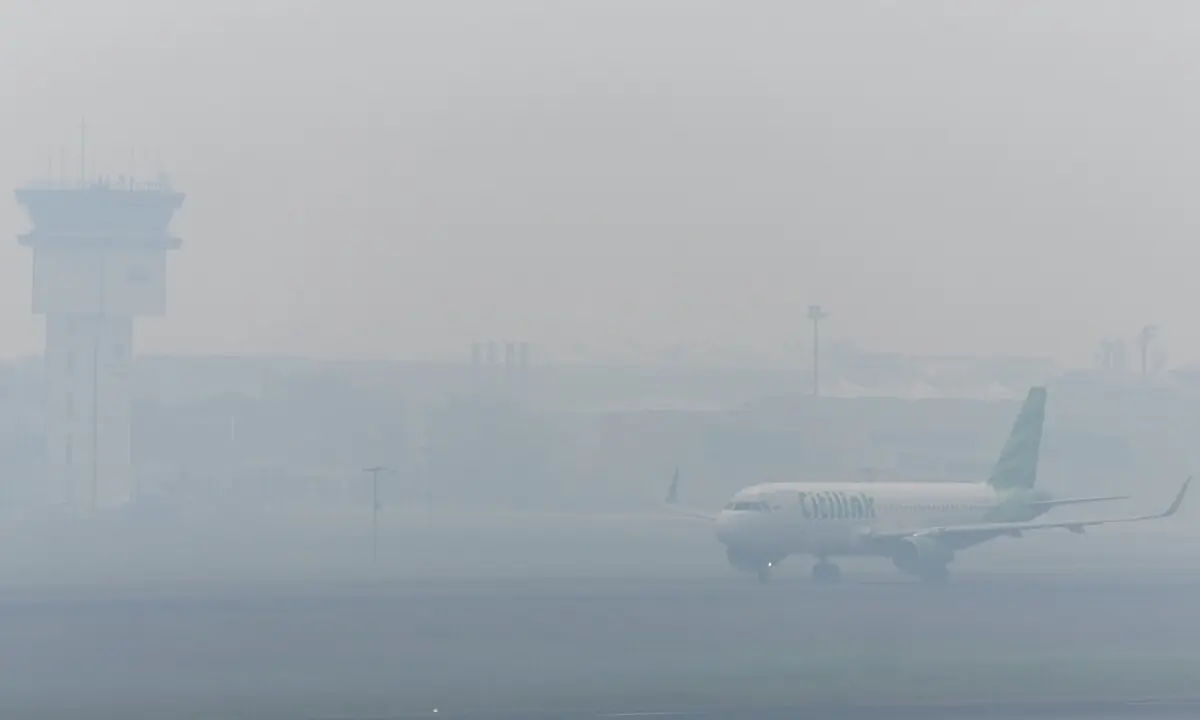
Header image: A Citilink Airbus prepares to take off as haze from wildfires shrouds Sultan Mahmud Badaruddin II International Airport in Palembang, South Sumatra province, Indonesia on September 30, 2026. asserted
haze → prepare → September

Give feedback · no sign-in needed

No sign-in needed for now. Your note is sent without a name, so it cannot be answered.

History Support