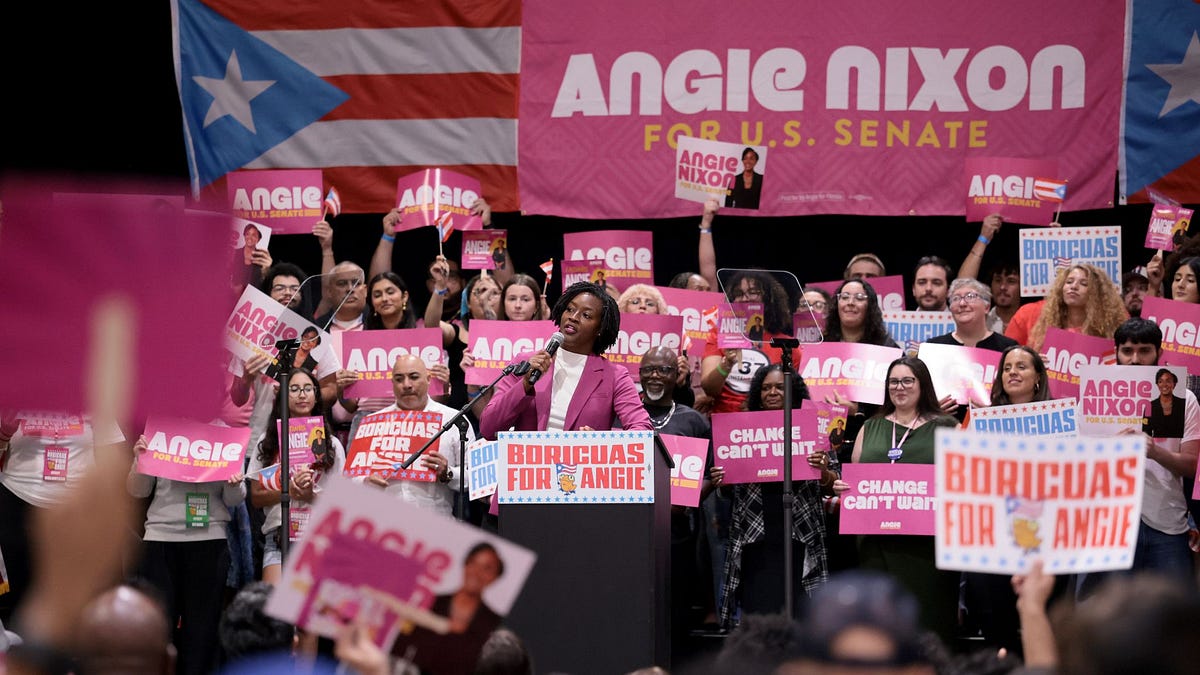
Photo via Silver Bulletin

A tour of the 7 key Senate races

Read the original at Silver Bulletin ↗
Cite

McKown-Dawson, E. (2026, September 4). A tour of the 7 key Senate races. Silver Bulletin. https://www.natesilver.net/p/a-tour-of-the-7-key-senate-races

Dated when The Aporia collected the article, usually within hours of publication. Check the original for its exact date and byline.

Silver Bulletin · collected 2026-09-04 · by Eli McKown-Dawson commentary

Quick Summary

The author discusses the competitive Senate races in the 2026 election cycle using their FLIPR forecast model, which currently favors Democrats but still considers the Senate to be a toss-up. According to the model, Democrats need to net at least four seats from states that Donald Trump carried in 2024, with the national popular vote being a key indicator of their chances. The article specifically highlights seven key Senate races, including Ohio and Michigan, where polls show contradictory results but can be influenced by various factors such as candidate strength and fundamentals. These seven races have a combined 71% chance of deciding which party controls the Senate after 2026.
Written by AI on 2026-09-05, from this article's own text only (the story summary below draws on all the coverage).
See how they differ ↓

AI analysis

Story summary

The US Senate has become unexpectedly competitive ahead of the November elections, with Democrats potentially on track to win control from Republicans. 74 days remain until election day and the party only needs to flip three seats to gain control. Historically, a party out of the White House tends to gain more than two dozen seats in midterm elections, which suggests Democrats have a good chance. The biggest question now is whether they can capitalize on this momentum in key states such as Ohio, Michigan, and North Carolina, where polls show mixed results. In Ohio, Democrat Sherrod Brown is leading by 8 points, while in Michigan, Democrat Abdul El-Sayed trails by 4 points according to recent polls. The Senate currently has 53 Republicans and Democrats need to net at least four seats to take control.

Written for “US Senate Election Outlook” on 2026-11-20, grounded in this article and the 1 other(s) covering the same event.

How they differ

2 outlets covered “US Senate Election Outlook”.

What each outlet says

One AI summary per outlet of its latest article on this story, written from that article alone and checked against it. Open the article for the outlet's own words.

Silver BulletinThis outlet4 Sep

The author discusses the competitive Senate races in the 2026 election cycle using their FLIPR forecast model, which currently favors Democrats but still considers the Senate to be a toss-up. According to the model, Democrats need to net at least four seats from states that Donald Trump carried in 2024, with the national popular vote being a key indicator of their chances. The article specifically highlights seven…

A tour of the 7 key Senate races (this article)
Los Angeles Times31 Aug

The article discusses how the US Senate is suddenly in play for Democrats, who previously seemed unlikely to gain control. According to historical trends, Democrats need only flip three seats to take control of the Senate, but they face a tough path with toss-up races in six mostly red states. Despite the challenges, the Cook Political Report has classified the Senate as a toss-up, citing potential for Democratic…

Barabak: Don't look now, but suddenly the U.S. Senate is in play →

Compared with similar articles

This article reads leans right and hedges 8% of its claims. Each row says how that neighbour differs.
NPR
Leans left further left than this Hedges 1 of 18 claims Outlet record 60/100
“They report on related events (the start of the midterm election season and its implications), but do not describe the same specific happening”
Los Angeles Times
Leans left further left than this Hedges 7 of 74 claims Outlet record 95/100

Story

US Senate Election Outlook
Politics · 2 article(s) covering the same event. See how they differ ↑
How this article was measured signals, leaning charts, publisher record, byline, topics and claims

Signals How these are calculated →

Claims extracted
25
sentences that state something as happening or true
Uncertain
8%
2 of 25 hedged ("reportedly", "may", "according to")
Leaning
Leans right
expected in commentary, which argues a position · beta estimate
Publisher signals
not measured
these signals count newsroom corrections; Commentary has none to count
Outlets on this story
2
Politics
Same framing elsewhere
1
articles that frame the event the way this one does
Analyzed 2026-09-05 · how these are computed

How this is being covered How these are calculated →

Article leaning vs. publisher reliability
Source leaning vs. consistency

Publisher

Silver Bulletin · 72 article(s) · 0 correction(s) detected
No corrections detected for this publisher. That may mean careful reporting, or simply that nothing has been checked.

Who wrote this

Eli McKown-Dawson
9 article(s) here · 1 carrying a prediction
After a decade of losses and underinvestment, it looked like it could take another ten years for Democrats to turn Florida purple again.
2026-11-17 · assertive framing · Did Democrats blow it in Florida?
Our forecasts show good numbers for Democrats — the last round of polling resolved any doubt about that.
2026-11-03 · assertive framing · The FLIPR 🐬 guide to Election Night
We’ve also covered the topic in some detail, and it can be especially concerning for forecasters when Democrats are putting up their best polling performances in traditionally red states.
2026-11-02 · assertive framing · Where polls and fundamentals clash
FLIPR’s Deluxe forecast gives Democrats a 95 percent chance of retaking the lower chamber.
Here at Silver Bulletin, we’ve been predicting that AI would become one of the most salient political issues for quite some time.
2026-10-06 · assertive framing · The Democrats’ AI primary is heating up
In case you missed it, we launched our 2026 election forecast — now named FLIPR — on Tuesday.
2026-09-04 · assertive framing · A tour of the 7 key Senate races
Yesterday, the Missouri Supreme Court ruled that the state’s new congressional map — which likely would have flipped Kansas City’s Democratic 5th District red — could not be used in November.
After taking tours through the most competitive House and Senate contests over the past two weeks, we’re moving on to the final class of races FLIPR forecasts: governors.
2026-08-31 · assertive framing · A tour of the 9 key governor races
The theme will be roughly the same: we’re going to look at every district that the opposition party has a 25 percent chance or greater of flipping, according to FLIPR’s Deluxe forecast.
2026-08-24 · assertive framing · A tour of the 48 key House races
Also by Eli McKown-Dawson
Did Democrats blow it in Florida?
2026-11-17 · Silver Bulletin
The FLIPR 🐬 guide to Election Night
2026-11-03 · Silver Bulletin
Where polls and fundamentals clash
2026-11-02 · Silver Bulletin
Nothing else under this byline is closely related to this article, so these are simply their most recent.
All 9 articles by Eli McKown-Dawson →

Topics

Democrat Democrats Michigan Republicans Senate

Subjects

Democrats NORP · 7× Senate ORG · 6× Michigan GPE · 3× Democrat NORP · 2× Democratic NORP · 2× El-Sayed PERSON · 2× FLIPR ORG · 2× North Carolina GPE · 2× Ohio GPE · 2× Republicans NORP · 2×

Narrative

Still, nobody should take North Carolina too much for granted: it has only voted for Democrats once for president since 1976 (it went for Barack Obama in 2008) and has frequently been a close-but-not-quite state for Democrats in federal races.
framing: assertive · carried by 1 article(s) · first seen 2026-09-05
In case you missed it, we launched our 2026 election forecast — now named FLIPR — on Tuesday.
2026-09-05 · Silver Bulletin
A tour of the 7 key Senate races · assertive framing

Claims (25 extracted, 2 hedged)

In case you missed it, we launched our 2026 election forecast — now named FLIPR — on Tuesday. asserted
we → miss → Tuesday
But while it currently rates the House as “likely D”, the Senate is still in true tossup territory.1 Why is the upper chamber so competitive? asserted
chamber → rat → territory.1
Well, it’s pretty simple. asserted
it → ’ → ?
True, the GOP has few solid pickup opportunities, but they already have 53 senators and a tie-breaking VP. asserted
they → have → senators
Democrats need to net at least four seats, mostly from states that Donald Trump carried handily in 2024. asserted
Trump → need → 2024
If the national popular vote comes in anywhere under D +6, Republicans are the clear favorites to retain the Senate. asserted
Republicans → come → Senate
But Democrats are on track to beat that number, perhaps by a wide margin. asserted
Democrats → beat → margin
That’s a big enough blue wave to give Democrats a real shot at winning enough competitive seats. asserted
That → ’ → seats
Some of the data can also seem contradictory, however. asserted
Some → seem → data
Just this week, Fox News released polls showing Democrat Sherrod Brown leading by 8 points in Ohio — but Abdul El-Sayed trailing by 4 points in Michigan. asserted
Sayed → release → Michigan
In the context of a presidential race, that wouldn’t make much sense, since Michigan is the considerably bluer state. asserted
Michigan → make → sense
Particularly if you believe that moderation matters, El-Sayed is arguably a weaker candidate than Brown.2 asserted
Sayed → believe → ?
Brown is also a more familiar face, having served in the Senate from 2007 through 2025. asserted
Brown → serve → 2025
Outcomes in congressional races are correlated with one another, although considerably less so than in presidential races. asserted
Outcomes → correlate → races
Still, the more advanced versions of FLIPR are a little bit skeptical about taking these polls at face value. asserted
versions → take → value
It’s not that they’re necessarily wrong about what might happen in an election held today. uncertain
what → ’ → election
But El-Sayed has several months to repair the damage from a bruising Democratic primary, while Republicans have time to bring the race more in line with fundamentals in Ohio. asserted
Republicans → have → Ohio
So for my first model talk of the 2026 cycle, I’m bringing back a popular article format from 2024 and taking you on a tour of the seven most likely Senate tipping-point states (plus some honorable mentions at the end). asserted
I → bring → end
We’ll look at where polls and fundamentals are in tension with one another, like in Michigan, and where they’re more aligned. asserted
they → look → Michigan
Combined, these races have a 71 percent chance of deciding which party controls the Senate after 2026.3 Full disclosure: we’re cheating just slightly here. asserted
we → combine → disclosure
For purposes of this article, we’ve promoted North Carolina from that tier into the Big 7. asserted
we → promote → Big
Our model doesn’t think NC is a particularly likely tipping point because it’s pretty confident that Democrat Roy Cooper will win, perhaps comfortably. asserted
Cooper → think → ?
Still, nobody should take North Carolina too much for granted: it has only voted for Democrats once for president since 1976 (it went for Barack Obama in 2008) and has frequently been a close-but-not-quite state for Democrats in federal races. asserted
it → take → races
So it deserves some attention as we explain why FLIPR thinks this might finally be the year for a Democratic breakthrough. uncertain
this → deserve → breakthrough
But let’s begin with Democrats’ white whale: Texas. asserted
’s → let → whale

Give feedback · no sign-in needed

No sign-in needed for now. Your note is sent without a name, so it cannot be answered.

History Support