Photo via TIME

‘I Wouldn’t Call it a War’: Vance Downplays Conflict With Iran, Even as Strikes Continue

Read the original at TIME ↗
Cite

Popli, N. (2026, September 4). ‘I Wouldn’t Call it a War’: Vance Downplays Conflict With Iran, Even as Strikes Continue. TIME. https://time.com/article/2026/09/03/vance-iran-war-press-briefing/

Dated when The Aporia collected the article, usually within hours of publication. Check the original for its exact date and byline.

TIME · collected 2026-09-04 · by Nik Popli

Quick Summary

Vice President J.D. Vance downplayed the conflict with Iran, stating that he wouldn't call it a "war", despite recent strikes and a prolonged period of hostilities lasting over six months. He acknowledged a "flare-up" in violence but claimed major combat operations had ended long ago. The US has repeatedly bombed targets inside Iran, while Iran attacks commercial shipping vessels through the Strait of Hormuz, contributing to higher energy prices. Vance offered no clear indication of when the conflict might end, saying only that it would depend on Iran's actions and not providing a timeline.
Written by AI on 2026-09-05, from this article's own text only (the story summary below draws on all the coverage).
See how they differ ↓

AI analysis

Story summary

Mohammad Ghaemi, an analyst, stated that Iran views its military actions primarily as a means for coercive negotiation rather than as a standalone objective. Iran's foreign minister is set to meet with Gulf state ministers in Oman next week to discuss ensuring the safety of commercial shipping through the Strait of Hormuz, though any agreement would likely require U.S. approval due to the ongoing naval blockade against Iran.

U.S. President Donald Trump declared that the war with Iran will end immediately after the midterms on November 3, asserting his defense of military actions aimed at preventing Tehran from developing a nuclear weapon. Despite these assurances, rising oil prices—Brent crude reached over $100 per barrel—are expected to negatively impact Republicans' electoral chances in upcoming midterms.

Vice President J.D. Vance confirmed that the U.S. is investigating reports of civilian casualties during a recent strike on a wedding celebration in Iran's Kuhestak region, where at least five people were killed and dozens injured. Iranian state media reported the incident, while Reuters independently verified footage showing a residential building attack during a wedding.

The United States and Iran have exchanged missile and drone attacks this week after an earlier lull in hostilities since July. Reports indicate that six Iranian military personnel, including three pilots, died in U.S.-led airstrikes; however, the U.S. has expressed skepticism about these casualty claims from Iranian state media. The investigation into the wedding strike is ongoing.

Oil prices surged following escalating conflicts between the United States and Iran. Brent crude reached its highest since May 22 at $101.21 per barrel on September 9, while West Texas Intermediate settled at $96.05. Despite these price increases, major oil companies like Chevron Corporation, TotalEnergies SE, Exxon Mobil Corporation, Eni S.p.A., and BP p.l.c. have been trading assets rather than adding new drilling operations in response to geopolitical tensions.

Written for “Iran Attacks After US Hits Tankers” on 2026-11-20, grounded in this article and the 107 other(s) covering the same event.

How they differ

31 outlets covered “Iran Attacks After US Hits Tankers”.

What each outlet says

One AI summary per outlet of its latest article on this story, written from that article alone and checked against it. Open the article for the outlet's own words.

TimeThis outlet4 Sep

Vice President J.D. Vance downplayed the conflict with Iran, stating that he wouldn't call it a "war", despite recent strikes and a prolonged period of hostilities lasting over six months. He acknowledged a "flare-up" in violence but claimed major combat operations had ended long ago. The US has repeatedly bombed targets inside Iran, while Iran attacks commercial shipping vessels through the Strait of Hormuz…

‘I Wouldn’t Call it a War’: Vance Downplays Conflict With Iran, Even as Strikes Continue (this article)4 articles from Time on this story
The Straits Times7 Sep

US and Iranian strikes on ships in the Strait of Hormuz have led to a significant decline in maritime traffic in the area, with an average of only 10 commodity ships transiting the strait per day over the past 10 days, the lowest since May. The number of vessels passing through the strait has been declining since September 4, when it was more than 15, and is now down to as low as six on September 5. Data from…

Hormuz traffic dips to lowest since May after US, Iranian strikes on ships →9 articles from The Straits Times on this story
NBC News10 Sep

President Donald Trump made a speech at the Republican party's midterm convention in Dallas, using the war with Iran as a campaign issue. He claimed that the war will end "very shortly after the election", despite it being in its seventh month and polls showing 69% of Americans disapprove of his handling of the war. Several attendees at the convention expressed support for Trump's actions, citing concerns about Iran…

Trump says the war in Iran will end after Election Day →8 articles from NBC News on this story
Al Jazeera7 Sep

Iran's Supreme National Security Council Secretary Mohsen Rezaei announced plans to establish a restricted zone in the Strait of Hormuz, a global energy chokepoint. The new zone will reportedly start from the US Navy's blockade line and include areas of the Persian Gulf. According to Rezaei, any ship entering this zone will be placed on Iran's sanctions list. No details were provided on the zone's precise boundaries…

Can Iran enforce a restricted zone in the Strait of Hormuz? →7 articles from Al Jazeera on this story
Dawn9 Sep

Benchmark Brent crude oil futures rose past $100 a barrel on Wednesday, hitting a six-week high due to intensifying conflict in the Middle East. The price increase is attributed to concerns about oil flows from the region and supply risks that have mounted since the Iran war began on February 28. Brent crude prices have risen by a quarter since early last month, with some banks, including Goldman Sachs and HSBC…

Brent crude rises above $100 a barrel as Middle East conflict intensifies →6 articles from Dawn on this story
CBS News10 Sep

Multiple US military aircraft were damaged in Iranian strikes on Muwaffaq Salti Air Base in Jordan overnight Tuesday into Wednesday local time. According to sources with direct knowledge of the matter, one A-10 Thunderbolt lost a wing and roughly eight F-15s sustained light damage, but were reportedly put back into service. No US deaths have been reported in the strikes on Jordan, which followed retaliatory attacks…

Multiple U.S. military aircraft damaged in Iranian strikes on base in Jordan, sources say →6 articles from CBS News on this story
Show 25 more outlets
The Hindu6 Sep

Iran claimed Sunday that it struck an unmanned US vessel attempting to enter the Strait of Hormuz, but the US military denied the attack as a "total lie." The US Energy Secretary Chris Wright said around 9 million barrels of oil per day are currently passing through the strait, which is crucial for global oil and natural gas shipments. This number is significantly lower than pre-conflict levels, but still sufficient…

Iran claims strike on U.S. ship in Hormuz but Washington denies it →6 articles from The Hindu on this story
The Independent7 Sep

Iran's Supreme National Security Council head Mohsen Rezaei announced plans to establish an "exclusion zone" outside the Strait of Hormuz within the next few days. The zone will target vessels attempting to transit the waterway and will extend from the US naval blockade line, stretching into the Persian Gulf. This comes after a week of escalating tensions between Iran and the US, which have traded strikes on ships…

Iran-US war latest: Tehran vows to extend ‘exclusion zone’ near Strait of Hormuz after US strikes on tankers →6 articles from The Independent on this story
Euronews10 Sep

US President Donald Trump said Iran's economy is "destroyed" due to ongoing war with the US, citing 300% inflation. Six months into the conflict, Iranians are struggling to afford basic food items as fuel prices have doubled overnight and the national currency has plummeted. The Iranian rial has lost over 63% of its value against the dollar since March, with the free-market exchange rate for the US dollar breaching…

'The country is falling apart': Iranians tell Euronews how war emptied their wallets →5 articles from Euronews on this story
Semafor10 Sep

US President Donald Trump claims that a war with Iran would end "immediately" after the midterm elections in November, contradicting warnings from his own advisors and outside experts. Top White House officials have reportedly told Trump that Iran would continue to resist US actions through at least January 2029. Experts agree that Iran's economy is resilient enough to withstand US pressure, allowing its elite to…

Trump sees end to Iran war “immediately” after midterm elections →5 articles from Semafor on this story
BBC10 Sep

US President Donald Trump has said he believes the Iran war will continue until after the November midterm elections, predicting that oil prices will drop afterwards. He made these comments on Wednesday and repeated them at a Republican Party convention in Texas, where he also tried to energize his party ahead of the elections. The conflict, which began in February, has seen significant increases in oil prices, with…

Iran war won't end until after crucial November elections, says Trump →4 articles from BBC on this story
The Guardian6 Sep

Iranian state media has revised the death toll from a reported US missile strike in Sirik, southern Iran, to four people. The attack, which occurred at a wedding celebration, is also claimed to have resulted in civilian casualties. US Central Command has released footage of its own attacks on Iranian military targets, including missile and drone strikes. Iran subsequently retaliated by firing missiles towards Jordan.

Iran retaliates after US missile strike reportedly hits wedding – video →3 articles from The Guardian on this story
CBC10 Sep

Iran fired missiles at a US base in Jordan and attacked several ships near the Strait of Hormuz, escalating tensions with the US and causing oil prices to surge back over $100 per barrel. The price of Brent crude has breached $100 for the first time since July, while gas prices in the US have increased 26% from last year to an average of $4.15 per gallon. The attacks follow a series of tit-for-tat exchanges between…

Renewed U.S.-Iran exchanges send oil price back over $100 US for first time in several weeks →3 articles from CBC on this story
South China Morning Post6 Sep

Iran's Supreme National Security Council is planning to announce an "exclusion zone" outside the Strait of Hormuz, which will extend into the Persian Gulf. The new zone will be aimed at vessels attempting to transit the waterway and entering this area will result in being placed on Iran's sanctions list. According to Mohsen Rezaei, Iran's security chief, the zone should be announced within days or weeks. Over 20 US…

Iran plans new ‘exclusion zone’ outside Strait of Hormuz after ship attacks →3 articles from South China Morning Post on this story
Washington Examiner9 Sep

The article suggests that President Donald Trump use Iran's frozen billions as leverage against Tehran, rather than immediately confiscating them. The key proposal is for a Congressional-approved fund that would gradually release Iranian assets if Tehran complies with certain conditions, such as ending attacks on US and partner targets. The plan would aim to help repair damaged infrastructure in Gulf countries and…

Trump, don’t just seize Iran’s billions. Weaponize them →3 articles from Washington Examiner on this story
The Bulwark4 Sep

A recording from The Bulwark's live video shows that Trump made a comment in which he referred to 18 deaths as "small potatoes". No specific context or information about the situation surrounding these deaths is provided in the article. There are no key numbers mentioned outside of the number of deaths, and the article primarily serves as an advertisement for The Bulwark's subscription service rather than a news…

BREAKING: Trump Says 18 Deaths Are “Small Potatoes” | Command Post →2 articles from The Bulwark on this story
Deutsche Welle12 Sep

US President Donald Trump addressed the Republican midterm convention in Dallas, asserting that Iran's war efforts will end after the November elections due to their inability to sustain it further. Meanwhile, oil prices surged above $100 per barrel as tensions escalated with new strikes involving US and Iranian forces in the Persian Gulf. According to Mohammad Ghaedi from George Washington University, Iran is…

Iran pursues cautious escalation ahead of US midterms →2 articles from Deutsche Welle on this story
NPR9 Sep

The U.S. military destroyed five Iranian oil tankers in the Gulf of Oman, with Iran retaliating by targeting U.S. troops in Jordan. The U.S. has now struck eight Iranian crude tankers since Saturday as part of its efforts to weaken Iran's economy. Brent crude oil prices have risen above $100 a barrel as a result of the conflict. The move is part of a broader strategy by the U.S. to pressure Iran, although the exact…

U.S. military destroys 5 Iranian oil tankers. And, the Smithsonian head resigns →2 articles from NPR on this story
National Post6 Sep

Iran's top negotiator Mohammad Bagher Ghalibaf threatened a more forceful response to US attacks after Iran targeted American warships in the latest round of clashes, which have been ongoing for six months. According to Ghalibaf, any aggression against Iran's interests will receive a "faster, more intense and more painful response". The conflict has resulted in US strikes on three oil tankers linked to Iran's…

Iran warns U.S. of ‘more painful response’ after oil tanker strikes →2 articles from National Post on this story
The Globe and Mail5 Sep

Survivors of a recent strike are recalling the events surrounding it from their hospital beds in Iran. Five people were killed and dozens were injured in the strike at a wedding event in southern Iran. The incident occurred recently, although no specific date is mentioned. The survivors' accounts provide a firsthand account of the explosions that took place.

Injured people in Iran hospital recall strikes that killed five at wedding in south of country →2 articles from The Globe and Mail on this story
Global News6 Sep

The US military has denied claims by Iran that it struck an unmanned American vessel in the Strait of Hormuz on Sunday, calling the claim a "total lie". The incident occurred amid ongoing tensions between the two countries, with both sides trading blows in the region. According to US Energy Secretary Chris Wright, around 9 million barrels of oil per day pass through the Strait of Hormuz, which is crucial for global…

U.S. says claim Iran struck unmanned ship in Strait of Hormuz ‘total lie’ →2 articles from Global News on this story
Toronto Star11 Sep

The largest oil companies in the world, including Chevron, TotalEnergies, Exxon Mobil, Eni, and BP, did not increase drilling activities when crude prices broke above $100, but instead traded assets and made acquisitions in countries like Venezuela. During the past three weeks, Brent crude rose 3.4% to $101.21 and West Texas Intermediate rose 3.3% to $96.05 due to escalating tensions between the US and Iran in the…

Brent Broke $100 and the Majors Went Shopping in Venezuela →2 articles from Toronto Star on this story
ABC News (AU)6 Sep

US Secretary of Defense Pete Hegseth has been quietly extending troop deployments into 2027, suggesting the conflict with Iran may drag on for another year. President Donald Trump has reportedly considered declaring the war over despite neither side having achieved its main objectives, including preventing Iran from acquiring nuclear weapons and regime change. The Strait of Hormuz, a crucial waterway used to…

Running out of cards, Trump weighs declaring the Iran war over →2 articles from ABC News (AU) on this story
Los Angeles Times6 Sep

President Trump has adopted a new strategy to contain the fallout from setbacks in Iran, amid concerns that risks to Tehran outweigh potential political costs ahead of the midterm elections. The administration is relying on an economic choke hold led by Treasury Secretary Scott Bessent, which aims to strangle Iran's economy through sanctions and blockades. According to Trump, Iranian capabilities have been…

Trump turns to containing the fallout from setbacks in Iran →2 articles from Los Angeles Times on this story
Persuasion4 Sep

This opinion piece argues that America's assessment of its adversaries' strength is often flawed and based on incomplete or misleading information. The author points out historical examples, such as the Soviet Union's supposedly rapid economic growth during the Cold War, which was later revealed to be exaggerated. According to the article, China's economic takeoff from $1 trillion in 1990 to $16 trillion in 2022 is…

Why America Is Losing the New Cold War →
Letters from an American4 Sep

Military leaders, including the heads of the Army, Navy, and Air Force, are warning Defense Secretary Pete Hegseth that a plan to continue large-scale operations in Iran is unsustainable due to troop deployment fatigue. Over 50,000 troops have been kept on high alert for months under pressure from former President Trump's insistence on maintaining military options against Iran. The leaders of the Navy, US European…

August 31, 2026 →
Zeteo4 Sep

The article reports on a media campaign by President Donald Trump's administration to portray the Iran war as going well, which is disputed by multiple U.S. government officials. According to four officials and one Trump adviser, the widespread belief within the federal government, including the Pentagon, is that the U.S. is losing the conflict. The officials are criticizing the White House's propaganda efforts as a…

‘We Aren’t Winning’: Don’t Believe Team Trump’s Iran War Propaganda →
New York Post6 Sep

Iran claimed it struck an unmanned US vessel trying to enter the Strait of Hormuz on Sunday, but the US has not confirmed the attack. The incident is part of a renewed escalation between the two countries that began with US and Israeli attacks on Iran on February 28. At least five people were killed earlier in the week during a US bombardment of southern Iran. The conflict has continued despite a ceasefire agreement…

Iran claims strike on unmanned US vessel in Strait of Hormuz as attacks intensify →
UPI6 Sep

The US military struck three Iranian oil tankers on Saturday in retaliation for Iranian attacks on a US aircraft carrier and guided missile destroyer. The targeted ships were M/T Downy, M/T Stark 1, and M/T Kylo (also known as Noxen), with the motor tanker Kylo being completely destroyed. According to CENTCOM commander Adm. Brad Cooper, the strike was intended to impose an economic cost on Iran by targeting its oil…

U.S. strikes 3 Iranian oil tankers after Iran fires at Navy ships →
The Free Press8 Sep

The article discusses a shift in Donald Trump's approach to Iran following the death of Senator Lindsey Graham, who advocated for a more forceful strategy against Tehran. According to the article, Trump was previously considering following Graham's advice, including taking Kharg Island and inflicting significant damage on Iran. However, at the urging of regional allies, Trump stood down from what would have been the…

Trump Is Charting a New Course on Iran →
ABC News (US)9 Sep

Oil prices have surpassed $100 per barrel for the first time since July as global tensions between Iran and the US escalate. According to benchmark Brent crude oil prices, they climbed by approximately 2.7% on Wednesday to around $100.57 per barrel. The price hike is attributed to ongoing conflict in the region, including a recent statement from the US Central Command that destroyed five Iranian oil tankers…

Oil prices climb over $100 per barrel as US war in Iran continues →

Compared with similar articles

This article reads leans right and hedges 14% of its claims. Each row says how that neighbour differs.
The Independent
Leans right Hedges 6 of 36 claims Outlet record 59/100
Deutsche Welle
Leans left further left than this Hedges 10 of 45 claims Outlet record 95/100
The Hindu
Leans right Hedges 3 of 20 claims Outlet record 60/100
The Independent
Leans strongly right further right than this Hedges 1 of 17 claims Outlet record 59/100
CBS News
Hedges 29 of 197 claims Outlet record 67/100
NBC News
Outlet record 78/100
Euronews
Leans left further left than this Hedges 0 of 18 claims Outlet record 60/100
The Straits Times
Leans strongly right further right than this Hedges 0 of 16 claims Outlet record 64/100
The Independent
Leans strongly right further right than this Hedges 1 of 17 claims Outlet record 59/100
The Independent
Hedges 2 of 44 claims Outlet record 59/100

Story

Iran Attacks After US Hits Tankers
Politics · 108 article(s) covering the same event. See how they differ ↑
How this article was measured signals, leaning charts, publisher record, byline, topics and claims

Signals How these are calculated →

Claims extracted
50
sentences that state something as happening or true
Uncertain
14%
7 of 50 hedged ("reportedly", "may", "according to")
Leaning
Leans right
of the writing, not the subject · beta estimate
Publisher signals
60/100
TIME's corrections and hedging, across everything collected from it. Not a measure of accuracy.
Outlets on this story
108
Politics
Same framing elsewhere
1
articles that frame the event the way this one does
Analyzed 2026-09-05 · how these are computed

How this is being covered How these are calculated →

Article leaning vs. publisher reliability
Source leaning vs. consistency

Publisher

TIME · 1070 article(s) · 2 correction(s) detected
Running correction rate · 2 correction(s)

Who wrote this

Nik Popli
13 article(s) here · 1 carrying a prediction
Senator Chris Van Hollen of Maryland is making the regulation of artificial intelligence a central part of his campaign to lead Senate Democrats, arguing that Congress must move more aggressively to confront the technology's growing risks and that the party needs a leader willing to challenge the powerful companies seeking to shape the rules.
When House Democrats gather Wednesday to choose their nominee for speaker, there will be little doubt about the outcome.
But it may have only delayed a political showdown over the defense secretary's future.
For the first time since Trump returned to Washington, Democrats will be empowered to do more than stomp and shout.
2026-11-04 · assertive framing · Inside the Democrats' Plans to Take On Trump
At a rally in Michigan nine days before the election, Trump baselessly described El-Sayed as a member of the Muslim Brotherhood—an Islamist political movement—and warned that his election would bring terrorists into the country.
When the top Democrat on the House Armed Services Committee was asked by TIME in May about the prospect of impeaching President Donald Trump, he declined to commit, warning that every impeachment he had witnessed during his decades in Congress had left its target politically stronger.
The demand offers a preview of the intense scrutiny Trump would face in the final years of his presidency if Democrats reclaim the House in next week’s midterm elections.
Zacharia would replace Karoline Leavitt, who stepped down in August, in the position.
They could campaign on fixing a rigged economy, reducing corporate power, or raising taxes on the rich without feeling compelled to affirm their belief in the economic system itself.
Sometime next year, the U.S. government will hit its debt ceiling again.
Also by Nik Popli
Nothing else under this byline is closely related to this article, so these are simply their most recent.
All 13 articles by Nik Popli →

Topics

Administration American Iran Iranian the United States

Subjects

Iran GPE · 7× American NORP · 4× Vance PERSON · 4× Administration ORG · 3× Trump PERSON · 3× the United States GPE · 3× House ORG · 2× Iranian NORP · 2× Iranians NORP · 2× Republicans NORP · 2×

Narrative

But it echoed an argument that President Trump and other Republicans made in the earliest days of the conflict: that the United States was carrying out a limited military operation rather than embarking on another prolonged Middle Eastern war, which, under the Constitution, would require congressional approval.
framing: assertive · carried by 1 article(s) · first seen 2026-09-05
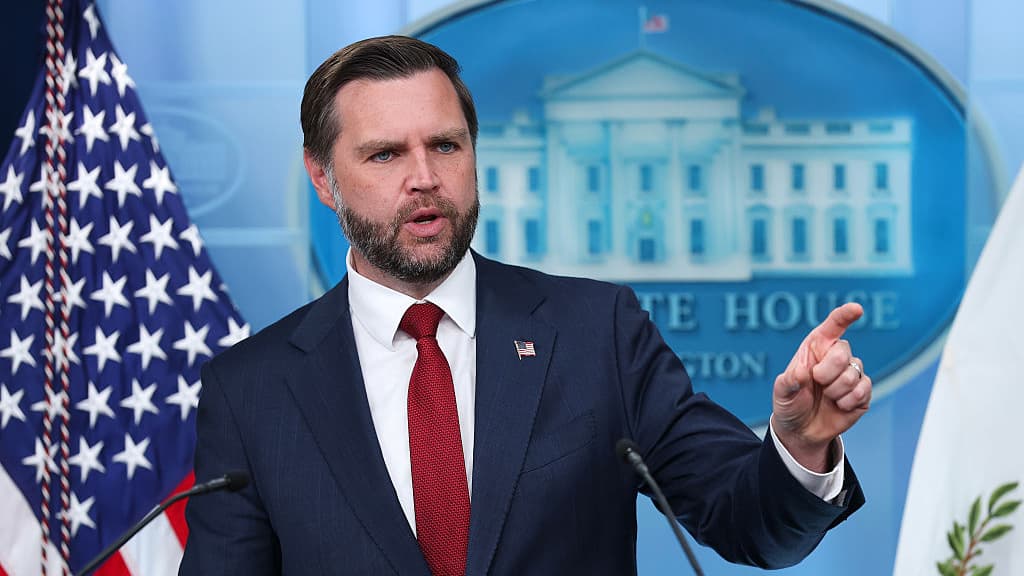
Vice President J.D. Vance said Thursday that he would not characterize the United States as being at war with Iran, even as the two countries have exchanged strikes in recent days and the Trump Administration has declined to say when a conflict now stretching beyond six months might finally end.

Claims (50 extracted, 7 hedged)

Vice President J.D. Vance said Thursday that he would not characterize the United States as being at war with Iran, even as the two countries have exchanged strikes in recent days and the Trump Administration has declined to say when a conflict now stretching beyond six months might finally end. uncertain
conflict → say → months
“I wouldn’t call it a war,” Vance told reporters at a White House press briefing, the first since Karoline Leavitt stepped down as press secretary last month. asserted
Leavitt → call → secretary
The distinction was striking after a renewed burst of hostilities this week, including American strikes inside Iran and Iranian attacks in the region. asserted
distinction → strike → region
But it echoed an argument that President Trump and other Republicans made in the earliest days of the conflict: that the United States was carrying out a limited military operation rather than embarking on another prolonged Middle Eastern war, which, under the Constitution, would require congressional approval. asserted
which → echo → approval
More than six months later, that distinction has become increasingly difficult to sustain. asserted
distinction → become → ?
The United States has repeatedly bombed targets inside Iran as Tehran attacks commercial shipping vessels through the Strait of Hormuz, contributing to higher energy prices. asserted
Tehran → bomb → prices
Vance acknowledged what he called a recent “flare-up” but argued that the most intensive phase of the American campaign had ended long ago. asserted
phase → acknowledge → campaign
“Major combat operations are currently not ongoing, and they haven’t been ongoing in a very long time,” he said. asserted
he → say → time
He said Operation Epic Fury, the large-scale campaign that followed last year’s Operation Midnight Hammer, lasted roughly six weeks. asserted
that → say → weeks
The earlier operation, he said, destroyed Iranian nuclear facilities, while Epic Fury severely damaged Iran’s conventional military and its ability to produce weapons and rebuild its nuclear program. asserted
Fury → say → program
But Vance offered little indication of when the broader confrontation might end, saying the Administration would not commit itself to a timeline while Iran continued threatening commercial shipping and global energy supplies. uncertain
Iran → offer → shipping
Asked whether the conflict would be over before November’s midterm elections, Vance said he did not know. asserted
he → ask → elections
“You would have to ask the Iranians,” he said, adding: “When will the Iranians stop shooting at ships?” asserted
Iranians → have → ships
The answer underscored the open-ended nature of a conflict that Trump and others in the Administration repeatedly predicted would be brief. asserted
Trump → underscore → Administration
As recently as Wednesday, the President said he did not believe it would last “much longer.” asserted
it → say → Wednesday
But his Administration is simultaneously intensifying economic pressure on Iran, maintaining a naval blockade, and reserving the option of further military strikes if Iran attacks American interests or interferes with commercial shipping. asserted
Iran → intensify → shipping
History of avoiding the word “war” Presidents have long resisted the “war” label in conflicts undertaken without a formal declaration of war. asserted
Presidents → avoid → war
Harry Truman called the American intervention in Korea a United Nations “police action,” while Bill Clinton avoided describing NATO’s bombing campaign in Kosovo as a war. asserted
Clinton → call → war
Barack Obama similarly argued that the 2011 intervention in Libya did not constitute a “war” requiring congressional authorization. asserted
intervention → argue → authorization
In March, Trump openly acknowledged that referring to the conflict as “war” carried legal significance because Congress had not authorized it. asserted
Congress → acknowledge → it
“I won’t use the word ‘war’ because they say, if you use the word war, that’s maybe not a good thing to do,” he told House Republicans at the time. asserted
he → use → time
“They don’t like the word ‘war,’ because you’re supposed to get approval, so I’ll use the word ‘military operation,’ which is really what it is.” asserted
it → like → word
House Speaker Mike Johnson similarly insisted shortly after the initial strikes that the country was “not at war,” describing the campaign instead as “a very specific, clear mission.” asserted
country → insist → mission
Democrats have rejected that characterization and repeatedly tried to force votes requiring congressional authorization for continued hostilities. asserted
Democrats → reject → hostilities
Those efforts have failed largely along party lines. asserted
efforts → fail → lines
The dispute has revived a decades-old argument over presidential war powers and the extent to which a president can sustain military operations abroad without explicit approval from Congress. asserted
president → revive → Congress
Economic and military pressure Vance said Thursday that the administration would not rely on Iran to negotiate in good faith and would instead use whatever tools it considered necessary to prevent Iran from obtaining a nuclear weapon and to protect global energy markets. asserted
it → say → markets
He argued that Iran’s grip on the Strait of Hormuz was “effectively gone” and that oil traffic through the crucial waterway was nearing its pre-conflict level. asserted
traffic → argue → level
Shipping data, however, shows traffic remains well below where it stood before the fighting began. asserted
fighting → show → ?
The Administration has made restoring commercial traffic through the strait a central objective as energy prices have become an increasing political liability ahead of the midterms. asserted
prices → make → midterms
Vance acknowledged the pain of higher gasoline prices but argued that they could have risen substantially more without American intervention in Iran. uncertain
they → acknowledge → Iran
“Gas, frankly, could have been much, much higher were it not for our efforts,” he said. uncertain
he → say → efforts
He declined to predict when prices might return to around $3 a gallon, saying the more important objective was ensuring “that Iran doesn’t have a nuclear weapon.” uncertain
Iran → decline → weapon
The Administration is now pursuing what amounts to a strategy of intermittent military force combined with sustained economic pressure. asserted
what → pursue → pressure
Last week, it announced “Operation Economic Outcast,” an effort to further isolate Iran from its remaining trading partners. asserted
it → announce → partners
But the campaign has so far produced limited results, and imposing sanctions aggressive enough to cripple Iranian trade could require confronting countries including China, India, and Russia. uncertain
imposing → produce → China
Secretary of State Marco Rubio said this week that the Administration expected the principal pressure on Iran going forward to be economic, while reserving the right to use military force when necessary. asserted
pressure → say → force
Iranian uprising Trump himself has resumed publicly encouraged Iranians to challenge the regime, writing on Truth Social on Tuesday, “When are the Iranian people going to rise up and fight?” asserted
people → resume → Tuesday
When asked by TIME on Thursday whether the Trump Administration was considering arming Iranian dissidents or providing them with other direct assistance, Vance declined to provide more details. asserted
Vance → ask → details
“Everything that could happen is on the table: economic pressure, military pressure, diplomatic pressure, covert pressure,” he said. uncertain
he → happen → table
…and 10 more, not listed.
Give feedback · no sign-in needed

No sign-in needed for now. Your note is sent without a name, so it cannot be answered.

History Support