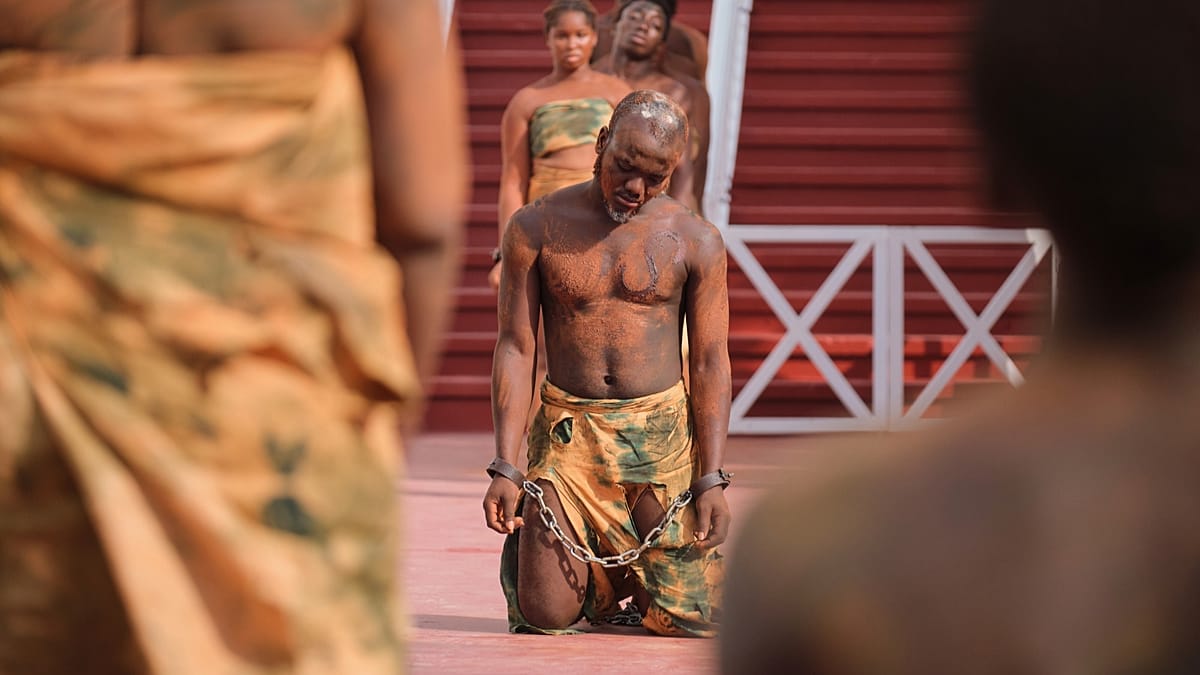
Photo via The Hindu

U.N. committee says countries must consider reparations for slave trade

Read the original at The Hindu ↗
Cite

Reuters. (2026, August 31). U.N. committee says countries must consider reparations for slave trade. The Hindu. https://www.thehindu.com/news/international/un-committee-says-countries-must-consider-reparations-for-slave-trade/article71410123.ece

Dated when The Aporia collected the article, usually within hours of publication. Check the original for its exact date and byline.

The Hindu · collected 2026-08-31 · by Reuters

Quick Summary

A U.N. committee has issued guidance stating that countries are legally obligated to consider reparations for the transatlantic slave trade and address its ongoing legacy of racial discrimination. According to the Committee on the Elimination of Racial Discrimination, at least 12.5 million Africans were forcibly displaced between the 15th and 19th centuries. The document argues that current international obligations supersede historical laws, making countries responsible for tackling the effects of slavery today. Countries are urged to take "transformative" measures such as opening archives and establishing truth commissions, rather than just providing financial compensation.
Written by AI on 2026-08-31, from this article's own text only (the story summary below draws on all the coverage).
See how they differ ↓

AI analysis

Story summary

A United Nations committee has stated that countries are legally required to consider reparations for the transatlantic slave trade. The Committee on the Elimination of Racial Discrimination (CERD) said this in a document published on Monday, which claims that these obligations arise from a 1965 convention on racial discrimination, not from the legal standards at the time of the slave trade. This approach is seen as a shift away from debates over historical responsibility, and could be used to support reparations claims in courtrooms. The committee emphasized that countries must implement comprehensive measures to address the harms caused by slavery and its ongoing consequences. The document states that "states parties must implement comprehensive reparatory measures for people of African descent, covering all aspects of remedies." This includes monetary, non-monetary, and structural measures. At least 12.5 million Africans were taken and sold between the 15th and 19th centuries, making it the largest forced displacement in history.

Written for “Global Slavery Reparations” on 2026-11-20, grounded in this article and the 2 other(s) covering the same event.

How they differ

3 outlets covered “Global Slavery Reparations”.

What each outlet says

One AI summary per outlet of its latest article on this story, written from that article alone and checked against it. Open the article for the outlet's own words.

The HinduThis outlet31 Aug

A U.N. committee has issued guidance stating that countries are legally obligated to consider reparations for the transatlantic slave trade and address its ongoing legacy of racial discrimination. According to the Committee on the Elimination of Racial Discrimination, at least 12.5 million Africans were forcibly displaced between the 15th and 19th centuries. The document argues that current international obligations…

U.N. committee says countries must consider reparations for slave trade (this article)
The Guardian31 Aug

The UN Committee on the Elimination of Racial Discrimination (CERD) has published guidance stating that countries are legally obliged to consider reparations for the transatlantic slave trade under a 1965 convention. The document argues that current international obligations take precedence over the laws in place at the time of slavery, making it impossible for states to use the intertemporality principle to avoid…

Countries legally obliged to consider slavery reparations, says UN committee →
Euronews31 Aug

The United Nations Committee on the Elimination of Racial Discrimination (CERD) has issued a document stating that countries are legally obliged to provide broad reparations for harms resulting from their involvement in the transatlantic African slave trade. The document, entitled General Recommendation-40, was approved last week and outlines comprehensive measures that countries must take to redress the harms…

UN racial discrimination committee presents legal case for broad slavery reparations →

Where they agree and split

Framing

How the first headlines put it

Attributed to a source2
Stated as fact1
The headlines (3)

Countries legally obliged to consider slavery reparations, says UN committee The Guardian · attributed to a source

U.N. committee says countries must consider reparations for slave trade The Hindu · attributed to a source

UN racial discrimination committee presents legal case for broad slavery reparations Euronews · stated as fact

The full story: what happened, how it changed, and all 3 articles →

Compared with similar articles

This article reads unscored and hedges 21% of its claims. Each row says how that neighbour differs.
The Guardian
Hedges 3 of 14 claims Outlet record 64/100
Euronews
Hedges 3 of 19 claims Outlet record 60/100
Daily Mail
Leans left Hedges 0 of 18 claims Outlet record 69/100
“Article A describes a U.N. committee's guidance, while Article B reports on Jamaica's plan to file a petition for reparations during King Charles' visit”

Story

Global Slavery Reparations
Politics · 3 article(s) covering the same event. Compare every outlet's account →
How this article was measured signals, leaning charts, publisher record, byline, topics and claims

Signals How these are calculated →

Claims extracted
14
sentences that state something as happening or true
Uncertain
21%
3 of 14 hedged ("reportedly", "may", "according to")
Leaning
withheld
no quote in the article backed the model's score
Publisher signals
60/100
The Hindu's corrections and hedging, across everything collected from it. Not a measure of accuracy.
Outlets on this story
3
Politics
Same framing elsewhere
1
articles that frame the event the way this one does
Analyzed 2026-08-31 · how these are computed

How this is being covered How these are calculated →

Article leaning vs. publisher reliability
Source leaning vs. consistency

Publisher

The Hindu · 907 article(s) · 2 correction(s) detected
Running correction rate · 2 correction(s)

Who wrote this

Reuters
1187 article(s) here · 1 carrying a prediction
US Secretary of State Marco Rubio said last month the issue was a “domestic political matter” and Washington would not comment on it.
CA bosses said on Wednesday that an independent forum would be set up to allow players to give their accounts of the incident, but the results would not necessarily be made public and no sanctions would follow.
Some analysts said the outcome of the Shenzhen summit may actually diminish Trump’s stature on the world stage as he enters the lame-duck phase of his presidency, while bolstering two of Washington’s main adversaries.
Department of Defence Chief Information Officer Kirsten Davies will assume the position temporarily, according to the source.
FIFA last month said it would amend the rule in its disciplinary code, which had allowed for the reversal of the ban.
While Aikman’s contract is set to expire after February’s Super Bowl, Buck finalized a six-year extension with ESPN that is worth more than $100m, The Athletic reported in September.
Pakistan, along with 14 other countries, has welcomed the imposition of sanctions by the United Kingdom and Australia in response to Israeli settlement activities in the occupied Palestinian territory and expressed hope that the decisions would encourage others to follow suit.
He added it was possible Republican candidates would have fared worse without the spending, but said the result demonstrated that campaign cash alone could not determine an election.
Pakistan, along with 14 other countries, has welcomed the imposition of sanctions by the United Kingdom and Australia in response to Israeli settlement activities in the occupied Palestinian territory and expressed hope that the decisions would encourage others to follow suit.
Wire or desk byline, not an individual reporter.
Also by Reuters
Nothing else under this byline is closely related to this article, so these are simply their most recent.
All 1187 articles by Reuters →

Topics

African Africans The European Union U.N. the Committee on the Elimination of Racial Discrimination

Subjects

U.N. ORG · 5× the Committee on the Elimination of Racial Discrimination ORG · 2× African NORP · 1× Africans NORP · 1× Britain GPE · 1× Liberia GPE · 1× Pela Boker-Wilson PERSON · 1× Reuters ORG · 1× The European Union ORG · 1×

Narrative

Guidance published on Monday (August 31, 2026) by the Committee on the Elimination of Racial Discrimination stated that the obligations arise from a legally binding 1965 convention on racial discrimination, not from the legal standards that existed when the slave trade took place.
framing: mixed · carried by 1 article(s) · first seen 2026-08-31
“States Parties must implement comprehensive reparatory measures for people of African descent, covering all aspects of remedies,” said the U.N. document, which may be cited in courtrooms.

Claims (14 extracted, 3 hedged)

A U.N. committee said countries are legally obliged to consider reparations for the transatlantic slave trade and take other measures to address the enduring legacy of racial discrimination it says persists today. asserted
it → say → discrimination
Guidance published on Monday (August 31, 2026) by the Committee on the Elimination of Racial Discrimination stated that the obligations arise from a legally binding 1965 convention on racial discrimination, not from the legal standards that existed when the slave trade took place. asserted
trade → publish → place
The committee described the approach as a “paradigm shift” away from debates over historical responsibility that have often been used by governments to resist reparations claims. uncertain
that → describe → claims
“States Parties must implement comprehensive reparatory measures for people of African descent, covering all aspects of remedies,” said the U.N. document, which may be cited in courtrooms. uncertain
which → implement → courtrooms
At least 12.5 million Africans were taken and sold between the 15th and 19th centuries in what the Committee on the Elimination of Racial Discrimination called the largest forced displacement in history. asserted
Committee → take → history
Calls for reparations — ranging from official apologies to financial compensation — have gained momentum internationally, though opponents argue states and institutions should not be held responsible for historical crimes. asserted
states → range → crimes
The European Union and Britain abstained from a U.N. resolution on slavery in March. asserted
Union → abstain → March
Some states have sought to dodge claims for justice in courtrooms by arguing that there were no international laws outlawing the slave trade at the time — the so-called intertemporality principle. uncertain
states → seek → time
But the U.N. document argues that, regardless of whether slavery and the slave trade were illegal under the laws of the day, countries remain responsible under current international obligations to tackle their continuing effects. asserted
countries → argue → effects
“Irrespective of the legal characterization of the original historical acts, States Parties remain bound by their present obligations under the Convention to address structural inequalities,” the U.N. document states. asserted
document → bind → inequalities
Financial compensation alone is not sufficient, it adds, urging “transformative” measures including opening archives, revising public memorials and establishing independent truth commissions. asserted
it → add → commissions
Pela Boker-Wilson, a committee expert from Liberia who helped draft the document, said she expects states to move beyond broad expressions of regret and review policies and laws. asserted
states → draft → policies
“We are calling on state parties to take concrete and meaningful action,” she told Reuters. asserted
she → call → Reuters
“We want to affirm the dignity of those whose suffering was denied, whose suffering was minimised or forgotten.” asserted
suffering → want → those
Give feedback · no sign-in needed

No sign-in needed for now. Your note is sent without a name, so it cannot be answered.

History Support