Photo via The Straits Times

Dispute over cheese names causes stumbling block in US-Mexico trade negotiations

Read the original at The Straits Times ↗
Cite

The Straits Times. (2026, August 28). Dispute over cheese names causes stumbling block in US-Mexico trade negotiations. The Straits Times. https://www.straitstimes.com/world/europe/dispute-over-cheese-names-causes-stumbling-block-in-us-mexico-trade-negotiations

Dated when The Aporia collected the article, usually within hours of publication. Check the original for its exact date and byline.

The Straits Times · collected 2026-08-28 · by The Straits Times

Quick Summary

A dispute over cheese names has become a sticking point in US-Mexico trade negotiations. The US objects to Mexico's new trade deal with the EU, which gives special protections to European products such as Parmigiano Reggiano, feta, and manchego. The US argues that this would restrict its producers from selling cheeses like parmesan and feta in Mexico. According to Jaime Castaneda of the U.S. Dairy Export Council, "It's absolutely wrong what Mexico did," and the Mexican government must ensure that US cheese manufacturers can continue to sell their products in Mexico.
Written by AI on 2026-08-28, from this article's own text only (the story summary below draws on all the coverage).
See how they differ ↓

AI analysis

Story summary

Mexico and the United States are locked in a trade dispute over cheese names, with the US objecting to Mexico's new trade deal with the European Union. The EU agreement gives special protections to European products like Parmigiano Reggiano, feta, and manchego, which are tied to specific regions. The US argues that these names are generic and should not be restricted, while the EU claims that they must refer specifically to products from those regions. This dispute is a stumbling block in trade negotiations between the two countries, with some estimates suggesting that US cheese exports to Mexico could be affected by the agreement, which was signed in May. The issue has sparked criticism from US dairy producers, who say that Mexico's actions are "absolutely wrong". The value of US cheese exports to Mexico is estimated to be around $1 billion.

Written for “US Cheese Trade Dispute” on 2026-11-22, grounded in this article and the 1 other(s) covering the same event.

How they differ

2 outlets covered “US Cheese Trade Dispute”.

What each outlet says

One AI summary per outlet of its latest article on this story, written from that article alone and checked against it. Open the article for the outlet's own words.

The Straits TimesThis outlet28 Aug

A dispute over cheese names has become a sticking point in US-Mexico trade negotiations. The US objects to Mexico's new trade deal with the EU, which gives special protections to European products such as Parmigiano Reggiano, feta, and manchego. The US argues that this would restrict its producers from selling cheeses like parmesan and feta in Mexico. According to Jaime Castaneda of the U.S. Dairy Export Council…

Dispute over cheese names causes stumbling block in US-Mexico trade negotiations (this article)
The Independent28 Aug

A dispute between the US and Mexico has arisen over labeling of certain cheeses, such as parmesan and feta, which are protected by the EU's Geographical Indication framework. The US claims that this could harm American dairy producers' ability to sell these types of cheese in Mexico, while Mexico argues it is simply adhering to international agreements. The US is seeking to protect its $1 billion export market for…

Make America Grate Again? U.S. and Mexico locked in $1 billion cheese war →

Compared with similar articles

This article reads leans right and hedges 10% of its claims. Each row says how that neighbour differs.
The Independent
Leans right Hedges 3 of 30 claims Outlet record 59/100

Story

US Cheese Trade Dispute
Economy/Business · 2 article(s) covering the same event. See how they differ ↑
How this article was measured signals, leaning charts, publisher record, byline, topics and claims

Signals How these are calculated →

Claims extracted
31
sentences that state something as happening or true
Uncertain
10%
3 of 31 hedged ("reportedly", "may", "according to")
Leaning
Leans right
of the writing, not the subject · beta estimate
Publisher signals
64/100
The Straits Times's corrections and hedging, across everything collected from it. Not a measure of accuracy.
Outlets on this story
2
Economy/Business
Same framing elsewhere
1
articles that frame the event the way this one does
Analyzed 2026-08-28 · how these are computed

How this is being covered How these are calculated →

Article leaning vs. publisher reliability
Source leaning vs. consistency

Publisher

The Straits Times · 5701 article(s) · 7 correction(s) detected
Running correction rate · 7 correction(s)

Who wrote this

The Straits Times
4015 article(s) here · 1 carrying a prediction
Ben-Gvir replied in an X post that Eisenkot's condemnation amounted to selling out to Arab parties, which could be part of a possible new government.
Ex British PM Theresa May tells successor to ‘move on’ from Brexit AI generated
Its annual summit is seen as an important opportunity to signal that nations are willing to work together to find solutions and help finance the myriad problems caused by rising temperatures.
"If you step aside at the height of a victory you helped secure, you would show voters that the Democratic Party heeded their call for change.
Annual inflation hit 11% in October and prices are expected to rise further this year, economists say, leaving many Ukrainians feeling the pinch and less able to spend on eating out.
While no one obtained everything they might have desired, everyone can find a place for themselves within this text—that is the very essence of consensus.
At least 14 people missing after Russian drone hit building in Kyiv region, Zelenskiy says KYIV, Nov 22 - At least 14 people may still be trapped under the rubble of a residential building that was struck by a Russian drone on Sunday morning in Ukraine's Kyiv region, President Volodymyr Zelenskiy said.
Ferguson said at a news conference that the ICE agents may have broken a state law limiting facial coverings for law enforcement, and that he was looking into how they accessed the jet bridge.
Before departing for his overseas trip, Trump told reporters that he might meet Kim in China.
The latest draft expressed “deep concern” that global warming would cross 1.5 deg C above pre-industrial levels in the next few years.
2026-11-22 · assertive framing · Fossil fuels still missing from latest COP31 draft deal
Also by The Straits Times
Nothing else under this byline is closely related to this article, so these are simply their most recent.
All 4015 articles by The Straits Times →

Topics

European Mexican Mexico U.S. the European Union

Subjects

Mexico GPE · 14× U.S. GPE · 13× Mexican NORP · 4× European NORP · 3× the European Union ORG · 3× Greece GPE · 1× Italy GPE · 1× MEXICO CITY GPE · 1× U.S.-Mexico GPE · 1× Washington ORG · 1×

Narrative

But cheese imports, mainly from the U.S., have surged since the 1980s and now make up nearly 30% of domestic consumption, driven by products like Kraft's Grated Parmesan and Walmart's Great Value Manchego, as well as the growing popularity of pizzerias in Mexico.
framing: assertive · carried by 1 article(s) · first seen 2026-08-28
Washington argues that the deal, signed in May, would restrict future U.S. producers from selling cheeses in Mexico under names such as parmesan and feta.
2026-08-28 · The Straits Times
Dispute over cheese names causes stumbling block in US-Mexico trade negotiations · assertive framing

Claims (31 extracted, 3 hedged)

Dispute over cheese names causes stumbling block in US-Mexico trade negotiations MEXICO CITY, Aug 28 - What's in a cheese name? asserted
What → cause → name
That question has become a sticking point in U.S.-Mexico trade talks, according to two Mexican government sources who spoke on condition of anonymity because, no matter how you slice it, cheese diplomacy can be delicate. The U.S. is objecting to Mexico's new trade deal with the European Union, which extends special protections to hundreds of European products whose names are tied to specific regions, such as Parmigiano Reggiano, feta and manchego. uncertain
which → become → Reggiano
It also gives the European Union legal recourse against violations. asserted
It → give → violations
Washington argues that the deal, signed in May, would restrict future U.S. producers from selling cheeses in Mexico under names such as parmesan and feta. uncertain
deal → argue → parmesan
The U.S. has long maintained those names are generic, while the EU says parmesan should be reserved for Parmigiano Reggiano from northern Italy and feta cheese from select parts of Greece. asserted
parmesan → maintain → Greece
"It's absolutely wrong what Mexico did," said Jaime Castaneda, executive vice president of the U.S. Dairy Export Council. asserted
Castaneda → do → Council
"The Mexican government has to make it absolutely certain that the United States and the Mexican manufacturers of common cheese names will continue to be able to be in the market." asserted
States → have → market
The U.S. and Mexico are in the midst of thorny bilateral talks to secure an interim trade deal this year, while parallel discussions are ongoing to renew the U.S.-Mexico-Canada Agreement, a linchpin of Mexico's economy. asserted
discussions → secure → economy
Those high-stakes negotiations have given the U.S. leverage to push its case for what has become a billion-dollar market for U.S. cheese exporters. asserted
what → give → exporters
And it is causing a headache for Mexican authorities. asserted
it → cause → authorities
Although the Mexico-EU treaty has been signed, Mexico has yet to complete the procedures needed for the pact to take effect, while the European Union has, according to a European Commission spokesperson. uncertain
Union → sign → spokesperson
A spokesperson for Mexico's economy ministry said the agreement needs to be ratified by lawmakers. asserted
agreement → say → lawmakers
The European Commission told Reuters it would not be possible to change the agreement's terms and that it had "taken note of the U.S. actions" opposing the protections for European cheeses. asserted
it → tell → cheeses
Mexico's economy ministry and the Office of the U.S. Trade Representative did not respond to requests for comment, though the U.S. agency has previously stated its views on the EU's Geographical Indication (GI) product protection scheme. asserted
agency → respond → scheme
"The EU continues to seek to expand its harmful GI system within its territory and beyond," the trade office said in an April report. asserted
office → continue → report
It said that forcing dairy producers outside the bloc to use descriptors such as "imitation feta" or "asiago-style" was costly and unnecessary and contributes to the $1.2 billion U.S. cheese trade deficit with the bloc. asserted
forcing → say → bloc
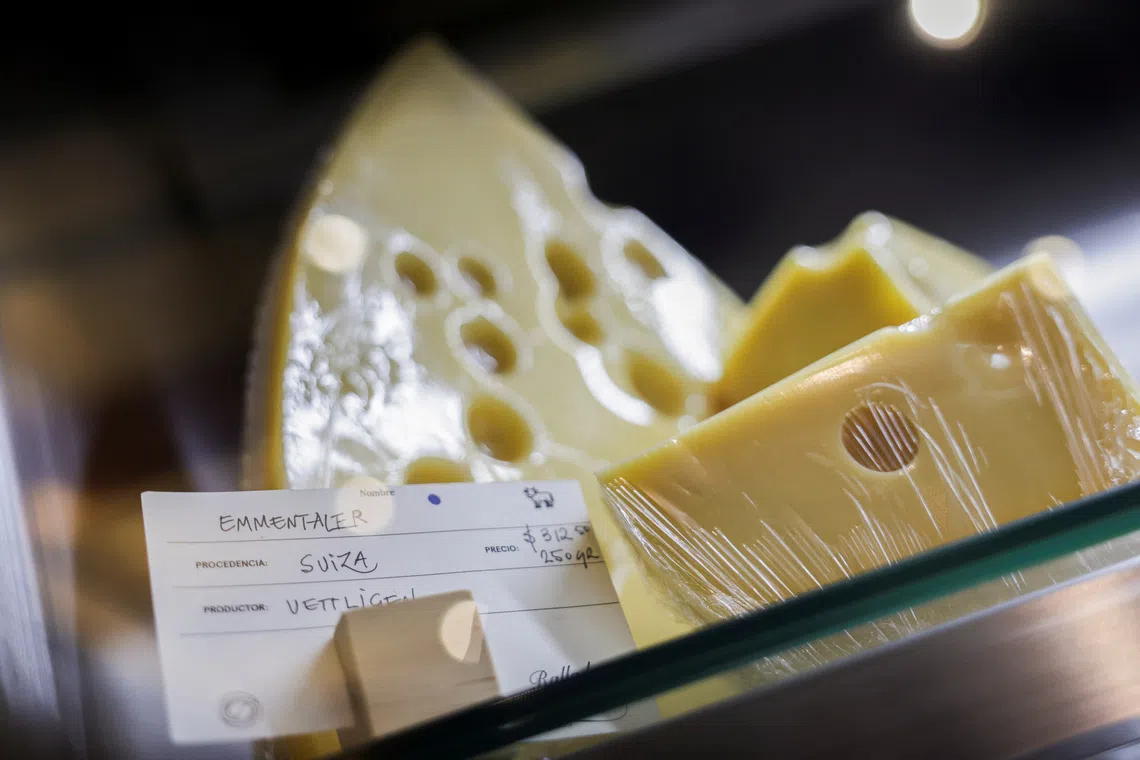
MEXICO'S CHEESY LOVE AFFAIR Mexico is among the world's top consumers of cheese, favoring domestic varieties such as stringy Oaxaca cheese, often melted on quesadillas, and queso fresco, ideal for crumbly breakfast toppings. asserted
Mexico → favor → toppings
But cheese imports, mainly from the U.S., have surged since the 1980s and now make up nearly 30% of domestic consumption, driven by products like Kraft's Grated Parmesan and Walmart's Great Value Manchego, as well as the growing popularity of pizzerias in Mexico. asserted
imports → surge → Mexico
The U.S. exports about $1 billion worth of cheese to Mexico annually, while the EU's total dairy exports to the country only amount to $200 million. asserted
exports → export → million
European cheese producers said the clash with the U.S. reflects opposing agricultural cultures — mass production versus protected regional traditions. asserted
clash → say → traditions
"The U.S. has always been a nation of high-volume consumption, which is precisely the opposite of what designations of origin represent," said Antonio Martinez, head of a organization that protects manchego's regional designation. asserted
that → represent → designation
The smaller scale of manchego producers in Spain gives them their "charm and unique identity," he added. asserted
he → give → identity
Cheese sellers in Mexico like Rodolfo Navarro, who heads a family-owned cheese distributor, support the trade deal with the EU because it would lower tariffs on European-imported cheeses. asserted
it → head → cheeses
"These cheeses will serve different markets. asserted
cheeses → serve → markets
European cheese will be sold in a higher niche," he said. asserted
he → sell → niche
Navarro's gripe is with U.S. producers, whom he and other Mexican cheesemakers accuse of undercutting local production. asserted
he → accuse → production
The Institute for Agriculture and Trade Policy warned in 2023 that Mexican dairy producers were vulnerable to cheap U.S. exports. asserted
producers → warn → exports
U.S. cheese has a reputation for poor quality, exacerbated by the continuing popularity of the processed slices known as American cheese – made of emulsified salts and dairy leftovers, and technically not a cheese at all – as well as canned, sprayable cheese. asserted
cheese → have → salts
U.S. producers say their cheeses have beaten European rivals in international competitions, while fans of the processed cheese value their long shelf life, versatility and low cost. asserted
fans → say → life
"The U.S. is flooding the Mexican market with its cheeses because they can sell them very cheap," said Georgina Yescas Trujano, co-founder of Mexica cheesemonger Lactography. asserted
Trujano → flood → Lactography
"I'm glad tariffs on European cheese are being lowered, because Mexicans can learn to eat better cheese." asserted
Mexicans → lower → cheese
Give feedback · no sign-in needed

No sign-in needed for now. Your note is sent without a name, so it cannot be answered.

History Support