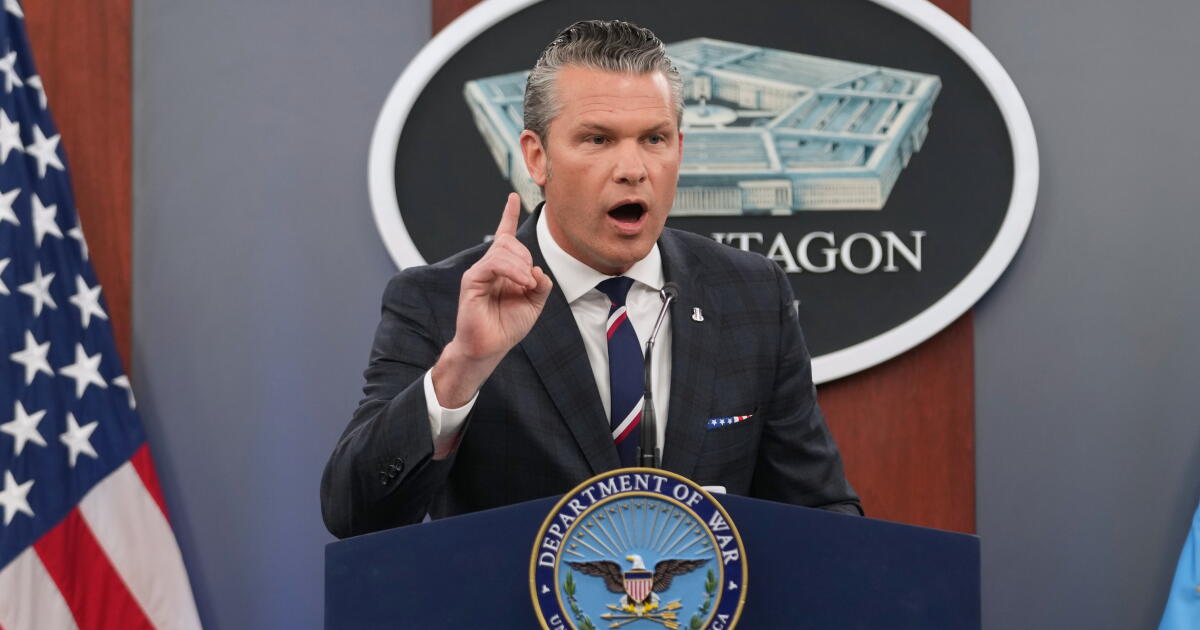
Photo via Los Angeles Times

California, other states sue again to block new Postal Service rules for mail ballots

Read the original at Los Angeles Times ↗
Cite

Rector, K. (2026, August 27). California, other states sue again to block new Postal Service rules for mail ballots. Los Angeles Times. https://www.latimes.com/politics/story/2026-08-26/california-other-states-sue-again-to-block-new-u-s-postal-service-rules-for-mail-ballots

Dated when The Aporia collected the article, usually within hours of publication. Check the original for its exact date and byline.

Los Angeles Times · collected 2026-08-27 · by Kevin Rector

Quick Summary

California and other Democratic-led states have filed a lawsuit against the U.S. Postal Service's new rules for mail ballots, which were issued in response to an executive order from President Trump in March. The rules require states to submit voter lists to the Postal Service and reject ballots that don't match those lists, and 24 state attorneys general are asking a federal court to halt implementation of these changes while litigation continues. California officials argue that the new rules usurp state authority over elections and expose voter information unnecessarily. The lawsuit was filed in U.S. District Court in Massachusetts by California and other Democratic-led states.
Written by AI on 2026-08-27, from this article's own text only (the story summary below draws on all the coverage).
See how they differ ↓

AI analysis

Story summary

The Trump Administration's Efforts to Restrict Mail-In Voting

President Donald Trump's executive order, issued on March 31, aimed to create a federal list of eligible voters and restrict mail-in voting by requiring states to use specific envelopes and barcodes. The US Postal Service (USPS) was instructed to deliver ballots only to those on the approved list.

However, this move was blocked by two court orders in Massachusetts, issued by Judge Indira Talwani on June 25 and August 11. These injunctions prevented the USPS from implementing the new rule before the midterm elections in November.

In response, the Trump administration appealed to the Supreme Court, which initially decided to allow the restriction of mail-in voting to proceed while the case was ongoing. This decision was seen as a preliminary victory for President Trump.

However, the Supreme Court's unsigned opinion did not declare the executive order lawful, and Democratic-led states argued that permitting the administration to push ahead with changes would contribute to pre-election chaos.

In response, California Governor Gavin Newsom announced that his state would sue again to block federal changes to mail voting. The California legislature also proposed two new laws that would make it a crime to interfere with the delivery of mail ballots, punishable by up to four years in prison.

The USPS has submitted a motion to dissolve one of the court injunctions blocking the implementation of the Trump administration's plan, and published new guidelines that could take effect if legal barriers are removed.

Written for “Trump's Mail Voting Restrictions” on 2026-11-20, grounded in this article and the 15 other(s) covering the same event.

How they differ

9 outlets covered “Trump's Mail Voting Restrictions”.

What each outlet says

One AI summary per outlet of its latest article on this story, written from that article alone and checked against it. Open the article for the outlet's own words.

Los Angeles TimesThis outlet27 Aug

California and other Democratic-led states have filed a lawsuit against the U.S. Postal Service's new rules for mail ballots, which were issued in response to an executive order from President Trump in March. The rules require states to submit voter lists to the Postal Service and reject ballots that don't match those lists, and 24 state attorneys general are asking a federal court to halt implementation of these…

California, other states sue again to block new Postal Service rules for mail ballots (this article)2 articles from Los Angeles Times on this story
NBC News28 Aug

Federal Judge Indira Talwani has blocked a US Postal Service regulation that would have added bureaucracy to mail-in ballot process, citing it as likely unlawful and potentially disenfranchising voters. The measure was part of President Donald Trump's executive order on mail-in ballots, which aimed to track ballots and reject those submitted by people not on a federal list of eligible voters. Talwani's decision…

Judge blocks Trump’s Postal Service regulation on mail-in ballots →3 articles from NBC News on this story
The Guardian28 Aug

Federal Judge Indira Talwani has temporarily blocked Donald Trump's executive order limiting mail voting in midterms for 14 days. The ruling came a week before mail ballots are set to be sent out and follows a recent Supreme Court decision that overturned a previous injunction against the order, but did not rule on its legality. Nearly one-third of Americans vote by mail, and election officials say there is not…

Federal judge again halts Trump’s executive order limiting mail voting in midterms →3 articles from The Guardian on this story
The Independent28 Aug

US District Judge Indira Talwani issued a temporary restraining order on Thursday blocking key elements of a new US Postal Service policy directed by President Donald Trump that restricts mail-in voting ahead of the November congressional elections. The policy, which took effect on Wednesday, required states to submit lists of mail-in voters to an electronic database and obtain USPS approval for ballot envelopes…

Judge blocks Trump mail ballot rules over ‘overwhelming risk’ to voters →2 articles from The Independent on this story
The Bulwark26 Aug

The article reports on President Trump's efforts to potentially subvert the 2022 midterm elections through various means. Despite a recent Supreme Court decision staying a lower court injunction related to mail-in ballots, the author argues this is not a definitive win for Trump and notes he remains determined to prevent a free and fair election if possible. The article also mentions other attempts by the…

Prepare for Trump to Try to Steal the Midterms →2 articles from The Bulwark on this story
Time24 Aug

The United States Postal Service (USPS) has issued a 95-page final rule that requires employees to verify federal ballot mailings comply with new requirements before accepting them from election officials. The rule was designed to comply with President Donald Trump's executive order from March 31 and would take effect immediately if the government obtains relief from two existing injunctions. Two court orders, one…

What to Know About the USPS’s Rule for Mail-In Ballots →
Show 3 more outlets
Mother Jones25 Aug

The US Supreme Court has temporarily blocked federal court rulings that had blocked President Trump's executive order severely restricting mail-in voting. The unsigned opinion, with dissents from Justices Jackson, Sotomayor, and Kagan, stated that states have not shown how they would be harmed by the order. This decision does not rule on the merits of the executive order but overrules lower court rulings…

SCOTUS Hands Trump a Temporary Win In His Crusade to Restrict Mail Voting →
Fox News28 Aug

A former White House deputy counsel, Gene Hamilton, is saying that following a Supreme Court ruling, federal agencies can now move forward with parts of President Trump's election-integrity order, which includes new ballot-mail standards and efforts involving state citizenship lists. The court's majority rejected a challenge from opposing states who claimed harm could come from the order. Hamilton notes that the…

Mail-voting crackdown moves ahead as Trump court win opens door to federal action →
UPI28 Aug

A federal judge has blocked the Trump administration from enforcing mail-in voting restrictions ahead of November's midterm elections. U.S. District Judge Indira Talwani issued a 14-day temporary restraining order, citing "substantial confusion" and potential disenfranchisement due to time constraints. The rule in question requires the US Postal Service to screen mail-in ballots for compliance with envelope…

Federal judge blocks Trump administration mail-in voting restrictions →

Where they agree and split

The full story: what happened, how it changed, and all 16 articles →

Compared with similar articles

This article reads leans left and hedges 11% of its claims. Each row says how that neighbour differs.
The Guardian
Leans strongly left further left than this Hedges 23 of 175 claims Outlet record 64/100
The Guardian
Leans left Hedges 2 of 23 claims Outlet record 64/100
The Independent
Leans strongly left further left than this Hedges 2 of 18 claims Outlet record 59/100
UPI
Leans strongly left further left than this Hedges 1 of 16 claims Outlet record 56/100
NBC News
Leans right further right than this Hedges 1 of 26 claims Outlet record 78/100
“Article A describes a court decision on August 25, while Article B mentions a lawsuit to block new USPS rules in response to an executive order from March, indicating different points in time and distinct actions.”
NBC News
Leans left Hedges 3 of 18 claims Outlet record 78/100
Mother Jones
Leans strongly left further left than this Hedges 7 of 39 claims Outlet record 60/100
Los Angeles Times
Leans strongly left further left than this Hedges 4 of 54 claims Outlet record 95/100
“Article A refers to a decision by the Supreme Court on August 25, while Article B mentions a lawsuit filed on August 27, indicating two separate events”
The Bulwark
Leans right further right than this Hedges 0 of 4 claims
“Article A mentions a SCOTUS decision, while Article B mentions states suing again to block USPS rules, indicating two different steps in a larger process”

Story

Trump's Mail Voting Restrictions
Politics · 16 article(s) covering the same event. Compare every outlet's account →
How this article was measured signals, leaning charts, publisher record, byline, topics and claims

Signals How these are calculated →

Claims extracted
38
sentences that state something as happening or true
Uncertain
11%
4 of 38 hedged ("reportedly", "may", "according to")
Leaning
Leans left
of the writing, not the subject · beta estimate
Publisher signals
95/100
Los Angeles Times's corrections and hedging, across everything collected from it. Not a measure of accuracy.
Outlets on this story
16
Politics
Same framing elsewhere
1
articles that frame the event the way this one does
Analyzed 2026-08-27 · how these are computed

How this is being covered How these are calculated →

Article leaning vs. publisher reliability
Source leaning vs. consistency

Publisher

Los Angeles Times · 337 article(s) · 0 correction(s) detected
No corrections detected for this publisher. That may mean careful reporting, or simply that nothing has been checked.

Who wrote this

Kevin Rector
24 article(s) here · 1 carrying a prediction
Bonta’s office said information gleaned from the subpoenas “will help the California Department of Justice evaluate whether Nvidia’s actions violated California law.”
Newsom — who has a mixed record on AI regulation — said his 85-page plan will take “things to the next level” for how to regulate the fast-developing technology in California, and should serve as “a template” for federal regulation as well.
Experts say it’s a tactic - - Trump and administration officials have increasingly accused opponents of corruption and crime, while warning some could face prosecution.
- Defense Secretary Pete Hegseth called Rep. Thomas Massie’s impeachment push a ‘political spectacle,’ arguing it targets him for policy disagreements rather than misconduct. - Massie’s resolution focuses on Hegseth’s handling of the Iran war and other military actions; a House vote could come by midweek.
His appointment as chief of staff, a powerful position for driving the president’s policy agenda, managing his staff and twisting the arms of allies and opponents alike to bend to the executive’s will, ends speculation that Trump might ease back from his less popular policies or moderate following devastating losses for his party in the midterms.
Midterm results could shape 2028 presidential dialogue
2026-11-06 · assertive framing · Midterm results could shape 2028 presidential dialogue
“Maybe it’s all of the above but regardless, she used the Civil Rights Division against the very communities and values it was founded to protect and that will be her legacy.”
- - The court cases have put a spotlight on the state vs. federal divide in election law. - The National Voter Registration Act of 1993 said voters may fill out a registration form by attesting under oath they are citizens.
The ruling followed three others — one in district court in Los Angeles and two in the U.S. 9th Circuit Court of Appeals — in which federal judges blocked the administration’s effort to force California elections officials to immediately set aside the ballots of 20,000 voters the administration alleges may be noncitizens, instead setting a schedule for more fact-finding in the case after polls close.
- Courts have twice rejected the Trump administration’s bid to block the counting of 20,000 ballots it says may be from noncitizens; the Justice Department is appealing. -
Also by Kevin Rector
Nothing else under this byline is closely related to this article, so these are simply their most recent.
All 24 articles by Kevin Rector →

Topics

California Democratic Postal Service the Postal Service the U.S. Postal Service

Subjects

Trump PERSON · 9× the Postal Service ORG · 8× California GPE · 6× Democratic NORP · 2× Postal Service ORG · 2× U.S. GPE · 2× the U.S. Postal Service ORG · 2× Donald Trump PERSON · 1× Rob Bonta PERSON · 1× USPS ORG · 1×

Narrative

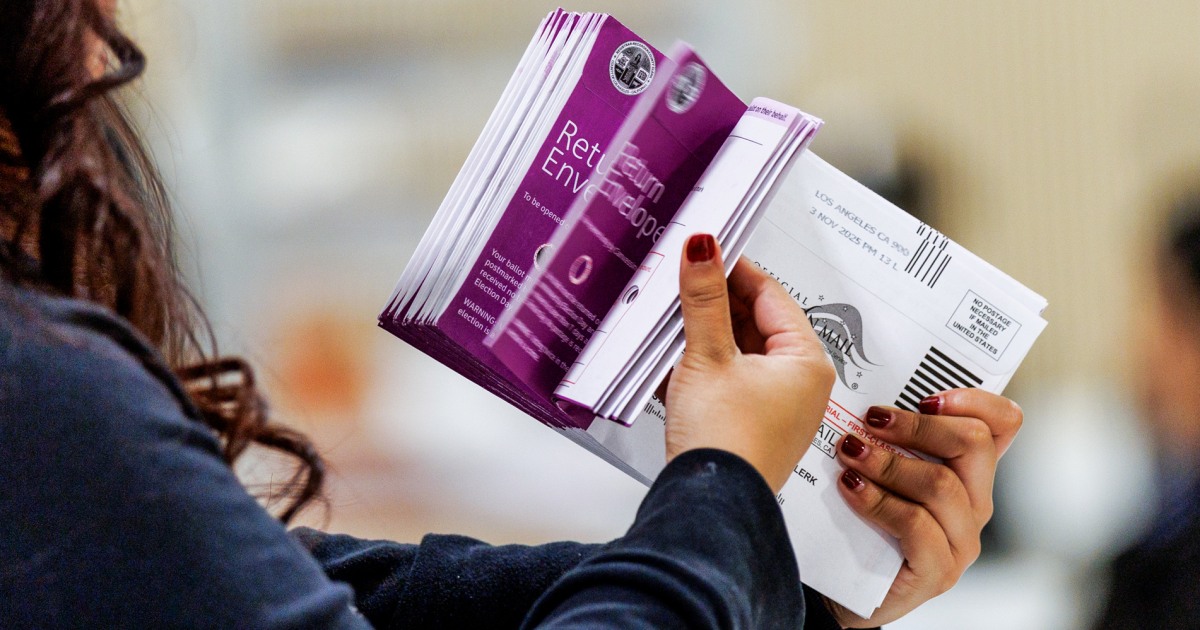
California and other Democratic-led states sued again Wednesday to block the U.S. Postal Service from implementing new nationwide rules for mail ballots, arguing they usurp state authority over elections at President Trump’s behest, expose voter information unnecessarily and threaten chaos in the rapidly approaching November election.
framing: assertive · carried by 1 article(s) · first seen 2026-08-27
“This mail-in voting rule is an unlawful overreach that shows just how far President Trump will go to control elections, but as I’ve said before, this fight is far from over and we are confident that the facts and the law are on our side,” California Atty. Gen. Rob Bonta said.

Claims (38 extracted, 4 hedged)

California, other states sue again to block new Postal Service rules for mail ballots asserted
California → sue → ballots
- California and other Democratic-led states are challenging rules for mail ballots that the U.S. Postal Service issued in response to an executive order from President Trump in March. - asserted
Service → lead → March
The rules require states to submit voter lists to the Postal Service, and for the USPS to reject ballots that don’t match those lists. asserted
that → require → lists
California and other Democratic-led states sued again Wednesday to block the U.S. Postal Service from implementing new nationwide rules for mail ballots, arguing they usurp state authority over elections at President Trump’s behest, expose voter information unnecessarily and threaten chaos in the rapidly approaching November election. asserted
they → lead → election
The Postal Service formally issued a 95-page “final rule” on Friday asserting that it was amending its mailing standards for mail ballots in federal elections to comply with Trump’s March executive order. asserted
it → issue → order
Trump demanded the rule changes as part of a broader plan to combat what he alleges — without evidence — is widespread voter fraud in the U.S., including by noncitizens voting through the mail. asserted
he → demand → mail
Election experts say there is zero evidence of such problems existing in significant numbers. asserted
problems → say → numbers
“This mail-in voting rule is an unlawful overreach that shows just how far President Trump will go to control elections, but as I’ve said before, this fight is far from over and we are confident that the facts and the law are on our side,” California Atty. Gen. Rob Bonta said. asserted
Bonta → mail → side
“Donald Trump does not run elections. asserted
Trump → run → elections
States do. asserted
States → do → ?
And his latest attack on democracy is proof of how weak he has become,” Gov. Gavin Newsom said. asserted
Newsom → become → democracy
“California will continue to lead the way in defending democracy — using every tool at our disposal and every minute in our day. asserted
California → continue → day
This perilous moment in history demands no less from us.” asserted
moment → demand → us
The states’ lawsuit, filed in U.S. District Court in Massachusetts by 24 state attorneys general and the governor of Pennsylvania, asks for immediate court intervention to halt the Postal Service changes from being implemented while the litigation continues. asserted
litigation → file → changes
California officials stressed that the court’s ruling does not allow final implementation of the new rules requested by Trump. asserted
ruling → stress → Trump
The new postal rules require states to submit lists of eligible voters — including their names and addresses — to the Postal Service, and to use new ballot envelopes with digital bar codes that would allow the Postal Service to identify and reject ballots that don’t match those lists. asserted
that → require → lists
The rules do not give the Postal Service authority to dictate which voters may appear on state lists. uncertain
voters → give → lists
However, the rules acknowledge that the lists would provide state voter data to federal law enforcement for the first time, and would put those authorities in “a better position to identify any potential issues regarding compliance with federal law that may merit further investigation.” uncertain
that → acknowledge → investigation
Trump’s March executive order also required the Department of Homeland Security to use available federal data to compile its own state lists of eligible citizen voters, ostensibly to compare them with the mail voter lists provided by the states to the Postal Service, and identify and pursue any ineligible voters. asserted
order → require → voters
Trump administration officials have said they are pursuing fraudulent voters and have warned state election officials that they could face legal consequences personally if they don’t do everything in their power to prevent voter fraud, including by noncitizens. uncertain
they → say → noncitizens
Wednesday’s lawsuit follows a decision Monday by the U.S. Supreme Court that found an earlier challenge from the states was premature, in part because it sought court relief to a rule-making process that required nothing of the states and before the Postal Service had moved to implement any changes. asserted
Service → follow → changes
The high court’s ruling allowed the Postal Service to move forward with its work to comply with Trump’s order — lifting multiple lower court rulings blocking the process, including one early Wednesday — but explicitly noted that it had reached no conclusions as to the legality of the pending rules. asserted
it → allow → rules
Bonta said Wednesday’s lawsuit calls on the courts to address that legality head on, as do other challenges filed since Monday by independent voting rights groups, Democratic Party organizations and leading Democrats in Congress. asserted
challenges → say → Congress
And he said he is confident the lower courts — and ultimately the Supreme Court if necessary — will agree that the finalized rules constitute federal overreach. asserted
rules → say → overreach
“President Trump doesn’t get to rewrite our voting system on a whim, and the United States Postal Service cannot sidestep the laws that govern the Postal Service just to carry out the president’s agenda,” Bonta said. asserted
Bonta → get → agenda
“We’ll fight this every step of the way.” asserted
We → fight → way
In response, Lauren Bis, a White House spokesperson, said Wednesday that the Supreme Court’s ruling “was a major win for the security of American elections” and defended the Postal Service process as being in line with Trump’s campaign promises. asserted
ruling → say → promises
“Radical Democrats continue to oppose commonsense measures that protect the security of mail-in ballots and ensure only Americans are electing American leaders,” Bis said. asserted
Bis → continue → leaders
“The Trump administration will continue to lawfully enact the agenda President Trump was elected on — which includes the safety and security of our elections. asserted
which → continue → elections
Critics contend Trump’s executive order was devised as an end run around laws and a slew of recent court rulings blocking the administration’s outright demands for state voter rolls — which states, including California, have refused to provide. asserted
states → contend → California
States have argued the administration’s demands are in bad faith, intended to bolster Trump’s baseless claims that U.S. elections are compromised rather than enhance election security. uncertain
elections → argue → security
In issuing its new rules, the Postal Service rejected a slate of concerns from critics who submitted comments on the proposed rules, including that the changes are being proposed far too close to the November election and compliance will cost states and localities a huge amount of money. asserted
compliance → issue → money
It also rejected concerns that creating a single nationwide voter database — which has never existed before — will provide a massive new target for foreign adversaries and other bad actors interested in disrupting U.S. elections. asserted
which → reject → elections
The Postal Service concluded that the cost to the states is outweighed by the benefits of the changes. asserted
cost → conclude → changes
It said it has sufficient staffing to implement the changes and is ready to safeguard the database it builds using “multi-layered security controls.” asserted
it → say → controls
Bonta said he shares many of those concerns but is confident the changes will be ruled unlawful and halted before such problems are realized. asserted
problems → say → concerns
“This is once more the president, and also this time the U.S. Postal Service, exerting authority they do not have, overreaching, interfering with our elections, undermining our elections integrity, trying to suppress the right to vote and disenfranchise voters,” Bonta said. asserted
Bonta → exert → voters
More importantly, it’s unlawful.” asserted
it → ’ → ?
Give feedback · no sign-in needed

No sign-in needed for now. Your note is sent without a name, so it cannot be answered.

History Support