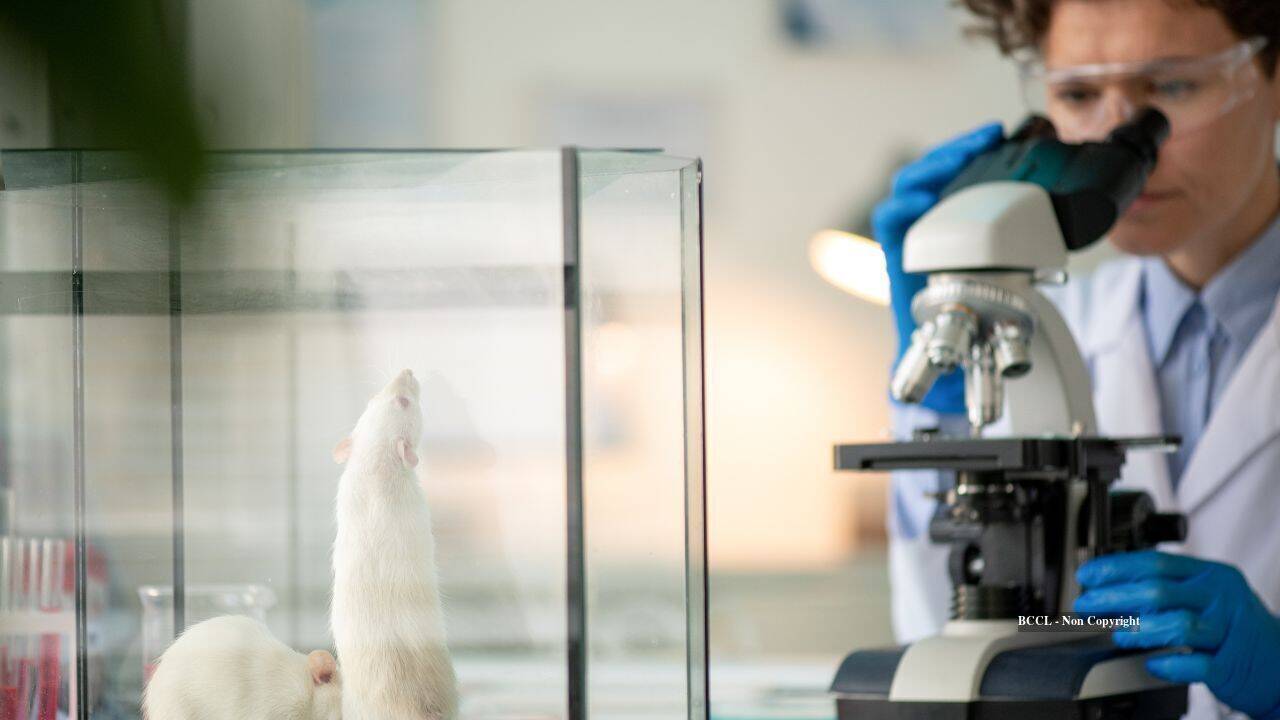
Photo via Times of India

Stanford scientists grow human brain tissue inside mice, filling more than 90% of missing cortex space

Read the original at Times of India ↗
Cite

TOI Science Desk. (2026, September 19). Stanford scientists grow human brain tissue inside mice, filling more than 90% of missing cortex space. Times of India. https://timesofindia.indiatimes.com/science/discovery/stanford-scientists-transplanted-human-brain-tissue-into-mice-missing-most-of-their-cortex-within-months-it-grew-to-occupy-more-than-90-of-the-space/articleshow/134353316.cms

Dated when The Aporia collected the article, usually within hours of publication. Check the original for its exact date and byline.

Times of India · collected 2026-09-19 · by TOI Science Desk

Quick Summary

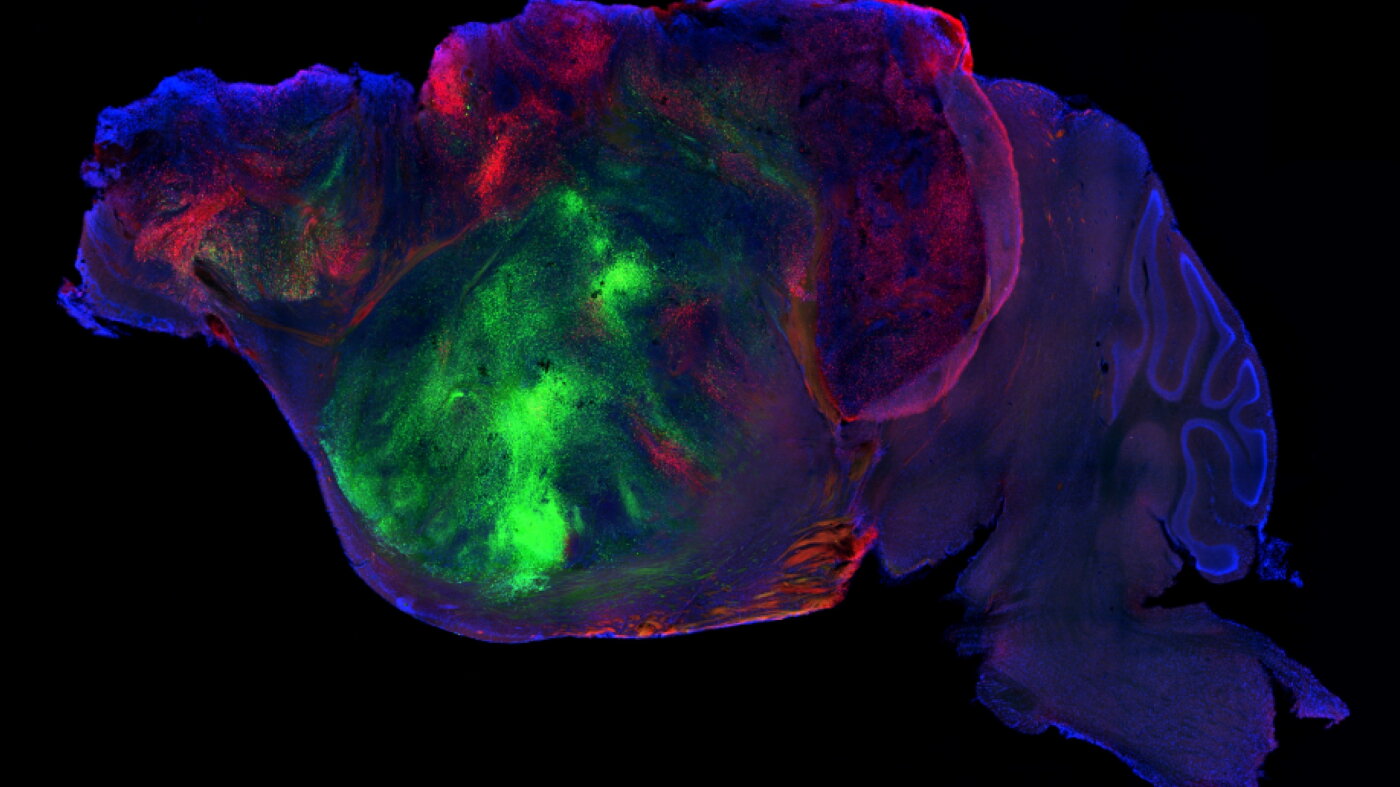
Stanford researchers have successfully transplanted lab-grown human brain tissue into mice engineered to lack most of their cerebral cortex. Within months, this tissue expanded to fill over 90% of the available space in these modified mice, forming functional connections with the mouse’s nervous system. Published in Nature on September 16, the study uses cortical organoids derived from human stem cells to observe brain development and response to injury in a living animal model, potentially advancing research into neurological conditions such as autism and schizophrenia.
Written by AI on 2026-09-19, from this article's own text only (the story summary below draws on all the coverage).
See how they differ ↓

AI analysis

Story summary

Researchers at Stanford University developed a method to install millions of lab-grown human brain cells into mice, creating animals with partially human cerebral cortexes. The study, published in the journal Nature, aims to better understand and develop treatments for neurodegenerative diseases that are hard to replicate in non-human models. Mice were genetically altered to lack most of their cerebral cortex tissue, then implanted with human cortical organoids—three-dimensional clusters of brain cells grown from reprogrammed skin cells. The transplanted human neurons survived and thrived, forming functional connections within the mice’s brains and spinal cords. Sergiu Pașca, a professor at Stanford University, emphasizes that this breakthrough offers new opportunities to study human-specific neurological conditions such as autism, epilepsy, schizophrenia, and cerebral palsy, but stresses these are not "mice with human-like thoughts." The research was conducted under strict ethical guidelines.

Written for “Human Brain Cells In Mice” on 2026-11-20, grounded in this article and the 4 other(s) covering the same event.

How they differ

5 outlets covered “Human Brain Cells In Mice”.

What each outlet says

One AI summary per outlet of its latest article on this story, written from that article alone and checked against it. Open the article for the outlet's own words.

Times of IndiaThis outlet19 Sep

Stanford researchers have successfully transplanted lab-grown human brain tissue into mice engineered to lack most of their cerebral cortex. Within months, this tissue expanded to fill over 90% of the available space in these modified mice, forming functional connections with the mouse’s nervous system. Published in Nature on September 16, the study uses cortical organoids derived from human stem cells to observe…

Stanford scientists grow human brain tissue inside mice, filling more than 90% of missing cortex space (this article)
NPR16 Sep

Researchers have developed a method to implant millions of human brain cells into mice that lack parts of their cerebral cortexes. This technique allows scientists to study neurodegenerative diseases using more accurate models of the human brain than previously possible. The research, led by Sergiu Pașca from Stanford University and published in Nature, addresses ethical concerns while advancing scientific…

Mice with human brain cells offer a tool to study disease. Ethicists ask: What's next? →
BBC16 Sep

US neuroscientists have created mice with functioning human cells in their brains to study psychiatric and neurodevelopmental diseases that cannot be effectively modeled in animals. The researchers genetically engineered the mice so they develop almost no cerebral cortex, then implanted brain-like tissue grown from human skin cells into these rodents. Published in Nature, this breakthrough aims to improve…

Part-human part-mouse brain developed in science breakthrough →
New York Post18 Sep

Scientists at Stanford University have successfully transplanted lab-grown human cortical organoids into mice, which had been bred with most of their cerebral cortex missing. Published in Nature, this study involves transforming human skin cells into stem cells that form brain tissue resembling the cerebral cortex. The transplanted tissue not only survived but also integrated with and developed connections to the…

Stanford geniuses create lab rats with half-human brains →

Where they agree and split

Framing

How the first headlines put it

Stated as fact2
The headlines (2)

Mice with human brain cells offer a tool to study disease. Ethicists ask: What's next? NPR · stated as fact

Part-human part-mouse brain developed in science breakthrough BBC · stated as fact

The full story: what happened, how it changed, and all 5 articles →

Compared with similar articles

This article reads unscored and hedges 18% of its claims. Each row says how that neighbour differs.
NPR
Hedges 6 of 53 claims Outlet record 60/100
BBC News
Hedges 4 of 33 claims Outlet record 65/100
New York Post
Hedges 0 of 15 claims Outlet record 66/100

Story

Human Brain Cells In Mice
Science · 5 article(s) covering the same event. Compare every outlet's account →
How this article was measured signals, leaning charts, publisher record, byline, topics and claims

Signals How these are calculated →

Claims extracted
39
sentences that state something as happening or true
Uncertain
18%
7 of 39 hedged ("reportedly", "may", "according to")
Leaning
not political
takes no side on a contested political question
Publisher signals
59/100
Times of India's corrections and hedging, across everything collected from it. Not a measure of accuracy.
Outlets on this story
5
Science
Same framing elsewhere
1
articles that frame the event the way this one does
Analyzed 2026-09-19 · how these are computed

How this is being covered How these are calculated →

Article leaning vs. publisher reliability
Source leaning vs. consistency

Publisher

Times of India · 5404 article(s) · 6 correction(s) detected
Running correction rate · 6 correction(s)

Who wrote this

TOI Science Desk
330 article(s) here · 1 carrying a prediction
The study, conducted by the Beaver Trust and the University of Exeter, confirmed 349 territories and identified 56 more that may be occupied, bringing the total to as many as 405.
Although its external lettered dials could still turn, nobody had managed to find the correct combination since its discovery.
It states that, while they may be small, they are still extremely venomous, and that its experienced reptile team is handling them under the highest safety and care protocols.
Elephants are known for their strong family bonds and complex social relationships, but declining populations may be putting these connections at risk.
Individually, such objects might seem small; together, they provide strong evidence that the outpost was active during the Sui period.
Who knew one animal could change an entire landscape?
The snakes were temporarily brought to the San Francisco Zoo, where they could give birth in a controlled environment.
Scientists have drawn a treasure map of where fossils of ancient sea life may still be waiting to be found.
The newly excavated channels, along with additional connections to Darby Creek, are expected to improve tidal circulation overall.
We have often wondered what animals might be trying to tell us, whether it is a dog barking at the postman or birds calling out to one another from the trees.
Wire or desk byline, not an individual reporter.
Also by TOI Science Desk
Nothing else under this byline is closely related to this article, so these are simply their most recent.
All 330 articles by TOI Science Desk →

Topics

Nature Stanford Stanford Medicine

Subjects

Nature ORG · 2× Stanford ORG · 2× Stanford Medicine ORG · 2× Sergiu Pasca PERSON · 1× Stanford Medicine’s ORG · 1×

Narrative

To get around this limitation, Stanford researchers led by psychiatrist Sergiu Pasca have spent more than a decade refining ways to grow three-dimensional clusters of human brain cells, known as cortical organoids, from skin cells reprogrammed into stem cells.
framing: assertive · carried by 1 article(s) · first seen 2026-09-19
Even so, the rat’s native cortex developed quickly and competed for space, limiting how much human tissue could take hold.

Claims (39 extracted, 7 hedged)

Stanford scientists have created a new model for studying human brain development by transplanting lab-grown human brain tissue into mice that were engineered to lack most of their cerebral cortex. asserted
that → create → cortex
Within months, the human tissue not only survived but expanded to occupy more than 90 percent of the cortical space, forming working connections with the mouse brain and spinal cord. asserted
tissue → survive → brain
The study titled 'Developmental xenocortication using human-derived organoids in mice' was published in Nature online on September 16. asserted
study → title → September
According to Stanford Medicine, this breakthrough offers a rare chance to observe how human neurons mature, interact and respond to injury inside a living, behaving animal, opening fresh avenues for research into conditions like autism, epilepsy, schizophrenia and cerebral palsy. Why the cerebral cortex mattersThe cerebral cortex is the outer layer of the brain that supports many of the abilities we think of as distinctly human, including complex thought, language, attention and decision-making. uncertain
we → accord → thought
Studying how this region develops and functions has long been difficult because living human brain tissue is rarely accessible for research. asserted
tissue → study → research
Animal models have helped, but many biological features of the human cortex do not translate neatly from mice or rats. asserted
features → help → mice
To get around this limitation, Stanford researchers led by psychiatrist Sergiu Pasca have spent more than a decade refining ways to grow three-dimensional clusters of human brain cells, known as cortical organoids, from skin cells reprogrammed into stem cells. asserted
researchers → get → cells
These organoids can self-organise into structures that resemble parts of the developing human cortex, but they still lack blood supply, immune input and full connections to sensory and motor systems when kept only in a dish, as per Stanford Medicine report. asserted
they → organise → report
From dish to living brainIn earlier work, the team transplanted human cortical organoids into newborn rats and saw much more advanced neuronal development than in culture. asserted
team → live → culture
The human tissue grew larger, its neurons became more electrically active and branched more extensively, and it integrated with the rat’s own circuits. asserted
it → grow → circuits
Even so, the rat’s native cortex developed quickly and competed for space, limiting how much human tissue could take hold. uncertain
tissue → develop → hold
In the new study, published in Nature in September 2026, the researchers removed much of that competition. asserted
researchers → publish → competition
They created a strain of “apallial” mice that are genetically engineered so that the starter cells for most of the neocortex and certain related structures never form. asserted
cells → create → neocortex
As adults, these mice have only about 2 percent of the cortical tissue found in ordinary mice, leaving a large cavity that can be filled by transplanted human organoids. asserted
that → have → organoids
Human tissue takes asserted
tissue → take → ?
team grew cortical organoids from healthy human donors and, when the organoids were about two months old, surgically placed them into the brains of two-day-old apallial mouse pups. asserted
organoids → grow → pups
Over the next three months, the human tissue survived, thrived and expanded. asserted
tissue → survive → months
By the three-month mark, more than 90 percent of the cortical volume in these mice was human in origin, according to Stanford Medicine’s description of the work. uncertain
percent → accord → work
Importantly, the human neurons did not sit in isolation. asserted
neurons → sit → isolation
They extended projections, formed synapses and integrated with the mouse’s remaining brain regions and spinal cord. asserted
They → extend → regions
Behavioural testing showed that, three to six months after surgery, the “xenocortical” mice performed broadly similarly to normal mice of the same age, though with some subtle differences in gait and memory that hint at the stabilising role of a full cortex. asserted
that → show → cortex
A window into disease and injuryOne of the most powerful aspects of this model is the ability to use cells from specific individuals. asserted
window → use → individuals
Because the organoids carry the donor’s genetic material, researchers can create mice whose human cortical tissue reflects the biology of a particular patient, whether healthy or affected by a neurodevelopmental disorder. asserted
tissue → carry → disorder
This opens the door to studying how disease-associated changes in human circuitry show up in an intact nervous system and to testing drugs that might correct them. uncertain
that → open → them
In a proof-of-concept experiment, the xenocortical mice were exposed to five hours of low oxygen. asserted
mice → expose → oxygen
The human-origin cortical tissue suffered substantial damage, and the mice showed problems with balance and steady movement that resemble aspects of cerebral palsy. asserted
that → suffer → palsy
This difference could help scientists pinpoint why human cortical neurons are especially vulnerable to oxygen stress during pregnancy or birth, and screen potential therapies. uncertain
neurons → help → therapies
Rare cell types appear for the first time in asserted
types → appear → time
These large, cigar-shaped neurons are found in regions linked to social awareness and decision-making, and they are known to be affected in conditions like frontotemporal dementia. asserted
they → find → dementia
Until now, VENs had only been seen in post-mortem human brains and in some other large-brained social animals, not in lab-grown cultures or earlier rodent transplant models. asserted
VENs → see → cultures
In the xenocortical mice, these rare cells emerged naturally within the thriving human cortex. asserted
cells → emerge → cortex
That means researchers can now generate VENs from healthy donors or from patients with specific neurological conditions, study how they function in a living, behaving animal, and test drugs that might protect or restore them. uncertain
that → mean → them
According to Stanford Medicine, this capability could be especially valuable for disorders where these cells are known to degenerate early. uncertain
cells → accord → disorders
Ethical guardrails and future directionsWork that blends human brain tissue with animal brains raises clear ethical questions. asserted
that → blend → questions
Pasca and his colleagues say they have consulted ethicists, neurobiologists, patient advocates, philosophers and legal scholars over several years of experimentation. asserted
they → say → experimentation
In late 2025, Pasca convened a conference in Asilomar, California, to debate the implications of using human stem cell models in this way. asserted
Pasca → convene → way
One central argument in favour of the research is the potential to relieve suffering for hundreds of millions of people living with currently untreatable neurological disorders. asserted
argument → relieve → disorders
The model is not intended to create animals with human-like consciousness, but to provide a more faithful platform for studying human-specific aspects of brain development and disease. asserted
model → intend → development
With patents held by Stanford on aspects of the technology, the team expects other labs to build on this approach, using it to probe the roots of profound autism, schizophrenia, epilepsy and other conditions that have been hard to model accurately until now. asserted
that → hold → autism
Give feedback · no sign-in needed

No sign-in needed for now. Your note is sent without a name, so it cannot be answered.

History Support