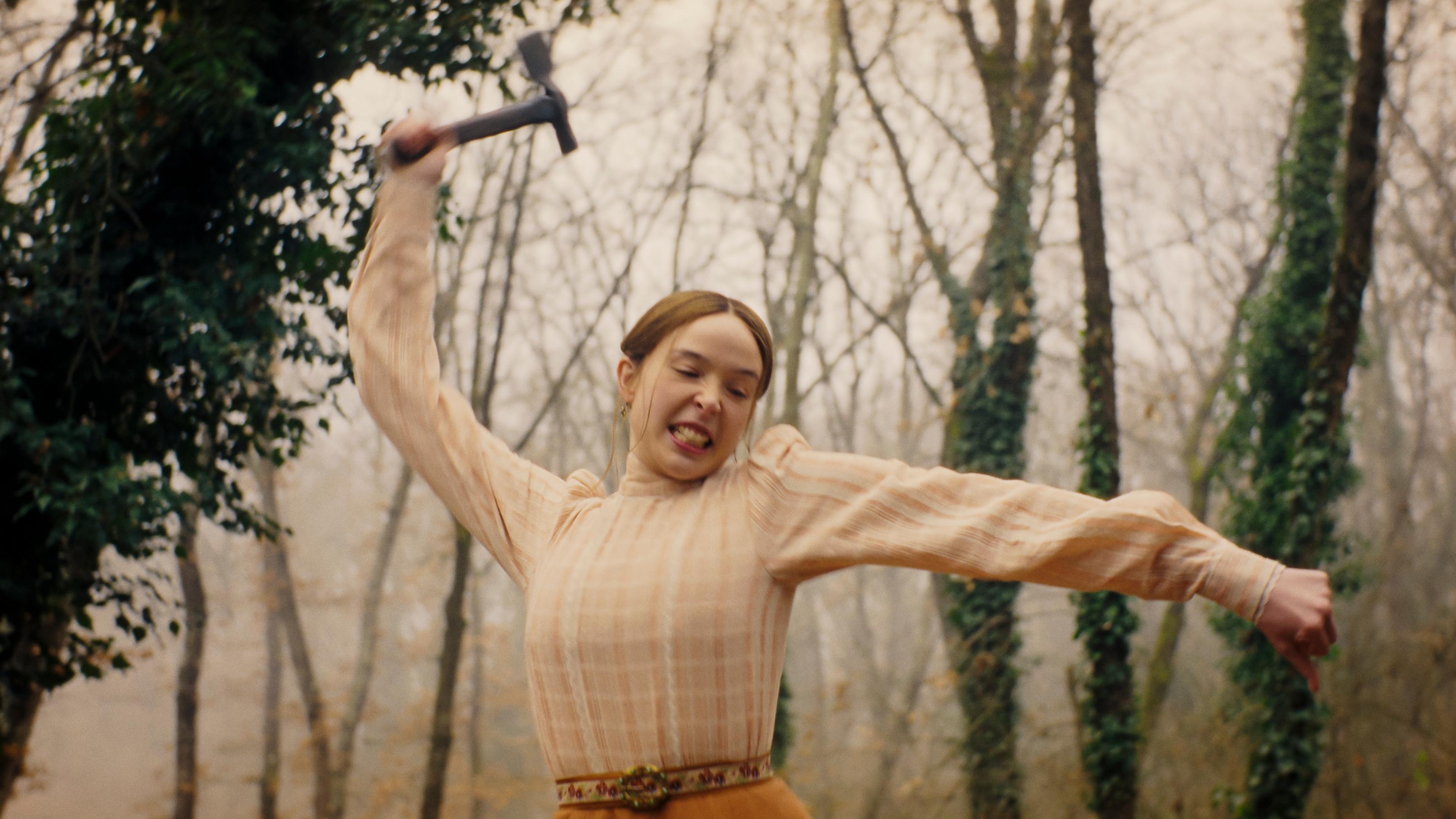
The Lizzie Borden Story on Netflix opens with a dramatic flourish: stage curtains open to reveal a small toy piano, decorated with the name “Lizzie,” playing the infamous Lizzie Borden nursery rhyme:
“Lizzie Borden took an axe
and gave her mother forty whacks.
asserted
Borden → open → whacks
When she saw what she had done,
she gave her father forty-one.”
asserted
she → see → one
We then get to watch young Lizzie (Ella Beatty) bring this macabre jingle to life.
asserted
Lizzie → get → life
She first confronts her literally evil stepmother, Abby (Rebecca Hall), in the family’s guest room.
asserted
She → confront → room
The axe hits Abby in the chest and she’s down quickly.
asserted
she → hit → chest
Lizzie continues to hack at the woman in feverish ecstasy.
asserted
Lizzie → continue → ecstasy
Then, her father Andrew (Charlie Hunnam) arrives home and gets a taste of his daughter’s fury.
asserted
father → arrive → fury
The show then skips back four months earlier to April 1892 to tell the tale of how a young woman in late 19th century Massachusetts came to (allegedly) massacre her parents in the first place.
uncertain
woman → skip → place
Past iterations of Ryan Murphy and Ian Brennan‘s Monster anthology series have received criticism for taking dramatic license in their interpretation of events and those three seasons all featured relatively modern cases, complete with vast amounts of photo and forensic evidence.
asserted
seasons → receive → evidence
Monster: The Lizzie Borden Story is set over a century ago and tackles a case that was controversial at the time thanks in huge part to conflicting accounts and poor evidence.
asserted
that → set → accounts
Is the new Ella Beatty show based on a true story?
asserted
show → base → story
And why does it (or doesn’t it) matter?
asserted
it → matter → ?
Is Monster: The Lizzie Borden Story Based on a True Story?
asserted
Monster → base → Story
There really was a Lizzie Borden (born 1860, died 1927) and she really was accused of murdering her stepmother and father with an axe.
asserted
she → bear → axe
She was considered odd by her neighbors in Fall River, Massachusetts, was eventually acquitted in a veritable circus of a murder trial, and was rumored to be a closeted lesbian.
asserted
considered → consider → trial
Her birth mother died when she was young, she had an older (and more social) sister named Emma, her father was wealthy due to his coffin business/frugal habits, and she had an Irish house maid named Bridget Sullivan (Vicky Krieps).
asserted
she → die → maid
These are all facts that we see dramatized in Netflix’s Monster: The Lizzie Borden Story.
asserted
we → see → Monster
Well, that’s fiction.
asserted
that → ’ → ?
If anything, Monster: The Lizzie Borden Story is more of a faithful adaptation of the mythology surrounding the real Lizzie, versus the historic record.
asserted
Monster → surround → record
That nursery rhyme that opens the show?
asserted
that → open → show
(Abby was struck 18 times and Andrew 10 or 11 times.)
asserted
Abby → strike → ?
The lesbian tryst that develops between Bridget and Lizzie?
asserted
that → develop → Bridget
A theory first proposed by mystery author Evan Hunter in his novel, Lizzie, which soon captured the popular imagination and became the inspiration behind a 2018 film.
asserted
which → propose → film
The real Bridget eventually married a man and lived out her days in Montana.
asserted
Bridget → marry → Montana
In real life, Portuguese immigrant Jose Correa de Mello was convicted of the axe murder of local girl Bertha Manchester, but it would have been impossible for him to have committed the Borden crimes.
asserted
him → convict → crimes
Part of what makes the Lizzie Borden case so compelling is that it was never solved.
asserted
it → make → ?
Well, lack of modern forensics, contradictory accounts of what happened that day, and the fact that authorities never really bothered to search Borden’s body or clothes for evidence.
asserted
authorities → happen → evidence
(In fact, she would go on to burn a dress that had a “paint” stain, but because no one recorded what dress she wore on the day of the murders, it was impossible to prove or disprove if she was destroying evidence or a ruined garment.
asserted
she → go → evidence
So, everything you see in Monster: The Lizzie Borden Story is a very dramatic retelling of real life…but why?
asserted
you → see → life
And why should it (or should it not) matter?
asserted
it → matter → ?
(Does It Matter?)
asserted
It → matter → ?
No, it’s not historically accurate.
asserted
it → ’ → ?
That said, there are two schools of thought on this and they often butt against each other in public discourse.
asserted
they → say → discourse
Because Lizzie Borden and her family were real people, many believe that any television adaptation of their stories should endeavor to be as accurate as possible, out of respect to the people who lived and died so long ago.
asserted
who → believe → people
By depicting salacious rumors as “fact” on screen, Brennan and Murphy et al are potentially disgracing the memories of real people.
asserted
Brennan → depict → people
It’s a piece of entertainment, an attempt at art.
asserted
It → ’ → art
It’s neither beholden to fact, nor is there a concrete, agreed-upon “truth” for the show to adapt.
asserted
show → ’ → fact
Everyone has their own opinion on the case.
asserted
Everyone → have → case
This is one interpretation of what happened.
asserted
what → happen → ?
Furthermore, Monster: The Lizzie Borden Story goes out of its way to present itself as a hyper-stylized, self-aware show.
asserted
Monster → go → show
…and 4 more, not listed.
 The Aporia