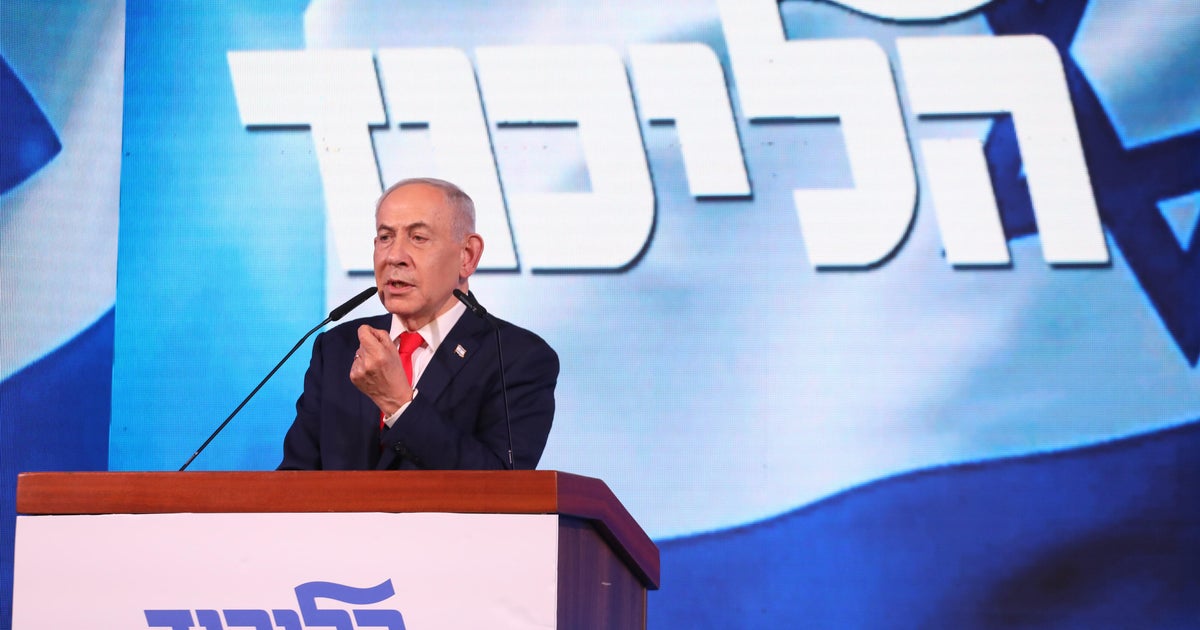
Photo via CBS News

Israel's Netanyahu meets opposition leader to discuss unity government

Read the original at CBS News ↗
Cite

Lieber, D. (2026, November 29). Israel's Netanyahu meets opposition leader to discuss unity government. CBS News. https://www.cbsnews.com/news/israel-netanyahu-meets-opposition-leader-discuss-forming-unity-government/

Dated from the outlet's own feed. Check the original for its byline.

CBS News · collected 2026-11-29 · by Dov Lieber

Quick Summary

Israeli Prime Minister Netanyahu met with opposition leader Gadi Eisenkot on Sunday to discuss forming a unity government after inconclusive national elections. Netanyahu's Likud party won 27 seats, while Eisenkot's Yashar party secured 21, with Arab-led parties winning 19. Both sides are working to bridge significant differences, with Netanyahu proposing a rotation arrangement where Eisenkot could serve as prime minister first. The discussions come amid calls from Arab and Jewish opposition leaders to oust Netanyahu, while some support the unity government idea.
Written by AI on 2026-11-29, from this article's own text only (the story summary below draws on all the coverage).
See how they differ ↓

AI analysis

Story summary

As of November 29, 2026, Gadi Eisenkot and Benjamin Netanyahu met in Tel Aviv without reaching an agreement to form a new Israeli government. Eisenkot, tasked with forming a government after inconclusive October elections, met Netanyahu to discuss a potential unity government. However, discussions broke down due to disagreements, with Eisenkot maintaining a firm stance against Netanyahu's bloc. Netanyahu had offered a rotation deal where Eisenkot would serve first, followed by Netanyahu, but this proposal was rejected. Eisenkot secured preliminary agreements with left-wing Democrats and right-wing Yisrael Beiteinu party, bolstering his efforts to form a coalition. This meeting is significant as it highlights ongoing political divisions in Israel following the elections that failed to produce a clear majority.

Written for “Netanyahu-Eisenkot Talks Break Down” on 2026-11-29, grounded in this article and the 45 other(s) covering the same event.
Why this leaning score
This article does not take a side on a contested political question, so it has no leaning score. That is an answer rather than a gap: a match report or a rescue can be warmly or critically written without being left or right, and scoring it anyway is how approval of a subject gets recorded as a political position.
No political leaning scored for article 188748 · logged 2026-11-29

How they differ

20 outlets covered “Netanyahu-Eisenkot Talks Break Down”.

What each outlet says

One AI summary per outlet of its latest article on this story, written from that article alone and checked against it. Open the article for the outlet's own words.

CBS NewsThis outlet29 Nov

Israeli Prime Minister Netanyahu met with opposition leader Gadi Eisenkot on Sunday to discuss forming a unity government after inconclusive national elections. Netanyahu's Likud party won 27 seats, while Eisenkot's Yashar party secured 21, with Arab-led parties winning 19. Both sides are working to bridge significant differences, with Netanyahu proposing a rotation arrangement where Eisenkot could serve as prime…

Israel's Netanyahu meets opposition leader to discuss unity government (this article)
The Straits Times29 Nov

Gadi Eisenkot, leader of the Yashar party, met with Israeli Prime Minister Benjamin Netanyahu in Tel Aviv to discuss the possibility of forming a unity government. However, Eisenkot appears to be leaning towards forming a coalition with other parties opposed to Netanyahu, as indicated by his previous deals with the Democrats and Yisrael Beiteinu, which together hold 48 seats out of 120 in the Knesset. The meeting…

Israel's Eisenkot downplays unity government option after meeting Netanyahu →7 articles from The Straits Times on this story
Al Jazeera29 Nov

Benjamin Netanyahu met with Gadi Eisenkot, the leader of the opposition, at Israeli military headquarters in Tel Aviv to discuss forming a unity government. Netanyahu offered a rotating premiership, with Eisenkot serving first, but the meeting highlighted significant differences, particularly over the inclusion of Arab and ultra-Orthodox parties. The talks, which began after inconclusive parliamentary elections in…

Eisenkot, Netanyahu hold talks: Can they agree on a unity government? →7 articles from Al Jazeera on this story
The Hindu28 Nov

Israeli caretaker Prime Minister Benjamin Netanyahu and his rival Gadi Eisenkot plan to meet on November 29, 2026, to discuss forming a unity government. Netanyahu proposed a rotating premiership, offering to serve as alternate prime minister, while Eisenkot would initially hold the top position. This development comes after inconclusive elections in late October left neither main bloc with a majority, leading…

Eisenkot, Netanyahu to hold coalition talks on Nov. 29 after rotating PM offer →5 articles from The Hindu on this story
Euronews29 Nov

Gadi Eisenkot met with Benjamin Netanyahu on Sunday in Tel Aviv to discuss forming a unity government in Israel, but the talks ended without a deal. Netanyahu offered a rotating prime minister role, which Eisenkot rejected, demanding to remain in office for the first three years. Both parties did not reach a compromise, and Netanyahu's entourage criticized Eisenkot's stance as extreme. Meanwhile, Eisenkot met with…

Netanyahu-Eisenkot meeting ends without deal on formation of new government →3 articles from Euronews on this story
ABC News (AU)28 Nov

Israeli Prime Minister Benjamin Netanyahu has offered to step down temporarily to allow his rival, former military chief Gadi Eisenkot, to lead a unity government. This move comes after Eisenkot was appointed by Israel's president to form a government following the recent inconclusive October 27 election. Eisenkot has until December 6, with a possible 14-day extension, to establish a new government.

Israel PM Netanyahu makes unity appeal to rival Eisenkot →2 articles from ABC News (AU) on this story
Show 14 more outlets
Dawn28 Nov

Prime Minister Benjamin Netanyahu offered to step down temporarily in favor of Gadi Eisenkot to join a unity government, responding to Eisenkot’s growing support from other political parties following a recent inconclusive election. Netanyahu’s statement came as Eisenkot, who was tasked with forming a new government, secured deals that could give him a majority. Netanyahu emphasized his readiness to lead but…

At risk of losing power, Netanyahu makes long-shot unity appeal to rival Eisenkot →2 articles from Dawn on this story
Daily Mail29 Nov

Israeli Prime Minister Benjamin Netanyahu has offered to step down and take a rotational leadership role to stay in government, meeting with his rival Gadi Eisenkot to discuss power-sharing terms. This move follows recent elections where neither Netanyahu nor Eisenkot achieved a majority, forcing Eisenkot to attempt to form a coalition government. Netanyahu proposes a rotational arrangement similar to previous…

Benjamin Netanyahu to meet rival for power sharing talks after offering to stand down as Israel's prime minister to stay in government →2 articles from Daily Mail on this story
BBC29 Nov

Benjamin Netanyahu and opposition leader Gadi Eisenkot are holding talks to resolve the election deadlock in Israel. Netanyahu's bloc won 53 seats, while Eisenkot's bloc secured 48 out of the 120 seats in the Knesset. Netanyahu proposed a national unity government with a rotating premiership, offering to allow Eisenkot to serve as prime minister initially. The negotiations come as Eisenkot faces a deadline to form a…

Israeli leadership rivals begin talks to break election deadlock →2 articles from BBC on this story
Global News29 Nov

Prime Minister Benjamin Netanyahu and opposition leader Gadi Eisenkot met Sunday to discuss forming a unity government in Israel, three weeks after Eisenkot was tasked with forming a government following inconclusive national elections. The meeting focused on bridging significant differences between the two sides. Netanyahu proposed a rotation arrangement where Eisenkot would serve as prime minister first. However…

Israel’s Netanyahu, Eisenkot met to discuss ‘national unity government’ →2 articles from Global News on this story
CBC29 Nov

Gadi Eisenkot, leader of the Yashar party, met with Prime Minister Benjamin Netanyahu in Tel Aviv to discuss the possibility of a unity government. However, Eisenkot, who has until December 6 to form a government, seems more inclined to form a coalition with parties opposing Netanyahu. The meeting, described as businesslike and focusing on bridging differences, did not lead to any immediate agreements. Political…

Israel's Gadi Eisenkot downplays reports of possible unity government after meeting Benjamin Netanyahu →2 articles from CBC on this story
Times of India29 Nov

Prime Minister Benjamin Netanyahu’s attempt to form a unity government with rival Gadi Eisenkot failed after a two-hour meeting in Tel Aviv, with no further talks expected. The meeting, which included a security briefing and mediation by Ron Dermer, did not bridge the substantial differences between the two sides, despite Netanyahu's offer to serve as the second prime minister in a rotation arrangement. With the…

No breakthrough in Netanyahu-Eisenkot meeting on Israel govt; further talks unlikely →2 articles from Times of India on this story
The Independent29 Nov

Gadi Eisenkot, the leader of the centre-right Yashar party, met with Israeli Prime Minister Benjamin Netanyahu in Tel Aviv on Sunday in an effort to form a coalition government following inconclusive elections on October 27. The meeting, the second between the two leaders this month, ended without substantial progress as Eisenkot, who is committed to forming a bloc to unseat Netanyahu, showed little willingness to…

Gadi Eisenkot snubs Netanyahu as Israeli government coalition talks break down →2 articles from The Independent on this story
New York Post28 Nov

Israeli Prime Minister Benjamin Netanyahu has proposed a power-sharing agreement with his rival, Gadi Eisenkot, to form a unity government. Under the deal, Eisenkot would initially serve as prime minister, followed by Netanyahu. Both leaders fell short of a majority in the recent elections, with Netanyahu’s Likud party securing 53 seats and Eisenkot’s Yashar party gaining 48 seats. Eisenkot, who was given the…

Netanyahu offers to temporarily step aside in power sharing deal with rival Eisenkot →
Sydney Morning Herald28 Nov

Israeli Prime Minister Benjamin Netanyahu offered his main rival, Gadi Eisenkot, the position of prime minister in a potential unity government, a move seen as an attempt to avoid being ousted from power. With Netanyahu’s coalition holding 53 seats in the 120-member parliament and Eisenkot’s supporters holding 48 seats, forming a stable majority requires coalition-building. Netanyahu’s offer came amid pressure from…

Under-pressure Netanyahu offers rival lead in unity government →
Fox News29 Nov

Benjamin Netanyahu, Israeli Prime Minister, proposed a rotating unity government where he would temporarily step down in favor of his rival Gadi Eisenkot. Netanyahu suggested that Eisenkot would initially serve as prime minister, with Netanyahu acting as alternate prime minister, before regaining the position later in the term. This offer came as Eisenkot, supported by various political parties, is close to forming…

Netanyahu offers to temporarily relinquish power in proposed unity government deal →
Toronto Star29 Nov

Benjamin Netanyahu and opposition leader Gadi Eisenkot met on Sunday to discuss forming a unity government in Israel, three weeks after the president tasked Eisenkot with the responsibility following inconclusive national elections. Netanyahu offered a new compromise by agreeing to allow Eisenkot to serve as prime minister first in a potential rotation deal.

Israel's Netanyahu and Eisenkot meet to discuss forming unity government →
NPR29 Nov

Benjamin Netanyahu and Gadi Eisenkot met on Sunday to discuss forming a unity government in Israel, following the inconclusive national elections on October 27. Netanyahu, willing to have Eisenkot become prime minister initially in a rotation arrangement, is facing pressure to include Arab-led or ultra-Orthodox parties in a potential coalition. The discussions come amid ongoing debates over sensitive issues like…

Israel's Netanyahu and Eisenkot meet to discuss forming unity government →
NBC News29 Nov

Benjamin Netanyahu and Gadi Eisenkot, Israeli political rivals, met for two hours on Sunday at the IDF defense headquarters in Tel Aviv to discuss forming a unity government following the October elections. Both leaders fall short of the 61-seat majority needed in the Knesset, with Arab-led parties holding significant sway, complicating coalition-building efforts. Netanyahu offered a rotating prime minister role to…

Israel’s Netanyahu and Eisenkot hold talks in push for a unity government to break deadlock →
Washington Examiner29 Nov

Prime Minister Benjamin Netanyahu and Yashar party leader Gadi Eisenkot met in an effort to form a unity government following Israel's October elections, which neither won a majority. Likud received 27 seats, and Yashar received 21 seats in the 120-seat Knesset. Despite Netanyahu's offer to let Eisenkot serve as prime minister initially, their high-profile meeting on Sunday did not produce an agreement due to…

Netanyahu and Eisenkot hold unity government talks in hopes of breaking deadlock →

Where they agree and split

Agreed

AI · cited, from two or more outlets

  • Eisenkot was tasked by Israel’s president to try to form a government after the inconclusive October 27 election.23
  • Netanyahu offered to serve as the second prime minister in a rotation agreement, allowing Eisenkot to lead a potential unity government initially.24
Quoted from the coverage (4)

Eisenkot could now seek support from ultra-Orthodox Jewish parties, Arab parties or a combination of both.

8 outlets

Mr Eisenkot has until December 6 to form a government, with the possibility of a 14-day extension.

7 outlets

Eisenkot’s Yashar party has so far agreed coalition deals with the left-leaning Democrats and the right-wing Israel Beiteinu party.

7 outlets

“Netanyahu’s proposal is yet another transparent con by a serial fraudster who has deceived every partner and violated every agreement,” wrote former premier Yair Lapid, co-chair of the centrist Beyachad party.

6 outlets

Framing

How the first headlines put it

  • Al Jazeera's headline focuses on the failure of the talks, while ABC News highlights Netanyahu's appeal to form a unity government.13
Stated as fact4
The headlines (4)

Eisenkot invites Netanyahu's party to Israeli coalition talks ABC News (Australia) · stated as fact

Gadi Eisenkot invites Netanyahu’s party for Israeli coalition talks The Straits Times · stated as fact

Eisenkot invites Netanyahu’s party for Israeli coalition talks The Hindu · stated as fact

Gadi Eisenkot invites Netanyahu's Likud party for 'marathon' coalition talks Euronews · stated as fact

The full story: what happened, how it changed, and all 46 articles →

Compared with similar articles

This article reads unscored and hedges 15% of its claims. Each row says how that neighbour differs.
NPR
Leans right Hedges 0 of 11 claims Outlet record 60/100
Global News
Hedges 2 of 18 claims Outlet record 63/100
BBC News
Leans right Hedges 1 of 14 claims Outlet record 70/100
Times of India
Hedges 5 of 27 claims Outlet record 58/100
Euronews
Hedges 4 of 16 claims Outlet record 60/100
Al Jazeera
Hedges 6 of 59 claims Outlet record 60/100
The Straits Times
Leans left Hedges 2 of 17 claims Outlet record 65/100
The Straits Times
Hedges 3 of 22 claims Outlet record 65/100
The Independent
Leans right Hedges 3 of 25 claims Outlet record 59/100

Story

Netanyahu-Eisenkot Talks Break Down
Politics · 46 article(s) covering the same event. Compare every outlet's account →
How this article was measured signals, leaning charts, publisher record, byline, topics and claims

Signals How these are calculated →

Claims extracted
20
sentences that state something as happening or true
Uncertain
15%
3 of 20 hedged ("reportedly", "may", "according to")
Leaning
not political
takes no side on a contested political question
Publisher signals
68/100
CBS News's corrections and hedging, across everything collected from it. Not a measure of accuracy.
Outlets on this story
46
Politics
Same framing elsewhere
1
articles that frame the event the way this one does
Analyzed 2026-11-29 · how these are computed

How this is being covered How these are calculated →

Article leaning vs. publisher reliability
Source leaning vs. consistency

Publisher

CBS News · 6510 article(s) · 13 correction(s) detected
Running correction rate · 13 correction(s)

Who wrote this

Dov Lieber
7 article(s) here · 1 carrying a prediction
The meeting came three weeks after Israeli President Isaac Herzog said he would give Eisenkot the first opportunity for the deeply divided country, following Israel's inconclusive national elections.
President this week that Iran may be seeking to develop chemical or biological weapons, though he provided no evidence to support the claim.
"Israel's elections have been stolen," Netanyahu's Likud party declared in a statement Thursday, claiming "an attack on democracy aimed at leading to a foreign takeover of the Knesset, the Islamization of Israel, and the overthrow of the right-wing government to cause a withdrawal and defeat of the IDF (Israeli military) on all fronts — first and foremost, Iran." The four parties that make up the main bloc opposing Netanyahu won 48 seats, so they would need some support from the Arab parties to try to form a coalition government, assuming none of the lawmakers currently aligned with Netanyahu's bloc defect.
After three years with their country at war on multiple fronts, Israelis will go to the polls Tuesday in a hotly contested election that will shape their next government.
The agreement — which has been framed very differently by London and Tel Aviv — may prevent the tension between the two longstanding allies from escalating, but it has highlighted how strained ties have become between Israel and several European governments over Israel's ongoing actions in the Palestinian territories.
Sources familiar with the investigation told CBS News it is possible al Hamami has dual citizenship, which could explain how he was allowed to fly to Israel.
"I would say much worse than a free-fall," he said, describing how the plane "started turning all sideways and going up and down in all different kinds of directions, for a pretty long time." "It's very hard to even to estimate if this was 30 seconds or a minute or more than that … it was just the scariest thing possible."
Also by Dov Lieber
Nothing else under this byline is closely related to this article, so these are simply their most recent.
All 7 articles by Dov Lieber →

Topics

Arab Israel Israeli Likud Yashar

Subjects

Netanyahu PERSON · 11× Eisenkot PERSON · 9× Israel GPE · 8× Arab NORP · 4× Likud ORG · 3× Iran GPE · 2× Yashar PERSON · 2× Gadi Eisenkot PERSON · 1× Isaac Herzog PERSON · 1× Israeli NORP · 1×

Narrative

A joint statement by their parties on Sunday afternoon said the meeting began with a security briefing and then moved to discussing "the formation of a national unity government," with "both sides seeking to bridge the substantial differences between them." For months, Eisenkot has called Netanyahu, Israel's longest-serving prime minister, unfit for office and a threat to Israel's future.
framing: assertive · carried by 1 article(s) · first seen 2026-11-29
The meeting came three weeks after Israeli President Isaac Herzog said he would give Eisenkot the first opportunity for the deeply divided country, following Israel's inconclusive national elections.

Claims (20 extracted, 3 hedged)

Israel's Prime Minister met with opposition leader Gadi Eisenkot on Sunday to discuss forming a coalition government. asserted
Minister → meet → government
The meeting came three weeks after Israeli President Isaac Herzog said he would give Eisenkot the first opportunity for the deeply divided country, following Israel's inconclusive national elections. asserted
he → come → elections
The discussions took on new urgency after Netanyahu announced Saturday night that he was willing to have Eisenkot become prime minister first in a rotation arrangement under a possible unity deal. asserted
Eisenkot → take → deal
A joint statement by their parties on Sunday afternoon said the meeting began with a security briefing and then moved to discussing "the formation of a national unity government," with "both sides seeking to bridge the substantial differences between them." For months, Eisenkot has called Netanyahu, Israel's longest-serving prime minister, unfit for office and a threat to Israel's future. asserted
Eisenkot → say → future
Netanyahu has led a relentless campaign against partnering with Arab-led parties — whose historic gains in turned them into likely but politically fraught allies for the opposition bloc. asserted
gains → lead → bloc
Neither Netanyahu's party nor the opposition bloc, led by Eisenkot, secured a majority in Israel's elections, according to the official election results. uncertain
party → lead → results
The prime minister's Likud party secured 27 seats in Israel's parliament, which contains 120 seats overall, while Eisenkot's Yashar party secured 21 seats, election data showed. asserted
data → secure → seats
Including its allies, the Likud party won 53 seats, while Yashar and its allies won 48 and the Arab-led parties won 19. asserted
parties → include → 19
Because none secured 61 seats, negotiations to form a majority must follow before choosing a new prime minister. asserted
negotiations → secure → minister
Yousef Jabareen, the Joint List of Arab parties head, urged rejecting Netanyahu's offer. asserted
Jabareen → urge → offer
"It's time to fulfill the shared will of the entire public — Jews and Arabs alike — and oust Netanyahu this week," he said. asserted
he → fulfill → Netanyahu
Yair Lapid, a leader of the Jewish-majority opposition parties who briefly served as prime minister in a coalition government formed in 2021 that ended 12 years of Netanyahu's rule, called the offer a scam. asserted
that → serve → offer
However, Naftali Bennett, who also served as prime minister in the coalition government with Lapid, welcomed Netanyahu's offer to let Eisenkot serve as premier first and said a unity government should be built around parties representing Israelis who perform military or national service. asserted
who → serve → service
While Netanyahu's party, Likud, garnered most votes in the country's election, the right-wing and ultra-Orthodox parties that have historically backed him failed to maintain their parliamentary majority and won fewer seats than his opponents in the country's 120-member Knesset. asserted
that → garner → Knesset
That left both Eisenkot and Netanyahu without an easy postelection path toward forming a government. asserted
That → leave → government
If no deal is reached by Dec. 6, Eisenkot could ask Israel's president to grant him a two-week extension for a final chance to strike a deal. uncertain
Eisenkot → reach → deal
If that fails, Netanyahu could get the next opportunity — and new elections, plus a new opportunity to form a government, might be called if he also fails. uncertain
he → fail → government
Parties backing Eisenkot have disagreed over whether to include Arab-led or ultra-Orthodox parties in a potential coalition. asserted
Parties → back → coalition
In addition, negotiations among the parties touched on some of the election's most sensitive issues, including mandating military service for ultra-Orthodox Jews and a state-led investigation into the security failures surrounding the Hamas-led Oct. 7, 2023, attacks. asserted
negotiations → touch → attacks
The country is still reeling from that trauma and the more than three years of wars that followed in Gaza, against Iran-backed Hezbollah militants in Lebanon, and in the war against Iran that Israel and the United States jointly attacked on Feb. 28. asserted
Israel → reel → Feb.
Give feedback · no sign-in needed

No sign-in needed for now. Your note is sent without a name, so it cannot be answered.

History Support