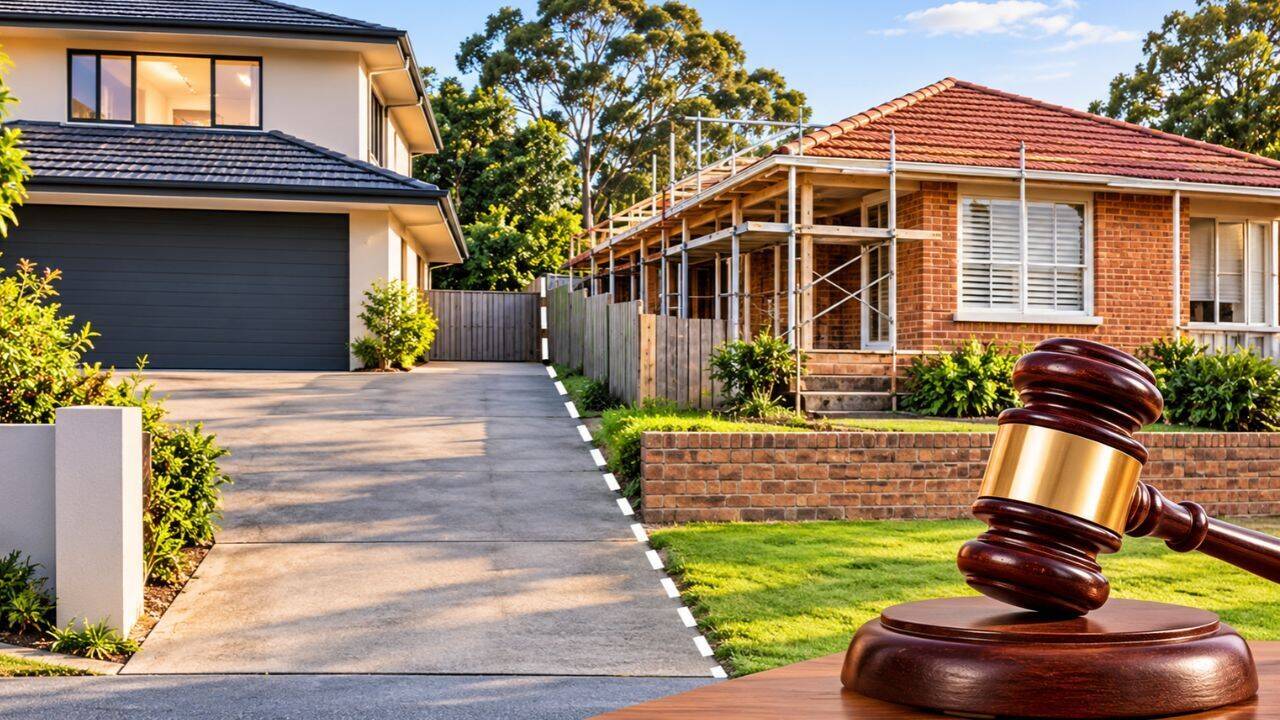
Photo via Times of India

Sydney neighbours settle property boundary dispute over driveway, home extensions; court orders A$24,000 compensation

Read the original at Times of India ↗
Cite

TOI World Desk. (2026, November 29). Sydney neighbours settle property boundary dispute over driveway, home extensions; court orders A$24,000 compensation. Times of India. https://timesofindia.indiatimes.com/world/rest-of-world/two-sydney-neighbours-found-their-properties-encroached-on-each-other-with-a-driveway-crossing-one-boundary-and-house-alterations-crossing-the-other-a-court-approved-reciprocal-access-rights-and-a24000-compensation/articleshow/136268467.cms

Dated from the outlet's own feed. Check the original for its byline.

Times of India · collected 2026-11-29 · by TOI World Desk

Quick Summary

In Sydney, two neighbours in Earlwood resolved a property boundary dispute involving encroaching driveways and home extensions. The New South Wales Land and Environment Court approved a settlement allowing both properties to retain their encroachments under specific easement arrangements and ordered the neighbour whose property was encroached upon to pay A$24,000 in compensation. The court held multiple conciliation conferences in 2026, culminating in an agreement that includes maintenance requirements and structural safety measures for the encroaching structures.
Written by AI on 2026-11-29, from this article's own text only (the story summary below draws on all the coverage).

AI analysis

Story summary

Two neighbours in Sydney's Earlwood suburb have settled a property boundary dispute after the New South Wales Land and Environment Court approved a reciprocal agreement and ordered A$24,000 in compensation. The dispute involved a concrete driveway at 10 Highland Crescent that extended onto the neighbouring property at 8 Highland Crescent, providing access to the garage but going beyond an existing registered right-of-way. Additionally, construction work on the 8 Highland Crescent property had encroached onto the 10 Highland Crescent property. The court's decision allows the encroaching structures, except for the fence, to remain in place under an easement arrangement, ensuring pedestrian access for the lifetime of those structures.

Written for “Sydney Property Boundary Dispute Settlement” on 2026-11-29, grounded in this article and the 0 other(s) covering the same event.

Compared with similar articles

Nothing to compare against. No article is close enough to this one for the pipeline to have linked or judged the pair.

Story

Sydney Property Boundary Dispute Settlement
Crime & Law · 1 article(s) covering the same event.
How this article was measured signals, leaning charts, publisher record, byline, topics and claims

Signals How these are calculated →

Claims extracted
13
sentences that state something as happening or true
Uncertain
8%
1 of 13 hedged ("reportedly", "may", "according to")
Leaning
not political
takes no side on a contested political question
Publisher signals
58/100
Times of India's corrections and hedging, across everything collected from it. Not a measure of accuracy.
Outlets on this story
1
Crime & Law
Same framing elsewhere
1
articles that frame the event the way this one does
Analyzed 2026-11-29 · how these are computed

How this is being covered How these are calculated →

Article leaning vs. publisher reliability
Source leaning vs. consistency

Publisher

Times of India · 6136 article(s) · 10 correction(s) detected
Running correction rate · 10 correction(s)

Who wrote this

TOI World Desk
1907 article(s) here · 1 carrying a prediction
The judges also rejected her arguments over the evidence, noting that the trial court's findings were supported by the record and that the appeals court would not reassess witness credibility.
The Bloomfield Hills Subdivision Association had sought assessments, late fees, interest and other costs from homeowner Alicia Awwiller, arguing that her fence breached community restrictions.
She eventually decided to shut down her shop at the rented premises, claiming she could no longer feel safe around the building's owner, Michael Stadler.
Under the settlement, the owners of 10 Highland Crescent will grant an easement allowing the neighbouring property's encroaching structures, except the fence, to remain in place, along with pedestrian access for the lifetime of those structures.

They said the law required the district court to consider the property allocated to each spouse and the potential income it could generate when deciding maintenance.
In practical terms, Serco is saying that the jury may have been persuaded by an incomplete or legally insufficient account of the facts, rather than by evidence that proves retaliation beyond a reasonable legal standard.
A Tennessee man who had initially planned to divide his estate equally among his three children later changed his will, leaving almost all his assets to his wife.
Clarkson and his wife, Frances, fenced off and diverted the route after complaining that ramblers could see into their kitchen.
It said that although the contempt motion might have been filed prematurely, the earlier court order concerning removal of the shed had not been clearly invalidated.
Felix Ngole had been offered a role as a hospital discharge mental health support worker in Wakefield, West Yorkshire, by Leeds-based charity Touchstone Leeds in May 2022.
Wire or desk byline, not an individual reporter.
Also by TOI World Desk
Nothing else under this byline is closely related to this article, so these are simply their most recent.
All 1907 articles by TOI World Desk →

Topics

Earlwood Sydney The New South Wales Land and Environment Court

Subjects

Earlwood GPE · 1× Sydney GPE · 1× The New South Wales Land and Environment Court ORG · 1×

Narrative

The driveway provided access to their garage but partly went beyond an existing registered right-of-way. Meanwhile, construction work carried out at the neighbouring house had also crossed the common boundary, with parts of the structures extending onto the first property's land.
framing: assertive · carried by 1 article(s) · first seen 2026-11-29
Under the settlement, the owners of 10 Highland Crescent will grant an easement allowing the neighbouring property's encroaching structures, except the fence, to remain in place, along with pedestrian access for the lifetime of those structures.

Claims (13 extracted, 1 hedged)

Two neighbours in Sydney have reached a settlement after finding that structures on their properties had crossed their shared boundary, with a court approving reciprocal access rights and ordering A$24,000 in compensation. asserted
court → reach → compensation
The dispute involved two adjoining homes in Earlwood, where one property's concrete driveway extended onto the neighbouring land, while construction work and alterations to the other house crossed the boundary in the opposite direction. asserted
work → involve → direction
The New South Wales Land and Environment Court upheld the appeal and formalised an agreement allowing the encroaching structures and driveway to remain in place under specified easement arrangements. asserted
structures → uphold → arrangements
Driveway and house alterations crossed property boundary asserted
alterations → cross → boundary
According to the court judgment, the owners of a property at 10 Highland Crescent had a driveway extending onto the neighbouring property at 8 Highland Crescent. uncertain
owners → accord → Crescent
The driveway provided access to their garage but partly went beyond an existing registered right-of-way. Meanwhile, construction work carried out at the neighbouring house had also crossed the common boundary, with parts of the structures extending onto the first property's land. asserted
parts → provide → land
The court held conciliation conferences on June 29, September 2 and October 8, 2026, during which the parties reached an agreement to resolve the dispute. asserted
parties → hold → dispute
Court approves reciprocal easements, orders A$24,000 payment asserted
Court → approve → payment
Under the settlement, the owners of 10 Highland Crescent will grant an easement allowing the neighbouring property's encroaching structures, except the fence, to remain in place, along with pedestrian access for the lifetime of those structures. asserted
structures → grant → structures
In return, the owner of 8 Highland Crescent will grant an easement allowing the driveway to remain in place, with both pedestrian and vehicle access permitted. asserted
access → grant → place
The court also ordered the respondent to pay A$24,000 in compensation to the applicants by January 31, 2027, or by the registration of the easements, whichever is later. asserted
whichever → order → easements
The agreement further requires the respondent to install a gate, obtain a structural safety report and carry out any recommended work at her expense. asserted
agreement → require → expense
Both parties must maintain their respective structures and cooperate in registering the easements. asserted
parties → maintain → easements
Give feedback · no sign-in needed

No sign-in needed for now. Your note is sent without a name, so it cannot be answered.

History Support