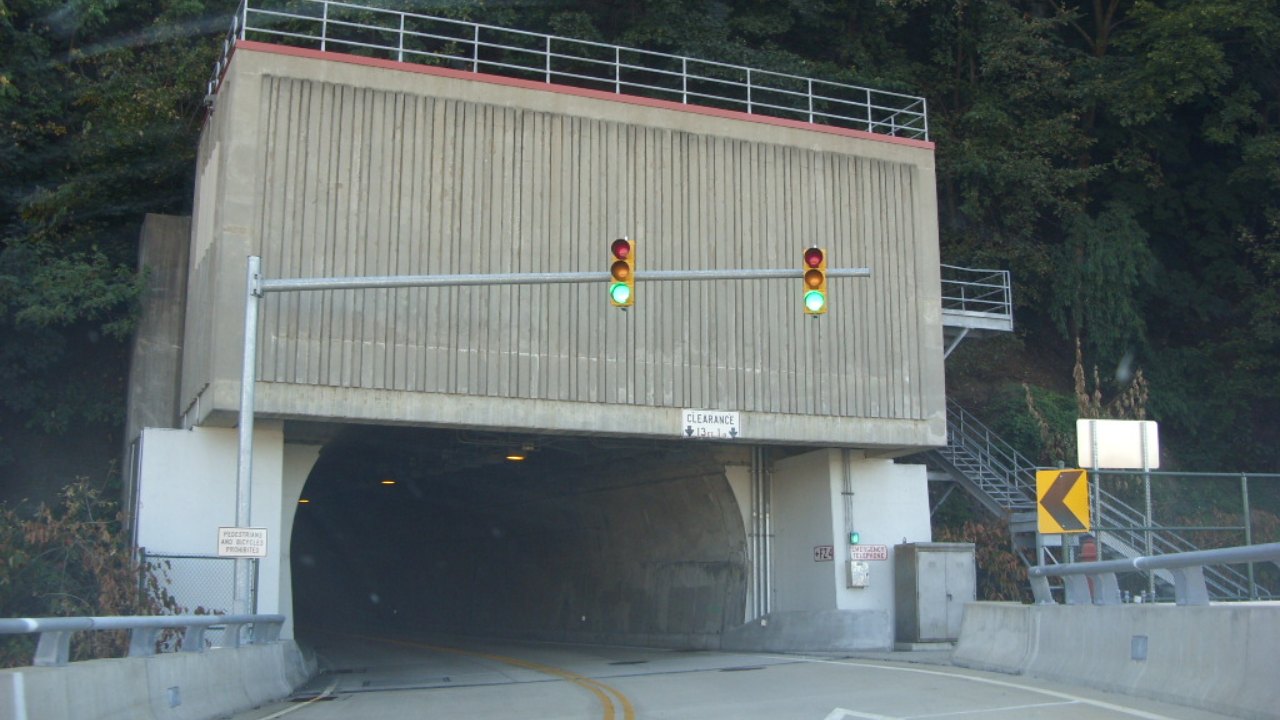
A railway tunnel carved through Pittsburgh's Mount Washington more than a century ago is preparing to close to motorists, ending a chapter that saw it move from a railway passage to an abandoned structure and eventually a road used by commuters.
asserted
it → carve → commuters
The Wabash Tunnel, originally built in 1903 for the Wabash-Pittsburgh Terminal Railroad, will close permanently to vehicles on December 1, 2026.
asserted
Tunnel → build → December
Pittsburgh Regional Transit (PRT), which operates the facility, says bringing it up to current safety standards would require an estimated $43 million in rehabilitation.
asserted
bringing → operate → rehabilitation
According to PRT's November 23 announcement on its website, the tunnel's final day of service will be November 30.
uncertain
day → accord → service
Barriers will then be installed at its entrances on West Carson Street and Woodruff Street to prevent further vehicle access.
asserted
Barriers → instal → access
The closure was approved by the transit agency's board in October after an assessment of the tunnel's condition, safety and long-term viability.
asserted
closure → approve → condition
Although the overall structure remains in fair condition, several essential systems, including lighting, ventilation and electrical components, have deteriorated and exceeded their useful life.
Built for a railway that struggled to survive
The closure will affect commuters who use the route to travel between the South Side and other parts of Pittsburgh.
The Wabash Tunnel was constructed as part of an ambitious railway project intended to connect Pittsburgh with the wider Wabash rail network.
asserted
Tunnel → remain → network
It runs through Mount Washington, linking the area near Station Square with Woodruff Street.
asserted
It → run → Street
However, the railway's plans ran into financial difficulties.
asserted
plans → run → difficulties
According to a historical report preserved by the American Archive of Public Broadcasting, the Wabash railroad went bankrupt after a series of financial problems, leaving the bridge and tunnel unused by 1917.
uncertain
railroad → accord → 1917
The tunnel's history did not end there.
asserted
history → end → ?
Freight and passenger services continued to use parts of the original railway infrastructure at different times.
asserted
services → continue → times
Passenger rail service through the tunnel ended in 1931, while freight operations continued for longer.
asserted
operations → end → 1931
The railway's downtown terminal and bridge were eventually lost.
asserted
terminal → lose → ?
A major fire in March 1946 destroyed the terminal, and the bridge was dismantled in 1948.
asserted
bridge → destroy → 1948
Decades of plans that never quite worked
The tunnel remained unused for years, but officials repeatedly considered ways to put it back into service.
asserted
officials → work → service
According to the American Archive of Public Broadcasting's report, Allegheny County purchased the tunnel in 1931 for $3 million.
uncertain
County → accord → million
A study was carried out in 1933 to examine whether it could be converted for road traffic, but the proposal did not move forward.
uncertain
proposal → carry → traffic
Another plan emerged decades later.
asserted
plan → emerge → ?
The Port Authority of Allegheny County considered using the tunnel as part of Skybus, an automated public transport system.
asserted
Authority → consider → Skybus
By 1971, around $6 million had been spent on renovations connected with the proposed project, according to the archive's report.
uncertain
million → spend → report
However, Skybus never became operational.
asserted
Skybus → become → ?
The tunnel also featured in proposals for a new bridge across the Monongahela River to connect it with downtown Pittsburgh.
asserted
tunnel → feature → Pittsburgh
The bridge was never built, leaving the tunnel without the connection needed to make the larger transport plan work.
asserted
plan → build → connection
Reopened for cars after decades of disuse
The tunnel finally found a new purpose in the early 2000s.
asserted
tunnel → reopen → 2000s
The Port Authority, which later became part of Pittsburgh Regional Transit, acquired it in 1996 and converted it into a paved roadway using federal transit funding.
asserted
which → become → funding
It reopened in 2004 as a high-occupancy vehicle (HOV) facility, intended primarily for vehicles carrying multiple passengers.
asserted
It → reopen → passengers
The restriction was later removed, and the tunnel was opened to all traffic in 2017.
asserted
tunnel → remove → 2017
According to PRT, around 1,500 vehicles used the tunnel daily before the decision to close it.
uncertain
vehicles → accord → it
However, it no longer carried scheduled public transit services.
asserted
it → carry → services
Buses used it only occasionally as a detour during roadwork or special events.
asserted
Buses → use → roadwork
The facility's limited role in the public transport network became an important factor in the agency's decision.
asserted
role → become → decision
Why the $43 million repair bill is too high
PRT will retain $848,238 in remaining federal funding value associated with the tunnel, after depreciation, and use it for a future eligible capital project.
asserted
PRT → retain → project
PRT's assessment found that while the tunnel's main structure remains in fair condition, its lighting, ventilation and electrical systems are in poor to critical condition.
asserted
systems → find → condition
The agency estimates that approximately $43 million would be needed to rehabilitate it and bring it up to current safety standards.
asserted
million → estimate → standards
As reported by Pittsburgh Business Times, the tunnel also costs at least $300,000 a year to maintain.
asserted
tunnel → report → 300,000
The report quoted PRT public relations director Melissa Rubin as saying there were no plans to reopen the facility after its closure.
asserted
report → quote → closure
The agency also approached the Pennsylvania Department of Transportation, Allegheny County and the City of Pittsburgh to find out whether another government body would be willing to take ownership and responsibility for its maintenance.
asserted
body → approach → maintenance
According to the report, none agreed to take it over.
uncertain
none → accord → it
PRT will retain $848,238 in remaining federal funding value associated with the tunnel, after depreciation, and use it for a future eligible capital project.
asserted
PRT → retain → project
…and 7 more, not listed.
 The Aporia