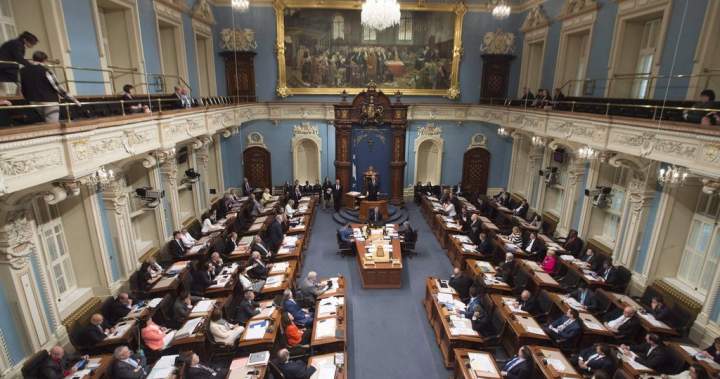
Photo via The Globe and Mail

Quebec argues ruling requiring oath will cause ‘major disruption’ if MNAs not allowed to sit

Read the original at The Globe and Mail ↗
Cite

Forrest, M. (2026, November 28). Quebec argues ruling requiring oath will cause ‘major disruption’ if MNAs not allowed to sit. The Globe and Mail. https://www.theglobeandmail.com/canada/article-quebec-oath-to-king-major-disruption-court-of-appeal-paul-st-pierre/

Dated from the outlet's own feed. Check the original for its byline.

The Globe and Mail · collected 2026-11-28 · by Maura Forrest

Quick Summary

Quebec’s government is arguing before the Court of Appeal of Quebec that there will be a “major disruption” if members of the National Assembly (MNAs) are not allowed to sit without taking an oath of allegiance to King Charles III, following a lower court ruling. The case stems from a 2022 law that abolished the requirement for MNAs to swear loyalty to the Crown, which was suspended by Justice Ian Demers last week. Lawrence David, the lawyer who initiated the constitutional challenge, asserts that the court cannot be intimidated by political threats and that the government lacks authority to unilaterally amend the Constitution in this manner. Justice Lori Renée Weitzman is set to deliver her decision on Monday, determining whether the government can appeal and if MNAs can proceed with legislative work without taking the oath.
Written by AI on 2026-11-28, from this article's own text only (the story summary below draws on all the coverage).
See how they differ ↓

AI analysis

Story summary

A Quebec Superior Court judge ruled on November 23 that members of the provincial legislature must swear an oath of allegiance to King Charles III before they can sit in the National Assembly, suspending a 2022 law that made the oath optional. Justice Ian Demers determined that any laws passed by legislators who did not swear the oath would be unconstitutional. The Parti Québécois government, led by Premier Paul St-Pierre Plamondon, is challenging this decision in the Quebec Court of Appeal, arguing that requiring the oath will cause a "major disruption" to parliamentary work. The Court of Appeal is expected to issue its ruling on November 28, the day before the legislature is scheduled to reconvene.

Written for “Quebec Court Rules on Oath to King” on 2026-11-28, grounded in this article and the 9 other(s) covering the same event.

How they differ

5 outlets covered “Quebec Court Rules on Oath to King”.

What each outlet says

One AI summary per outlet of its latest article on this story, written from that article alone and checked against it. Open the article for the outlet's own words.

The Globe and MailThis outlet28 Nov

Quebec’s government is arguing before the Court of Appeal of Quebec that there will be a “major disruption” if members of the National Assembly (MNAs) are not allowed to sit without taking an oath of allegiance to King Charles III, following a lower court ruling. The case stems from a 2022 law that abolished the requirement for MNAs to swear loyalty to the Crown, which was suspended by Justice Ian Demers last week…

Quebec argues ruling requiring oath will cause ‘major disruption’ if MNAs not allowed to sit (this article)4 articles from The Globe and Mail on this story
Global News28 Nov

Quebec’s Court of Appeal will rule on Monday whether to allow legislators to take office without swearing allegiance to the King, as per a 2022 law that the government passed and a lower court suspended. The case involves Justice Weitzman deciding whether to let the government appeal a previous ruling by Justice Demers, who ordered the law to be suspended due to its potential unconstitutionality. Law professor…

Quebec Court of Appeal to rule Monday on oath to the King by legislators →2 articles from Global News on this story
Toronto Star27 Nov

Justice Lori Renée Weitzman of the Quebec Court of Appeal will issue a ruling on Monday regarding whether legislators can return to work without taking an oath to the King. The case stems from a Superior Court decision this week that reinstated the oath requirement, which the Parti Québécois government is attempting to overturn to allow parliamentarians to resume their duties without the oath.

Quebec Court of Appeal to rule Monday about oath to the King by legislators →2 articles from Toronto Star on this story
CBC23 Nov

A Quebec Superior Court judge has suspended a provincial law that made the oath to King Charles III optional for Members of the National Assembly (MNAs), ruling that the law is unconstitutional. The judge, Ian Demers, determined that the Quebec government exceeded its constitutional limits by altering the mandatory nature of the oath. This ruling affects the planned start date of the National Assembly on December 1…

Quebec MNAs must swear oath to the King, judge rules →
Toronto Sun25 Nov

This editorial argues against Quebec’s new separatist premier, Paul St-Pierre Plamondon, who refuses to swear an oath of allegiance to King Charles III as required by a Quebec Superior Court decision. The court ruled that legislators must swear this oath before the National Assembly can reopen, suspending the previous government’s legislation that ended the requirement. The editorial criticizes St-Pierre Plamondon’s…

EDITORIAL: Quit posturing and get down to work →

Where they agree and split

Framing

How the first headlines put it

Stated as fact4
The headlines (4)

Quebec MNAs must swear oath to the King, judge rules CBC · stated as fact

Quebec court suspends law making it optional to swear oath to King Global News · stated as fact

Quebec court rules MNAs must swear oath to King The Globe and Mail · stated as fact

Quebec court suspends law making it optional to swear oath to King Toronto Star · stated as fact

The full story: what happened, how it changed, and all 10 articles →

Compared with similar articles

This article reads unscored and hedges 0% of its claims. Each row says how that neighbour differs.
Toronto Star
Hedges 0 of 2 claims Outlet record 64/100
CBC News
Hedges 0 of 2 claims Outlet record 70/100
“While both articles discuss the same legal ruling, Article B covers a subsequent court hearing where the Quebec government argues against the ruling, whereas Article A describes the original ruling itself.”
Global News
Hedges 0 of 6 claims Outlet record 63/100
The Globe and Mail
Leans left Hedges 8 of 39 claims Outlet record 52/100
CBC News
Leans right Hedges 0 of 2 claims Outlet record 70/100
“The articles discuss related legal proceedings and arguments but do not describe the exact same specific incident or moment in time.”
The Globe and Mail
Hedges 1 of 38 claims Outlet record 52/100
“Article A discusses the pending Supreme Court ruling on Bill 21, while Article B covers a court argument regarding a judge's ruling on an oath of allegiance, which is a separate legal proceeding.”
Toronto Star
Hedges 0 of 2 claims Outlet record 64/100
“The articles refer to different phases of the same ongoing issue but describe distinct events: one urges the premier not to delay the session, and the other discusses Quebec's legal argument in court to avoid disruption.”
Global News
Hedges 1 of 6 claims Outlet record 63/100
“The articles discuss related legal proceedings regarding the oath to the King but describe different specific events and timeframes.”
Toronto Star
Hedges 0 of 2 claims Outlet record 64/100
“Article A describes the court ruling suspending the law, while Article B describes the Quebec government's argument and request for appeal against that ruling.”
The Globe and Mail
Hedges 0 of 2 claims Outlet record 52/100
“Article A reports on the Premier's refusal to take the oath, while Article B discusses the legal arguments made by the Quebec government in court regarding the ruling's impact on the legislature.”

Story

Quebec Court Rules on Oath to King
Politics · 10 article(s) covering the same event. Compare every outlet's account →
How this article was measured signals, leaning charts, publisher record, byline, topics and claims

Signals How these are calculated →

Claims extracted
21
sentences that state something as happening or true
Uncertain
0%
0 of 21 hedged ("reportedly", "may", "according to")
Leaning
not political
takes no side on a contested political question
Publisher signals
52/100
The Globe and Mail's corrections and hedging, across everything collected from it. Not a measure of accuracy.
Outlets on this story
10
Politics
Same framing elsewhere
1
articles that frame the event the way this one does
Analyzed 2026-11-28 · how these are computed

How this is being covered How these are calculated →

Article leaning vs. publisher reliability
Source leaning vs. consistency

Publisher

The Globe and Mail · 1442 article(s) · 56 correction(s) detected
Running correction rate · 56 correction(s)

Who wrote this

Maura Forrest
21 article(s) here · 1 carrying a prediction
Quebec legislators will have to wait until next week to learn whether a judge will allow them to sit in the National Assembly without taking an oath of allegiance to King Charles III.
The Quebec Premier says his government will sit in the National Assembly next week, despite a court ruling that declares legislators must swear allegiance to King Charles III.
The legislature is set to open Dec. 1 for the first time since the Parti Québécois formed a minority government last month.
As a boy, he would run home from school to watch Question Period at Quebec’s National Assembly.
In court documents filed Tuesday, the province argues the Quebec Superior Court decision places members of the legislature “in an unprecedented situation that could create a risk of parliamentary proceedings being brought to a standstill for an indeterminate period.”
A Quebec Superior Court judge has ruled that members of the provincial legislature will have to take an oath of allegiance to King Charles III before they can assume their duties in the National Assembly.
2026-11-23 · assertive framing · Quebec court rules MNAs must swear oath to King
After weeks of testy exchanges and thinly veiled jibes, Prime Minister Mark Carney and Quebec Premier Paul St-Pierre Plamondon will meet face to face this weekend for the first time since the Parti Québécois won last month’s provincial election.
“What has just happened is truly sad and terrible,” Saint-Georges Mayor Manon Bougie said in the statement.
The federal government denied the province’s request to have its leader deliver a speech and hold its own reception, instead offering a seat at the head table for the opening supper and a role greeting visiting dignitaries at the airport. “The federal government would have us believe that the Premier of Quebec being granted permission to serve shrimp cocktails at a reception constitutes an acceptable and sufficient form of influence for representing Quebec’s interests,” said Mr. St-Pierre Plamondon in a social-media post on Tuesday.
Ms. Poulin did not respond to questions about how the alleged theft of military ammunition could have taken place, and when the CAF became aware of the issue.
Also by Maura Forrest
Nothing else under this byline is closely related to this article, so these are simply their most recent.
All 21 articles by Maura Forrest →

Topics

Crown MNAs Quebec Quebec Superior Court the National Assembly

Subjects

the National Assembly ORG · 7× Quebec GPE · 6× David PERSON · 4× Crown ORG · 3× Demers PERSON · 3× MNAs ORG · 2× St-Pierre Plamondon PERSON · 2× Charles III PERSON · 1× Quebec Superior Court ORG · 1× the Court of Appeal ORG · 1×

Narrative

But Mr. David said the judge accurately concluded the law is “manifestly unconstitutional,” and said the appeal court should not allow lawmakers to convene without taking the oath. “The fundamental question is this: Why allow systematic constitutional violations by an unlawfully constituted assembly that are certain to occur, instead of preventing them now?” he said.
framing: assertive · carried by 1 article(s) · first seen 2026-11-28
Quebec legislators will have to wait until next week to learn whether a judge will allow them to sit in the National Assembly without taking an oath of allegiance to King Charles III.

Claims (21 extracted, 0 hedged)

Quebec legislators will have to wait until next week to learn whether a judge will allow them to sit in the National Assembly without taking an oath of allegiance to King Charles III. asserted
them → have → III
On Friday, a lawyer for the Quebec government argued in court that there will be a “major disruption” to the provincial legislature if a Quebec Superior Court ruling declaring elected officials must swear fealty to the Crown is allowed to stand. asserted
officials → argue → Crown
The government is seeking leave to appeal the decision and is asking the Court of Appeal of Quebec to allow members of the legislature to sit without taking the oath while the case unfolds. asserted
case → seek → oath
After the hearing in Montreal on Friday, Justice Lori Renée Weitzman said she would render her decision on Monday, acknowledging the urgency of the matter. asserted
she → say → matter
Premier Paul St-Pierre Plamondon has said his Parti Québécois government will sit in the National Assembly as planned on Tuesday without taking an oath to Canada’s monarch. asserted
government → say → monarch
The constitutional showdown was triggered early this week, when Justice Ian Demers suspended a 2022 law that had abolished the requirement for members of the National Assembly to swear loyalty to the Crown. asserted
members → trigger → Crown
In his decision, Justice Demers wrote that the suspension of the law means that lawmakers will now “be required to take an oath to the King before assuming their duties.” asserted
lawmakers → write → duties
Lawrence David, an Ottawa lawyer who launched a constitutional challenge of the 2022 law in August, told the appeal court he is “deeply concerned” by the prospect of the government sitting next week “regardless of what this court decides.” asserted
court → launch → what
“This court cannot be intimidated by political threats to its judicial independence,” he said Friday. asserted
he → intimidate → independence
Mr. St-Pierre Plamondon has said the lower court decision doesn’t explicitly order lawmakers to swear allegiance to the King and there is nothing preventing them from convening in the National Assembly as planned. asserted
decision → say → Assembly
The 2022 law was passed with the support of all parties after Mr. St-Pierre Plamondon and his caucus, then in opposition, refused to take the oath and were barred from entering the National Assembly. asserted
Plamondon → pass → Assembly
But Mr. David argues Quebec has no authority to unilaterally amend the Constitution. asserted
Quebec → argue → Constitution
The substance of the case has yet to be heard, but Mr. David filed for an emergency injunction after the October election to force MNAs to take the oath before the legislature reconvened. asserted
legislature → have → oath
Justice Demers sided with Mr. David on Monday. asserted
Demers → side → Monday
He ruled that if lawmakers did not swear allegiance to the Crown, “all laws passed by the National Assembly would be unconstitutional and would have to be re-enacted,” which he said would cause “paralysis.” asserted
he → rule → paralysis
The appeal court ruling next week will determine whether an appeal of that injunction can proceed, and whether MNAs can sit without taking the oath while it does. asserted
it → determine → oath
Michel Déom, the lawyer for the Quebec government, said Justice Demers should have considered that he was creating “an unprecedented situation that will affect the work of the National Assembly.” asserted
that → say → Assembly
None of the province’s 127 legislators swore allegiance to the King after last month’s election. asserted
None → swear → election
Mr. Déom said the judge was wrong to focus on what would happen if the 2022 law were eventually found unconstitutional, instead of the immediate effects of suspending the law. asserted
law → say → law
But Mr. David said the judge accurately concluded the law is “manifestly unconstitutional,” and said the appeal court should not allow lawmakers to convene without taking the oath. “The fundamental question is this: Why allow systematic constitutional violations by an unlawfully constituted assembly that are certain to occur, instead of preventing them now?” he said. asserted
he → say → them
Friday’s hearing took place hours after the Supreme Court of Canada largely upheld Quebec’s secularism law, Bill 21, averting a potential constitutional crisis in the province. asserted
Court → take → province
Give feedback · no sign-in needed

No sign-in needed for now. Your note is sent without a name, so it cannot be answered.

History Support