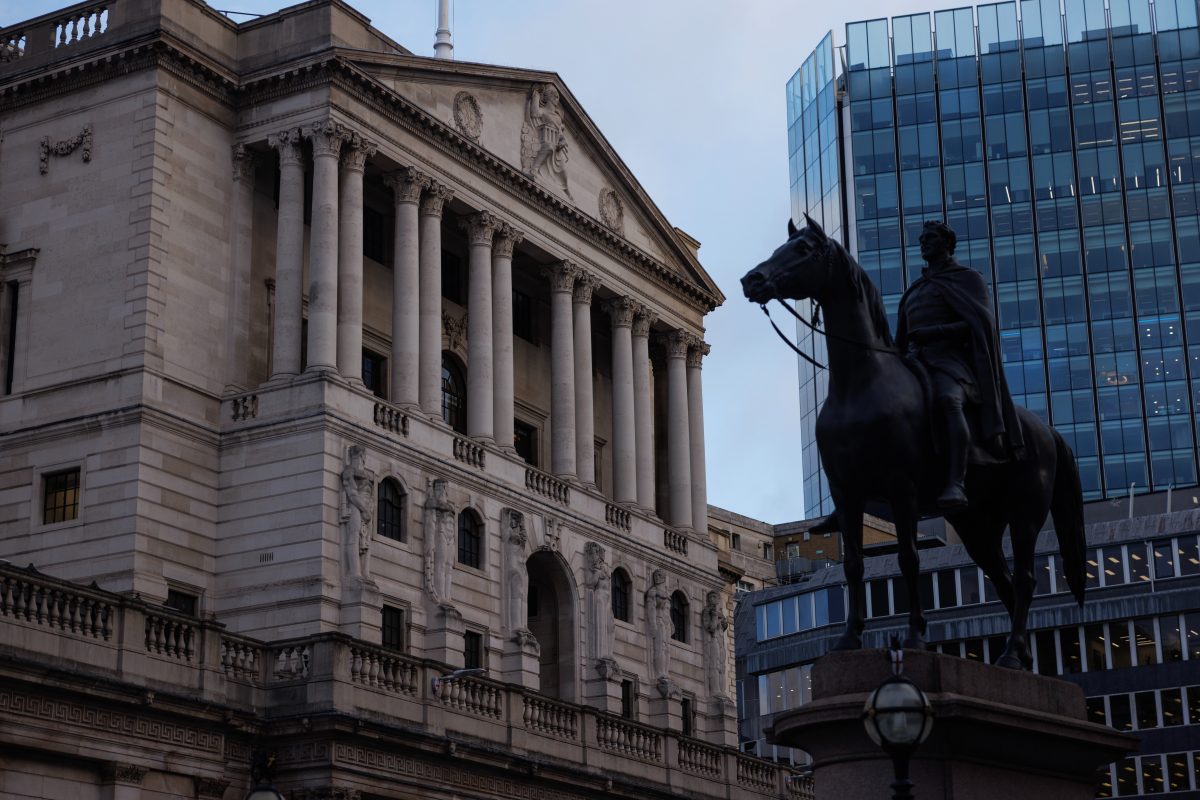
Photo via Daily Mail

Don't worry about AI... Quantum computing might well get you first, Bank Of England boss warns

Read the original at Daily Mail ↗
Cite

Rojas, J. p. F. (2026, November 27). Don't worry about AI... Quantum computing might well get you first, Bank Of England boss warns. Daily Mail. https://www.dailymail.com/money/markets/article-16325191/AI-Thats-Theres-bigger-tech-threat-says-Bank-England-boss.html?ns_mchannel=rss&ns_campaign=1490&ito=1490

Dated from the outlet's own feed. Check the original for its byline.

Daily Mail · collected 2026-11-27 · by John-paul Ford Rojas

Quick Summary

Bank of England governor Andrew Bailey warned about the emerging risks of quantum computing, suggesting it could pose greater threats than artificial intelligence. He highlighted potential vulnerabilities such as hackers using quantum technology to decrypt currently secure data, leading the Bank to advise commercial lenders to prepare for quantum-resistant encryption. Bailey also mentioned that some individuals are storing more cash at home as a precaution against technological disruptions.
Written by AI on 2026-11-27, from this article's own text only (the story summary below draws on all the coverage).

AI analysis

Story summary

The governor of the Bank of England, Andrew Bailey, warned on Thursday that quantum computing could pose greater risks than artificial intelligence (AI). Quantum computing, which harnesses the study of matter at the atomic scale, has the potential to solve complex problems beyond the capabilities of traditional computing. However, it also raises concerns about cybersecurity, as it could allow hackers to decode securely-encrypted data, potentially leading to "harvest now decrypt later" attacks. The Bank of England has now asked commercial lenders to guard against these risks, emphasizing the interconnectedness of global markets and the likelihood of stress spreading from one area to another. Bailey noted that households may start storing more cash at home in response to these heightened risks.

Written for “Quantum Computing Warning” on 2026-11-28, grounded in this article and the 0 other(s) covering the same event.

Compared with similar articles

This article reads unscored and hedges 32% of its claims. Each row says how that neighbour differs.
City AM
Leans strongly left Hedges 1 of 19 claims Outlet record 95/100
“The articles discuss different aspects of technology risks addressed by the Bank of England, with Article A focusing on quantum computing and Article B on AI financing.”

Story

Quantum Computing Warning
Technology · 1 article(s) covering the same event.
How this article was measured signals, leaning charts, publisher record, byline, topics and claims

Signals How these are calculated →

Claims extracted
31
sentences that state something as happening or true
Uncertain
32%
10 of 31 hedged ("reportedly", "may", "according to")
Leaning
not political
takes no side on a contested political question
Publisher signals
68/100
Daily Mail's corrections and hedging, across everything collected from it. Not a measure of accuracy.
Outlets on this story
1
Technology
Same framing elsewhere
1
articles that frame the event the way this one does
Analyzed 2026-11-27 · how these are computed

How this is being covered How these are calculated →

Article leaning vs. publisher reliability
Source leaning vs. consistency

Publisher

Daily Mail · 13534 article(s) · 29 correction(s) detected
Running correction rate · 29 correction(s)

Who wrote this

John-paul Ford Rojas
14 article(s) here · 1 carrying a prediction
The governor of the Bank of England on Thursday sounded the alarm about a new technology which could 'go beyond' the major risks posed by artificial intelligence (AI).
But it said a probe into whether he had been 'the target of a foreign intelligence effort' would 'proceed to conclusion'.
The number of people on UK payrolls fell by 34,000 in October The ONS said evidence from businesses was that 'smaller firms may not be recruiting because of labour costs and other economic conditions'. And while the overall unemployment rate crept lower to 4.6 per cent, the sustained decline in new job openings will further fuel concerns that Britain is becoming what Bank of England governor Andrew Bailey has called a 'low hire, low fire' economy.
It said that the government's 'hesitancy' in doing so risked making Britain's outlook even more painful and that balancing the books in the years ahead will instead rely on good luck.
The Bank of England has hiked interest rates and left the door open to a second increase before Christmas as it warned inflation could soar past 6 per cent.
That will add to the costs headache facing firms already being pummelled by the impact of Donald Trump’s Iran war, which has resulted in surging oil and gas prices.
Trade union Unite has urged Labour to consider nationalising Britain's Rough storage facility saying its closure would hit hundreds of jobs and make it harder to keep the lights on.
She said the increasing number of scams could mean major losses.
Figures from the International Monetary Fund (IMF) project that the UK tax burden will rise to 41.9 per cent of gross domestic product (GDP) by the start of the next Parliament.
The Bank of England’s leading interest rate 'hawk' has played down fears that there will be a succession of hikes over the coming year.
Also by John-paul Ford Rojas
Nothing else under this byline is closely related to this article, so these are simply their most recent.
All 14 articles by John-paul Ford Rojas →

Topics

Bank Bank of England Mythos the Bank of England

Subjects

Bank ORG · 7× Bailey PERSON · 3× Andrew Bailey PERSON · 2× Bank of England ORG · 1× Chinese NORP · 1× Jensen Huang PERSON · 1× Mythos ORG · 1× Nvidia ORG · 1× the Bank of England ORG · 1×

Narrative

The Bank said the huge expansion in AI financing 'in a form that is increasingly complex, circular and opaque' was deepening the interconnectedness of global markets 'making it increasingly likely for stress in one area to propagate to another'.
framing: mixed · carried by 1 article(s) · first seen 2026-11-27
The governor of the Bank of England on Thursday sounded the alarm about a new technology which could 'go beyond' the major risks posed by artificial intelligence (AI).

Claims (31 extracted, 10 hedged)

The governor of the Bank of England on Thursday sounded the alarm about a new technology which could 'go beyond' the major risks posed by artificial intelligence (AI). uncertain
which → sound → intelligence
Even as the threat of cyber attacks powered by AI mounts, Andrew Bailey said advances in quantum computing – which could unlock passwords – may add fresh dangers. uncertain
which → power → dangers
And Mr Bailey admitted that the increasing risks were likely to see households storing more cash at home in case of emergencies. asserted
households → admit → emergencies
Quantum computing harnesses the study of matter at atomic scale to solve problems beyond the ability of traditional computing. asserted
computing → harness → computing
A breakthrough in the field could represent a major advance for science with practical applications including for financial trading and payments. uncertain
breakthrough → represent → trading
But the Bank warned it could also pose major risks by enabling hackers to decode securely-encrypted data. uncertain
it → warn → data
Already, there are fears of 'harvest now decrypt later' attacks where hackers gather currently encrypted data with a view to unscrambling it when quantum developments allow in the future. asserted
developments → be → future
Bank of England chief Andrew Bailey said quantum computing could be more powerful than AI uncertain
computing → say → AI
For the first time on Thursday, the Bank asked commercial lenders to guard against the risks from quantum computing. asserted
Bank → ask → computing
It said they needed to step up preparations to use 'quantum resistant' encryption. asserted
they → say → encryption
Together with rapid advances in so-called 'frontier AI', developments in quantum could increase the risk of 'confidential data or secure critical processes' being hacked, the Bank said in its Financial Stability Report. uncertain
Bank → call → Report
As global tensions mount, the Bank said 'these technological developments could increase the risk and potential impact of malicious cyberattacks' that could disrupt markets and financial services. uncertain
that → mount → markets
Mr Bailey said: 'We can't forget about quantum computing. asserted
We → say → computing
It could and probably will have powers that will go beyond what we're seeing with frontier AI. uncertain
we → have → AI
Together, the latest frontier models and developments in quantum computing represent new risks that put the emergence of Mythos – a powerful AI programme whose emergence gripped policy makers earlier this year – in the shade. asserted
emergence → represent → shade
Mr Bailey said: 'The lifetime of these AI models is a very, very small number of months. asserted
lifetime → say → months
We talked about Mythos back in April. asserted
We → talk → April
We are aware that there is a latest version of models that are coming out of the production process on which the developers are expressing concerns – that these models have got even more powerful. asserted
models → be → concerns
Asked about whether people should stockpile cash in the face of all the risks, he said many were already storing it 'because they feel it is something of a contingency tool'. asserted
it → ask → tool
He added: 'I'm not for a moment going to say that's the wrong thing to do.' asserted
that → add → moment
The Bank is increasingly concerned about the risks posed by AI. asserted
Bank → pose → AI
Though the technology is helping to fuel economic growth, it is also both enabling cyber attacks and – because of the vast sums being spent on it – adding to strains on the financial system. asserted
it → help → system
A key factor is the growing use of so-called 'open-weight' AI models, many of them Chinese, which can be sourced for free unlike many of those provided by the big US tech firms. asserted
which → grow → firms
These become 'increasingly available to malicious actors' as they can be run more cheaply and with fewer safeguards than other models, the Bank said. asserted
Bank → become → models
Meanwhile US tech giants are expected to borrow more than $300bn this year to finance AI development, which includes the construction of vast data centres. asserted
which → expect → centres
Yet fears of a so-called 'AI bubble' are growing – as investors try to work out whether the enormous investments in AI will actually deliver sizeable returns. asserted
investments → call → returns
Recent drama at chip giant Nvidia – whose boss Jensen Huang was axed over a sex scandal before being reinstated after less than two weeks – has added to the volatility on markets. asserted
Huang → ax → markets
The Bank said the huge expansion in AI financing 'in a form that is increasingly complex, circular and opaque' was deepening the interconnectedness of global markets 'making it increasingly likely for stress in one area to propagate to another'. asserted
stress → say → another
Mr Bailey said a dramatic AI sell-off might even have the potential to hit UK bonds, known as gilts, in a way which might drive up UK borrowing costs. uncertain
which → say → costs
'I don't think any of us can rule out that something sufficiently big could have that effect,' he said. uncertain
he → think → effect
The Bank said recent outages of Google Cloud and Microsoft, which showed how problems at a single provider 'can affect many firms at once', highlighted the need for firms to guard against disruption. asserted
firms → say → disruption

Give feedback · no sign-in needed

No sign-in needed for now. Your note is sent without a name, so it cannot be answered.

History Support