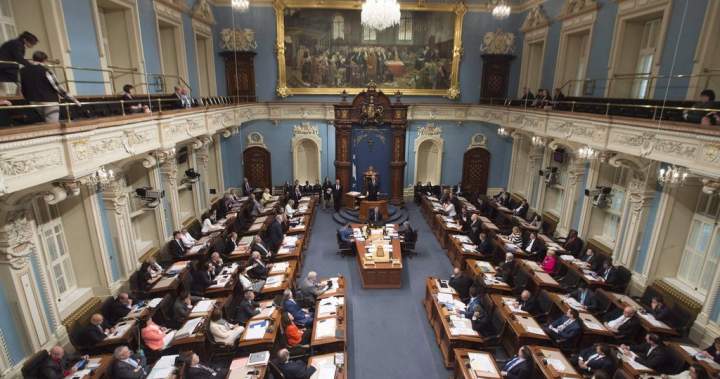
Photo via Global News

Supreme Court set to rule on Quebec secularism law in landmark Charter case

Read the original at Global News ↗
Cite

Maratta, A. (2026, November 26). Supreme Court set to rule on Quebec secularism law in landmark Charter case. Global News. https://globalnews.ca/news/12168107/supreme-court-quebec-bill-21-charter-ruling/

Dated from the outlet's own feed. Check the original for its byline.

Global News · collected 2026-11-27 · by Alessia Maratta

Quick Summary

The Supreme Court of Canada will deliver a ruling on Quebec’s secularism law, Bill 21, which bans public sector workers from wearing religious symbols. Passed in 2019, the law invokes the notwithstanding clause to override certain Charter rights. The court’s decision could set national precedents for the use of the notwithstanding clause, affecting other provinces' similar legislation. Legal experts predict this ruling could have far-reaching implications for how governments use Section 33 of the Constitution.
Written by AI on 2026-11-27, from this article's own text only (the story summary below draws on all the coverage).
See how they differ ↓

AI analysis

Story summary

On November 27, 2026, the Supreme Court of Canada delivered a landmark ruling on Quebec's Bill 21, which prohibits public sector workers in certain roles from wearing religious symbols. The decision, highly anticipated due to its potential to reshape how provinces use the Constitution’s notwithstanding clause, could affect fundamental rights and federal-provincial relations. Bill 21, introduced in 2019, faces sharp opposition, particularly from critics who argue it disproportionately targets religious minorities, especially Muslim women. The ruling could limit the use of the notwithstanding clause and expose the legislation to being overturned in the courts, potentially straining national unity.

Written for “Supreme Court Rules On Quebec Secularism Law” on 2026-11-27, grounded in this article and the 7 other(s) covering the same event.

How they differ

6 outlets covered “Supreme Court Rules On Quebec Secularism Law”.

What each outlet says

One AI summary per outlet of its latest article on this story, written from that article alone and checked against it. Open the article for the outlet's own words.

Global NewsThis outlet27 Nov

The Supreme Court of Canada will deliver a ruling on Quebec’s secularism law, Bill 21, which bans public sector workers from wearing religious symbols. Passed in 2019, the law invokes the notwithstanding clause to override certain Charter rights. The court’s decision could set national precedents for the use of the notwithstanding clause, affecting other provinces' similar legislation. Legal experts predict this…

Supreme Court set to rule on Quebec secularism law in landmark Charter case (this article)
Toronto Star26 Nov

The Supreme Court of Canada is set to deliver its ruling on Friday regarding the constitutionality of Quebec’s secularism law. The case could have significant implications for how provinces use the notwithstanding clause to override specific rights outlined in the Canadian Charter of Rights and Freedoms.

Supreme Court of Canada will rule on Quebec secularism law Friday →2 articles from Toronto Star on this story
The Globe and Mail26 Nov

Quebec is awaiting a Supreme Court ruling on Bill 21, which bans religious symbols for certain public servants, expected on Friday. The decision could restrict the use of the Charter of Rights and Freedoms' notwithstanding clause and potentially overturn the legislation, impacting Quebec’s politics and national unity. The Parti Québécois government hopes a controversial decision will bolster support for…

Quebec braces for Supreme Court decision on Bill 21 →2 articles from The Globe and Mail on this story
CBC26 Nov

Canada's Supreme Court is set to rule on Friday regarding Quebec's secularism law, Bill 21, which bans public sector workers from wearing religious symbols. The law, adopted in 2019, faces a constitutional challenge, with concerns that it violates the rights of religious minorities. The ruling is expected to determine the extent to which the notwithstanding clause can be used to bypass fundamental rights…

What's at stake as Canada's top court ruling on Quebec secularism law looms →
Toronto Sun26 Nov

The Supreme Court is set to decide on Quebec’s controversial Bill 21, which bans religious symbols for public sector employees. The case revolves around whether the court will uphold the use of the notwithstanding clause, which allows governments to override certain rights in the Charter of Rights and Freedoms. The article argues that the court should not limit or abolish the clause, which was a part of the…

LILLEY: Supreme Court setting Canada up for a crisis if it rewrites Constitution →
The Hindu27 Nov

On November 27, 2026, Canada's Supreme Court ruled on a Quebec law prohibiting certain public sector employees from wearing religious symbols. Passed in 2019, the law sparked intense legal debate over its impact on religious freedom and secularism. The case tests the extent to which provinces can use the "notwithstanding clause" to override constitutional protections, a move previously made by other conservative…

Canada’s top court rules on Quebec secularism law in landmark case →

Where they agree and split

Framing

How the first headlines put it

Stated as fact4
An achievement1
The headlines (5)

Why a Supreme Court ruling on a secularism law could reverberate across Canadian politics Toronto Star · stated as fact

What's at stake as Canada's top court ruling on Quebec secularism law looms CBC · stated as fact

LILLEY: Supreme Court setting Canada up for a crisis if it rewrites Constitution Toronto Sun · stated as fact

Supreme Court set to rule on Quebec secularism law in landmark Charter case Global News · stated as fact

The historic stakes in Friday’s landmark Supreme Court ruling on the Charter and Quebec’s Bill 21 The Globe and Mail · an achievement

Words to watch (1)

LILLEY: Supreme Court setting Canada up for a crisis if it rewrites Constitution Toronto Sun

The full story: what happened, how it changed, and all 8 articles →

Compared with similar articles

This article reads centre and hedges 17% of its claims. Each row says how that neighbour differs.
Toronto Star
Hedges 1 of 2 claims Outlet record 64/100
The Hindu
Leans right further right than this Hedges 2 of 20 claims Outlet record 72/100
Toronto Star
Leans right further right than this Hedges 11 of 35 claims Outlet record 64/100
The Globe and Mail
Leans right further right than this Hedges 4 of 39 claims Outlet record 52/100
Toronto Sun
Leans right further right than this Hedges 3 of 29 claims Outlet record 96/100
Global News
Hedges 0 of 6 claims Outlet record 63/100
“The articles discuss different legal rulings involving distinct laws and judicial bodies in Quebec, not the same specific incident.”
CBC News
Leans right further right than this Hedges 4 of 30 claims Outlet record 70/100
The Globe and Mail
Leans left further left than this Hedges 9 of 98 claims Outlet record 52/100
Al Jazeera
Hedges 8 of 68 claims Outlet record 60/100
“The articles discuss different aspects of the Quebec religious symbols ban; Article A focuses on a specific incident affecting a volunteer, while Article B discusses the broader legal context and upcoming Supreme Court ruling.”

Story

Supreme Court Rules On Quebec Secularism Law
Politics · 8 article(s) covering the same event. Compare every outlet's account →
How this article was measured signals, leaning charts, publisher record, byline, topics and claims

Signals How these are calculated →

Claims extracted
23
sentences that state something as happening or true
Uncertain
17%
4 of 23 hedged ("reportedly", "may", "according to")
Leaning
Centre
of the writing, not the subject · beta estimate
Publisher signals
63/100
Global News's corrections and hedging, across everything collected from it. Not a measure of accuracy.
Outlets on this story
8
Politics
Same framing elsewhere
1
articles that frame the event the way this one does
Analyzed 2026-11-27 · how these are computed

How this is being covered How these are calculated →

Article leaning vs. publisher reliability
Source leaning vs. consistency

Publisher

Global News · 3830 article(s) · 13 correction(s) detected
Running correction rate · 13 correction(s)

Who wrote this

Alessia Maratta
5 article(s) here · 1 carrying a prediction
Officials suspect the overdoses may be linked to medetomidine and/or xylazine in the local drug supply, with one test coming back positive for medetomidine.
The Supreme Court of Canada is set to hand down a highly anticipated ruling Friday on Quebec’s controversial secularism law, a decision that could change how provinces use the Constitution’s notwithstanding clause and override charter rights.
“The SPVM’s Professional Standards Division is continuing its investigation,” the police service said in a statement, adding it would not provide further details while the investigation is ongoing.
Montreal property owners could be facing a sharp increase in municipal taxes next year, with the average property tax rate potentially rising by 9.8 per cent.
Warning: This story deals with a sensitive issue that some readers may find upsetting.
Also by Alessia Maratta
Nothing else under this byline is closely related to this article, so these are simply their most recent.

Topics

Alberta Bill 21 Quebec Saskatchewan The Supreme Court of Canada

Subjects

Quebec GPE · 8× Alberta GPE · 2× Saskatchewan GPE · 2× the Supreme Court ORG · 2× Coalition Avenir Québec ORG · 1× François Legault PERSON · 1× Jewish NORP · 1× Muslim NORP · 1× Ontario GPE · 1× The Supreme Court of Canada ORG · 1×

Narrative

Bill 21 has faced sharp opposition since its introduction, with critics arguing it disproportionately targets racialized religious minorities, particularly Muslim women who wear the hijab, by forcing them to choose between some public sector jobs, like teaching, and their religious beliefs.
framing: assertive · carried by 1 article(s) · first seen 2026-11-27
The Supreme Court of Canada is set to hand down a highly anticipated ruling Friday on Quebec’s controversial secularism law, a decision that could change how provinces use the Constitution’s notwithstanding clause and override charter rights.

Claims (23 extracted, 4 hedged)

The Supreme Court of Canada is set to hand down a highly anticipated ruling Friday on Quebec’s controversial secularism law, a decision that could change how provinces use the Constitution’s notwithstanding clause and override charter rights. uncertain
provinces → set → rights
At the heart of the case is Bill 21, a provincial law adopted on June 16, 2019, by the Coalition Avenir Québec government led by then-premier François Legault. asserted
Bill → adopt → Legault
The government invoked closure to pass the legislation, which also pre-emptively invoked the notwithstanding clause. asserted
which → invoke → clause
The use of the notwithstanding clause shielded the law from challenges based on charter rights to freedom of conscience and religion and equality rights. asserted
use → shield → conscience
The law, designed to enforce state secularism, bars public sector workers in positions of authority from wearing religious symbols on the job, including hijabs, kippahs and turbans. asserted
law → design → hijabs
The law also requires people offering and receiving government services to have their faces uncovered while doing so. asserted
faces → require → services
But Friday’s ruling could have implications beyond the province of Quebec. uncertain
ruling → have → Quebec
The country’s top court has been asked to consider whether there are limits on governments’ use of Section 33 of the Constitution, known as the notwithstanding clause, which allows legislatures to override certain Charter rights. asserted
legislatures → ask → rights
Since 2019, Quebec, Ontario, Saskatchewan and Alberta have invoked the clause to shield controversial legislation from legal challenges, including laws restricting the rights of transgender people in Alberta and Saskatchewan and Quebec’s language-law reforms. asserted
Quebec → invoke → Alberta
Some legal observers say Friday’s decision could be studied by law students for generations, while others see it as a potential stepping stone toward lasting change rather than the final word. uncertain
others → say → word
The law applies to public school teachers, police officers, government lawyers and other officials. asserted
law → apply → teachers
A grandfather clause exempts those who were already employed before the bill was tabled, provided they do not change jobs. asserted
they → exempt → jobs
Bill 21 has faced sharp opposition since its introduction, with critics arguing it disproportionately targets racialized religious minorities, particularly Muslim women who wear the hijab, by forcing them to choose between some public sector jobs, like teaching, and their religious beliefs. asserted
who → face → teaching
- Advisory council to issue antisemitism report as Jewish groups call out campus hate - Summerland woman’s stolen family coin collection rebuilt by content creator - Restoring the bison population may be possible, ‘groundbreaking’ study finds - uncertain
study → issue → population
McGuinty investigating after Poilievre said nurse’s job threatened over photo Former premier Legault defended the legislation as a “moderate” way to settle Quebec’s long-running debate over secularism and religious accommodation. asserted
Legault → investigate → secularism
His government later extended the ban on religious symbols to everyone who interacts with children in public daycares, elementary schools and high schools, including volunteers. asserted
who → extend → volunteers
The law has been challenged by teachers, religious and civil liberties groups and the English Montreal School Board (EMSB), which argued it violates constitutional rights and exceeds Quebec’s legislative authority. asserted
it → challenge → authority
Lower courts upheld most provisions of the law, but the Supreme Court was also asked to determine whether Quebec properly used the notwithstanding clause, whether there are limits on its use and whether a court can still declare that Bill 21 violates Charter rights. asserted
Bill → uphold → rights
The Supreme Court heard the case over four days last March in what was one of the longest hearings in its history. asserted
what → hear → history
61 parties participated in the case, including 51 interveners, which the court says is a record number. asserted
court → participate → interveners
The federal government participated as an intervener and asked the court to impose limits on how provincial governments can override the Charter of Rights and Freedoms. asserted
governments → participate → Rights
Quebec’s newly elected premier and Parti Québécois Leader Paul St-Pierre Plamondon recently vowed to defend the province’s secularism laws. asserted
premier → elect → laws
He also pledged to extend the ban on religious symbols to schoolchildren. asserted
He → pledge → schoolchildren
Give feedback · no sign-in needed

No sign-in needed for now. Your note is sent without a name, so it cannot be answered.

History Support