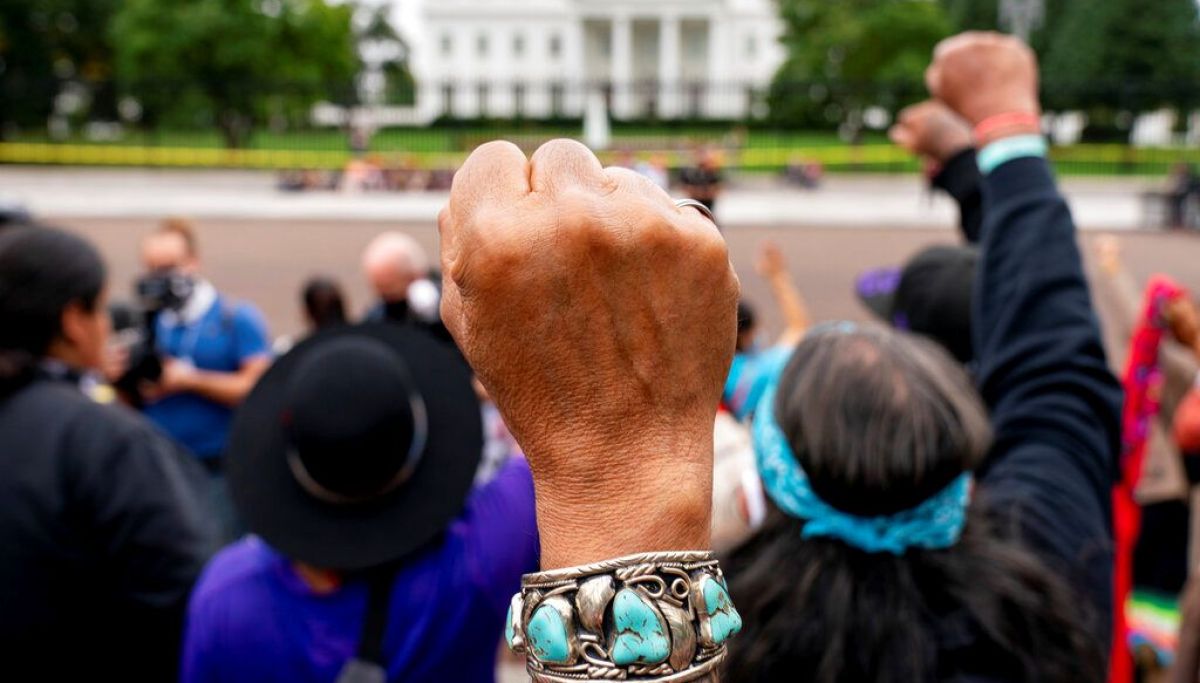
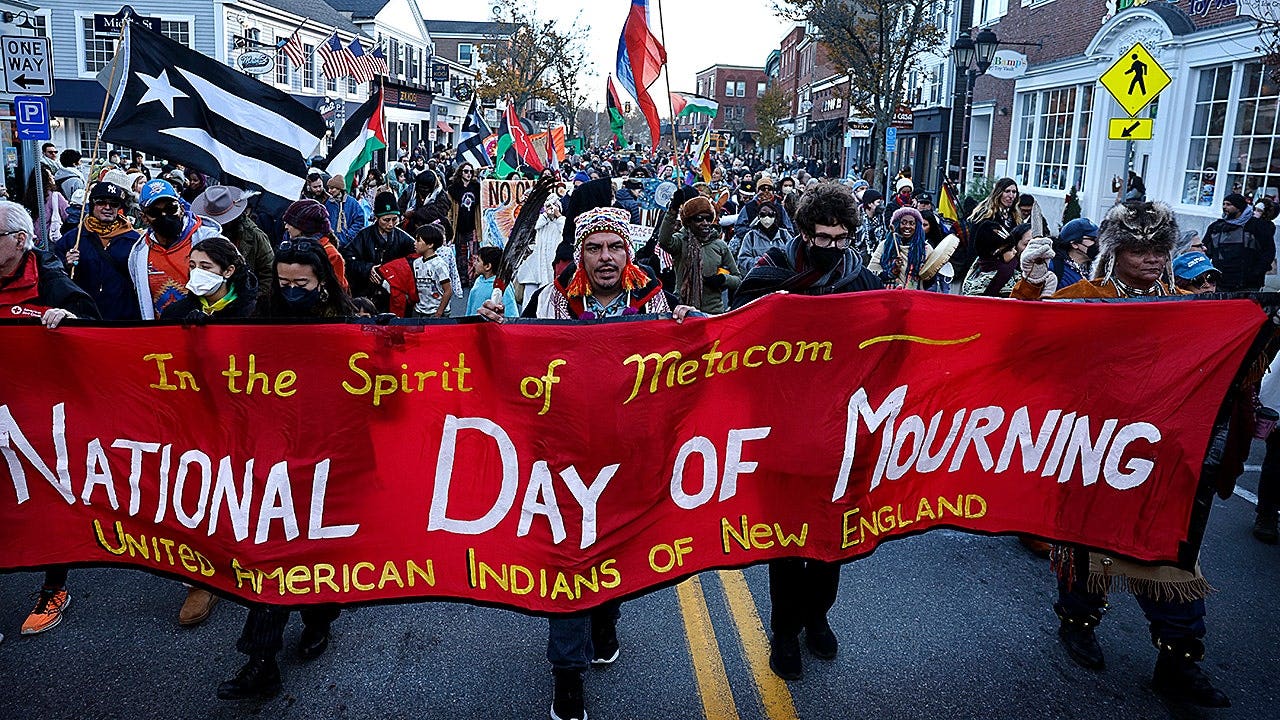
As millions of people across the United States meet with famiy and friends to celebrate Thanksgiving on Thursday, Indigenous people and their supporters will gather in Plymouth, Massachusetts, to mark the 57th annual National Day of Mourning.
asserted
people → meet → Mourning
For many Indigenous people, the traditional story of Thanksgiving overlooks centuries of colonisation, land dispossession and forced displacement.
asserted
story → overlook → colonisation
Recommended Stories
list of 3 items- list 1 of 3How a rejected Thanksgiving speech forged an Indigenous holiday tradition
- list 2 of 3Thanksgiving: A story of celebration and pain, in maps
- list 3 of 3Storms push Macy’s Thanksgiving Day Parade in New York City to Saturday
But
asserted
list → reject → Saturday
Indigenous activists say the day is also an opportunity to highlight the issues their communities continue to face, from the fight for sovereignty and the protection of their ancestral lands to the struggle to have their voices heard throughout the year.
asserted
voices → say → year
Here is what we know:
asserted
we → know → what
In the US, Thanksgiving Day is celebrated every year on the fourth Thursday of November; this year it falls on Thursday, November 26.
asserted
it → celebrate → Thursday
In 1863, during the US Civil War, President Abraham Lincoln proclaimed a national day of Thanksgiving to be observed on the last Thursday of November.
asserted
day → proclaim → November
In 1941, Congress officially established the fourth Thursday of November as Thanksgiving Day.
asserted
Congress → establish → Day
The National Day of Mourning is observed on the same day.
asserted
Day → observe → day
It’s an annual Indigenous-led gathering and protest held to honour Indigenous ancestors, challenge mainstream Thanksgiving narratives and draw attention to the ongoing struggles of Indigenous peoples.
asserted
It → ’ → peoples
It was first held in Plymouth, Massachusetts, in 1970.
asserted
It → hold → 1970
Other Indigenous-led gatherings and ceremonies take place elsewhere in the US, including the Indigenous Peoples Thanksgiving Sunrise Gathering on Alcatraz Island in California.
asserted
gatherings → lead → California
The US celebration commonly goes back to the autumn of 1621, when English settlers and members of the Wampanoag came together for a three-day harvest celebration in what is now Plymouth, Massachusetts.
asserted
what → go → celebration
But the tradition of giving thanks among Indigenous peoples goes way back before the arrival of European settlers.
asserted
tradition → give → settlers
“It did not take colonisation to bring a concept of Thanksgiving to this continent,” Jean-Luc Pierite, president of the North American Indian Center of Boston, told Al Jazeera.
asserted
Pierite → take → Jazeera
“For Indigenous peoples, we have had our ways of feasting, of expressing gratitude, of being in community,” he said.
asserted
he → have → community
In November 1620, a group of 102 colonists on board the Mayflower reached present-day Massachusetts.
asserted
group → reach → Massachusetts
They later established a settlement known as Plymouth on the ancestral lands of the Wampanoag people, at the site of a village known as Patuxet.
asserted
They → establish → Patuxet
Their arrival followed a series of devastating epidemics associated with European contact that had killed many Indigenous people in the region.
asserted
that → follow → region
In March 1621, the Wampanoag leader Ousamequin, also known as Massasoit, established an alliance with the English settlers for mutual protection.
asserted
leader → know → protection
Later that year, at least 90 Wampanoag men and about 50 English settlers took part in a harvest gathering that would later become known as the “first Thanksgiving”.
asserted
that → take → Thanksgiving
The moment was documented by English settler Edward Winslow.
asserted
moment → document → Winslow
This meeting became part of a story of friendship and cooperation between European settlers and Indigenous peoples.
asserted
meeting → become → settlers
But some Indigenous activists and leaders have contested that narrative, saying it ignores the broader history of colonisation, land dispossession and displacement.
asserted
it → contest → colonisation
It was more than two centuries after the gathering, in 1863, that Lincoln proclaimed a national day of Thanksgiving.
asserted
Lincoln → proclaim → Thanksgiving
The proclamation came in the middle of the American Civil War and followed a years-long campaign led by Sarah Josepha Hale, a writer and editor best known as the author of Mary Had a Little Lamb.
asserted
Mary → come → Lamb
What does the traditional Thanksgiving story leave out?
asserted
story → leave → What
For some, the popular Thanksgiving narrative ignores centuries of violence, land dispossession and forced displacement.
asserted
narrative → ignore → violence
“There is a sanitised version of history in which settlers and Indigenous peoples come together and share a meal,” Pierite said.
asserted
Pierite → be → meal
He said that this portrayal overlooks the loss of Indigenous lands and lives over the past 400 years.
asserted
portrayal → say → years
As European settlements expanded, the Indigenous peoples lost enormous parts of their traditional lands through war, forced relocation and broken treaties.
asserted
peoples → expand → war
In 1830, President Andrew Jackson signed the Indian Removal Act, which led to the forced displacement of tens of thousands of Indigenous peoples from their homelands.
asserted
which → sign → homelands
Later legislation broadened the reservation system and permitted ownership of tribal lands by non-Indigenous people.
asserted
legislation → broaden → people
Indigenous landholdings declined from about 138 million acres (56 million hectares) in 1887 to 48 million acres (19 million hectares) in 1934.
asserted
landholdings → decline → 1934
“More than 400 years after the arrival of the Mayflower, Indigenous people are still denied basic human rights and full control of their own homelands,” Kisha James, co-leader of the United American Indians of New England (UAINE), who is Aquinnah Wampanoag and Oglala Lakota, said in a statement.
asserted
who → deny → statement
What is the National Day of Mourning, and why did it begin?
asserted
it → begin → Mourning
The National Day of Mourning was first held in 1970 after Wamsutta Frank James, an Aquinnah Wampanoag activist, was invited to speak at an event marking the 350th anniversary of the Pilgrims’ arrival.
asserted
James → hold → arrival
After the organisers objected to his speech on the history of violence, land seizure and treatment of Indigenous peoples, James refused to deliver a different version.
asserted
James → object → version
Instead, Indigenous people and their supporters gathered in Plymouth on Thanksgiving Day, starting what would become an annual protest.
asserted
what → gather → Day
The gathering, organised by the United American Indians of New England (UAINE), has since become a day of remembrance, resistance and advocacy for Indigenous rights.
asserted
gathering → organise → rights
…and 29 more, not listed.
 The Aporia