The National Weather Service’s Climate Prediction Center sent out an advisory Monday that El Niño continues to strengthen as forecasters record ocean warming and atmospheric disruptions globally.
asserted
forecasters → send → warming
“Chances for a historic event exceeding previous El Niños dating back to 1950 … are now ~60%,” it said.
asserted
it → exceed → 1950
In an update on a weekly report from Nov. 12, the advisory showed more than a 79% chance of remaining strong to very strong through January–March 2027.
asserted
advisory → show → January
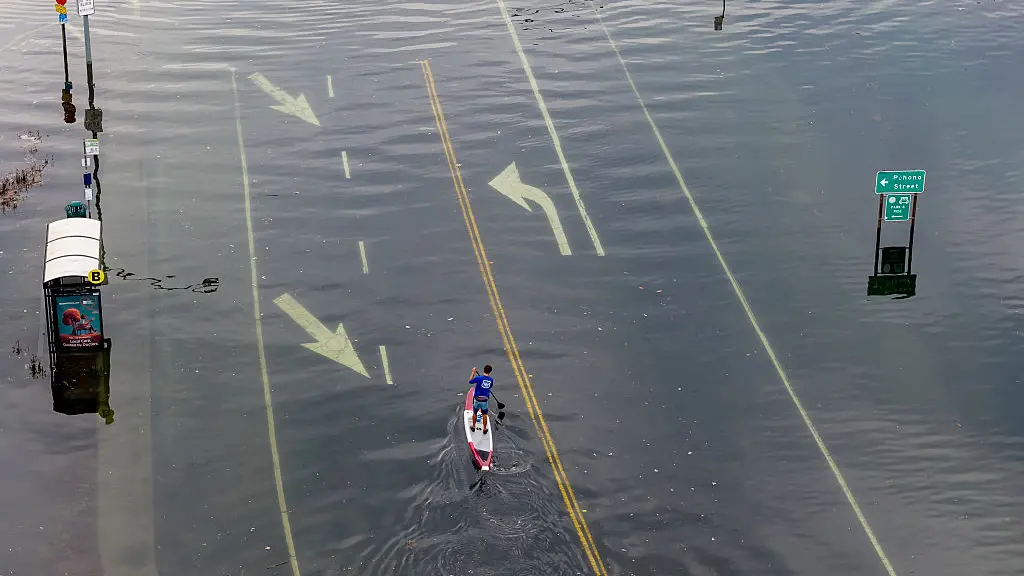
The advisory comes as Thanksgiving week brings heavy rain, coastal flooding, and mountain snow to both coasts, elevating flood risks in California and Florida.
asserted
week → come → California
What is El Niño and how is it affecting the U.S.?
asserted
it → affect → U.S.
El Niño refers to the warm phase of the El Niño-Southern Oscillation (ENSO) cycle, and it occurs every two to seven years when surface waters in the eastern and central tropical Pacific become unusually warm, reaching at least 0.5 degrees Celsius above average.
asserted
waters → refer → average
This ocean heat is released eventually into the atmosphere, and influences atmospheric circulation, temperatures, precipitation and other weather events around the globe.
asserted
heat → release → globe
Though the phenomenon is relatively common, this year’s El Niño has earned headlines for being among the strongest of its kind on record, partially because it's arriving on top of an ocean that is already warmer than it used to be.
asserted
it → earn → ocean
Andrew Kruczkiewicz, senior researcher at the International Research Institute for Climate and Society at Columbia University, tells TIME that the effects of El Niño are region-dependent—which is why it is both associated with warmer, drier winters in the North, and wetter winters in the South, ice storms across the southern Plains.
asserted
it → tell → Plains
“The impacts from El Nino across the U.S. are not uniform—El Nino does not lead to everyone seeing above average temperatures for winter or everybody seeing above average rainfall or everybody seeing below average rainfall,” he says.
asserted
he → lead → rainfall
Risper Nyairo, assistant professor of environmental studies at Davidson College, calls it a “seesaw system” that depends on the pressure systems in each region.
asserted
that → call → region
“The whole idea behind this is really the pressure—pressure changes with the temperatures of our waters,” she says.
asserted
she → say → waters
“So if you are in a low-pressure zone, those tend to be warmer areas, which encourage air to rise and condense and form clouds and precipitation.
asserted
air → tend → clouds
If you are on the opposite side of it, which is a high-pressure zone, then your winds are sort of sinking, which means precipitation is not forming, and you get a drought.
asserted
you → sink → drought
But some of these impacts are already rearing their heads, showing how the systems are strengthening and could ripple across the world.
uncertain
systems → rear → world
Near Ecuador’s Galápagos Islands, off the coast of Peru, sea surface temperatures show an anomaly of +10 degrees Celsius, according to meteorologist Ryan Maue, meaning the ocean surface at that specific location and time of year is 10 degrees warmer than the long-term historical average.
uncertain
surface → show → average
High tides in California and Florida
The effects of El Niño are being seen in California, where a mixture of seasonal “king tides” combined with an unusually strong El Niño and large Pacific swells are driving near-record to record coastal water levels and flooding across California this week.
asserted
mixture → see → California
King tides are unusually high tides caused by the alignment and positions of the moon and sun.
asserted
tides → cause → moon
El Niño has raised coastal water levels, increasing the risk of flooding when those tides arrive.
asserted
tides → raise → flooding
It also predicted “numerous road closures” in San Francisco on Wednesday, claiming there could be up to 2.7 feet of flooding above ground level in coastal regions.
uncertain
It → predict → regions
In Central California, Santa Cruz temporarily closed its beaches and wharf, and local officials issued evacuation warnings covering roughly 200 coastal homes.
asserted
officials → close → homes
NOAA’s Los Angeles tide gauge recorded more high-tide flooding days than in any previous year in its record.
asserted
gauge → record → record
Potential drought relief in the South
El Niño's strengthening, according to NOAA, is likely to bring a wetter-than-average winter to parts of the southern United States, particularly the Southeast, which has been plagued by drought throughout 2026.
uncertain
which → accord → 2026
NOAA said in mid-November that much of the Southeast has a 50% chance or greater for above-normal precipitation during winter—a probability that could increase with a strengthening El Niño.
uncertain
that → say → Niño
This relief is already beginning, with coastal storms developing off the coast of Florida, Georgia, and South Carolina this week.
asserted
storms → begin → Florida
“We are expected to have more precipitation, and we are seeing some of that in Florida, where some locations have reported receiving precipitation that is greater than a year's worth of rain within a day or two,” Nyairo says.
asserted
Nyairo → expect → day
She says that this drought relief in some regions is a rare “positive” to El Niño this year.
asserted
relief → say → Niño
But with drought relief comes elevated risk of flooding over the winter—one people in low-lying regions should take seriously.
asserted
people → come → regions
“I would say you know if you've seen the map and you are in a location where you think there might be above-average precipitation, you should be taking the warning seriously, especially with flooding,” she adds.
uncertain
she → say → flooding
 The Aporia