Photo via ABC News (AU)

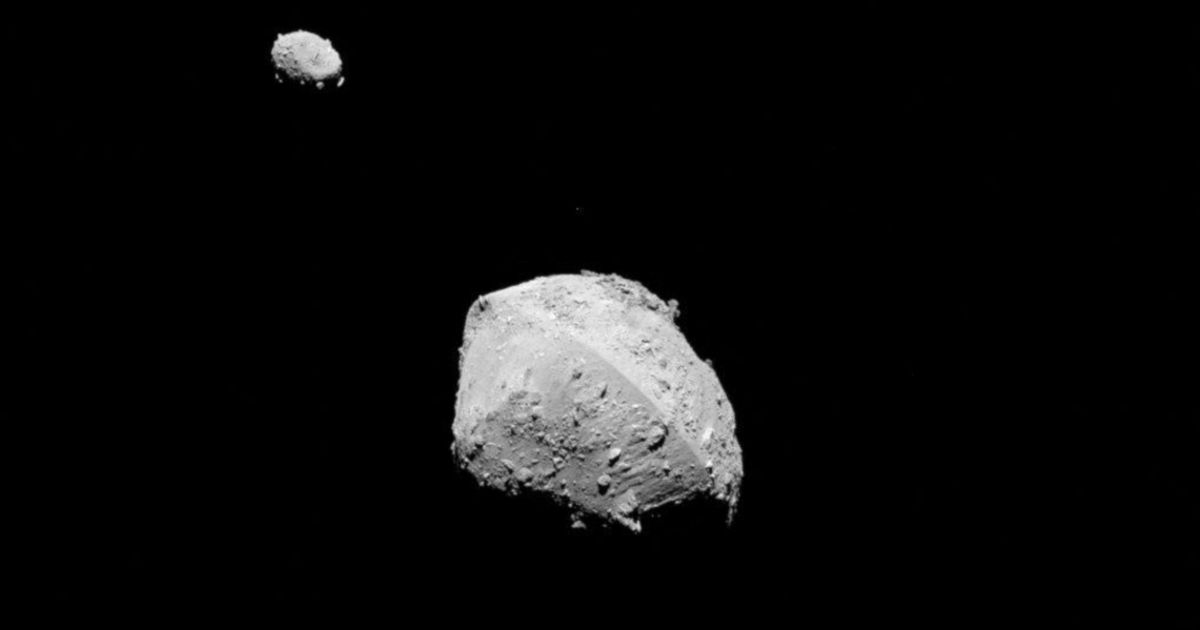
New photos reveal stadium-sized crater in asteroid knocked off course by NASA

Read the original at ABC News (AU) ↗
Cite

New photos reveal stadium-sized crater in asteroid knocked off course by NASA. (2026, November 25). ABC News (AU). https://www.abc.net.au/news/2026-11-26/new-photos-of-struck-asteroid-dimorphos/107428078

Dated from the outlet's own feed. Check the original for its byline.

ABC News (AU) · collected 2026-11-25

Quick Summary

New photos from the European Space Agency's Hera spacecraft reveal a stadium-sized crater on the asteroid Dimorphos, caused by NASA's DART spacecraft impact in September 2022. The crater covers nearly the entire front side of Dimorphos, which orbits the larger asteroid Didymos, and the asteroid is now tumbling chaotically with hundreds of boulders floating around it. Hera, about the size of a small car, is currently observing the asteroid pair from a distance of 25–30 km and will approach within 13 km next month to capture higher-resolution images.
Written by AI on 2026-11-25, from this article's own text only (the story summary below draws on all the coverage).
See how they differ ↓

AI analysis

Story summary

Nasa's Dart spacecraft collided with the asteroid Dimorphos in 2022 to test planetary defense technology, and ESA's Hera spacecraft recently arrived at the asteroid to assess the impact. New images show a stadium-sized crater on Dimorphos, confirming that the mission successfully altered the asteroid's orbit. Dimorphos, which is 150m wide, orbits a larger asteroid called Didymos, and the pair pose no threat to Earth. The mission demonstrated the feasibility of using spacecraft to change the trajectory of an asteroid headed towards Earth, a crucial step in planetary defense strategies.

Written for “DART Mission Crater Revealed” on 2026-11-26, grounded in this article and the 6 other(s) covering the same event.

How they differ

6 outlets covered “DART Mission Crater Revealed”.

What each outlet says

One AI summary per outlet of its latest article on this story, written from that article alone and checked against it. Open the article for the outlet's own words.

ABC News (AU)This outlet25 Nov

New photos from the European Space Agency's Hera spacecraft reveal a stadium-sized crater on the asteroid Dimorphos, caused by NASA's DART spacecraft impact in September 2022. The crater covers nearly the entire front side of Dimorphos, which orbits the larger asteroid Didymos, and the asteroid is now tumbling chaotically with hundreds of boulders floating around it. Hera, about the size of a small car, is currently…

New photos reveal stadium-sized crater in asteroid knocked off course by NASA (this article)
BBC26 Nov

NASA released footage and images showing the impact of its spacecraft on the asteroid Dimorphos in 2022, revealing a significant crater. The mission, aimed at testing methods to protect Earth from potential asteroid threats, has now been followed up by the ESA's Hera spacecraft, which is analyzing the aftermath of the collision. The BBC's science editor, Rebecca Morelle, provides an explanation of the mission's…

Moment Nasa spacecraft hit asteroid - and what happened next →2 articles from BBC on this story
CBC25 Nov

NASA's DART mission successfully crashed a spacecraft into the moonlet Dimorphos of the binary asteroid system Didymos in September 2022, changing its orbit by about 33 minutes, more than the anticipated 10 minutes. Four years later, the European Space Agency's Hera mission has released close-up images showing a significant crater on Dimorphos and hundreds of boulders moving around the pair of asteroids, the origin…

Remember when NASA slammed a spacecraft into an asteroid? We now have close-up images of the aftermath →
The Straits Times26 Nov

Images released on November 25 by the European Space Agency’s Hera spacecraft show that the asteroid Dimorphos, struck by NASA’s DART spacecraft in September 2022, now has a large stadium-sized crater and is tumbling in space. The impact caused significant changes to one side of the asteroid, which is about 151 meters wide, while the opposite side remained largely unchanged. Hera is observing the asteroid pair from…

New images reveal crater on asteroid struck by DART spacecraft →
Dawn26 Nov

The European Space Agency’s Hera spacecraft has revealed new images of the asteroid Dimorphos, which shows a stadium-sized crater created by NASA’s DART spacecraft collision in 2022. The impact has caused Dimorphos to tumble chaotically in space, with hundreds of boulders floating around in the system. Dimorphos, a 495-foot-wide asteroid orbiting the larger Didymos asteroid, is now about 193.5 million kilometers…

New images reveal crater on small asteroid struck by spacecraft in 2022 →
Times of India26 Nov

The European Space Agency released the first images of the asteroid Dimorphos, showing a stadium-sized crater created by Nasa’s Dart spacecraft impact in 2022. The images, captured by the ESA’s Hera spacecraft, reveal that Dart collided with Dimorphos at 14,000 miles per hour, changing the asteroid's orbit by 33 minutes, demonstrating the potential to deflect asteroids from a collision course with Earth. Hera’s…

Nasa's asteroid crash test left stadium-sized crater; first images reveal →

Compared with similar articles

This article reads unscored and hedges 10% of its claims. Each row says how that neighbour differs.
The Straits Times
Hedges 1 of 21 claims Outlet record 64/100
BBC News
Hedges 9 of 41 claims Outlet record 65/100
BBC News
Hedges 0 of 6 claims Outlet record 65/100

Story

DART Mission Crater Revealed
Science · 7 article(s) covering the same event. See how they differ ↑
How this article was measured signals, leaning charts, publisher record, byline, topics and claims

Signals How these are calculated →

Claims extracted
20
sentences that state something as happening or true
Uncertain
10%
2 of 20 hedged ("reportedly", "may", "according to")
Leaning
not political
takes no side on a contested political question
Publisher signals
66/100
ABC News (AU)'s corrections and hedging, across everything collected from it. Not a measure of accuracy.
Outlets on this story
7
Science
Same framing elsewhere
1
articles that frame the event the way this one does
Analyzed 2026-11-25 · how these are computed

How this is being covered How these are calculated →

Article leaning vs. publisher reliability
Source leaning vs. consistency

Publisher

ABC News (AU) · 6664 article(s) · 13 correction(s) detected
Running correction rate · 13 correction(s)

Who wrote this

No reporter is named on this article.

Topics

DART ESA European Space Agency's Hera NASA

Subjects

Küppers PERSON · 2× NASA ORG · 2× ESA ORG · 1× European Space Agency's ORG · 1× Michael Küppers PERSON · 1× Reuters ORG · 1×

Narrative

The DART, short for Double Asteroid Redirection Test, spacecraft collided with Dimorphos on September 26, 2022, at about 22,530 km/h. "We knew that the DART mission impacted Dimorphos successfully and that it changed its orbit," Dr Küppers said. "But we did not know what happened to Dimorphos itself. "
framing: assertive · carried by 1 article(s) · first seen 2026-11-25
The Hera spacecraft will approach within 13km of Dimorphos next month, obtaining increasingly higher-resolution images.

Claims (20 extracted, 2 hedged)

In short: Dimorphos was left with one side flattened with a stadium-sized crater when NASA's DART struck it. asserted
DART → leave → it
DART was sent on a proof-of-principle mission for using a spacecraft to change a celestial object's trajectory in 2022. asserted
DART → send → 2022
The Hera spacecraft will approach within 13km of Dimorphos next month, obtaining increasingly higher-resolution images. asserted
spacecraft → approach → images
NASA's test of its planetary defence DART spacecraft in 2022 left a stadium-sized crater in the asteroid Dimorphos, new photos show. asserted
photos → leave → asteroid
The asteroid remains tumbling in space, according to the new images from European Space Agency's Hera spacecraft. uncertain
asteroid → tumble → spacecraft
DART was sent on a proof-of-principle mission for using a spacecraft to change a celestial object's trajectory. asserted
DART → send → trajectory
Dimorphos, an oblong rocky object about 151 metres wide, orbits its companion asteroid Didymos, with a diameter of 730 metres, and the pair is currently about 193.5 million kilometres from Earth. asserted
pair → orbit → Earth
They are defined as near-Earth asteroids, though neither object imperils Earth. asserted
object → define → Earth
Previous data showed how DART succeeded in changing the path of Dimorphos, demonstrating that a spacecraft could alter the trajectory of an object headed toward a collision with Earth. uncertain
spacecraft → show → Earth
Hera is now getting a close-up look at how DART physically changed Dimorphos. asserted
DART → get → Dimorphos
"The side impacted is now completely covered by a crater, with the visual impression that a piece of the asteroid was cut off by the impact," Michael Küppers, ESA's Hera mission scientist, said. asserted
Küppers → impact → impact
"We do not see evidence for major changes on the site opposite to the DART impact. " asserted
We → see → impact
The big crater covers nearly the whole front side of Dimorphos as it continues its orbit of Didymos. asserted
it → cover → Didymos
"Dimorphos is now tumbling in a chaotic way," Dr Küppers said. " asserted
Küppers → tumble → way
" Hera, about the size of a small car, is presently observing Didymos and Dimorphos from a distance of about 25–30 km. asserted
Hera → observe → km
Hera next month is slated to approach within 13 km of the pair, obtaining increasingly higher-resolution images. asserted
month → slat → images
In January, Hera is due to deploy two shoebox-sized miniature satellites, called CubeSats, that will approach even closer for further study, including investigating the interior structure of the two asteroids. asserted
that → deploy → asteroids
Hera's mission manager unveiled the new images at a dinosaur hall in the Museum für Naturkunde Berlin as a reminder of the danger of asteroid impacts like the one 66 million years ago that caused a mass extinction on Earth and doomed the dinosaurs. asserted
that → unveil → dinosaurs
The DART, short for Double Asteroid Redirection Test, spacecraft collided with Dimorphos on September 26, 2022, at about 22,530 km/h. "We knew that the DART mission impacted Dimorphos successfully and that it changed its orbit," Dr Küppers said. "But we did not know what happened to Dimorphos itself. " asserted
what → collide → Dimorphos
The investigation of what the impact did to Dimorphos and the characterisation of it in general is needed to be able to apply the kinetic impactor technique to another asteroid, should we find one on a collision course with Earth." asserted
we → need → Earth

Give feedback · no sign-in needed

No sign-in needed for now. Your note is sent without a name, so it cannot be answered.

History Support