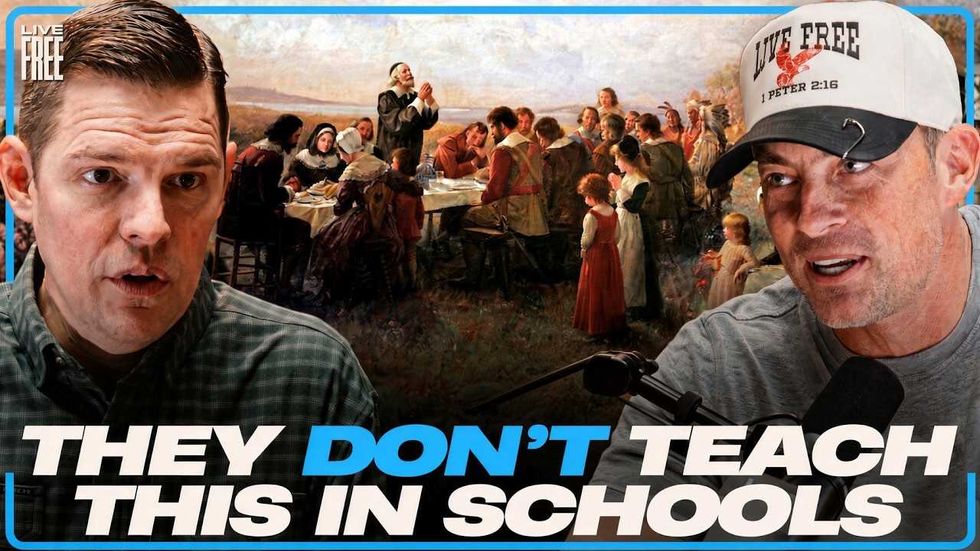
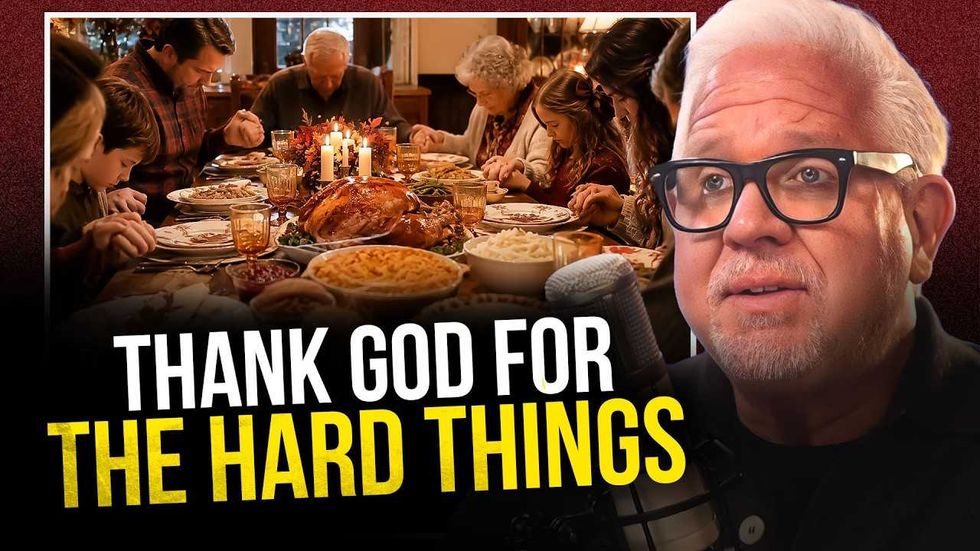
On 'Live Free,' Josh Howerton and historian Tim Barton reveal how God used Squanto's suffering, much like Joseph's in Genesis, to save the Pilgrims.
asserted
God → live → Pilgrims
Every November, the left pushes the same narrative: Thanksgiving isn't a celebration of gratitude but rather of European settlers slaughtering Native Americans.
asserted
settlers → push → Americans
One viral video that is circulating claims that "after every killing of a whole village," the settlers "celebrated it and they called it Thanksgiving.
uncertain
they → circulate → it
But what do the primary sources actually say?
asserted
sources → say → what
Historian Tim Barton, co-author of "The American Story," has spent years gathering the facts about America's founding, including the origins of Thanksgiving.
asserted
Barton → spend → Thanksgiving
On a recent episode of BlazeTV's "Live Free," host Josh Howerton and Barton dive into the true story of Thanksgiving and the remarkable role Squanto played in it.
asserted
Squanto → live → it
After fleeing religious persecution in England and spending 11 years in Holland, about 40 Pilgrims crossed the Atlantic on the Mayflower in 1620 so they could worship God freely, only to be blown off course to Massachusetts, where roughly half of them died during the first brutal winter.
Enter Squanto with his lifesaving advice.
uncertain
half → flee → advice
"This is my favorite part of the story," Barton says, "because … for Bible people, this is Joseph in Genesis."
asserted
this → say → Genesis
Genesis recounts the story of how Joseph was sold into slavery by his jealous brothers but over time rose to become Pharaoh's second-in-command.
asserted
Joseph → recount → command
Ironically, he ended up saving his entire family from starvation after he interpreted Pharaoh's dreams and created a plan to see Egypt through the famine.
asserted
he → end → famine
"What [Joseph’s brothers] meant for evil, God used for good," Barton says.
asserted
Barton → mean → good
Squanto's story, he says, follows a similar trajectory.
asserted
he → say → trajectory
Like Joseph, Barton says, Squanto was kidnapped and sold into slavery — in his case, in 1614 by an English ship captain named Thomas Hunt.
asserted
Squanto → say → captain
After being rescued by Spanish friars, who took him in and likely schooled him in the Christian faith, Squanto traveled to England and was hired by an English merchant.
asserted
Squanto → rescue → merchant
In this position, he learned "English customs, the culture, and the language," as well as the merchant trade, Barton explains.
asserted
Barton → learn → customs
After about five years abroad, Squanto returned home, only to discover that his tribe had been wiped out by disease.
asserted
tribe → return → disease
He ended up joining the neighboring Wampanoag tribe — the very tribe headed by Chief Massasoit, who would soon make a peace and mutual-defense treaty with the Pilgrims.
asserted
who → end → Pilgrims
In an act Howerton describes as the "providence of God," the Pilgrims happened to settle on Squanto's own vacant tribal land, which other tribes wanted nothing to do with given the death that had happened there.
asserted
that → describe → death
Knowing the land intimately and being fluent in English and familiar with the culture, Squanto, like Joseph, became the savior of the countrymen of the very captain who had enslaved him years before.
asserted
who → know → him
"It's almost like Squanto's heart was burdened to help these people that have no clue.
asserted
that → burden → clue
And so he lives with them for the next 20 months," Barton says, recounting how Squanto taught the settlers how to cultivate and live off the land.
asserted
Squanto → live → land
Barton points out that Plymouth Colony Gov. William Bradford saw Squanto as a gift from God.
asserted
Bradford → point → God
In his journal, Bradford called Squanto "a special instrument sent of God for their good beyond their expectation.
asserted
Bradford → call → expectation
"
In the fall of 1621, after their first harvest, the settlers wanted to celebrate with a "feast festival day" and include their "native friends," Barton explains.
asserted
Barton → want → friends
At this first Thanksgiving feast, there were the 53 surviving settlers, many of whom were women and children, and Chief Massasoit, along with "90 male warriors."
asserted
many → be → warriors
Barton says that these numbers are significant because they debunk the "prevailing narrative" that Thanksgiving should be a "day of mourning."
While he acknowledges that there are "other stories" where native peoples were mistreated, "that's not what this story is."
"When Chief Massasoit shows up with 90 warrior braves against 53 pilgrims, and only 22 of them adult-age male, had Chief Massasoit had ill feelings toward them, had he thought they were stealing our land, that first Thanksgiving would have gone real different," Barton says.
asserted
Barton → say → land
Chief Massasoit's men, he adds, were actually the ones who "brought the meat."
asserted
who → add → meat
"They enjoyed themselves so much they stayed for three days, and during that three days … they had races and wrestling matches.
asserted
they → enjoy → races
They played games.
asserted
They → play → games
They had shooting competitions," Barton continues.
asserted
Barton → have → competitions
In addition to this gathering of vastly different people groups, the first Thanksgiving, he explains, was also a beautiful example for Christians of what it looks like to praise God amid suffering.
asserted
it → explain → suffering
The Pilgrims' numbers had dwindled by nearly half, leaving children orphaned and people grieving their lost ones, and yet they chose to be thankful anyway.
asserted
they → dwindle → ones
"Paul writes, 'In everything give thanks, for this is the will of God for you in Christ Jesus.'
asserted
this → write → Jesus
These [Pilgrims] found a way …
asserted
Pilgrims → find → way
This is part of what their Thanksgiving was — like ‘God, thank you that any of us made it because we all could have died.
uncertain
we → thank → it
Thank you, God, for the friends now you've given us that we have a chance to survive in the New World,’" Barton says.
asserted
Barton → thank → World
"The day of Thanksgiving that ends up being a feast and festival for three days, it really was them enjoying the new friends that God had given them," he continues.
asserted
he → end → them
As for Squanto, it appears the Pilgrims' faith left its mark on him.
asserted
faith → appear → him
According to Bradford's journal, a dying Squanto asked the governor "to pray for him, that he might go to the Englishmen's God in heaven.
uncertain
he → accord → heaven
"
"[The Pilgrims] never lost sight of part of why we are here is the advancement of the gospel of Jesus Christ," Barton says.
To hear more, watch the episode above.
asserted
Barton → lose → episode
 The Aporia