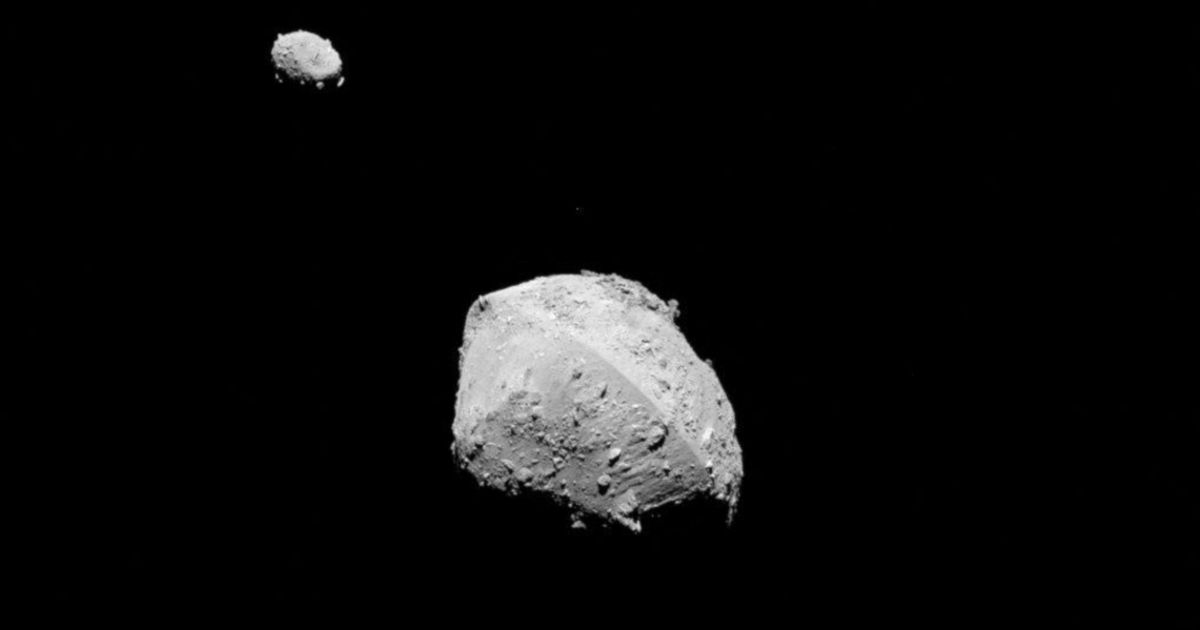
Photo via CBC News

Remember when NASA slammed a spacecraft into an asteroid? We now have close-up images of the aftermath

Read the original at CBC News ↗
Cite

Mortillaro, N. (2026, November 25). Remember when NASA slammed a spacecraft into an asteroid? We now have close-up images of the aftermath. CBC News. https://www.cbc.ca/news/science/esa-hera-mission-dimorphos-didymos-9.7435354?cmp=rss

Dated from the outlet's own feed. Check the original for its byline.

CBC News · collected 2026-11-25 · by Nicole Mortillaro

Quick Summary

NASA's DART mission successfully crashed a spacecraft into the moonlet Dimorphos of the binary asteroid system Didymos in September 2022, changing its orbit by about 33 minutes, more than the anticipated 10 minutes. Four years later, the European Space Agency's Hera mission has released close-up images showing a significant crater on Dimorphos and hundreds of boulders moving around the pair of asteroids, the origin of which remains unclear. The Hera mission scientist expresses excitement over the detailed insights into the impact's aftermath.
Written by AI on 2026-11-25, from this article's own text only (the story summary below draws on all the coverage).
See how they differ ↓

AI analysis

Story summary

Nasa's Dart spacecraft collided with the asteroid Dimorphos in 2022 to test planetary defense technology, and ESA's Hera spacecraft recently arrived at the asteroid to assess the impact. New images show a stadium-sized crater on Dimorphos, confirming that the mission successfully altered the asteroid's orbit. Dimorphos, which is 150m wide, orbits a larger asteroid called Didymos, and the pair pose no threat to Earth. The mission demonstrated the feasibility of using spacecraft to change the trajectory of an asteroid headed towards Earth, a crucial step in planetary defense strategies.

Written for “DART Mission Crater Revealed” on 2026-11-26, grounded in this article and the 6 other(s) covering the same event.

How they differ

6 outlets covered “DART Mission Crater Revealed”.

What each outlet says

One AI summary per outlet of its latest article on this story, written from that article alone and checked against it. Open the article for the outlet's own words.

CBCThis outlet25 Nov

NASA's DART mission successfully crashed a spacecraft into the moonlet Dimorphos of the binary asteroid system Didymos in September 2022, changing its orbit by about 33 minutes, more than the anticipated 10 minutes. Four years later, the European Space Agency's Hera mission has released close-up images showing a significant crater on Dimorphos and hundreds of boulders moving around the pair of asteroids, the origin…

Remember when NASA slammed a spacecraft into an asteroid? We now have close-up images of the aftermath (this article)
BBC26 Nov

NASA released footage and images showing the impact of its spacecraft on the asteroid Dimorphos in 2022, revealing a significant crater. The mission, aimed at testing methods to protect Earth from potential asteroid threats, has now been followed up by the ESA's Hera spacecraft, which is analyzing the aftermath of the collision. The BBC's science editor, Rebecca Morelle, provides an explanation of the mission's…

Moment Nasa spacecraft hit asteroid - and what happened next →2 articles from BBC on this story
ABC News (AU)25 Nov

New photos from the European Space Agency's Hera spacecraft reveal a stadium-sized crater on the asteroid Dimorphos, caused by NASA's DART spacecraft impact in September 2022. The crater covers nearly the entire front side of Dimorphos, which orbits the larger asteroid Didymos, and the asteroid is now tumbling chaotically with hundreds of boulders floating around it. Hera, about the size of a small car, is currently…

New photos reveal stadium-sized crater in asteroid knocked off course by NASA →
The Straits Times26 Nov

Images released on November 25 by the European Space Agency’s Hera spacecraft show that the asteroid Dimorphos, struck by NASA’s DART spacecraft in September 2022, now has a large stadium-sized crater and is tumbling in space. The impact caused significant changes to one side of the asteroid, which is about 151 meters wide, while the opposite side remained largely unchanged. Hera is observing the asteroid pair from…

New images reveal crater on asteroid struck by DART spacecraft →
Dawn26 Nov

The European Space Agency’s Hera spacecraft has revealed new images of the asteroid Dimorphos, which shows a stadium-sized crater created by NASA’s DART spacecraft collision in 2022. The impact has caused Dimorphos to tumble chaotically in space, with hundreds of boulders floating around in the system. Dimorphos, a 495-foot-wide asteroid orbiting the larger Didymos asteroid, is now about 193.5 million kilometers…

New images reveal crater on small asteroid struck by spacecraft in 2022 →
Times of India26 Nov

The European Space Agency released the first images of the asteroid Dimorphos, showing a stadium-sized crater created by Nasa’s Dart spacecraft impact in 2022. The images, captured by the ESA’s Hera spacecraft, reveal that Dart collided with Dimorphos at 14,000 miles per hour, changing the asteroid's orbit by 33 minutes, demonstrating the potential to deflect asteroids from a collision course with Earth. Hera’s…

Nasa's asteroid crash test left stadium-sized crater; first images reveal →

Compared with similar articles

This article reads unscored and hedges 9% of its claims. Each row says how that neighbour differs.
BBC News
Hedges 9 of 41 claims Outlet record 65/100
ABC News (AU)
Hedges 2 of 20 claims Outlet record 66/100
The Straits Times
Hedges 1 of 21 claims Outlet record 64/100
BBC News
Hedges 0 of 6 claims Outlet record 65/100

Story

DART Mission Crater Revealed
Science · 7 article(s) covering the same event. See how they differ ↑
How this article was measured signals, leaning charts, publisher record, byline, topics and claims

Signals How these are calculated →

Claims extracted
45
sentences that state something as happening or true
Uncertain
9%
4 of 45 hedged ("reportedly", "may", "according to")
Leaning
not political
takes no side on a contested political question
Publisher signals
70/100
CBC News's corrections and hedging, across everything collected from it. Not a measure of accuracy.
Outlets on this story
7
Science
Same framing elsewhere
1
articles that frame the event the way this one does
Analyzed 2026-11-25 · how these are computed

How this is being covered How these are calculated →

Article leaning vs. publisher reliability
Source leaning vs. consistency

Publisher

CBC News · 2567 article(s) · 7 correction(s) detected
Running correction rate · 7 correction(s)

Who wrote this

Nicole Mortillaro
16 article(s) here · 1 carrying a prediction
In 2021, NASA embarked on an ambitious mission: Sending a spacecraft to slam into one of two asteroids in a double-asteroid system to test whether the impact could change its orbit.
It is what will happen to our own sun in roughly five billion years.
Will this year’s super El Niño push 2026 to be the warmest year on record?
This is the 100th spacewalk at the International Space Station and will involve installing solar arrays The International Space Station is roughly 400 kilometres above Earth, moving at roughly 7.66 kilometres per second, and on Thursday, Canadian Space Agency astronaut Joshua Kutryk will be whizzing around Earth while working outside of it.
While Canada's temperature is forecast to be warmer than normal, 'weather isn't going away,' says one expert
“For those unaware, SpaceX has already shifted focus to building a self-growing city on the moon, as we can potentially achieve that in less than 10 years, whereas Mars would take 20+ years,” he wrote.
Kutryk noted that, during the Q&A, he was crossing over Vancouver and would soon pass over Quebec.
"And now we look forward to seeing how Josh Kutryk's work will continue to obviously participate in international efforts about space exploration and space co-operation, but also to inspire so many young Canadians and older ones that are very much fascinated by space.
Kutryk's wife expecting their 3rd child while he's in orbit All eyes will be on the weather Thursday morning, as Canadian Space Agency (CSA) astronaut Joshua Kutryk prepares to launch to the International Space Station (ISS).
This medical device heading to space with Joshua Kutryk is also helping people here on Earth ACTIS can determine whether or not someone is prone to or has a blood clot On Oct. 1 Canadian Space Agency (CSA) astronaut Joshua Kutyrk will blast off from Cape Canaveral, Fla., and he’s bringing some innovative Canadian tech with him. Living and working in space is a dangerous job.
Also by Nicole Mortillaro
Nothing else under this byline is closely related to this article, so these are simply their most recent.
All 16 articles by Nicole Mortillaro →

Topics

ESA Hera NASA the Double Asteroid Redirection Test the European Space Agency’s

Subjects

NASA ORG · 5× ESA ORG · 2× European Space Agency ORG · 2× ISAE-SUPAERO ORG · 1× Murdoch PERSON · 1× Naomi Murdoch PERSON · 1× Sabina Raducan PERSON · 1× the European Space Agency’s ORG · 1× the International Space Science Institute ORG · 1× the Université de Toulouse ORG · 1×

Narrative

Looking closely at the images and video, there is a noticeable flattening on Dimorphos compared to pre-impact. “But now where that rounded face was, now, well, it's a big crater … that is almost as large as the body itself, which is really, really spectacular,” said Sabina Raducan, planetary scientist with the International Space Science Institute and part of the Hera mission.
framing: assertive · carried by 1 article(s) · first seen 2026-11-25
In 2021, NASA embarked on an ambitious mission: Sending a spacecraft to slam into one of two asteroids in a double-asteroid system to test whether the impact could change its orbit.

Claims (45 extracted, 4 hedged)

Remember when NASA slammed a spacecraft into an asteroid? asserted
NASA → remember → asteroid
We now have close-up images of the aftermath 'It's hard to describe in words all the excitement to finally see what happened,' says Hera mission scientist asserted
scientist → have → excitement
In 2021, NASA embarked on an ambitious mission: Sending a spacecraft to slam into one of two asteroids in a double-asteroid system to test whether the impact could change its orbit. uncertain
impact → embark → orbit
To see if the technology could be used to redirect any potentially hazardous asteroid that was on a collision course with Earth. uncertain
that → see → Earth
The binary asteroid system consists of Didymos and its smaller moonlet, Dimorphos, which orbit a common centre of mass. asserted
which → consist → mass
The mission was to slam into the moonlet to see if it would change its orbit around Didymos. asserted
it → slam → Didymos
Fast forward to September 2022, and the Double Asteroid Redirection Test (DART) did just that. asserted
Test → fast → that
It shortened Dimorphos's orbit around Didymos by roughly 33 minutes. asserted
It → shorten → minutes
NASA had anticipated a change of roughly 10 minutes. asserted
NASA → anticipate → minutes
While telescopes on Earth revealed the aftermath, another mission — the European Space Agency’s (ESA) Hera — was planned to take a closer look. asserted
mission → reveal → look
Now, ESA has released close-up images and videos of the pair four years after DART. asserted
ESA → release → DART
Looking closely at the images and video, there is a noticeable flattening on Dimorphos compared to pre-impact. “But now where that rounded face was, now, well, it's a big crater … that is almost as large as the body itself, which is really, really spectacular,” said Sabina Raducan, planetary scientist with the International Space Science Institute and part of the Hera mission. asserted
Raducan → look → mission
“It's hard to describe in words all the excitement to finally see what happened.” asserted
what → describe → excitement
A big surprise But there was more for Hera to discover. asserted
Hera → be → ?
“Every space mission has surprises. asserted
mission → have → surprises
But there was a particularly big one in store for Hera,” said Naomi Murdoch, planetary scientist with ISAE-SUPAERO at the Université de Toulouse, and part of the Hera science team. asserted
Murdoch → be → team
“Hera has observed hundreds of boulders moving around these two asteroids and ranging in size from tens of centimetres to metre-sized,” she said. asserted
she → observe → centimetres
The image produced by 11 long-exposure images look like fireflies are swarming around the pair of asteroids. asserted
fireflies → produce → asteroids
This is a composite image combining 11 long-exposure Hyperscout H images, centred on the Didymos asteroid. asserted
This → combine → asteroid
The dot trails correspond to hundreds of boulders of differing sizes in motion around the Didymos-Dimorphos system. asserted
trails → correspond → system
The two asteroids have been subtracted from the image for improved visualisation of the boulders. asserted
asteroids → subtract → boulders
These images were acquired on 6 November with an approximate distance of 29.9 km from the asteroids. asserted
images → acquire → asteroids
But it’s not clear from where they originated. asserted
they → ’ → ?
“We're still really trying to characterize them,” Murdoch said. “So, understanding with lots of imaging what their sizes are and how exactly they're moving in the space around the asteroids. asserted
they → try → asteroids
So right now, we're not entirely sure where they came from.” asserted
they → come → where
Hera has been orbiting the dual asteroid system for the past three weeks. asserted
Hera → orbit → weeks
And scientists are eager to discover more. asserted
scientists → discover → more
The right-side image is a view from Hera, aiming to match the previous mission's view angle as closely as possible. asserted
image → aim → angle
Dimorphos appears entirely transformed, with its once-rounded face flattened into a crater that seems as wide as the impacted face of the asteroid and some weird structures inside it, including an apparent cigar-shaped structure at its centre. asserted
that → appear → centre
For example, Didymos looks like a giant walnut, with a pronounced ridge across the 700-metre wide asteroid. asserted
Didymos → look → asteroid
What we know is that the asteroid is rotating very fast, and we think that what happens when asteroids rotate fast is that the material on the surface actually flows down from the higher latitudes, down towards the equatorial region,” Murdoch explained. asserted
Murdoch → know → region
NASA's asteroid deflection test for planetary defence even more successful than we thought NASA's planetary defence test successfully shifts asteroid orbit Another interesting thing is that, since the impact, Dimorphos is now tumbling as it orbits. asserted
it → think → impact
So it was always showing the same face to Didymos,” Raducan said. asserted
Raducan → show → Didymos
“It was behaving quite nicely. asserted
It → behave → ?
More successful than anticipated Not only did DART change Dimorphos’s orbit around Didymos, but it turns out it also changed the pair’s orbit around the sun. asserted
it → anticipate → sun
In March, a study published in the journal Science Advances, reported that the impact changed its 770-day orbital period around the sun by a fraction of a second. asserted
impact → publish → second
A fraction of a second may not seem like much, but it marks the first time in history that a human-made object has changed the orbit of an object around the sun. uncertain
object → seem → sun
Over the next six months, Hera will continue to collect data about the binary asteroid system to see what else may have changed. uncertain
what → continue → system
It will deploy two CubeSats (miniature satellites), to further explore both the mineral make-up of Dimorphos as well as the first radar sounding within an asteroid. asserted
It → deploy → asteroid
After that, the pair will descend to the asteroid’s surface. asserted
pair → descend → surface
…and 5 more, not listed.
Give feedback · no sign-in needed

No sign-in needed for now. Your note is sent without a name, so it cannot be answered.

History Support