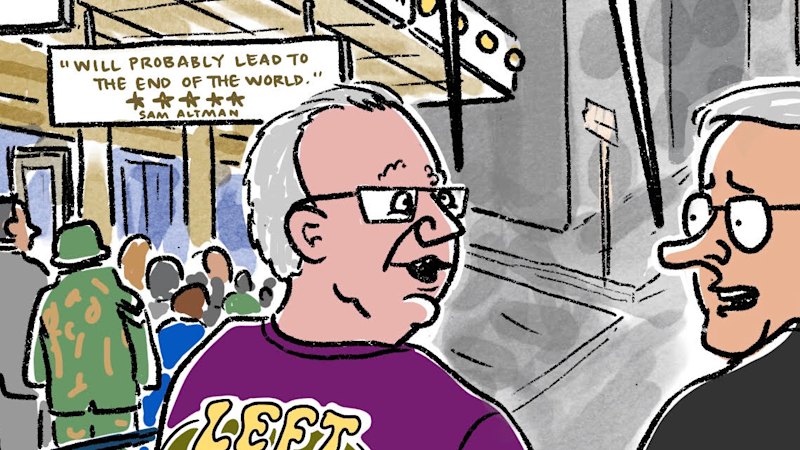
We all have it, we all do it.
asserted
we → have → it
As far as school work to be done at home, it’s absolutely a good idea, but it must be relevant and meaningful (“Skirmish shows it’s not all quiet on homework front”, November 25).
asserted
it → do → front
It’s not the amount given or time spent on it.
asserted
It → ’ → it
What does it provide the teacher?
asserted
it → provide → teacher
Does the teacher look at it, use it, mark it?
asserted
teacher → look → it
What does it do for the student?
asserted
it → do → student
Let them know if they understood or learned anything from the class lesson?
asserted
they → let → lesson
It was all these things when parents weren’t so involved and teachers actually taught.
asserted
teachers → teach → ?
Any intuitive parent and teacher knows that the benefits of homework outlined by Christopher Harris are self-evident.
asserted
benefits → know → Harris
Education is like the economy that swung from over-regulated tariffs to the wide open spaces of free trade, resulting in pockets of privilege and pervading inequality.
asserted
that → swing → privilege
What student hasn’t empathised with Romeo and Juliet after wading through 100 comprehension questions, but expecting a large class to “get” Shakespeare and write a polished essay in blocks of 50 minutes is equally unrealistic.
asserted
class → empathise → minutes
As a high school student in the 1970s I was given homework in various subjects, but I would only ever complete it for the subjects I enjoyed.
asserted
I → give → subjects
As a teacher, I would set a small amount of homework maybe once a week and only in some of the subjects I taught, while some faculties would set it after nearly every lesson.
asserted
faculties → set → lesson
I came to the conclusion that homework is beneficial, but it must be relative to what the students are studying, not take hours to do and, most importantly, be marked by the teacher and meaningful feedback given.
asserted
students → come → teacher
Peter Miniutti, Ashbury
It seems this research was based on interviews with kids, parents and teachers.
asserted
research → seem → kids
Parents seeking homework which includes spelling words and maths sheets plus pursuing academic tutoring is just an extension of the school day.
asserted
which → seek → day
Kids in Early Stage 1 through to Stage 2 (K – 4) hardly need this.
asserted
Kids → need → this
Parents should be focusing on instructive play, sport, talking and listening and reading.
asserted
Parents → focus → play
Reading to your child is perhaps the most important ″homework″.
asserted
Reading → read → child
In later stages of schooling, homework may have its place, but allowing young children the space to relax and enjoy their parents’ company and modelling, is the best option for after school activity.
uncertain
allowing → have → activity
Scott Warnes, Suffolk Park
Homework beats tutoring every school day of the week.
asserted
Homework → beat → week
Sure no student likes it, but boy does it help with reinforcing knowledge, applying key concepts, time management and self-confidence.
asserted
it → like → concepts
But how did I ever get it done after playing sport all weekend, then rushing home on a Sunday night to watch Molly on Countdown?
asserted
it → get → Countdown
Michael Blissenden, Castle Hill
Homework sometimes becomes an ego trip for a parent.
asserted
Homework → become → parent
At a P&C meeting I once heard a competitive mother ask, ″Well, what is our homework project for this week?″
asserted
mother → hear → meeting
The reply was, ″Read to your children and have them read to you.″
asserted
them → have → children
Joy Cooksey, Harrington
CO2 argument hot air
One of your correspondents (Letters, November 25) states that “in reality land we all continue to use fossil fuels” and claims that CO2 is an elixir of life.
uncertain
CO2 → state → life
However, we are producing too much of it, which is having a detrimental effect on planetary systems.
asserted
which → produce → systems
Anthropogenic climate change is a scientific fact, and not a political ploy by the left in politics as your correspondent suggests.
uncertain
correspondent → suggest → politics
No scientist has claimed that CO2 is evil, but the science of global climate change was settled decades ago, we are increasingly seeing the results, it is disappointing that your correspondent misrepresents the science, and claims that emissions reductions are misguided.
uncertain
reductions → claim → science
The $150 million spent on COP31, is a drop in the ocean compared with the cost of increasing massive storm events, floods, droughts, bushfires, and people displaced through famine.
asserted
million → spend → famine
I’m afraid that the straw man argument used in the letter has no credibility.
asserted
argument → ’m → credibility
Barrington Salter, Elanora (Qld)
It seems likely that Chris Bowen will get skewered for his perceived failure to get an agreement at COP31.
asserted
Bowen → seem → COP31
If so, it will be disappointing because that failure was caused by government decisions made over several decades.
asserted
failure → cause → decades
Australia is locked into not only fossil use but also its export to pay for the import of goods we use to manufacture, an industry killed by both sides of politics who succumbed to the entreaties of lobby groups that argued for a resource-based economy.
asserted
that → lock → economy
Our imports have ballooned because of population growth and the demand created for housing and appliances like cars.
asserted
imports → balloon → cars
Yet back in the 1970s we were exporting cars.
asserted
we → export → cars
Don Owers, Whitebridge
Taylor needs some reverse swing
Angus Taylor has made it clear by his comments on the economy that we need to be rid of this rotten government(“Economic woe ’may force rate cuts by June‴ , November 25).
uncertain
woe → need → June‴
Could he try some sandpaper, to assist reversing his party’s woeful performance in opposition?
uncertain
he → try → opposition
We now know what Xi Jinping was whispering into Trump’s ear (″Huang back at helm of Nvidia as Trump steps in″, November 25).
asserted
Trump → know → Nvidia
…and 52 more, not listed.
 The Aporia