- Published
A spacecraft has arrived at an asteroid to investigate the damage caused by an unprecedented cosmic crash.
asserted
spacecraft → publish → crash
It what may sound like the plot of a disaster movie, Nasa's Dart spacecraft deliberately smashed into the space rock in 2022 to knock it off course.
uncertain
spacecraft → sound → course
The Nasa craft was obliterated on impact.
asserted
craft → obliterate → impact
Four years on, a European Space Agency (ESA) mission, called Hera, is scouring the scene to fully assess the aftermath of the collision - with the first images set to be released later on Wednesday.
asserted
images → call → Wednesday
The asteroid poses no threat, instead this was the first ever test of our planetary defences to see what action we could take if a space rock was heading for our planet.
uncertain
rock → pose → planet
"Hera is a sort of Inspector Columbo going back to the crash scene to investigate what is the outcome of this impact," said Patrick Michel, principal investigator of ESA's Hera mission.
asserted
Michel → go → mission
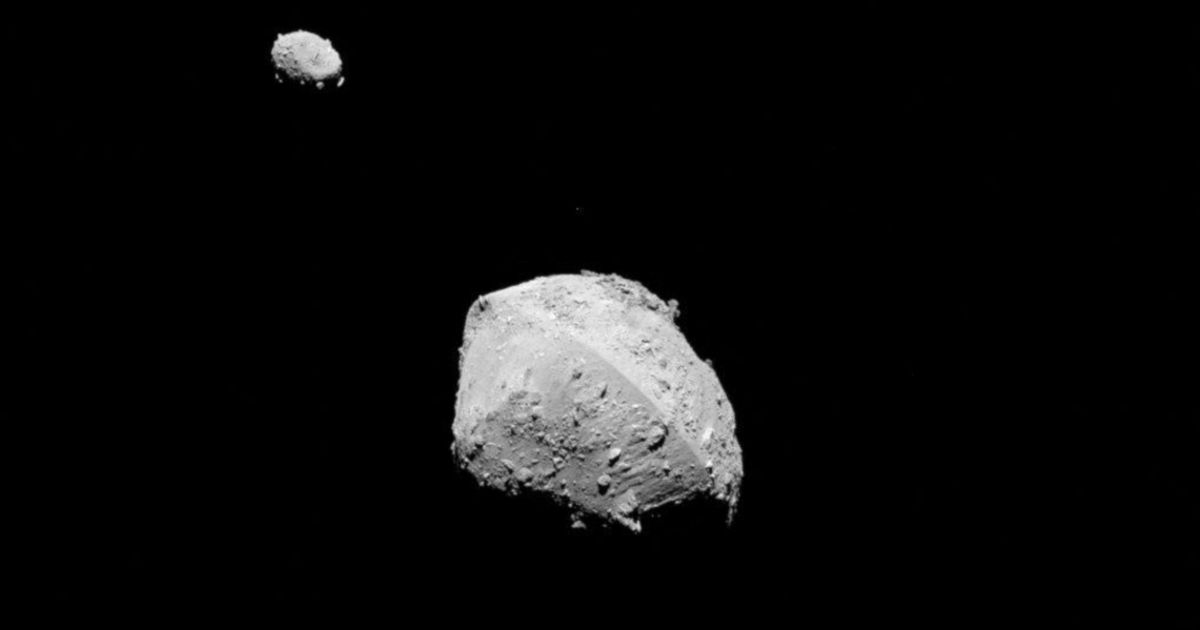
The crash test focussed on a pair of asteroids: a larger one called Didymos - about 730m (2,400ft) wide - which is orbited by a smaller rock called Dimorphos, about 150m (490ft) wide.
asserted
which → focusse → rock
The Dart spacecraft targeted Dimorphos, hurtling into the rock at 22,000km per hour (14,000mph).
asserted
spacecraft → target → hour
Images beamed back showed the asteroid's rocky surface coming ever closer until the feed cut out on impact.
asserted
feed → beam → impact
It was such a big smash-up that the trail of debris, measuring about 10,000km long (6,200 miles), was spotted by telescopes on Earth and in space.
asserted
trail → measure → space
The crash showed it was possible to change the path of the smaller asteroid.
asserted
it → show → asteroid
Before the collision it took Dimorphos 11 hours and 55 minutes to orbit around Didymos.
asserted
it → take → Didymos
After the Dart crash, the duration of its orbit had shrunk by about 33 minutes.
asserted
duration → shrink → minutes
But the arrival of the second spacecraft, Hera, will help scientists to answer many more questions.
asserted
scientists → help → questions
"Dart exploded in the asteroid, and therefore we don't have the information of what is its final state," explained Michel.
asserted
Michel → explode → information
"The impact could have left a crater - and if it is the case, we need to understand the size and the depth.
uncertain
we → leave → size
Or [the impact] may have entirely reshaped the asteroid."
uncertain
impact → reshape → asteroid
The Hera mission will spend the next year studying Dimorphos, and take a look at Didymos too.
asserted
mission → spend → Didymos
The spacecraft is packed with instruments, and it also has two small shoe-boxed sized satellites onboard, which can study the impact site up close, and then later land on the asteroid.
asserted
which → pack → asteroid
A key task is to measure the mass of Dimorphos, to work out how effective the spacecraft's shove was.
asserted
shove → measure → Dimorphos
This information would be vital if we ever spotted a space rock that was on a collision course with Earth.
"
asserted
that → spot → Earth
It would help us to predict what would happen if we had to hit another asteroid," said Prof Simon Green, a planetary scientist who is on Hera's science team.
asserted
who → help → team
"We [could] measure its properties and say: 'Well, we need this mass of spacecraft, travelling at this speed, this early, in order to deflect it enough so that it misses the Earth'.
uncertain
it → measure → Earth
"
Asteroids pose a significant threat to our planet.
asserted
Asteroids → pose → planet
The biggest, which measure more than a kilometre across, could cause global devastation.
uncertain
which → measure → devastation
But medium-sized asteroids around the same dimensions as Dimorphos could wipe out a city.
uncertain
asteroids → wipe → city
"We all know what happened to the dinosaurs, right?
asserted
what → know → dinosaurs
And we don't want that to happen to us," said Carolyn Ernst, Johns Hopkins Applied Physics Laboratory, who works on both the Dart and Hera missions.
asserted
who → want → missions
"The good news for us is that there are far fewer potential threats out there in the Solar System than there were millions of years ago.
asserted
news → be → years
She said the biggest asteroids have been spotted, and none are heading to Earth.
asserted
none → say → Earth
"The smallest stuff isn't too much of a threat because our atmosphere protects us," she added.
asserted
she → protect → us
"But there's a size range in the middle where we don't know where all of them are, and it could, if impacted, cause problems for humanity.
uncertain
it → be → humanity
And if we can find out about that and know about that, well, we sure as heck would want to try to stop that."
asserted
we → find → that
Scientists want to gather as much intelligence as they can about space rocks - to make us as well equipped as possible to deal with whatever the Universe throws at us.
asserted
Universe → want → us
A new mission is launching in 2027 to track potentially hazardous asteroids: a space telescope called the Near-Earth Object (NEO) Surveyor.
asserted
mission → launch → asteroids
There are also more visits planned to asteroids, including to one called Apophis, which is about 450m (1,480ft) long.
asserted
which → be → one
Apophis was discovered in 2004 and it was initially thought it might hit the Earth as early as 13 April 2029.
uncertain
it → discover → April
But now scientists understand its orbit better, and say it won't hit us for at least the next 100 years.
asserted
it → understand → years
Instead of a crash in 2029, it will fly just 32,000km (20,000 miles) above our surface.
asserted
it → fly → surface
This will give scientists the rare chance to study a space rock up-close.
asserted
This → give → rock
…and 1 more, not listed.

 The Aporia