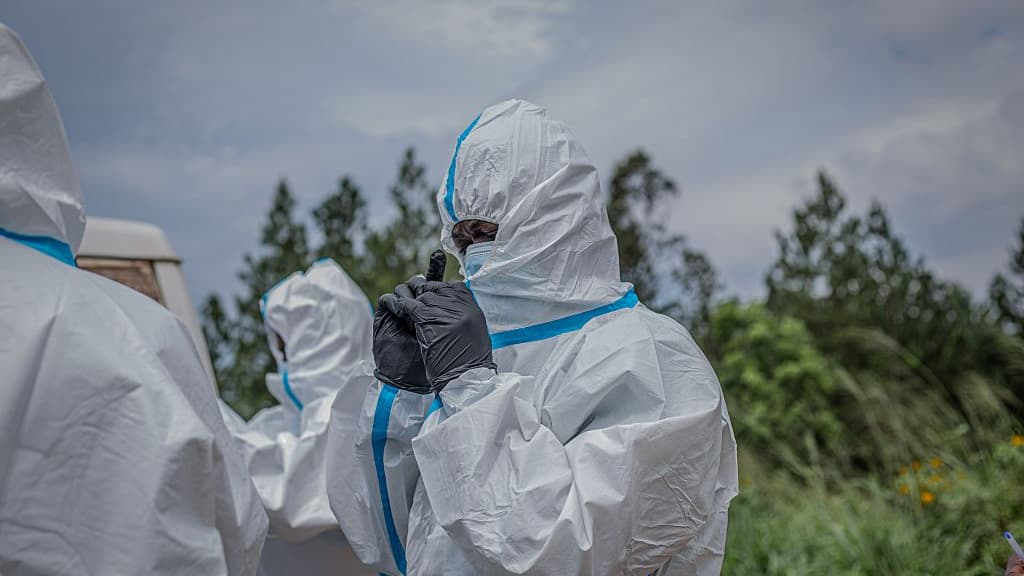
Photo via ABC News (AU)

Women and girls at Ebola epicentre report surge in violence, abuse

Read the original at ABC News (AU) ↗
Cite

Morris-Grant, B. (2026, November 25). Women and girls at Ebola epicentre report surge in violence, abuse. ABC News (AU). https://www.abc.net.au/news/2026-11-25/ebola-violence-against-women-report-unicef/107425166

Dated from the outlet's own feed. Check the original for its byline.

ABC News (AU) · collected 2026-11-25 · by Brianna Morris-Grant
Content note This article describes sexual violence and abuse of a child.

Quick Summary

A survey conducted in the Ituri region of the Democratic Republic of Congo, at the heart of the ongoing Ebola outbreak, revealed that over half of the 1,062 women and girls interviewed experienced increased violence and abuse since the outbreak began. With nearly 8,000 confirmed cases and over 3,750 deaths in the region, the survey highlighted specific instances of emotional, psychological, physical, and sexual abuse, exacerbated by stress and fear due to the spread of Ebola. UNICEF, along with local organizations, is calling for more support to maintain essential services for women and children during the crisis.
Written by AI on 2026-11-25, from this article's own text only (the story summary below draws on all the coverage).

Compared with similar articles

This article reads unscored and hedges 6% of its claims. Each row says how that neighbour differs.
TIME
Leans left Hedges 3 of 68 claims Outlet record 60/100
“The articles discuss the same general Ebola outbreak but focus on different aspects—one on the overall growth and expert analysis, the other on violence and abuse towards women and girls in a specific region.”
The Straits Times
Hedges 3 of 9 claims Outlet record 64/100
“The articles cover different aspects of the Ebola outbreak, with Article A focusing on the increase in violence and abuse against women and girls, while Article B reports on the overall number of confirmed cases and deaths.”
Times of India
Hedges 4 of 15 claims Outlet record 58/100
“The articles discuss different aspects of the Ebola outbreak in Congo: Article A focuses on the increase in violence and abuse faced by women and girls, while Article B reports on the total number of confirmed cases and the impact of fighting on the response efforts.”
Al Jazeera
Hedges 2 of 16 claims Outlet record 60/100
“The articles discuss different aspects of the Ebola outbreak in the DRC, with Article A focusing on increased violence and abuse against women and girls, while Article B focuses on the total number of cases surpassing 12,000 and the disruption of response efforts due to fighting.”
Toronto Star
Hedges 1 of 2 claims Outlet record 65/100
“The articles describe different aspects of the same broader situation, but they do not focus on the same specific event. Article A discusses increased violence and abuse towards women and girls as a result of the Ebola outbreak, while Article B focuses on the total number of confirmed cases and the disruption caused by violence between rebels and the army.”
NPR
Hedges 3 of 13 claims Outlet record 60/100
“The articles report on different aspects of the Ebola outbreak, with Article A focusing on increased violence and abuse towards women and girls, while Article B reports on the total number of cases and evacuation of some responders.”

Story

Violence Surge in Ebola Epicentre
Health · 1 article(s) covering the same event.
How this article was measured signals, leaning charts, publisher record, byline, topics and claims

Signals How these are calculated →

Claims extracted
32
sentences that state something as happening or true
Uncertain
6%
2 of 32 hedged ("reportedly", "may", "according to")
Leaning
withheld
no quote in the article backed the model's score
Publisher signals
66/100
ABC News (AU)'s corrections and hedging, across everything collected from it. Not a measure of accuracy.
Outlets on this story
1
Health
Same framing elsewhere
1
articles that frame the event the way this one does
Analyzed 2026-11-25 · how these are computed

How this is being covered How these are calculated →

Article leaning vs. publisher reliability
Source leaning vs. consistency

Publisher

ABC News (AU) · 6680 article(s) · 13 correction(s) detected
Running correction rate · 13 correction(s)

Who wrote this

Brianna Morris-Grant
13 article(s) here · 1 carrying a prediction
"In the past, I could go and buy goods to resell here," she said.
"Several years ago, it was a safe box that you could lock, or you had your data stored somewhere physically," he said. "
Every evening, he would unpack his things and settle in with his German shepherd dog on the Rosebud foreshore.
There have been 4,887 deaths across eight provinces in the DRC since the outbreak was declared in mid-May.
But the drug will only dissolve in an extremely strong solution, according to Dr Crowe.
Pike survived two doses of the lethal injection drug pentobarbital and is awake and "speaking", her legal team says. What's next? Pike's lawyers are set to hold a press conference overnight following a court appearance on Wednesday, local time. Tennessee officials could still choose to execute Christa Pike even after she survived the first two doses of a lethal injection drug last week, legal experts say.
"If you are in favour of the death penalty, you think that in principle, [for] certain kinds of crimes … it might be proportionate justice for you to lose your own life," Dr Koplin told the ABC.
Warning: This story contains details that may be distressing for some readers.
"I would say that Pike appeared noticeably awake as the execution began," she told media outside the prison.
Also by Brianna Morris-Grant
Nothing else under this byline is closely related to this article, so these are simply their most recent.
All 13 articles by Brianna Morris-Grant →

Topics

DRC SOFEPADI UNICEF Washington University the Democratic Republic of Congo's

Subjects

DRC GPE · 4× SOFEPADI ORG · 4× UNICEF ORG · 4× Bunia GPE · 3× Noble PERSON · 2× Douglas Noble PERSON · 1× Human Rights Watch ORG · 1× Kasemire Mugavu PERSON · 1× Washington University ORG · 1× the Democratic Republic of Congo's GPE · 1×

Narrative

Women and girls 'bearing the cost' of Ebola outbreak In January, Human Rights Watch and SOFEPADI reported a rise in conflict-related sexual violence in the eastern DRC, with many clinics offering health care and support forced to close.
framing: assertive · carried by 1 article(s) · first seen 2026-11-25
"In the past, I could go and buy goods to resell here," she said.
2026-11-25 · ABC News (AU)
Women and girls at Ebola epicentre report surge in violence, abuse · assertive framing

Claims (32 extracted, 2 hedged)

In short: A survey of women and girls at the epicentre of the Ebola outbreak found more than half faced increased abuse and violence. asserted
half → find → abuse
The ongoing outbreak has surpassed 11,600 confirmed cases. What's next? UNICEF is calling for more support for women and children to keep services online as the outbreak continues. asserted
outbreak → surpass → services
Hundreds of women and girls at the epicentre of one of the world's largest recorded Ebola outbreaks face a surge in violence and abuse as the disease spreads. asserted
disease → record → violence
More than 1,000 women and adolescents were interviewed in the Democratic Republic of Congo's (DRC) Ituri region, where an outbreak of Ebola virus has risen to almost 8,000 confirmed cases and more than 3,750 deaths. asserted
outbreak → interview → cases
Almost 60 per cent said violence and abuse had started or increased in their lives since the outbreak began. asserted
outbreak → say → lives
More than one-third reported someone taking more control over their lives, with others reporting emotional, psychological, physical and sexual abuse. asserted
others → report → abuse
The ongoing outbreak has reached a total of 11,613 confirmed cases and 5,678 deaths across the DRC, with isolated cases also reported in neighbouring countries. asserted
cases → reach → countries
The latest survey, led by UNICEF alongside women's rights organisation SOFEPADI and Washington University, interviewed 1,062 women and girls aged 15 and above. asserted
survey → lead → women
Of those who experienced both increased violence and an Ebola response measure in their home, 90 per cent named stress and fear brought on by the outbreak as contributing factors. asserted
cent → experience → factors
As the disease spread further across Ituri, visits to eight safe spaces for women run by SOFEPADI rose by 200 per cent between July and September. asserted
visits → spread → July
Douglas Noble, UNICEF global lead for Public Health Emergencies and global incident manager for Ebola, said the risk of rising violence was "anticipated". asserted
risk → say → violence
"The findings make it clear protecting women and girls has to be part of the Ebola response," Dr Noble said. " asserted
Noble → make → response
That's especially true when women are finding it harder to reach help, and when protecting women and children is one of the most underfunded parts of this response." asserted
protecting → find → response
Bunia resident Kasemire Mugavu said fear of the disease often caused increased tension and isolation in homes. asserted
fear → say → homes
"In the past, I could go and buy goods to resell here," she said. uncertain
she → go → goods
"Today, I can no longer do this because of the outbreak. asserted
I → do → outbreak
The only work I do now is going to the fields. asserted
I → do → fields
"Some women find themselves forced to accept exploitation by men because they do not have the means to provide for their families. asserted
they → find → families
Women and girls 'bearing the cost' of Ebola outbreak In January, Human Rights Watch and SOFEPADI reported a rise in conflict-related sexual violence in the eastern DRC, with many clinics offering health care and support forced to close. asserted
clinics → bear → care
Of those who had been unsuccessful in getting specialised support, 49 per cent of women and girls said Ebola response restrictions had prevented them from accessing services. asserted
restrictions → get → services
A further 37 per cent cited shame, lack of trust and fear, while 24 per cent feared contracting Ebola virus at a health facility and 12 per cent did not know where to go. asserted
cent → cite → facility
One in 10 said the service had been closed or was not working. asserted
service → say → 10
Mapendo Linganaisa, the head of SOFEPADI's Bunia office, said women were being prevented from going to work or to the market, exposing them to further violence. asserted
women → say → violence
"Behind every number is a woman or a young girl who needs to be heard, protected and provided with services in a dignified manner," she said. "There will also be consequences we have to address after the Ebola outbreak. "Some women may have contracted HIV because they reached health facilities too late. uncertain
they → need → facilities
There will also be children born as a result of rape who will need support." asserted
who → bear → support
UNICEF's U-Report poll, launched in September to track the impact on women and girls, surveyed around 11,500 young people in Ituri and other affected regions. asserted
poll → launch → Ituri
Almost 50 per cent of female respondents mentioned increased risk of violence. asserted
cent → mention → violence
Dr Noble returned from a trip to Beni, Butembo and Bunia, cities in the heavily impacted eastern region of the DRC, earlier this week. asserted
Noble → return → DRC
In remarks at the Palace of Nations in Geneva, he said the first-time surveillance revealed risks while there was "still time". asserted
surveillance → say → risks
"I want to be very clear about something," he told the United Nations audience. asserted
he → want → audience
"Isolation, quarantine and contact tracing are absolutely critical to stopping Ebola. asserted
Isolation → stop → Ebola
"But what these findings are telling us is that families are under enormous pressure because of Ebola, and women and girls are bearing much of the cost." asserted
women → tell → cost

Give feedback · no sign-in needed

No sign-in needed for now. Your note is sent without a name, so it cannot be answered.

History Support