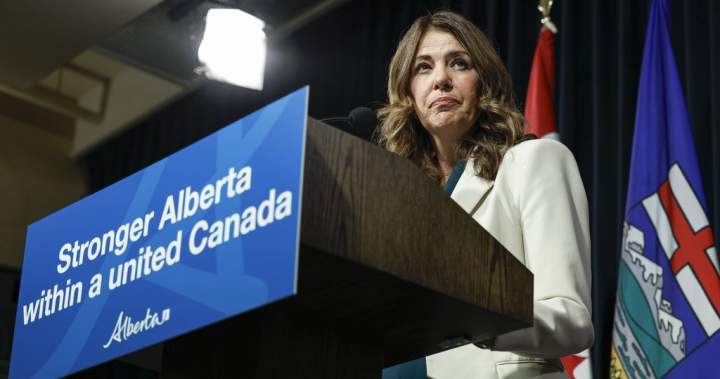
Photo via The Globe and Mail

Smith pushes back on hate-speech law changes, citing Alberta sovereignty act

Read the original at The Globe and Mail ↗
Cite

Scace, M. (2026, November 25). Smith pushes back on hate-speech law changes, citing Alberta sovereignty act. The Globe and Mail. https://www.theglobeandmail.com/canada/alberta/article-smith-pushes-back-on-changes-to-hate-speech-laws/

Dated from the outlet's own feed. Check the original for its byline.

The Globe and Mail · collected 2026-11-25 · by Matthew Scace

Quick Summary

Alberta Premier Danielle Smith is using her Sovereign Alberta Within a United Canada Act to challenge recent changes to Canada’s hate-speech laws that removed a religious exemption. The act, criticized by experts as constitutionally weak, does not allow the province to override federal law but instead directs the cabinet to consider further measures in response to the change. Justice Minister Mickey Amery stated that the government wants to avoid discouraging the expression of political and religious views. Smith’s move comes days before the UCP annual general meeting and amid tensions over the sovereignty act, with some party members frustrated by her stance against advocating for Alberta’s independence.
Written by AI on 2026-11-25, from this article's own text only (the story summary below draws on all the coverage).
See how they differ ↓

AI analysis

Story summary

Alberta Premier Danielle Smith’s government is taking a symbolic stand against a federal hate crime law that came into effect earlier this year. The federal law removed religious speech as a defense or exemption in hate crimes, leading Smith to express concern that the change could silence religious speech and potentially criminalize pastors. Smith’s government plans to invoke the Alberta Sovereignty within a United Canada Act in the legislature and table a motion to push back against the federal law, though the motion would not override federal law. The province has already instructed police and Crown prosecutors not to prioritize hate crimes. Critics, like Brian Dijkema of the Christian policy think tank Cardus, argue that while the federal decision is ambiguous, the province should not attempt to override federal law.

Written for “Alberta Pushes Back on Hate Speech Law” on 2026-11-27, grounded in this article and the 2 other(s) covering the same event.

How they differ

3 outlets covered “Alberta Pushes Back on Hate Speech Law”.

What each outlet says

One AI summary per outlet of its latest article on this story, written from that article alone and checked against it. Open the article for the outlet's own words.

The Globe and MailThis outlet25 Nov

Alberta Premier Danielle Smith is using her Sovereign Alberta Within a United Canada Act to challenge recent changes to Canada’s hate-speech laws that removed a religious exemption. The act, criticized by experts as constitutionally weak, does not allow the province to override federal law but instead directs the cabinet to consider further measures in response to the change. Justice Minister Mickey Amery stated…

Smith pushes back on hate-speech law changes, citing Alberta sovereignty act (this article)
Global News24 Nov

Danielle Smith, the Premier of Alberta, is proposing a symbolic opposition to a recent federal hate crime law that restricts religious speech as a defense or exemption. Smith argues the law could silence religious leaders, expressing concern that pastors might face legal consequences for their sermons. The federal government maintains that the law targets speech specifically intended to promote hatred or…

Alberta takes symbolic stand against federal hate crime law, says it silences speech →

Compared with similar articles

This article reads leans right and hedges 3% of its claims. Each row says how that neighbour differs.
Global News
Leans right Hedges 1 of 7 claims Outlet record 63/100
Toronto Star
Leans right Hedges 0 of 2 claims Outlet record 65/100
CBC News
Centre further left than this Hedges 0 of 7 claims Outlet record 70/100
“Article A discusses the introduction of a motion to defend Albertans’ rights, while Article B discusses Premier Smith using the Sovereignty Act to push back on federal hate-speech law changes. These are related but different events.”

Story

Alberta Pushes Back on Hate Speech Law
Politics · 3 article(s) covering the same event. See how they differ ↑
How this article was measured signals, leaning charts, publisher record, byline, topics and claims

Signals How these are calculated →

Claims extracted
29
sentences that state something as happening or true
Uncertain
3%
1 of 29 hedged ("reportedly", "may", "according to")
Leaning
Leans right
of the writing, not the subject · beta estimate
Publisher signals
52/100
The Globe and Mail's corrections and hedging, across everything collected from it. Not a measure of accuracy.
Outlets on this story
3
Politics
Same framing elsewhere
1
articles that frame the event the way this one does
Analyzed 2026-11-25 · how these are computed

How this is being covered How these are calculated →

Article leaning vs. publisher reliability
Source leaning vs. consistency

Publisher

The Globe and Mail · 1412 article(s) · 55 correction(s) detected
Running correction rate · 55 correction(s)

Who wrote this

Matthew Scace
34 article(s) here · 1 carrying a prediction
The Alberta government says it’s on track to post an $8.5-billion surplus as the oil-rich province continues to reap financial benefits from global turmoil, adding billions of dollars more to its coffers than it projected even a few months ago.
The motion, yet to be tabled, would not allow the government to subvert federal law, regardless of whether it is passed in the provincial legislature.
The Alberta government is proposing changes to provincial law that would eliminate mandatory public fatality inquiries for people who die in prison or police custody, a move the province says aims to clear a backlog of investigations.
Ms. Smith has begged her fellow conservatives to focus on winning the 2027 provincial election, which she said will require abandoning the quest for secession given that 75 per cent of Albertans rejected the idea in a referendum last month.
Alberta Premier Danielle Smith’s government has introduced legislation that will force a vote on a proposed new electoral map that contains controversial changes to key provincial ridings and has fuelled accusations of gerrymandering.
“When you’re on the opposite side of the world it’s just about the last thing you would expect,” he told The Globe and Mail.
They might have a different level of intensity, but they’re not outliers.”
Ms. Smith’s governing United Conservative Party voted on Wednesday night to approve a motion that will result in the government creating a bill to put the map into law.
Premier Danielle Smith is rejecting allegations that an independent panel has torqued the province’s electoral map to favour her United Conservative Party, saying the recommended changes to redraw the boundaries are reasonable and would give voters better representation.
Mr. McClure said Elections Alberta’s resources are strained and pursuing a different avenue would protect “the readiness and successful delivery of Alberta’s next provincial general election.”
Also by Matthew Scace
Nothing else under this byline is closely related to this article, so these are simply their most recent.
All 34 articles by Matthew Scace →

Topics

Alberta Canada Ottawa the Criminal Code the House of Commons

Subjects

Alberta GPE · 6× Smith PERSON · 6× Amery PERSON · 3× Canada GPE · 2× Fraser PERSON · 2× Ottawa ORG · 2× UCP ORG · 2× the House of Commons ORG · 2× Danielle Smith PERSON · 1× Mickey Amery PERSON · 1×

Narrative

Brian Dijkema, president of Christian policy think tank Cardus, said in an e-mail to The Globe and Mail that while Ottawa’s decision to remove the exemption “is ambiguous and creates uncertainty for Canadians,” he has concerns about the province attempting to override federal law. “We need to respect the Constitution’s divisions,” said Mr. Dijkema.
framing: assertive · carried by 1 article(s) · first seen 2026-11-25
The motion, yet to be tabled, would not allow the government to subvert federal law, regardless of whether it is passed in the provincial legislature.
2026-11-25 · The Globe and Mail
Smith pushes back on hate-speech law changes, citing Alberta sovereignty act · assertive framing

Claims (29 extracted, 1 hedged)

Alberta Premier Danielle Smith is wielding her signature sovereignty act in a bid to shield her province from recent changes to Canada’s hate-speech laws that, until this year, allowed a person who quotes from a religious text to escape prosecution under the Criminal Code. asserted
who → wield → Code
Ms. Smith’s Sovereign Alberta Within a United Canada Act is widely viewed by experts as constitutionally dubious and toothless. asserted
Act → view → experts
The motion, yet to be tabled, would not allow the government to subvert federal law, regardless of whether it is passed in the provincial legislature. asserted
it → table → legislature
Instead, the motion asks Ms. Smith’s cabinet to “consider further lawful measures” in response to the change to federal law, Alberta Justice Minister Mickey Amery told reporters at a news conference on Tuesday. “We do not want to create the chilling effect of dissuading people from expressing their political or religious views,” Mr. Amery said. asserted
Amery → ask → views
Ms. Smith has wielded the sovereignty act in symbolic moves to push back against Ottawa’s proposed environmental regulations, and last December, she invoked it again while directing provincial law-enforcement agencies to not enforce Ottawa’s gun buyback program. asserted
she → wield → program
The sovereignty act was the first piece of legislation Ms. Smith introduced as Premier in 2022 and was a key plank of her campaign for leadership of the United Conservative Party that year. asserted
Smith → introduce → Party
Her decision to use the act arrives almost a year since the proposed change was tabled in the House of Commons, triggering tense debate among federal legislators. asserted
change → use → legislators
It was contained in a suite of amendments to Canadian hate-speech laws that received royal assent in June. asserted
that → contain → June
Ms. Smith’s invocation of the sovereignty act also comes days before the UCP annual general meeting, where the Premier will look to shore up her support, even as a segment of the party refuses to heed her warnings that advocacy for an independent Alberta must be abandoned. asserted
advocacy → come → Alberta
Separatists and free-speech absolutists in the UCP have been particularly frustrated by Ms. Smith’s demand that party leaders pledge to uphold the referendum result, in which 75 per cent of Albertans voted to remain in Canada. asserted
cent → frustrate → Canada
The motion introduced on Tuesday targets recent changes to the Criminal Code that removed a long-standing religious exemption that allowed people quoting from religious texts to avoid prosecution for hate speech. asserted
people → introduce → speech
The change led to bitter disagreements in the House of Commons when the Bloc Québécois proposed it earlier this year. asserted
Québécois → lead → it
Backers of the revised law have argued the exemption was a loophole that could be used as cover for promoting homophobia, racial abuse and antisemitism. uncertain
that → revise → homophobia
But the change has received significant criticism across the political spectrum and in faith communities. asserted
change → receive → communities
The federal Conservatives vehemently opposed the move while it was being debated. asserted
it → oppose → move
At the time, Conservative MP Larry Brock said removing the religious exemption was a “direct attack on freedom of religion.” asserted
removing → say → religion
Federal Justice Minister Sean Fraser and his colleagues with the governing federal Liberals supported the change. asserted
Fraser → govern → change
Last December, Mr. Fraser attempted to assuage concerns about the change, saying that it will “in no way, shape or form, prevent a religious leader from reading their religious texts.” asserted
it → attempt → texts
Joannie Fogue, spokesperson for Mr. Fraser, said in a statement to The Globe and Mail that the federal government agrees with Alberta that people should “be free to practise their faith, read scripture, and express their religious beliefs.” asserted
people → say → beliefs
Ms. Fogue said the new federal law doesn’t criminalize opinions, disagreement, criticism or religious teaching. asserted
law → say → opinions
Consent from Alberta’s attorney-general – in this case, Mr. Amery – is required for hate-speech charges to proceed, she added. asserted
she → require → case
Mr. Amery said the province isn’t planning to challenge the exemption removal in court. asserted
province → say → court
He described the motion as Alberta “drawing a constitutional line.” asserted
Alberta → describe → line
“The federal government, yes, has the constitutional authority to define what areas they believe should be in the Criminal Code,” he said. asserted
he → have → Code
“We have the authority to decide which areas of priority we have for policing and which areas of priority we have for prosecution.” asserted
we → have → prosecution
Brian Dijkema, president of Christian policy think tank Cardus, said in an e-mail to The Globe and Mail that while Ottawa’s decision to remove the exemption “is ambiguous and creates uncertainty for Canadians,” he has concerns about the province attempting to override federal law. “We need to respect the Constitution’s divisions,” said Mr. Dijkema. asserted
Dijkema → say → divisions
He added that he hasn’t reviewed the motion. asserted
he → add → motion
Outside of her use of the sovereignty act, Ms. Smith indicated interest in overriding federal laws in Alberta’s recent 10-question referendum, where she asked voters whether they support a constitutional amendment that would give provincial law priority over federal laws when the two conflict. asserted
two → indicate → laws
Nearly 56 per cent of Albertans rejected the idea. asserted
cent → reject → idea
Give feedback · no sign-in needed

No sign-in needed for now. Your note is sent without a name, so it cannot be answered.

History Support