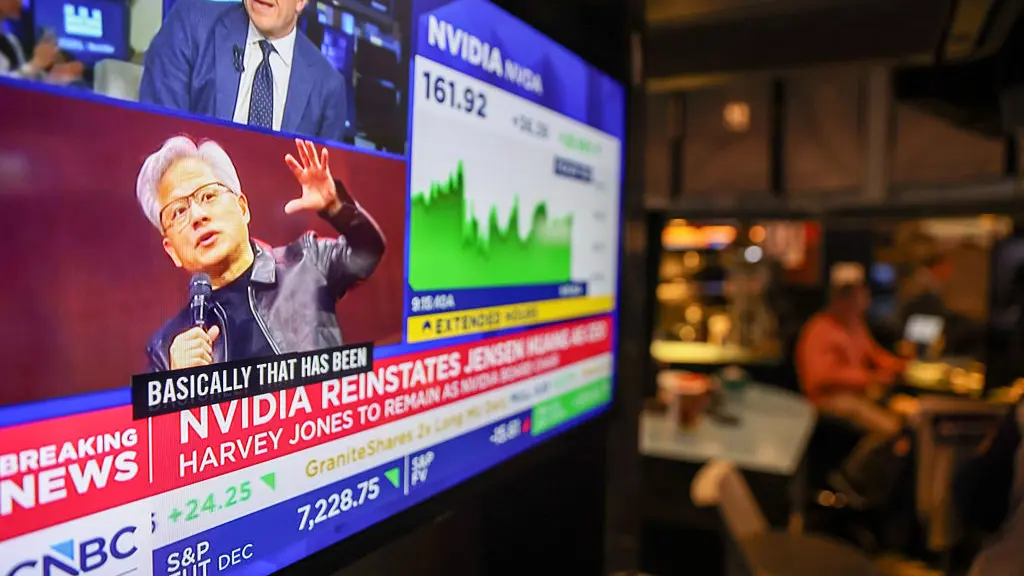
Huang resigned two weeks ago following reports that he had an affair with tech executive Alice Huang, an alleged Chinese spy whose company was suspected of steering restricted advanced AI chips to the country.
asserted
company → resign → country
He has also reportedly engaged in at least two other affairs with subordinates at Nvidia and was known for belittling those who worked under him.
uncertain
who → engage → him
While Huang’s controversies have been unusually shocking for an industry whose real-life corporate dramas often create the plotlines of Hollywood blockbusters, his return to helm the CEO position at Nvidia is not.
asserted
return → create → Nvidia
For decades, tech founders have left their companies amid managerial or ethical controversies, only to be brought back by supporters who argue they alone contain the ability and vision to lead the companies they created.
asserted
they → leave → companies
Experts who study the industry refer to this as the “cult of the founder”—the idea that entrepreneurs should be given wide latitude to grow their transformative companies, even if that means their employees and the marketplace are forced to accept some of their obvious leadership flaws.
asserted
employees → study → flaws
“Nvidia is too big to fail and Nvidia will fail without Jensen at the helm—that's the message this seems to be sending,” says Margaret O’Mara, a professor of history at the University of Washington, who has studied the tech sector.
asserted
who → fail → sector
Yet, the cultural and political support behind Huang and other male founders takes place in an industry in which women leaders have struggled to obtain promotions and investment for their companies, and are often held to higher standards of behavior when they occupy those roles.
asserted
they → take → roles
Other times, they are brought in to rescue companies already plagued with problems that other executives failed to solve such as when Yahoo tapped former Google executive Marissa Mayer as CEO in 2012.
asserted
Yahoo → bring → 2012
The tech sector tends to uphold the views of male founders to chart the path for the industry, while relying on female executives to fix issues inside companies, says Bhaskar Chakravorti, dean of global business at The Fletcher School at Tufts University.
asserted
Chakravorti → tend → University
A Taiwanese immigrant, Huang founded Nvidia after getting into a conversation with two other engineers at a Denny’s diner about building a computer chip that would improve video game graphics.
asserted
that → found → graphics
Huang, who often touted his prior work as a busboy at Denny’s, later founded and grew the company to become a lynchpin of America’s AI boom by selling graphics processing units that make training AI models faster.
asserted
models → tout → units
Earlier this month, Nvidia’s board tapped chief financial officer Colette Kress to be interim CEO, and said it would initiate an independent investigation into reports that Huang was the subject of a foreign intelligence effort.
asserted
Huang → tap → effort
Not only did Nvidia’s stock plunge following the announcement of Huang’s departure, it also dragged down the S&P 500, which has benefited from investors’ excitement about artificial intelligence.
asserted
which → plunge → intelligence
While many regulators and advocates supported Huang’s departure, a cohort of influential tech industry leaders publicly urged the board to reinstate him including Tesla CEO Elon Musk, Y Combinator CEO Garry Tan, hedge fund manager Bill Ackman, Epic Games founder and CEO Tim Sweeney, and many Nvidia employees.
asserted
cohort → support → Musk
The “Stand with Jensen” campaign argued that “accountability requires evidence, a fair hearing, and a reasoned decision.
asserted
accountability → stand → evidence
Jensen deserves due process, not mob justice.”
asserted
Jensen → deserve → process
Huang also had the backing of President Donald Trump’s administration, urging the board to reinstate the executive after assuring them that he was not facing criminal charges, nor did he pose a national security risk, according to the New York Times.
uncertain
he → have → Times
Alice Huang’s former company, Megaspeed, is being investigated by federal agencies, alongside a probe initiated by Nvidia’s board of directors.
asserted
company → investigate → directors
As the campaign to bring Huang back expanded, the founder himself indicated earlier this month that he would welcome the opportunity to return to the role.
asserted
he → bring → role
“It's hard for me to imagine a woman CEO even getting to that position of prominence, and it's even harder for me to imagine a woman CEO doing what Huang did, and then also having this sort of comeback,” says Mar Hicks, an associate professor at the University of Virginia.
asserted
Hicks → imagine → Virginia
“There isn't much precedent for that, and it's definitely the case that generally women, and in particular, women of color are held to much, much higher standards, and oftentimes don't even have to do anything wrong to lose their jobs or lose their positions of prominence or lose respect.
asserted
women → be → respect
The tech industry commonly embraces the idea that founders are critical to the success of their companies.
asserted
founders → embrace → companies
Tech leaders such as Meta CEO Mark Zuckerberg have relied on a dual-class share structure that gives them majority voting power.
asserted
that → rely → power
Some VCs have sought to cast themselves as being founder-friendly by refraining from criticizing or firing them, in part to gain a competitive edge in the market.
asserted
VCs → seek → market
Prominent investors have argued that founders often have judgment that surpasses that of their reports, and therefore should take a hands-on role in running their companies even as they grow bigger.
asserted
they → argue → companies
Nvidia’s board had their pick of examples in which bringing back a founder to lead a tech company was seen to boost its performance.
asserted
bringing → have → performance
Michael Dell stepped down as CEO in 2004 only to return to the role three years later, and has since repositioned Dell to take advantage of the artificial intelligence boom.
asserted
Dell → step → boom
Steve Jobs famously was ousted from his role at Apple in 1985 during a power struggle with the board and then-CEO John Sculley, only to return as CEO more than a decade later when the company was struggling.
asserted
company → oust → CEO
Jobs was seen to have rescued the company, partly with a wave of new product launches that transformed personal computing, including the iPod, iPhone, and App Store.
asserted
that → see → iPod
More recently, OpenAI’s board of directors fired founder and CEO Sam Altman in 2023, only for the company to bring him back less than a week later after intense pressure from employees and outside investors.
asserted
company → fire → employees
After news surfaced that Huang was returning as CEO, Nvidia's stock surged on Monday by more than 30%.
asserted
stock → surface → %
Haung’s return supports the idea “that these people are too important and these companies are too economically consequential, so we're just going to forgive.
asserted
we → support → idea
We are going to forgive these things because this is the price of doing business,” O’Mara says.
asserted
O’Mara → go → business
 The Aporia