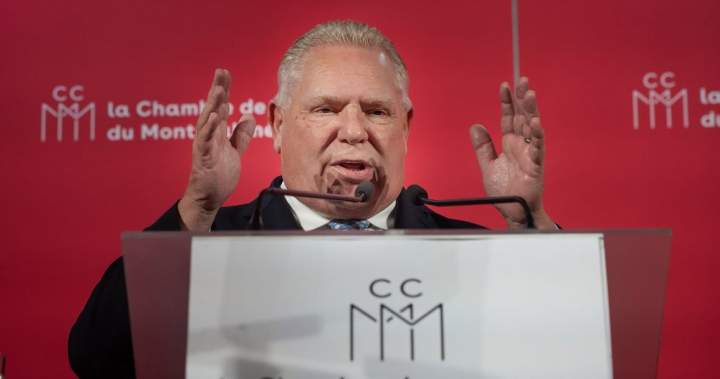
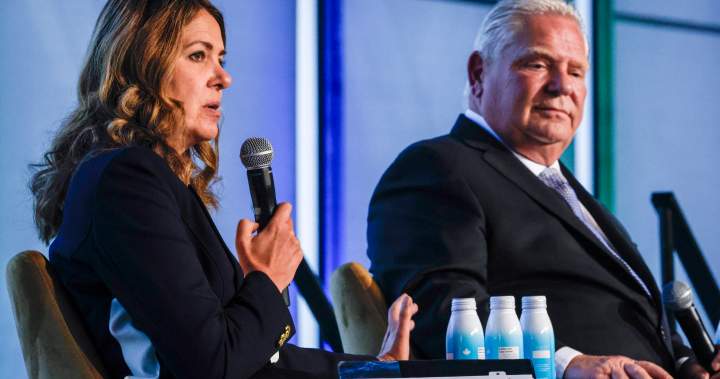
Ontario Premier Doug Ford and Alberta Premier Danielle Smith mostly presented a united front on Monday as the two leaders touted the still-embryonic concept of a new cross-country pipeline but pointed fingers over foot-dragging on interprovincial trade barriers.
asserted
leaders → present → barriers
The pair appeared together at a downtown Toronto business luncheon organized by the Toronto Region Board of Trade and the Calgary Chamber of Commerce, where they were questioned onstage by CTV chief financial correspondent Amanda Lang.
asserted
they → appear → Lang
The two premiers shared a stage at a similar event in Calgary in September, and are usually eager to show unity and talk pipelines.
asserted
premiers → share → pipelines
But in the face of tariffs and annexation threats from U.S. President Donald Trump, they have often taken different approaches.
asserted
they → take → approaches
Some have dubbed Mr. Ford “Captain Canada” for his confrontational tack, while Ms. Smith has urged a more conciliatory tone.
asserted
Smith → dub → tone
The U.S. tariffs have targeted Ontario’s key auto and steel sectors, while recent rising oil prices have benefited Alberta.
asserted
prices → target → Alberta
On Monday, Ms. Smith praised Mr. Ford for his “outspoken support” for Alberta’s oil and gas sector and for his “visionary” idea for a “Northern Shield” pipeline that would run from Alberta to Ontario.
asserted
that → praise → Ontario
Mr. Ford said his proposed pipeline, which he has in the past suggested could be funded by Ontario taxpayers, would provide energy security and allow for larger oil and gas reserves.
uncertain
he → say → reserves
The initiative, which is undergoing a feasibility study, has buy-in from Alberta and Saskatchewan but not Manitoba.
asserted
which → undergo → Alberta
Mr. Ford said he recently spoke to Manitoba Premier Wab Kinew, who told him he was “very, very close” on the pipeline idea, but was focused on a proposal to upgrade the Arctic Port of Churchill.
asserted
he → say → Churchill
Mr. Ford and Ms. Smith briefly aired differences on measures to lower interprovincial trade barriers, something governments and business leaders have focused on as a counterweight to the tariffs imposed by Mr. Trump.
asserted
governments → air → Trump
Some economic studies have said these barriers – which include differing rules for doctors and divergent standards for everything from food to trucks – cost Canada’s economy as much as $200-billion a year.
asserted
which → say → billion
While provinces and the federal government have all pledged to lower them, actual progress has been slow.
asserted
progress → pledge → them
Asked by Ms. Lang why Alberta was insisting on various exemptions to interprovincial trade rules, Ms. Smith responded with a shot at Ontario – and said the gritty details of actually lowering barriers are complicated.
asserted
details → ask → barriers
She said Alberta has a “free enterprise” system for stocking alcohol shelves that allows in more than 1,000 Ontario products.
asserted
that → say → products
Meanwhile, Ontario, she added, has a “monopoly system” that stocks just 53 products from Alberta.
asserted
that → add → Alberta
“So we can say all we want, ‘Yeah, we want to have free trade.’
asserted
we → say → trade
But you have to get down to the purchasing decisions of the individual agency and how much shelf space they have,” Ms. Smith said.
asserted
Smith → have → space
Mr. Ford did not directly address Ms. Smith’s criticism of the Liquor Control Board of Ontario’s purchasing monopoly, but pointed to his changes that have allowed alcohol sales in corner stores.
asserted
that → address → stores
He boasted that Ontario was the only province to drop all of its exceptions to interprovincial trade rules and said other provinces were insisting on maintaining some of them, including Quebec.
asserted
provinces → boast → Quebec
The Ontario Premier also repeated his calls, made in recent months, for an end to the federal requirement for provinces to have industrial carbon pricing systems, saying that Ontario’s steel and auto industries face an existential threat from U.S. tariffs.
asserted
industries → repeat → tariffs
Ms. Smith would not go so far as Mr. Ford on the industrial levy.
asserted
Smith → go → levy
She said Alberta’s system has been in place since 2007 and is applied differently than in other provinces.
asserted
system → say → provinces
She said provincial governments should make their own deals with Ottawa.
asserted
governments → say → Ottawa
Mr. Ford has previously said he wanted Ottawa to allow exemptions for “tariff-impacted sectors.”
asserted
Ottawa → say → sectors
In a letter to Prime Minister Mark Carney in August, Mr. Ford said Ontario was considering such a move and called on Mr. Carney to “accelerate these efforts.”
asserted
Ontario → say → efforts
Any changes to Ontario’s system must align with Ottawa’s rules.
asserted
changes → align → rules
These industrial pricing systems are separate from the former consumer carbon price, which was imposed by the government of Justin Trudeau and repealed by Mr. Carney.
asserted
which → impose → Carney

 The Aporia