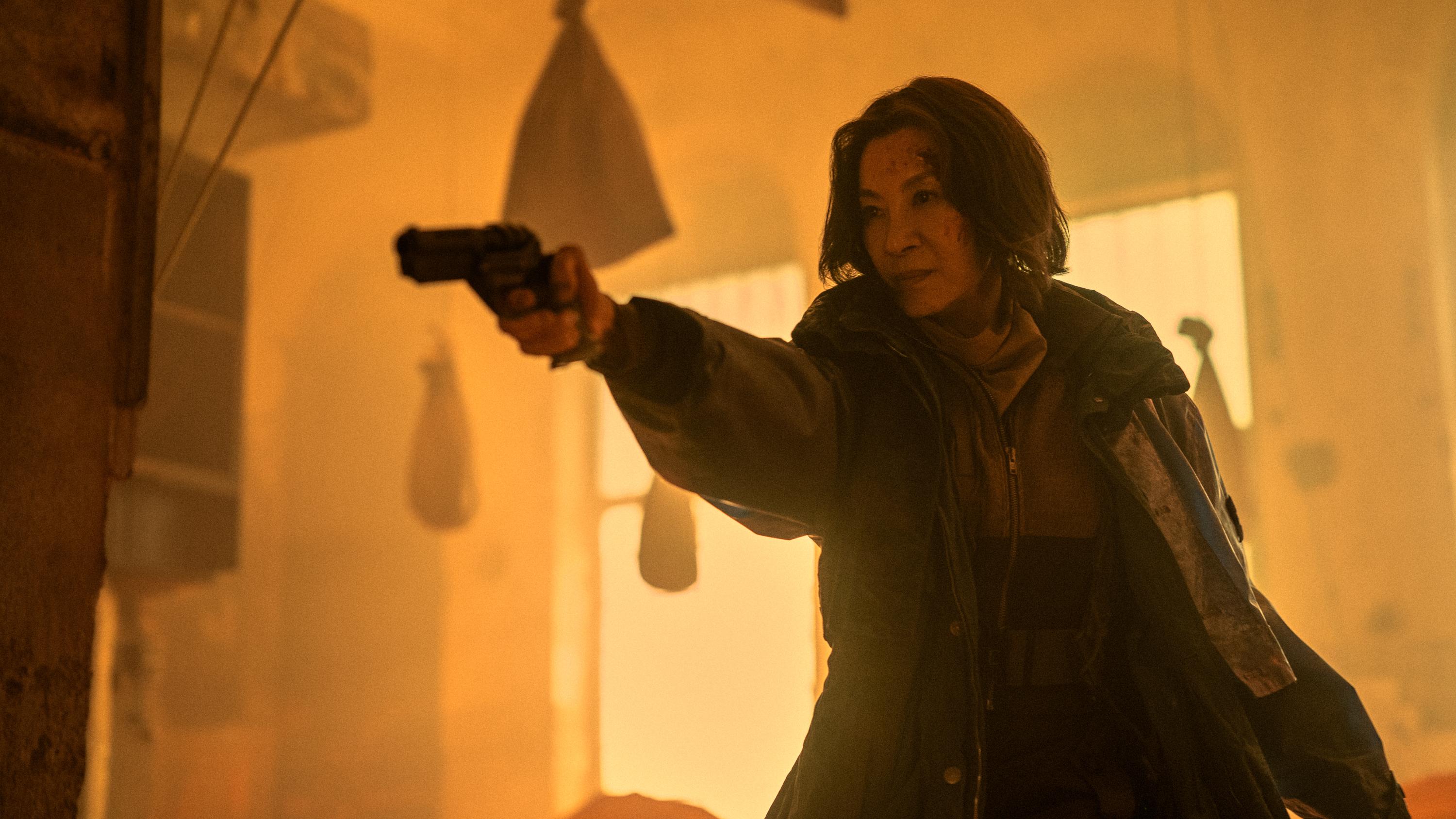
For nearly half a century, the Blade Runner franchise has been on the run from the accusation that its future-noir visual style eclipses the substance of its stories.
asserted
style → eclipse → stories
Critics rhapsodized over the look of Ridley Scott’s 1982 film—a box-office flop that gradually achieved cult-classic status on home video—but judged it to be, as Janet Maslin wrote in the New York Times, “a mess, at least as far as its narrative is concerned.”
asserted
narrative → rhapsodize → Times
TIME’s Richard Corliss concluded that “Blade Runner, like its setting, is a beautiful, deadly organism that devours life.”
asserted
that → conclude → life
Denis Villeneuve’s 2017 sequel, Blade Runner 2049, fared somewhat better in theaters and with reviewers, though the critiques were of a similar nature.
asserted
critiques → fare → nature
In the years since I took in that 164-minute epic on the biggest screen available, those hazy, saffron-tinted, almost tangibly toxic landscape shots of a bombed-out wasteland that used to be Las Vegas have stayed with me more than the busy plot.
asserted
that → take → plot
That its mise-en-scène is more memorable than its storytelling may strike Blade Runner’s most devoted audience as a feature, not a bug.
uncertain
is → strike → feature
When movies attract cult followings, it’s usually the immersive vibe that keeps fans coming back.
asserted
that → attract → fans
Television is a different medium, though, one that can be greatly enhanced by technical artistry but needs to be anchored in a compelling narrative and characters with depth in order to hold our attention episode after episode.
asserted
that → enhance → episode
The speculative worlds of sci-fi TV must be as intricately constructed as they are aesthetically awesome.
asserted
they → construct → TV
Prime Video’s Blade Runner 2099, an eight-part limited series that will stream in full on Nov. 25, never quite overcomes its big-screen legacy.
asserted
that → stream → legacy
Yet that bleak beauty continues to obscure the personalities of its protagonists and the shape of their society.
asserted
beauty → continue → society
As its title suggests, 2099 takes place a few generations after 2049.
uncertain
2099 → suggest → 2049
Maybe because the environmental and corporatocratic dystopia of the original Blade Runner’s then-near-future, now-recent-past 2019 Los Angeles was becoming hard to distinguish from our reality, showrunner Silka Luisa (Shining Girls) adds a major dread-enhancing development.
asserted
Luisa → become → development
Once enslaved to build “Off-world” colonies for refugees of an increasingly uninhabitable Earth, replicants—the flesh-and-blood humanoids engineered by the monolithic Tyrell Corporation to be “more human than human,” i.e., smarter, stronger, and 20 times more productive than us—have overthrown their inferior masters.
asserted
be → enslave → masters
Now, as they endeavor to restore the global ecosystem, humanity is the underclass relegated to grunt work.
asserted
humanity → endeavor → work
Of course, not every human submits.
asserted
human → submit → ?
Rebels assume false identities to fight their oppressors.
asserted
Rebels → assume → oppressors
And just as earlier installments followed LAPD officers called blade runners, who are tasked with killing rogue replicants, this one centers around a unit of Los Angeles replicant cops rooting out rogue humans.
asserted
one → follow → humans
Confusingly but perhaps necessarily, given the franchise’s branding, they’ve appropriated the blade runner moniker.
asserted
they → give → moniker
Olwen is one such blade runner, now just days away from the preordained death date with which all replicants are born; that this character is played by Michelle Yeoh, who at 64 has lost none of her action-star prowess, is its own implicit argument against planned obsolescence.
asserted
who → bear → obsolescence
As she attempts to stay stoic about her demise, she’s partnered with Cora (Hunter Schafer), a human fugitive protecting her disabled younger brother, Elias (Lewis Gribben).
asserted
she → attempt → brother
Cora's desperate circumstances have driven her to go undercover as a blade runner.
asserted
circumstances → drive → runner
It isn’t easy for a human to impersonate a replicant.
asserted
human → impersonate → replicant
While the subtle differences in appearance can be faked, replicants aren’t just superior to humans by every quantifiable metric—they also supposedly lack empathy, a side effect of being gestated to adulthood in artificial wombs rather than raised by loving parents.
asserted
they → fake → parents
As tends to be the case in odd-couple, buddy-cop stories, Cora and Olwen have more in common than they know.
asserted
they → tend → more
A draconian spoiler list prevents me from getting too specific about their joint quests, but suffice to say that the human’s rough past has equipped her to blend in with her taciturn new colleagues and the replicant has a greater capacity for interpersonal connection that she realizes.
asserted
she → prevent → that
Schafer and Yeoh come from very different onscreen backgrounds (while Yeoh earned global fame as the queen of Hong Kong action movies, Schafer is best known for her arresting work as the artistic love interest of Zendaya’s character in HBO’s lurid and downbeat Euphoria)
asserted
Schafer → come → Euphoria
both excel at layering vulnerability beneath a stolid mask.
asserted
both → excel → mask
Even so, it could’ve made an adequate foundation for a show that really engaged viewers—who are still predominantly human, I’m told—with Cora, Olwen, the mostly underwritten characters around them, the relationships among all of the above, and the overlapping societies in which they’re situated.
uncertain
they → make → which
The texture of everyday human life in L.A., such as it is under the boot of the Übermenschen humanity created, doesn’t get much attention.
asserted
humanity → create → attention
Nor do we understand the larger philosophies or motivations or social structures of the replicants, who can’t reproduce sexually and for whom “ongoing relationships” are proscribed.
asserted
relationships → understand → whom
A peepshow-esque establishment where physically optimized replicants try on prosthetics like pregnant bellies and saggy, elderly skin offers the most telling glimpse at their fantasy lives.
asserted
replicants → optimize → lives
These are the details great sci-fi shows like Andor and The Expanse are built on.
asserted
shows → build → Andor
Here, they’re few and far between.
asserted
they → ’re → ?
Our understanding is, for the most part, limited to the goals that drive Olwen and Cora and various villains in their hunts for particular objects and people—video-game stuff.
asserted
that → limit → objects
(Would it shock you to learn that the owners of this IP do indeed envision video games in its future?)
asserted
owners → shock → future
Part of the problem is how little 2099 shows us of the relationships these characters are so invested in.
asserted
characters → show → relationships
Rather than replicants who are more human than human, we get humans who, in the mootness of their personalities, are more replicant than replicant.
asserted
who → get → personalities
Screen time that might’ve been spent on narrative world-building is instead given over to aesthetic world-building.
uncertain
that → spend → building
For all that it lingers on eye candy long enough to induce a sugar coma, the series really does look incredible.
asserted
series → linger → coma
…and 4 more, not listed.
 The Aporia