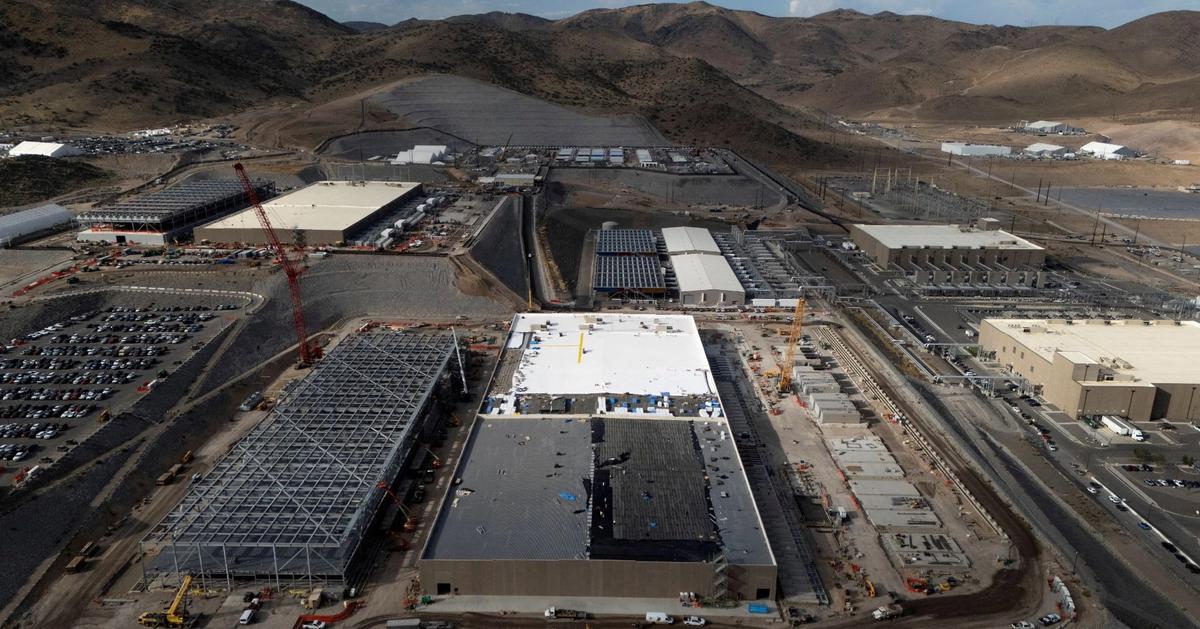
Photo via Semafor

The AI infrastructure buildout is remaking global economies

Read the original at Semafor ↗
Cite

Rao, P. (2026, November 23). The AI infrastructure buildout is remaking global economies. Semafor. https://www.semafor.com/article/11/23/2026/ais-infrastructure-buildout-is-remaking-global-economics

Dated from the outlet's own feed. Check the original for its byline.

Semafor · collected 2026-11-23 · by Prashant Rao

Quick Summary

The Wall Street Journal reports that significant investments in AI infrastructure are reshaping global economies and business deals. An UBS economist noted the far-reaching impact of AI, citing examples such as revenue growth for hotels near data centers and increased purchases by contractors for building data facilities. The article highlights that AI-related capital expenditures this year exceed 1.5 times Belgium’s GDP, leading to a worldwide shortage of memory chips that won’t be resolved until at least 2030, according to a US think tank. Meanwhile, SoftBank has shown interest in financing a $1 trillion acquisition of South Korean chip manufacturer SK Hynix, seeing it as a business opportunity amid the chip shortage.
Written by AI on 2026-11-23, from this article's own text only (the story summary below draws on all the coverage).

AI analysis

Story summary

The rapid buildout of AI infrastructure is significantly reshaping global economies, with AI-related capital expenditures this year surpassing 1.5 times Belgium’s GDP. This surge in spending has led to a worldwide shortage of memory chips, which is expected to persist until at least 2030, according to a U.S. think tank. The economic impact is widespread, with hotels near data centers experiencing increased revenue growth and a snowmobile manufacturer noting higher purchases from contractors constructing these facilities. SoftBank has shown interest in financing a $1 trillion buyout of South Korean chip giant SK Hynix, seeing an opportunity in the chip shortage.


Written for “AI Infrastructure Remakes Economies” on 2026-11-23, grounded in this article and the 0 other(s) covering the same event.

Compared with similar articles

This article reads unscored and hedges 25% of its claims. Each row says how that neighbour differs.
CBC News
Hedges 6 of 42 claims Outlet record 70/100
“The articles discuss different aspects of AI infrastructure and its economic impacts without focusing on the same specific event.”
Toronto Star
Hedges 1 of 23 claims Outlet record 65/100
“The articles discuss the broader impact and economic implications of AI infrastructure, but they are not describing the same specific event or incident.”
NBC News
Hedges 0 of 1 claims Outlet record 72/100
“Article A reports on specific developments in Shenzhen's AI sector, while Article B discusses broader global economic impacts of AI infrastructure buildout.”
The Sydney Morning Herald
Leans left Hedges 2 of 27 claims Outlet record 61/100
“Article A discusses a specific event involving Sam Koppelman's video and report about AMD, while Article B discusses general trends and impacts of AI infrastructure on global economies.”

Story

AI Infrastructure Remakes Economies
Economy/Business · 1 article(s) covering the same event.
How this article was measured signals, leaning charts, publisher record, byline, topics and claims

Signals How these are calculated →

Claims extracted
4
sentences that state something as happening or true
Uncertain
25%
1 of 4 hedged ("reportedly", "may", "according to")
Leaning
not political
takes no side on a contested political question
Publisher signals
70/100
Semafor's corrections and hedging, across everything collected from it. Not a measure of accuracy.
Outlets on this story
1
Economy/Business
Same framing elsewhere
1
articles that frame the event the way this one does
Analyzed 2026-11-23 · how these are computed

How this is being covered How these are calculated →

Article leaning vs. publisher reliability
Source leaning vs. consistency

Publisher

Semafor · 1965 article(s) · 9 correction(s) detected
Running correction rate · 9 correction(s)

Who wrote this

Prashant Rao
153 article(s) here · 0 carrying a prediction
AI’s potential to accelerate health research is one of its greatest promises, with leaders in the sector forecasting that it will be used to develop a cure for cancer within a lifetime.
2026-11-23 · assertive framing · UK launches major trial to use AI in cancer screening
Further restrictions could also be afoot: Washington should pull contracts with any defense firms with investments in China’s aerospace sector, one Congressional committee argued.
2026-11-20 · speculative framing · Washington takes aim at China after Trump-Xi talks
The limited agreement would allow increased food and drinks trade, a re-linking of their carbon markets, and closer migration cooperation.
2026-11-20 · assertive framing · UK and EU to sign deal aimed at resetting relations
As the COP31 climate summit in Türkiye neared its close, negotiators haggled over a narrow draft deal that activists said was limited even by the standards of recent meetings; the representative for co-host Australia acknowledged that officials were “finding the most ambitious outcome that consensus will allow.”
2026-11-20 · assertive framing · High energy prices reshape global climate debate
Asian stocks tumbled and US markets looked set to follow on worsening tech-sector sentiment, although experts said the selloff was likely overdone.
2026-11-20 · assertive framing · Tech rout drags down global bourses
The trio argued their 80 minute meeting would help undergird global stability, but few tangible steps were taken and the talks were hampered by the leaders’ domestic constraints and geopolitical disputes. On AI, US President Donald Trump voiced opposition to “globalist regulation,” whereas Chinese leader Xi Jinping had previously advocated strong rules; on nuclear nonproliferation, Beijing has opposed controls pushed by Washington; China and Russia have maintained ties with Iran throughout the US war on the Middle East nation; and Moscow has long struggled to get Beijing to agree a gas-purchase deal.
2026-11-19 · assertive framing · Trump, Xi and Putin hold landmark talks in Shenzhen
In particular, it has huge financial commitments to buy chips and build data centers, and must assuage customers who fear it will compete with them in sectors far beyond tech and AI.
2026-11-19 · assertive framing · Anthropic raises record sums in IPO
The forecast-beating figures from Japan came days after official Chinese data pointed to a deepening slowdown, with one notable exception: AI-related production “is not only leading manufacturing output, but is the only part of China’s vast manufacturing machine experiencing [investment] growth,” Trivium analysts noted.
2026-11-18 · assertive framing · AI hardware demand lifts Asian exports to record highs
Beijing wants to build up its nuclear arsenal, while a longrunning treaty between Washington and Moscow limiting their weapons stockpiles expired this year, The Wall Street Journal noted, setting up a “three-body problem” that could result in “an unprecedented era of instability around the world’s most dangerous weapons.”
Nvidia’s chair declared the chip giant would look elsewhere for a new CEO, though some members of its board favor a return of former leader Jensen Huang, throwing into doubt the future of a company at the center of the AI boom.
Also by Prashant Rao
Nothing else under this byline is closely related to this article, so these are simply their most recent.
All 153 articles by Prashant Rao →

Topics

Belgium SoftBank South Korean The Wall Street Journal UBS

Subjects

Belgium GPE · 1× SK Hynix ORG · 1× SoftBank ORG · 1× South Korean NORP · 1× The Information ORG · 1× The Wall Street Journal ORG · 1× UBS ORG · 1×

Narrative

Hotels near data centers have seen increased revenue growth and a snowmobile maker has reported rising purchases from contractors building the giant facilities, with overall AI-related capex this year equivalent to more than 1.5 times Belgium’s GDP. The massive expenditure has led to memory chip shortfalls worldwide, a shortage that is unlikely to be fully addressed until at least 2030, a US think tank warned.
framing: mixed · carried by 1 article(s) · first seen 2026-11-23
2026-11-23 · Semafor
The AI infrastructure buildout is remaking global economies · mixed framing

Claims (4 extracted, 1 hedged)

Evidence mounted that the AI infrastructure buildout is remaking global economics and dealmaking. asserted
buildout → mount → economics
“The tentacles of AI are remarkable,” a UBS economist told The Wall Street Journal: asserted
economist → tell → Journal
Hotels near data centers have seen increased revenue growth and a snowmobile maker has reported rising purchases from contractors building the giant facilities, with overall AI-related capex this year equivalent to more than 1.5 times Belgium’s GDP. The massive expenditure has led to memory chip shortfalls worldwide, a shortage that is unlikely to be fully addressed until at least 2030, a US think tank warned. asserted
tank → see → 2030
To some, that represents a lucrative opportunity: SoftBank recently inquired about financing a $1 trillion buyout of South Korean chip giant SK Hynix, according to The Information. uncertain
SoftBank → represent → Information
Give feedback · no sign-in needed

No sign-in needed for now. Your note is sent without a name, so it cannot be answered.

History Support