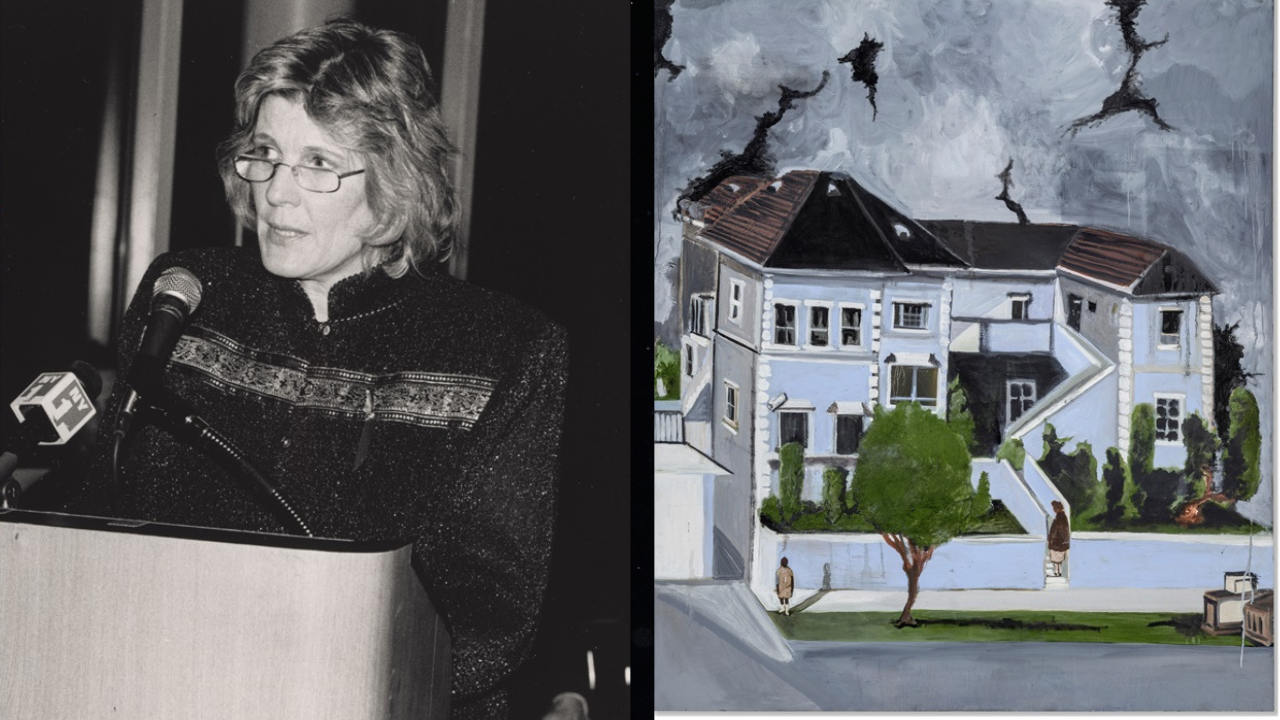
Art is often valued through the eyes of the people who collect it, but its significance can extend far beyond the price it commands in a gallery or at an auction.
asserted
it → value → auction
A painting may represent a particular memory, an emotional connection or a lifetime spent appreciating the work of an artist.
uncertain
painting → represent → artist
For collectors, parting with such pieces can sometimes mean letting go of something deeply personal, even when the proceeds serve a purpose larger than the collection itself.
asserted
proceeds → part → collection
This was reflected in a recent auction in New York, where the art collection of American collector and philanthropist Agnes Gund raised $25.7 million for her charitable foundation.
asserted
collection → reflect → foundation
Among the works that went under the hammer was a portrait she affectionately called her 'Mona Lisa'.
asserted
she → go → hammer
The painting, created by artist Jim Nutt, fetched $1.1 million, setting a new auction record for the artist.
asserted
painting → create → artist
According to a press release published by
Christie's on November 19, 2026, the sale was part of its 21st Century Evening Sale held at Rockefeller Center in New York.
uncertain
sale → accord → York
The auction house confirmed that the works from Gund's collection, offered to benefit the Gund Art Foundation, collectively realised $25.7 million.
asserted
works → confirm → million
The results also included Jim Nutt's
Loom (1999), the painting Gund had referred to as her 'Mona Lisa', which sold for $1.1 million, achieving an auction record for the artist.
The story behind Agnes Gund's $25.7 million art collection
Agnes Gund (Image Courtesy of Christies)
Agnes Gund was not simply an art collector who accumulated valuable paintings and sculptures over the years.
asserted
who → include → years
Her collection reflected a lifelong interest in modern and contemporary art, as well as her belief that artists and their work deserved wider recognition.
asserted
artists → reflect → recognition
Bringing together works from the mid-1940s to the late 2010s, it featured artists such as Roy Lichtenstein, Ellsworth Kelly, Vija Celmins, Cy Twombly, Cindy Sherman and Robert Rauschenberg.
asserted
it → bring → Lichtenstein
Many of these works were acquired directly from the artists themselves, reflecting the personal connections she developed with the art world.
asserted
she → acquire → world
Gund also played an influential role in shaping major cultural institutions in the United States.
asserted
Gund → play → States
She served as president of the Museum of Modern Art (MoMA) in New York from 1991 to 2002 and donated more than 800 works to its collection.
asserted
She → serve → collection
Her commitment to making art accessible extended beyond museums, particularly through her philanthropic initiatives supporting arts education and social causes.
asserted
art → make → education
How Agnes Gund used art to support social causes
The artist Jasper Johns and Agnes Gund at a benefit in New York in 2008.
asserted
used → use → 2008
One of the most significant examples of Gund's approach to philanthropy came in 2017, when she decided to sell Roy Lichtenstein's
Masterpiece (1962), a painting she had owned for decades and considered among the most prized works in her collection. The artwork was sold for $165 million, of which Gund committed $100 million to establish the Art for Justice Fund in partnership with the Ford Foundation.
asserted
Gund → come → Foundation
The initiative was created to support organisations working to address mass incarceration and advance criminal justice reform in the United States.
asserted
initiative → create → States
Rather than simply donating an artwork to a museum, Gund chose to turn its financial value into resources for social change.
asserted
Gund → donate → change
Her philanthropic work also extended to making art education more accessible to children.
asserted
education → extend → children
In 1977, she founded
Studio in a School, a nonprofit organisation that brought professional artists into public school classrooms, giving students opportunities to learn and engage with visual arts.
asserted
that → found → arts
The initiative also provided meaningful work for practising artists.
asserted
initiative → provide → artists
Together, these efforts reflected Gund's belief that art should not remain confined to private collections or galleries, but should be accessible to wider communities and contribute to causes beyond the art world.
asserted
art → reflect → world
In the end, the significance of Agnes Gund's collection lies in more than the millions it brought in at auction or the records set by individual artworks.
asserted
it → lie → artworks
A collection built over a lifetime can hold personal memories, artistic appreciation and a deep connection to the people behind the work.
asserted
collection → build → work
Yet, by choosing to direct its proceeds towards her foundation, Gund ensured that its value would extend beyond the walls of galleries and private collections.
asserted
value → choose → galleries
The paintings may now belong to new owners, but the purpose behind their sale carries forward a different kind of legacy, one in which art becomes not only something to preserve and admire, but also a means of giving back
uncertain
art → belong → which
 The Aporia