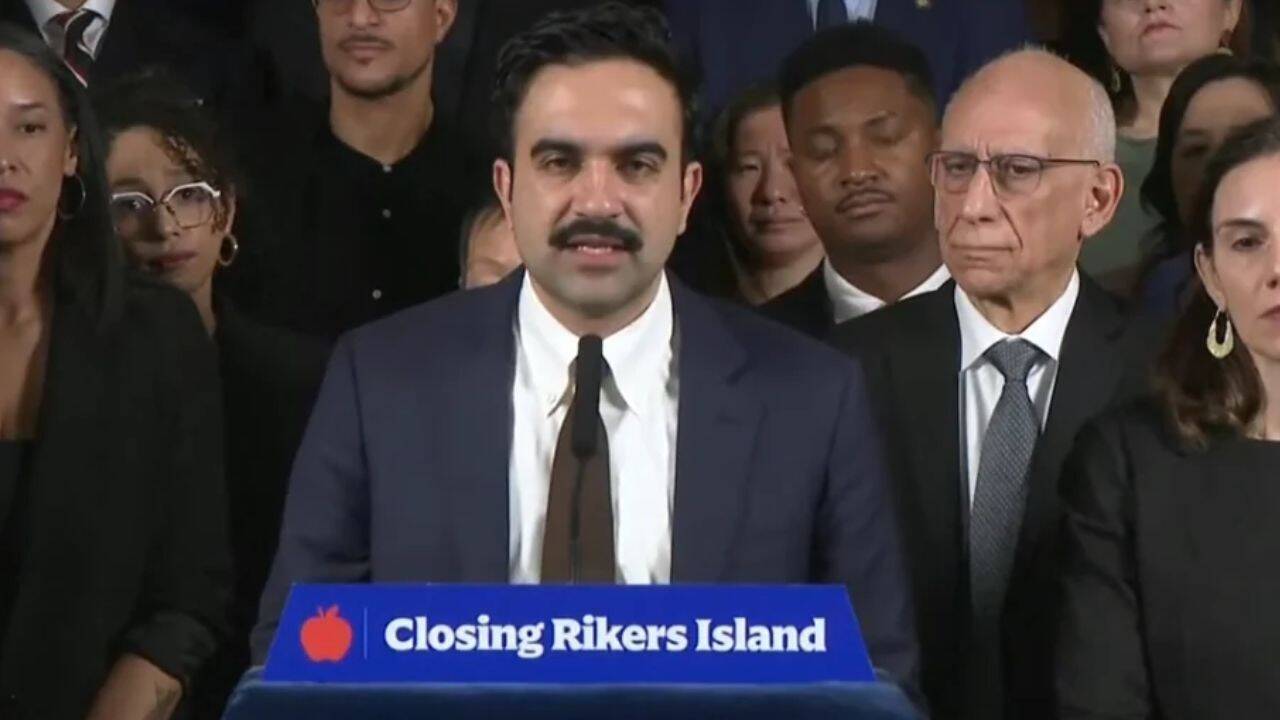
Last week Mayor Zohran Mamdani announced that he’ll ask the City Council to delay its deadline for shuttering the jails on Rikers Island from 2027 to 2032.
asserted
he → announce → 2032
If they do so, the mayor and council will cure one legal problem that plagues their plan for Rikers’ closure — but leave another far more serious and dangerous legal flaw unresolved.
Under New York state’s Correction Law, the city cannot close its current jails until it has “designated or erected” replacement facilities.
That means the 2027 closure deadline set by the City Council’s local law is nothing but an unenforceable aspiration: Rikers may only close entirely when the city has erected new jails to take its place.
uncertain
city → do → place
By moving the deadline at the mayor’s request, the council simply avoids an imminent and impractical conflict with state law.
asserted
council → move → law
A more pressing and dangerous legal problem looms, though.
asserted
problem → loom → ?
The four borough-based jails slated to replace the Rikers facilities will have only a fraction of Rikers’ capacity.
asserted
jails → base → capacity
The Rikers jails can hold about 15,000 inmates, and they house more than 6,600 people now.
asserted
they → hold → people
The four new jails will have a combined capacity of about 4,100 inmates.
asserted
jails → have → inmates
That substantial difference is no oversight — it has been, from the beginning, the plan’s foundation.
Ever since Mayor Bill de Blasio announced the closure plan in 2019, throughout Mayor Eric Adams’ tenure and continuing into the Mamdani administration, the city has openly touted “decarceration” as the primary purpose behind the “close Rikers” push.
asserted
city → announce → push
As the mayor’s office website currently proclaims, “New York is leading a historic decarceration plan to close Rikers Island and replace it with a smaller network of safer modern jails.”
asserted
York → proclaim → jails
The city is deliberately building a jail system that slashes capacity — not because of a reduced need for jail cells, but because of an ideological antipathy to incarceration.
asserted
that → build → incarceration
State law and the constitutional prerogatives of the judicial branch, however, do not permit the city to build such a purposefully inadequate system.
asserted
law → permit → system
The state Correction Law, for example, assigns mandatory tasks to local jails: They “shall be used” for the “detention” of those held for trial, and for the “confinement” of those convicted of crimes who are required by the court to serve their sentences locally.
asserted
who → assign → sentences
The Penal Law and Criminal Procedure Law, meanwhile, empower judges to detain defendants awaiting trial and to impose sentences in local jails on those convicted.
asserted
Law → empower → those
If judges lawfully order defendants into custody and local jails can’t accommodate them, the city will violate the judiciary’s constitutional and statutory prerogatives — and find itself in contempt of court.
asserted
itself → order → court
That would be a legal disaster, opening the city correction commissioner and other officials to fines and further legal consequences.
asserted
That → open → fines
The correction officers’ union, for example, has already voiced alarm over the dangers to its members and the public that will arise from the lack of adequate capacity.
asserted
that → voice → capacity
And a host of interested parties could launch lawsuits to force the city to comply with the state law’s mandates.
uncertain
host → launch → mandates
Even the principal architect of the closure plan, Elizabeth Glazer, who served as de Blasio’s criminal justice coordinator, has called for the city to abandon it, citing the lack of capacity as a major error.
asserted
city → serve → error
But instead of calling for the logical solution of adding more beds, Mamdani announced vague aspirations, pledging $30 million for programs to reduce re-arrests and promising a “task force” to lessen the time inmates spend incarcerated while awaiting trial.
asserted
inmates → call → trial
The city formed an “independent commission” to guide the Rikers closure a decade ago, yet has made little progress toward reducing the inmate headcount.
asserted
city → form → headcount
In fact, despite years of “planning” for Rikers’ demise, the average time an inmate spends in jail jumped from 87 days in 2025 to 116 days in 2026.
asserted
inmate → plan → 2026
Of course, the jail population will inevitably fluctuate with circumstances largely outside the city’s control — including crime rates, the types of offenses moving through the system and the courts’ administrative management.
asserted
population → fluctuate → system
Even assuming City Hall could reduce the population to match the new jails’ capacity, it would have no flexibility to handle even a minor increase in the number of detainees.
uncertain
it → assume → detainees
The city could be one violent protest away from a crisis that would wreak havoc on the entire criminal justice system.
uncertain
that → wreak → system
Insisting upon adequate capacity is not a defense of the conditions on Rikers Island, nor is it tantamount to opposing its elimination.
asserted
it → insist → elimination
Advertisement
Rather, it is an insistence that the city construct and maintain jails that comply with state law — an essential component of a functional criminal justice system.
Christian Browne is an attorney and adjunct fellow at the Manhattan Institute.
asserted
Browne → construct → Institute

 The Aporia