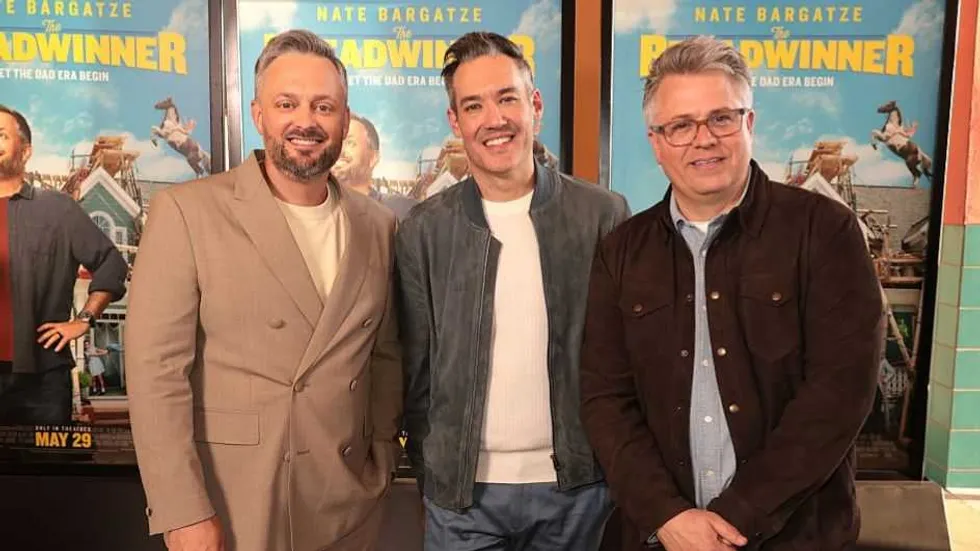
Eric Charbonneau/Getty Images
Jeremy Latcham's faith helped inform the Marvel movies that conquered Hollywood.
asserted
that → inform → Hollywood
Now he's taking over a franchise in need of its own redemption.
asserted
he → take → redemption
Jeremy Latcham was 6 years old when his pastor showed him "Top Gun."
asserted
pastor → show → Gun
This was an unlikely choice of entertainment at the Nazarene church in Chandler, Oklahoma, where Latcham grew up.
asserted
Latcham → grow → Chandler
The denomination discouraged moviegoing, and as Latcham remembers it, his pastor wasn't even supposed to own a VCR.
asserted
pastor → discourage → VCR
'It wasn't like instilling faith per se,' Latcham recalled, 'but it was like instilling redemptive qualities into these characters.
asserted
it → instill → characters
'
But for some reason, the Rev. Steve Profett decided to screen the Tom Cruise blockbuster for his son Luke and Luke's best friend, young Jeremy.
asserted
Profett → decide → son
"Oh, I want to make movies," Latcham remembers thinking.
asserted
Latcham → want → movies
Four decades later, the boy who discovered Hollywood through a pastor's illicit VCR is about to take charge of Superman, Batman, Wonder Woman, and the rest of the DC universe.
asserted
who → discover → universe
On November 9, Skydance announced that Latcham will become president and chief creative officer of DC Studios on December 1, replacing James Gunn and Peter Safran after four years running the studio.
asserted
Latcham → announce → studio
The announcement sent some DC fans digging through Latcham's past interviews, where they discovered that the incoming studio chief is a practicing Christian.
asserted
chief → send → interviews
Online, some worried that his religious convictions would mean the end of DC's darker, more irreverent fare, including "Peacemaker" and "Creature Commandos."
asserted
convictions → worry → Peacemaker
It's an odd concern, considering that Latcham has been helping make superhero movies since before the Marvel Cinematic Universe existed.
asserted
Universe → consider → movies
He joined Marvel Studios in 2004 and helped develop "Iron Man," "The Avengers," "Guardians of the Galaxy," and other films that made superheroes Hollywood's biggest attraction.
asserted
superheroes → join → Galaxy
And as he tells it, his faith was already informing the way he approached those stories.
asserted
he → tell → stories
Would Grandma like it?
asserted
Grandma → like → it
In June, Latcham appeared on "The Bible Bros Podcast," where he spoke with hosts Billy Hallowell and Dalton Harper about his faith, his years at Marvel, and Hollywood's apparent disinterest in entertaining ordinary Americans.
asserted
he → appear → Americans
His father worked on oil rigs, and the family spent years in Venezuela and Colombia before returning to Oklahoma.
asserted
family → work → Oklahoma
Desperate to break into the movie business, Latcham once applied for a job at Tulsa Industrial Film, only to discover that the company made shrink-wrap.
asserted
company → break → wrap
Latcham operated a leaf blower to make two actors appear to be bungee-jumping toward an enormous serving of marinara sauce.
asserted
actors → operate → sauce
Eventually he made it to Los Angeles, joining Marvel Studios in 2004.
asserted
he → make → 2004
By the time the company began production on "Iron Man," its first self-produced feature, Latcham was working closely with director Jon Favreau on the film that would launch the Marvel Cinematic Universe.
asserted
that → begin → Universe
During production, Latcham kept making an observation that became a running joke among his colleagues.
asserted
that → keep → colleagues
"I don't know if my grandma would like that."
asserted
grandma → know → that
His Oklahoma grandparents became an unlikely presence in the editing room.
asserted
grandparents → become → room
Favreau and others teased him about whether particular jokes or scenes would pass muster with Granny and Pep, whom they insisted on calling Meemaw and Peepaw.
asserted
they → tease → Granny
Latcham had a larger audience in mind.
asserted
Latcham → have → mind
The Marvel films, Latcham explained, were meant to offer more than action and spectacle.
asserted
Latcham → explain → action
Would the movie work for people outside Hollywood's cultural bubble?
asserted
movie → work → bubble
Would an ordinary family find something worthwhile in it?
asserted
family → find → it
When "Iron Man" opened in 2008, he got his answer.
asserted
he → open → answer
Latcham's grandmother called to tell him that her pastor had preached about the movie.
asserted
pastor → call → movie
He didn't know Latcham had worked on it.
asserted
Latcham → know → it
He had simply recognized in Tony Stark's transformation a story of redemption worth sharing with his congregation.
asserted
He → recognize → congregation
"It wasn't like instilling faith per se," Latcham recalled, "but it was like instilling redemptive qualities into these characters."
asserted
it → instill → characters
That became the guidepost for MCU storytelling.
asserted
That → become → storytelling
The Marvel films, Latcham explained, were meant to offer "heart, humor, [and] spectacle in that order."
asserted
Latcham → explain → order
He wanted audiences to recognize something of themselves in flawed characters struggling to become better people.
asserted
audiences → want → people
Escape from LA
Latcham's own faith took a more circuitous route.
asserted
faith → take → route
Raised in the Nazarene church, he attended missionary congregations while living in South America.
asserted
he → raise → America
…and 25 more, not listed.
 The Aporia