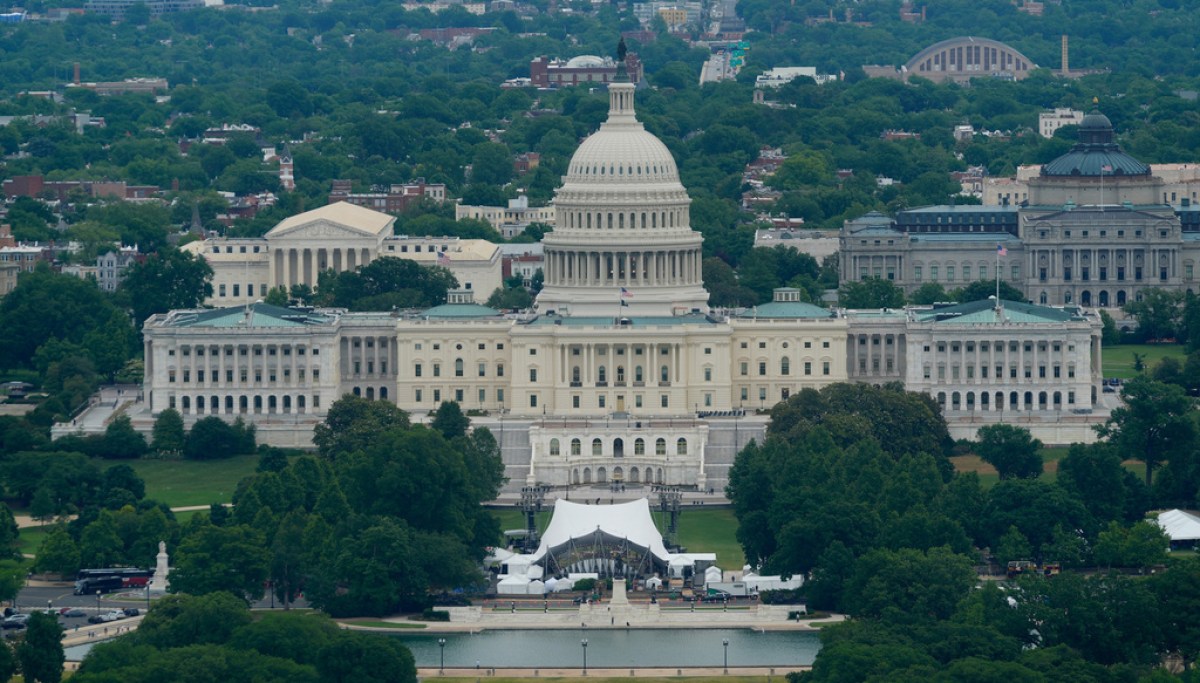
Photo via Washington Examiner

Court overturns federal pregnant workers’ law due to Congress’s COVID-era remote voting

Read the original at Washington Examiner ↗
Cite

Zimmermann, D. (2026, November 21). Court overturns federal pregnant workers’ law due to Congress’s COVID-era remote voting. Washington Examiner. https://www.washingtonexaminer.com/news/justice/4811197/court-overturn-pregnant-law-congresss-covid-remote-voting/

Dated from the outlet's own feed. Check the original for its byline.

Washington Examiner · collected 2026-11-21 · by David Zimmermann

Quick Summary

A federal appeals court has struck down the Pregnant Workers Fairness Act, ruling that it was unconstitutional due to Congress conducting the legislative process remotely during the COVID-19 pandemic, violating the Constitution’s requirement for in-person quorum. The 5th U.S. Circuit Court of Appeals issued a 9-8 decision, finding the law invalid because the vote did not meet the constitutional requirement for physical presence of a majority of members.
Written by AI on 2026-11-22, from this article's own text only (the story summary below draws on all the coverage).

AI analysis

Story summary

On November 21, 2026, the 5th U.S. Circuit Court of Appeals overturned the Pregnant Workers Fairness Act in a 9-8 ruling. The court determined that the act was unconstitutional because it was passed during the COVID-19 pandemic when Congress used remote voting, which violated the Constitution’s quorum clause requiring a majority of members to be physically present for official business. This decision means that the law, which aimed to protect pregnant workers by ensuring they receive reasonable accommodations from employers, is now unenforceable.

Written for “Court Overturns Pregnant Workers Law” on 2026-11-22, grounded in this article and the 0 other(s) covering the same event.

Compared with similar articles

This article reads leans right and hedges 0% of its claims. Each row says how that neighbour differs.
Reason
Hedges 4 of 63 claims Outlet record 67/100
“While both articles discuss court rulings related to Congress's remote voting during the COVID-19 pandemic, they describe different court decisions affecting distinct laws or acts.”
The Quorum Clause Case Different event
Reason
Leans strongly right further right than this Hedges 11 of 66 claims Outlet record 67/100
“Article A discusses the overturning of a specific law protecting pregnant workers, while Article B provides historical context about remote voting during the pandemic and does not focus on the overturning of this particular law.”

Story

Court Overturns Pregnant Workers Law
Crime & Law · 1 article(s) covering the same event.
How this article was measured signals, leaning charts, publisher record, byline, topics and claims

Signals How these are calculated →

Claims extracted
2
sentences that state something as happening or true
Uncertain
0%
0 of 2 hedged ("reportedly", "may", "according to")
Leaning
Leans right
of the writing, not the subject · beta estimate
Publisher signals
67/100
Washington Examiner's corrections and hedging, across everything collected from it. Not a measure of accuracy.
Outlets on this story
1
Crime & Law
Same framing elsewhere
1
articles that frame the event the way this one does
Analyzed 2026-11-22 · how these are computed

How this is being covered How these are calculated →

Article leaning vs. publisher reliability
Source leaning vs. consistency

Publisher

Washington Examiner · 5289 article(s) · 11 correction(s) detected
Running correction rate · 11 correction(s)

Who wrote this

David Zimmermann
175 article(s) here · 0 carrying a prediction
Two Delaware voters made a splash this month when they filed a federal lawsuit seeking a second House seat for the First State, which would raise the lower chamber’s 435-seat cap by one.
President Donald Trump said the newly reported FBI hack might reveal the extent of voter fraud and the “Ukraine hoax” that would not have been disclosed otherwise.
Several governors of Midwestern states set to be affected by the Army’s planned detonation of five tons of degraded lead azide in Middletown, Iowa, are reassuring the public that they’re monitoring the situation.
The executive order applies to confidential information about federal contractors that may be subject to congressional requests.
Katie Miller, the wife of White House chief of staff Stephen Miller, raised eyebrows on Friday night when she resurfaced President Donald Trump’s warning that Iran would be wiped out.
A federal judge sentenced the former Democratic mayor of Jackson, Mississippi, to more than three years in prison for bribery on Friday after he entered his plea in July.
A second federal judge is set to block the planned construction of President Donald Trump’s proposed memorial arch on Friday.
After serving two terms, Gov. Gavin Newsom (D-CA) will leave Sacramento in January 2027 to let Gov.-elect Xavier Becerra (D-CA) take his place.
Sen.-elect Scott Colom (D-MS) is set to become the fourth Senate Democrat who has an identical twin outside the upper chamber of Congress.
Treasury Secretary Scott Bessent directly blamed the Commerce Department for delaying the broader administration’s intent to place Nvidia customer Megaspeed on a special blacklist of companies that could pose a national security threat.
Also by David Zimmermann
Nothing else under this byline is closely related to this article, so these are simply their most recent.
All 175 articles by David Zimmermann →

Topics

Congress Constitution the 5th U.S. Circuit Court of Appeals the Pregnant Workers Fairness Act

Subjects

Congress ORG · 2× the 5th U.S. Circuit Court of Appeals ORG · 1×

Narrative

In a 9-8 ruling, the 5th U.S. Circuit Court of Appeals determined the Constitution’s quorum clause, which requires a majority of members in each chamber of Congress to be present for official business, renders the Pregnant Workers Fairness Act moot.
framing: assertive · carried by 1 article(s) · first seen 2026-11-22

Claims (2 extracted, 0 hedged)

A federal appeals court overturned a law protecting pregnant workers on Friday, concluding that the measure had been unconstitutionally enacted because Congress held the vote remotely during the COVID-19 pandemic. asserted
Congress → overturn → pandemic
In a 9-8 ruling, the 5th U.S. Circuit Court of Appeals determined the Constitution’s quorum clause, which requires a majority of members in each chamber of Congress to be present for official business, renders the Pregnant Workers Fairness Act moot. asserted
Act → determine → business
Give feedback · no sign-in needed

No sign-in needed for now. Your note is sent without a name, so it cannot be answered.

History Support