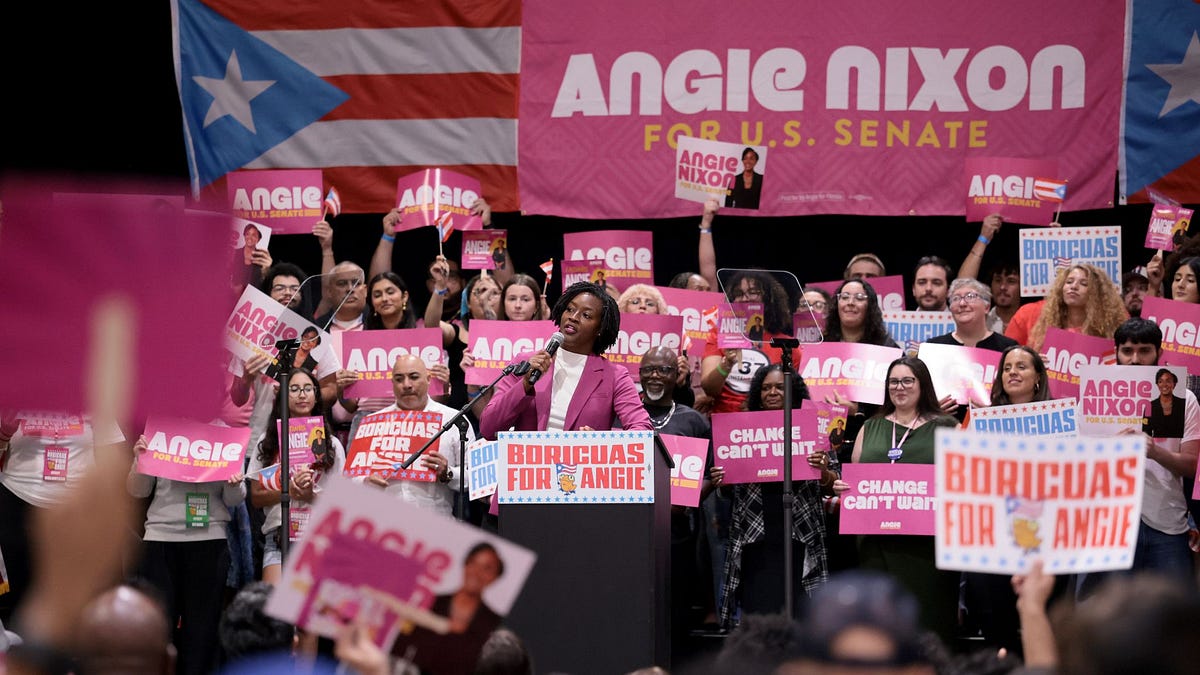
Photo via The Guardian

Did Democrats fail Florida? Angie Nixon on ‘missed opportunity’ in midterms

Read the original at The Guardian ↗
Cite

Washington, D. S. i. (2026, November 21). Did Democrats fail Florida? Angie Nixon on ‘missed opportunity’ in midterms. The Guardian. https://www.theguardian.com/us-news/2026/nov/21/democrats-florida-midterm-election-loss

Dated from the outlet's own feed. Check the original for its byline.

The Guardian · collected 2026-11-21 · by David Smith in Washington

Quick Summary

Angie Nixon, who lost her bid to become Florida's first Black senator to Republican Ashley Moody by 2.9 percentage points, discusses what she sees as a "missed opportunity" for Democrats in the state. Nixon attributes her loss partly to insufficient financial support from the national Democratic party, which directed resources to other battleground states like Kansas, Mississippi, South Carolina, and Texas. With Moody raising $14.5 million compared to Nixon's $11.3 million, Nixon struggled to counteract negative advertising that depicted her as raising taxes, a message that resonated with Florida voters.
Written by AI on 2026-11-21, from this article's own text only (the story summary below draws on all the coverage).

AI analysis

Story summary

In the 2026 midterm elections, Republican Byron Donalds narrowly defeated Democrat David Jolly in Florida's gubernatorial race by 1.3 percentage points, becoming the state's first Black governor. Meanwhile, Republican Ashley Moody won Florida's Senate race against Democrat Angie Nixon by 2.9 percentage points. Despite these losses, Nixon argued that it was a "missed opportunity" for Democrats, suggesting that the party's lack of support contributed to the defeat in a state that has trended rightward in recent years. Governor Ron DeSantis celebrated Florida's results as a significant victory for Republicans, noting that the state "held the line" against a generally favorable national trend for Democrats.

Written for “Angie Nixon on Midterms Missed Opportunity” on 2026-11-21, grounded in this article and the 0 other(s) covering the same event.

Compared with similar articles

This article reads unscored and hedges 3% of its claims. Each row says how that neighbour differs.
New York Post
Leans strongly right Hedges 5 of 27 claims Outlet record 66/100
“The articles discuss different aspects of the election results: Article A focuses on a poll analysis suggesting Trump supporters' abstention led to the Democratic gain, while Article B highlights specific results and commentary from Florida's governor about the election outcome in Florida.”
Silver Bulletin
Leans right Hedges 2 of 11 claims
“The articles discuss different times and outcomes, with Article A focusing on the 2026 midterm election results and Article B reflecting on the 2018 election and its impact on Florida Democrats.”
The Guardian
Leans left Hedges 3 of 38 claims Outlet record 64/100
“The articles discuss different aspects of the midterm elections, with Article A focusing on the overall success of Democrats while Article B focuses on the specific results in Florida.”
Washington Examiner
Leans right Hedges 6 of 36 claims Outlet record 67/100
“The articles discuss different aspects of the Democratic performance in the 2026 midterm elections, with Article A focusing on broader implications for the future and Article B specifically addressing Florida's results.”
The Independent
Centre Hedges 1 of 17 claims Outlet record 59/100
“The articles discuss different aspects of the midterm elections, with Article A focusing on the overall Republican losses and blame, while Article B focuses specifically on the results and analysis in Florida.”
TIME
Leans strongly left Hedges 2 of 47 claims Outlet record 60/100
“The articles discuss different aspects of the 2026 midterm elections, with Article A focusing on the impact in Memphis and Tennessee, while Article B discusses the outcomes in Florida.”

Story

Angie Nixon on Midterms Missed Opportunity
Politics · 1 article(s) covering the same event.
How this article was measured signals, leaning charts, publisher record, byline, topics and claims

Signals How these are calculated →

Claims extracted
66
sentences that state something as happening or true
Uncertain
3%
2 of 66 hedged ("reportedly", "may", "according to")
Leaning
withheld
no quote in the article backed the model's score
Publisher signals
64/100
The Guardian's corrections and hedging, across everything collected from it. Not a measure of accuracy.
Outlets on this story
1
Politics
Same framing elsewhere
1
articles that frame the event the way this one does
Analyzed 2026-11-21 · how these are computed

How this is being covered How these are calculated →

Article leaning vs. publisher reliability
Source leaning vs. consistency

Publisher

The Guardian · 2663 article(s) · 9 correction(s) detected
Running correction rate · 9 correction(s)

Who wrote this

David Smith in Washington
33 article(s) here · 1 carrying a prediction
To call it a blue wave, said the Florida governor, Ron DeSantis, would be an epic understatement.
Vance is widely expected to seek the crown, though it was Rubio who came out on top in the latest Emerson College national poll.
Wyne added: “Both of them recognise that it is next to impossible that any of President Trump’s successors will view them in comparable terms as friends, adopt conciliatory dispositions, and on certain issues come close to aligning US positions with those of China and Russia.
In 2016 she warned Zuckerberg and other Silicon Valley executives that an authoritarian disinformation model being tested in the Philippines would soon be exported to the west.
“Trump is about to get even weirder and, sadly, more dangerous,” tweeted Clinton, who has been a wry commentator on the Trump years, predicting that the president will deflect blame, become more unhinged, demand even greater loyalty from Republicans and potentially launch fresh attacks on Iran.
“I think it might be too tough, yeah.
I do believe that James Talarico will be working for the people of Texas and not for the oligarchs.”
But he could be facing a very different political landscape, depending on the results of the US midterm elections held the previous day.
With days to go before midterm elections that will decide the balance of power in Congress for the remainder of Donald Trump’s second term, Democrats have turned to their most formidable orator for a series of blistering speeches in the campaign’s closing days.
He quipped that his own supporters couldn’t afford a hamburger at his Mar-a-Lago club.
Also by David Smith in Washington
Nothing else under this byline is closely related to this article, so these are simply their most recent.
All 33 articles by David Smith in Washington →

Topics

Black Democrats Florida Moody Republican

Subjects

Nixon PERSON · 11× Florida GPE · 10× Democrats NORP · 4× Moody PERSON · 3× Angie Nixon PERSON · 2× Black NORP · 2× Mississippi GPE · 2× Republican NORP · 2× DeSantis PERSON · 1× Ron DeSantis PERSON · 1×

Narrative

On a night when almost everything else went right for Democrats, David Jolly fell short by 1.3 percentage points against Republican Byron Donalds, who will become Florida’s first Black governor, while Angie Nixon, bidding to become the state’s first Black senator, lost by 2.9 percentage points to Republican Ashley Moody.
framing: assertive · carried by 1 article(s) · first seen 2026-11-21
To call it a blue wave, said the Florida governor, Ron DeSantis, would be an epic understatement.

Claims (66 extracted, 2 hedged)

To call it a blue wave, said the Florida governor, Ron DeSantis, would be an epic understatement. asserted
governor → call → it
But one state, DeSantis added with pride, was able to “hold the line”. asserted
DeSantis → add → line
On a night when almost everything else went right for Democrats, David Jolly fell short by 1.3 percentage points against Republican Byron Donalds, who will become Florida’s first Black governor, while Angie Nixon, bidding to become the state’s first Black senator, lost by 2.9 percentage points to Republican Ashley Moody. asserted
Nixon → go → Moody
Even the losses, however, were remarkable performances in a state that has shifted right in recent years and become the adopted home of Donald Trump, and where two years ago he defeated Kamala Harris by 13 percentage points. asserted
he → shift → points
In an election where Democrats were winning in Kansas, Mississippi, South Carolina and Texas, Nixon was left asking: did Florida Democrats lose because the party didn’t support them? asserted
party → win → them
“It was a missed opportunity,” the 42-year-old said pointedly. asserted
old → miss → ?
“I’m going to work to bring everybody together so that we don’t miss opportunities like that anymore.” asserted
we → go → that
Democratic party leaders and major national donors made calculated investments in key battlegrounds elsewhere, producing stunning victories in unexpected places. asserted
leaders → make → places
Yet that generosity came at the expense of southern states like Florida and Louisiana, where local candidates were largely left to fend for themselves. asserted
candidates → come → themselves
Was that because too many people had written Florida off as a red state? asserted
people → write → state
“Folks often write the south off. asserted
Folks → write → south
Now we’ve shown that Florida is in play, the south is in play, and I’m hoping that through my advocacy and me being so vocal that people will take note and will listen and donate to more candidates in the south,” Nixon said. asserted
Nixon → show → south
Covering its vast geographical expanse requires a huge war chest and saturation TV strategy. asserted
Covering → cover → chest
Nixon had neither. asserted
Nixon → have → neither
“I would say we were out-fundraised and Florida’s a very big state,” was her simple diagnosis. asserted
diagnosis → say → ?
Moody had raised $14.5m compared to Nixon’s $11.3m, according to the Federal Election Commission, while outside groups spent $10.4m opposing Nixon versus $3.6m spent opposing Moody. uncertain
groups → raise → Moody
Without the funds to buy airtime across Florida’s multiple expensive media markets – from Miami and Orlando to Tampa and Jacksonville – Nixon found herself overwhelmed by negative advertising from Moody and her allied political committees. asserted
herself → buy → Moody
“They hit me hard on it, and we didn’t have enough money to push back until it was too late.” asserted
it → hit → money
While conservative groups sought to depict Nixon as a far left extremist (“Angie Nixon is actually a socialist,” said one), she believes it was a more traditional attack that hurt her the most. asserted
that → seek → her
“Those didn’t necessarily work. asserted
Those → work → ?
What we saw worked was when they were trying to say that I was raising taxes on people.” asserted
I → see → people
By the time Nixon’s campaign could afford to explain her economic platform, the ads had done their damage. uncertain
ads → afford → damage
Nixon believes that “of course” national Democrats should have intervened sooner. asserted
Democrats → believe → course
But she is careful not to dwell too long on the blame game. asserted
she → dwell → game
“I wish more people gave me money, period. asserted
people → wish → money
I’m going to work to move forward and work to organise and create an environment where, despite whatever the conditions of that year are, that we’ll still be able to win. asserted
we → go → year
Nixon’s optimism is bolstered by what transpired on election night in other southern contests, where underfunded candidates demonstrated that progressive, community centred campaigns can break through longstanding conservative strongholds. asserted
campaigns → bolster → strongholds
She points to Scott Colom, the progressive prosecutor who became the first Black senator elected in Mississippi since the Reconstruction era. asserted
who → point → era
The lesson of those races, for Nixon, is that no red state is a monolith and no southern state is permanently out of reach if the party is willing to contest it. asserted
party → contest → it
Even with more money, however, any Democrat running in Florida faces a structural barrier erected over successive legislative sessions: the deliberate erosion of voting rights. asserted
Democrat → run → rights
Nixon points the finger at DeSantis. asserted
Nixon → point → DeSantis
“That man has done so much as it relates to voter suppression. asserted
it → do → suppression
He’s done so much to suppress voters. asserted
He → do → voters
Every single year they have attacked voting rights and the election laws and so now we’re dealing with that.” asserted
we → attack → that
While turnout rates among registered Democrats remained high, the overall playing field has been warped by the fact Florida now has 1.5 million more registered Republicans than Democrats, a huge reversal after Democrats held the advantage for decades. asserted
Democrats → register → decades
Nixon argues that this gap did not emerge organically but was engineered by targeted legislation designed to debilitate voter registration drives. asserted
gap → argue → drives
In recent years, Florida’s Republican supermajorities have enacted onerous penalties and strict restrictions on grassroots civic organisations. asserted
supermajorities → enact → organisations
She continued: “That gap is there because they made it harder for third-party organisations to be able to register voters. asserted
organisations → continue → voters
Historically, those third-party groups registered more people of colour. asserted
groups → register → colour
That was intentional to make it harder.” asserted
it → make → ?
…and 26 more, not listed.

Give feedback · no sign-in needed

No sign-in needed for now. Your note is sent without a name, so it cannot be answered.

History Support