Photo via CBS News

Can Anthropic win hearts and minds by curing hearts and minds?

Read the original at CBS News ↗
Cite

Cerullo, M. (2026, November 20). Can Anthropic win hearts and minds by curing hearts and minds? CBS News. https://www.cbsnews.com/news/anthropic-drug-discovery-claude-science-ipo/

Dated from the outlet's own feed. Check the original for its byline.

CBS News · collected 2026-11-20 · by Megan Cerullo

Quick Summary

Anthropic, the company behind the AI model Claude, recently filed for an IPO and is now focusing on demonstrating its potential to generate profits by applying AI to medical research and drug development. In its prospectus, Anthropic claims that AI could accelerate the pace of medical breakthroughs and potentially cure diseases such as cancer and Alzheimer's within the next 5 to 10 years. The company has already partnered with biotech and pharmaceutical firms and operates its own AI-powered biology lab. However, turning its research into commercial success remains a challenge, as noted by analysts who question how Anthropic will convert its advancements into financial gains.
Written by AI on 2026-11-21, from this article's own text only (the story summary below draws on all the coverage).

AI analysis

Story summary

Anthropic, a leading AI company based in San Francisco, aims to win consumer trust and demonstrate long-term growth by focusing on curing diseases using AI technology. The company stated in its IPO prospectus that AI can "profoundly accelerate the rate of progress in biology and medicine," potentially curing diseases like cancer, Alzheimer's, heart disease, rare genetic diseases, and major infectious diseases within 5-10 years. CEO Dario Amodei expressed optimism about this timeline in an August post on X (formerly Twitter), noting that while this may seem unrealistic to many, including biologists, he believes it is achievable. Experts like Neerav Kaushal from Morningstar and Michigan Technological University agree that AI can significantly speed up the development of new drugs and treatments, making it a promising avenue for research and medical advancement.

Written for “Anthropic Wins Hearts And Minds” on 2026-11-21, grounded in this article and the 0 other(s) covering the same event.

Compared with similar articles

This article reads unscored and hedges 25% of its claims. Each row says how that neighbour differs.
Mother Jones
Hedges 3 of 10 claims Outlet record 60/100
“Article A discusses the concerns and context around Anthropic's IPO, while Article B focuses on the company's plan to use AI to cure diseases following the IPO.”
Toronto Star
Leans right Hedges 6 of 38 claims Outlet record 64/100
“The articles discuss Anthropic's IPO but focus on different aspects: Article A covers the historical context and safety concerns, while Article B focuses on the company's plan to use AI for medical advancements post-IPO.”
CBS News
Hedges 0 of 2 claims Outlet record 66/100
“The articles discuss different aspects of Anthropic's activities, one focusing on the rapid development of AI models and the other on the company's potential to cure diseases using AI.”
Semafor
Leans left Hedges 2 of 4 claims Outlet record 64/100
“The articles discuss different aspects of Anthropic's activities: one focuses on the company's potential to cure diseases post-IPO, while the other reports on the company's record-breaking IPO and its impact on employees' wealth.”
Toronto Star
Leans left Hedges 7 of 42 claims Outlet record 64/100
“The articles cover different aspects of Anthropic's IPO and its promises regarding AI's impact on society and medicine, but they describe distinct information and timing.”
The Dispatch
Hedges 0 of 3 claims Outlet record 61/100
“The articles discuss Anthropic's initial public offering and its strategic plans, but they describe different aspects and times within the same broader event, not a single specific incident.”
BBC News
Hedges 1 of 4 claims Outlet record 65/100
“The articles discuss different aspects of Anthropic's activities related to its IPO and its potential impact on healthcare, but they do not describe the same specific event.”
Semafor
Leans left Hedges 0 of 4 claims Outlet record 64/100
“While both articles discuss Anthropic's IPO, they describe different aspects of the event—one focuses on the financial details and market reaction, while the other discusses the company's long-term plans and potential impact on healthcare.”
Mother Jones
Leans strongly left Hedges 2 of 29 claims Outlet record 60/100
“The articles describe different aspects of Anthropic's IPO activities; Article A focuses on the protests and the IPO day, while Article B discusses the company's plans post-IPO.”
Daily Mail
Hedges 6 of 27 claims Outlet record 69/100
“Article A reports on Anthropic's stock market debut and initial public offering, while Article B discusses the company's plans for using AI to advance medical research and treatment, which are separate but related topics.”

Story

Anthropic Wins Hearts And Minds
Technology · 1 article(s) covering the same event.
How this article was measured signals, leaning charts, publisher record, byline, topics and claims

Signals How these are calculated →

Claims extracted
24
sentences that state something as happening or true
Uncertain
25%
6 of 24 hedged ("reportedly", "may", "according to")
Leaning
not political
takes no side on a contested political question
Publisher signals
66/100
CBS News's corrections and hedging, across everything collected from it. Not a measure of accuracy.
Outlets on this story
1
Technology
Same framing elsewhere
1
articles that frame the event the way this one does
Analyzed 2026-11-21 · how these are computed

How this is being covered How these are calculated →

Article leaning vs. publisher reliability
Source leaning vs. consistency

Publisher

CBS News · 5942 article(s) · 11 correction(s) detected
Running correction rate · 11 correction(s)

Who wrote this

Megan Cerullo
50 article(s) here · 1 carrying a prediction
Anthropic co-founder and CEO Dario Amodei said in a post on X in August that he believes "it will actually be possible to cure most human disease in ~5-10 years, as crazy as it may sound to ordinary people and frankly to biologists as well (I used to be one!).
"Things could need to escalate quite a bit for this to go from level one to level three, which would maybe start to move the needle for some companies.
Harvard scientist Gianluca Guidi, the lead author of the paper published in Nature Sustainability this week, told CBS News that it took two years to analyze the electricity use and carbon dioxide emissions of 403 hyperscale data centers between May 2024 and April 2025.
Nvidia reported robust growth on Tuesday, with interim CEO Colette Kress set to host her first earnings call since company founder and former chief executive Jensen Huang after revelations of multiple extramarital affairs.
Nvidia co-founder Jensen Huang broke his silence after from the company following revelations of multiple affairs, saying he'd be willing to return as its CEO."I
Huang's exit has heightened concerns that China and other nations could access Nvidia's advanced chips by renting computing resources through data centers in Southeast Asia.
A proposed order bans Family Dollar from misleading customers on prices and requires the company to adopt what the FTC described as a "pricing accuracy program" that is independently assessed and certified annually. "Today's order will ensure Family Dollar stops deceiving consumers about its prices and returns money to consumers harmed by these practices," Christopher Mufarrige, director of the FTC's Bureau of Consumer Protection, said in a statement on Thursday.
Analysts at TD Securities also predict three straight quarter-point hikes, up from their previous forecast of two, because hotter inflation signals that price pressures across the U.S. are broadening.
"It's very stressful knowing that every time the phone rings, you have to pick it up and talk to someone who says you owe them thousands of dollars for something you couldn't help," Coy, 32, a Cypress, Texas, resident, told CBS News. 40% of Americans The phone is also ringing off the hook for millions of other people facing overdue healthcare bills.
Yet Huang's long-range strategic vision, unique qualities as a leader and deep connections in the tech world will be hard to replace, Ives emphasized.
Also by Megan Cerullo
Nothing else under this byline is closely related to this article, so these are simply their most recent.
All 50 articles by Megan Cerullo →

Topics

Anthropic CBS News Michigan Technological University Morningstar San Francisco

Subjects

Anthropic ORG · 11× Khan PERSON · 4× CBS News ORG · 3× Dario Amodei PERSON · 1× Eli Lilly and Co. ORG · 1× Malik Ahmed Khan PERSON · 1× Michigan Technological University ORG · 1× Morningstar ORG · 1× Neerav Kaushal PERSON · 1× San Francisco GPE · 1×

Narrative

"If you are the AI company that helps advance some kind of cure or solution to a sickness or illness that's prevailed for quite some time, I think that gets you a ton more trust with consumers and end users," Khan said. "Because you end up becoming the company that is actually improving the quality of life for humans at large."
framing: mixed · carried by 1 article(s) · first seen 2026-11-21
Anthropic co-founder and CEO Dario Amodei said in a post on X in August that he believes "it will actually be possible to cure most human disease in ~5-10 years, as crazy as it may sound to ordinary people and frankly to biologists as well (I used to be one!).
2026-11-21 · CBS News
Can Anthropic win hearts and minds by curing hearts and minds? · mixed framing

Claims (24 extracted, 6 hedged)

Fresh off its record-setting , Anthropic now must show investors that it can sustain growth and generate profits. asserted
it → show → profits
The company has a plan for that: curing some of the world's gnarliest diseases. asserted
company → have → diseases
In its IPO prospectus, Anthropic states that AI holds the potential to "profoundly accelerate the rate of progress in biology and medicine, potentially curing diseases that have plagued humanity for millennia, including cancer, Alzheimer's disease, heart disease, rare genetic diseases, and the major infectious diseases." asserted
that → state → cancer
Anthropic co-founder and CEO Dario Amodei said in a post on X in August that he believes "it will actually be possible to cure most human disease in ~5-10 years, as crazy as it may sound to ordinary people and frankly to biologists as well (I used to be one!). uncertain
I → say → biologists
" Speeding in the right direction Developing breakthrough drugs is among the most promising avenues of research for AI, potentially bringing treatments for a range of conditions to market much faster than is currently possible, according to scientists and industry analysts. uncertain
Developing → speed → scientists
"AI can accelerate research. asserted
AI → accelerate → research
It will help you get there faster, but it's not just speed — it's directional speed," Neerav Kaushal, an AI and molecular biology expert at Michigan Technological University, told CBS News. asserted
Kaushal → help → News
"Let's say you're at the top of the mountain and your aim is to find a drug for cancer that lies in the valley. asserted
that → let → valley
AI will not just help you get down there faster — it will help you get down to the right valley where the drug is. asserted
drug → help → valley
For Anthropic, meanwhile, developing drugs could open up potentially enormous commercial opportunities. uncertain
developing → develop → opportunities
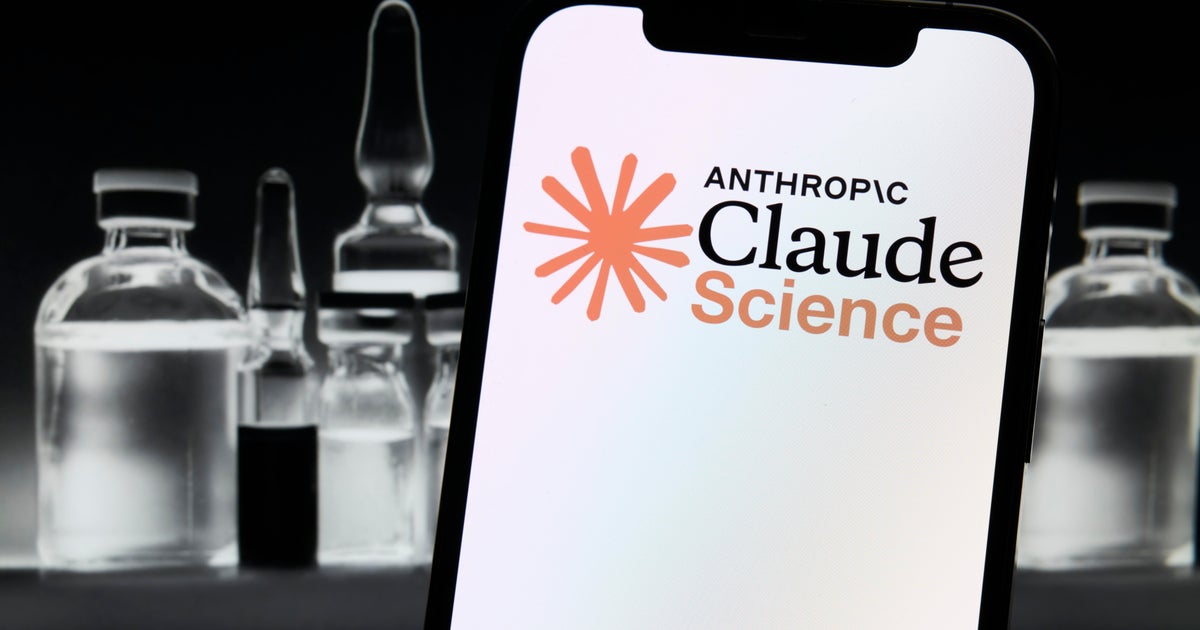
The company has partnered with biotech and pharmaceutical companies that use its Claude Science model for various purposes. asserted
that → partner → purposes
Anthropic also operates its own AI-powered biology wet lab in San Francisco that has already made scientific discoveries. asserted
that → operate → discoveries
"If you can use a large language model to condense any part of the timeline, it is very economically valuable," Morningstar senior equity analyst Malik Ahmed Khan told CBS News. asserted
Khan → use → News
The challenge for Anthropic will be how it turns its life sciences research into profits. asserted
it → turn → profits
That could take time, Khan told CBS News. uncertain
Khan → take → News
"How this becomes lucrative for Anthropic is a very important question, and I think it's a question Anthropic hasn't figured out yet," Khan said. asserted
Khan → become → Anthropic
"Coding is its best-proven use case, followed by cybersecurity applications, then financial and legal research. asserted
Coding → prove → applications
" But the potential to move the needle for both Anthropic and its pharma partners is significant. asserted
potential → move → Anthropic
"If you improve your drug's efficiency by a couple of percentage points, that can make a world of difference," Khan added. asserted
Khan → improve → difference
"You'll get asymmetric payouts in the sense that if a model can help with any part of the process, it's very economically valuable. asserted
it → get → process
For example, he expects a drug developer like Eli Lilly and Co., which partners with Anthropic to give its employees access to Claude, would be willing to pay "hundreds of millions or billions of dollars to make its arthritis drug 2% better than it is. asserted
it → expect → dollars
Developing potentially lifesaving drugs could have other benefits for Anthropic. uncertain
Developing → develop → Anthropic
By applying tools to the life sciences and using them to improve human life, the company could help shift the narrative around AI to a more positive one, according to experts. uncertain
company → apply → experts
"If you are the AI company that helps advance some kind of cure or solution to a sickness or illness that's prevailed for quite some time, I think that gets you a ton more trust with consumers and end users," Khan said. "Because you end up becoming the company that is actually improving the quality of life for humans at large." asserted
that → help → humans

Give feedback · no sign-in needed

No sign-in needed for now. Your note is sent without a name, so it cannot be answered.

History Support