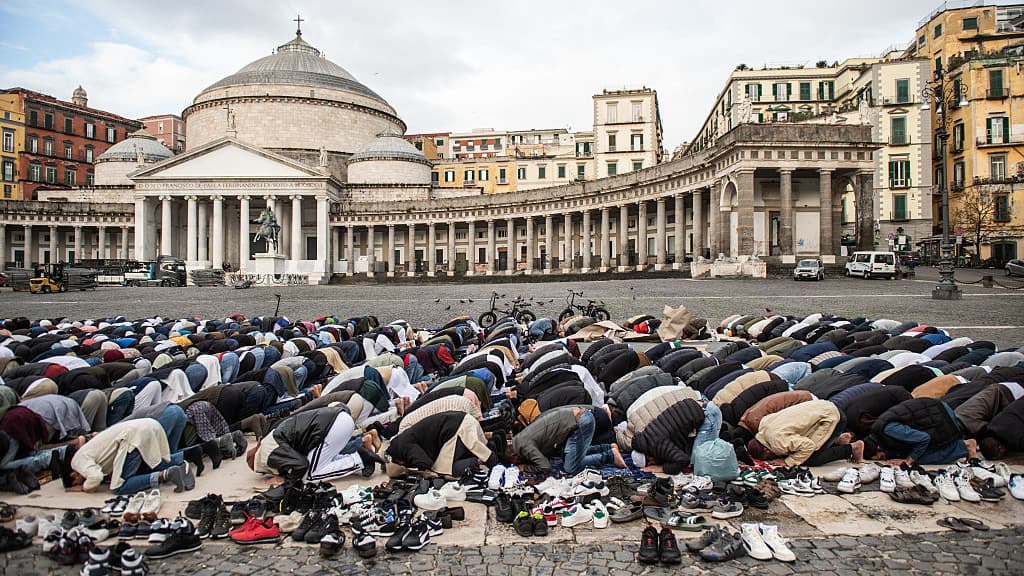
Photo via TIME

Muslims Are Projected to Become the World’s Largest Religious Group by 2035, Surpassing Christians. Here’s Why

Read the original at TIME ↗
Cite

Greene, C. (2026, November 20). Muslims Are Projected to Become the World’s Largest Religious Group by 2035, Surpassing Christians. Here’s Why. TIME. https://time.com/article/2026/11/20/muslims-christians-population-growth-study/

Dated from the outlet's own feed. Check the original for its byline.

TIME · collected 2026-11-20 · by Connor Greene

Quick Summary

Pew Research Center projects that Muslims will become the world’s largest religious group by 2035, surpassing Christians. By 2070, Muslims are expected to number 3.64 billion, compared to 2.96 billion Christians. This shift is driven primarily by higher fertility rates among Muslims, with Muslim women averaging 3.1 children versus 2.5 for Christians. The study attributes these demographic changes to factors including fertility, migration, and mortality rates, with sub-Saharan Africa playing a significant role due to its rapid population growth.
Written by AI on 2026-11-20, from this article's own text only (the story summary below draws on all the coverage).
See how they differ ↓

AI analysis

Story summary

Islam is projected to become the world's largest religion by 2035, surpassing Christianity, according to a new report by the Pew Research Center released on November 18, 2026. By 2035, the global Muslim population is expected to rise to 3.6 billion, while Christians will number just under 3 billion. This shift is largely attributed to higher birth rates among Muslims and lower birth rates among Christians in nations with older populations, where deaths are exceeding births. The United States, which had the largest Christian population in 2020, is expected to witness the greatest decline in Christian numbers. Additionally, the report forecasts that by 2070, Muslims will outnumber Christians by more than 600 million adherents.

Written for “Islam to Overtake Christianity By 2035” on 2026-11-21, grounded in this article and the 8 other(s) covering the same event.

How they differ

9 outlets covered “Islam to Overtake Christianity By 2035”.

What each outlet says

One AI summary per outlet of its latest article on this story, written from that article alone and checked against it. Open the article for the outlet's own words.

TimeThis outlet20 Nov

Pew Research Center projects that Muslims will become the world’s largest religious group by 2035, surpassing Christians. By 2070, Muslims are expected to number 3.64 billion, compared to 2.96 billion Christians. This shift is driven primarily by higher fertility rates among Muslims, with Muslim women averaging 3.1 children versus 2.5 for Christians. The study attributes these demographic changes to factors…

Muslims Are Projected to Become the World’s Largest Religious Group by 2035, Surpassing Christians. Here’s Why (this article)
The Daily Wire18 Nov

Pew Research Center projects that by 2035, Islam will become the world’s largest religion, surpassing Christianity due to higher Muslim birth rates and lower rates of religious switching. Between 2020 and 2025, the Muslim fertility rate was 3.1 children per woman, compared to 2.5 for Christians. By 2070, Muslims are expected to gain 1.6 billion people through natural population change, while Christians will see an…

Islam Projected To Overtake Christianity As World’s Largest Religion →
Washington Free Beacon19 Nov

Pew Research Center predicts that Islam will surpass Christianity as the world's largest religion by 2035, with Muslims outnumbering Christians by over 600 million by 2070. In the United States, Christians are projected to decline to less than half of the population by 2070, while religiously unaffiliated individuals will rise to about 41%. The report attributes these changes to higher fertility rates among Muslims…

Islam Will Overtake Christianity by 2035 as World's Largest Religion, New Pew Survey Predicts →
NPR19 Nov

A new report by the Pew Research Center projects that Muslims will outnumber Christians globally by 2035. The report, released today, predicts the world's Muslim population to reach 3.6 billion by 2070, while Christians will number just under 3 billion. These projections are based on demographic trends, including fertility rates and religious switching patterns, using data from national censuses, United Nations…

Muslims will outnumber Christians worldwide by 2035, report says →
Reason19 Nov

Pew Research Center released a report predicting religious trends in the United States from 2020 to 2070. The study forecasts a decline in Christianity to less than half of the U.S. population by 2070, with religiously unaffiliated people increasing to about 41%, and Jews being outnumbered by Muslims and Hindus. Additionally, the report projects that Israel will house 62% of the global Jewish population by 2070, up…

The Pew Research Center Report on Future of World Religions →
Dawn19 Nov

Pew Research Centre projects that Islam will surpass Christianity as the world’s largest religion by the middle of the next decade, with 2.57 billion Muslims compared to 2.52 billion Christians in 2035. By 2070, Muslims are forecast to number 3.6 billion and Christians 3 billion, with Islam accounting for 37% of the global population and Christianity for 29%. The study attributes the growth in the Muslim population…

Islam forecast to exceed Christianity as world's biggest religion by middle of next decade →
Show 3 more outlets
The Hindu19 Nov

Pew Research Center projects that Islam will surpass Christianity as the world's largest religion by 2035, with Muslims expected to number over 3.6 billion and Christians just under three billion by 2070. The study attributes this shift to higher fertility rates among Muslims and Christians compared to other religious groups, with the Muslim fertility rate at 3.1 children per woman and Christians at 2.5, while other…

Muslims to outnumber Christians by 2035 worldwide: Pew research →
Euronews20 Nov

Pew Research Center projects that both Islam and Christianity will grow significantly by 2070, with Islam becoming the world’s largest religion by 2035. The number of Muslims is expected to rise by over 80% to 3.6 billion, surpassing Christians by around 50 million people. Christianity is projected to grow by 30% to nearly 3 billion, but its share of the global population will remain stable at around 29%. The study…

Islam to become world's largest religion by 2035 as Christianity also grows, study says →
Al Jazeera20 Nov

Pew Research Center projects that Muslims will outnumber Christians globally by 2035, with the Muslim population expected to rise from 2.02 billion to 3.64 billion by 2070, marking an 80% increase. This growth is primarily driven by higher birth rates among Muslim women, who had an average of 3.1 children between 2020 and 2025. By 2070, most of the growth will occur in Muslim-majority countries, with Pakistan…

Islam set to be the largest religion by 2035: Where will most Muslims live? →

Where they agree and split

Agreed

Reported by outlets on both sides of the middle

The Democratic Republic of the Congo, however, is expected to surpass the United States as the most Christian country with nearly 300 million adherents by 2070.

5 outlets
The full story: what happened, how it changed, and all 9 articles →

Compared with similar articles

This article reads unscored and hedges 17% of its claims. Each row says how that neighbour differs.
NPR
Hedges 4 of 31 claims Outlet record 60/100
The Hindu
Hedges 3 of 25 claims Outlet record 78/100
Al Jazeera
Hedges 2 of 21 claims Outlet record 60/100
Euronews
Hedges 2 of 34 claims Outlet record 60/100
freebeacon
Hedges 3 of 39 claims Outlet record 95/100
The Daily Wire
Hedges 4 of 21 claims Outlet record 60/100
Dawn
Hedges 2 of 17 claims Outlet record 67/100
Muslim populations Different event
Dawn
Leans right Hedges 4 of 35 claims Outlet record 67/100
“Both articles discuss the projected growth of the Muslim population surpassing Christians by 2035 based on Pew Research Center data, but they do not describe the same specific event or incident; they are both reporting on the same topic and findings but are not referring to a singular, specific occurrence.”

Story

Islam to Overtake Christianity By 2035
World · 9 article(s) covering the same event. Compare every outlet's account →
How this article was measured signals, leaning charts, publisher record, byline, topics and claims

Signals How these are calculated →

Claims extracted
47
sentences that state something as happening or true
Uncertain
17%
8 of 47 hedged ("reportedly", "may", "according to")
Leaning
not political
takes no side on a contested political question
Publisher signals
60/100
TIME's corrections and hedging, across everything collected from it. Not a measure of accuracy.
Outlets on this story
9
World
Same framing elsewhere
1
articles that frame the event the way this one does
Analyzed 2026-11-20 · how these are computed

How this is being covered How these are calculated →

Article leaning vs. publisher reliability
Source leaning vs. consistency

Publisher

TIME · 1078 article(s) · 2 correction(s) detected
Running correction rate · 2 correction(s)

Who wrote this

Connor Greene
38 article(s) here · 1 carrying a prediction
Muslims are projected to become the world’s largest religious group—overtaking Christians, who have long held that distinction—by 2035.
Officially abolishing that longstanding system, in which presidents are selected via slates of electors representing each state rather than by a direct popular vote, would require a constitutional amendment.
“Some users may be experiencing issues with this service,” Apple wrote.
2026-11-17 · assertive framing · What to Know About the Apple Outage
JPMorgan Chase noted that other banks where it was “party to a transaction” may also be impacted by the technical issue it is experiencing.
Experts tell TIME that these victories could impact Texans across the state in a variety of areas—and soon.
“You need the qualitative aspects, the understanding of culture, understanding of India, the understanding of consumers, markets to decode … how you could plan for the future.”
They will nevertheless remain short of the 60 votes generally needed to overcome a filibuster on legislation.
For one, Muller wrote, they could mount a legal challenge over decisions to include or leave out certain ballots in the count, for instance.
Rep. Jim Jordan of Ohio will become the next House Minority Leader after beating out the party’s current Majority Leader Rep. Steve Scalise of Louisiana for the position.
“Virtually the entire Texas redistricting plan was based on the premise that Latino voters, in particular, and other voters in general, would behave … like voters in 2024,” Jones says.
Also by Connor Greene
Nothing else under this byline is closely related to this article, so these are simply their most recent.
All 38 articles by Connor Greene →

Topics

Christians Muslim Muslims Pew TIME

Subjects

Christians NORP · 11× Muslims NORP · 10× Muslim NORP · 8× Pew ORG · 8× Christian NORP · 3× TIME ORG · 2× Conrad Hackett PERSON · 1× Gina Zurlow PERSON · 1× Harvard Divinity School ORG · 1× the Pew Research Center ORG · 1×

Narrative

Other factors impacting religious populations Migration patterns and “religious switching,” which the Pew study defined as “a change between the religious group in which a person was raised,” are also expected to contribute to shifts in religious populations around the world in the coming decades—though they’re projected to have a much less significant effect on the groups’ global growth than fertility rates.
framing: assertive · carried by 1 article(s) · first seen 2026-11-20
Muslims are projected to become the world’s largest religious group—overtaking Christians, who have long held that distinction—by 2035.

Claims (47 extracted, 8 hedged)

Muslims are projected to become the world’s largest religious group—overtaking Christians, who have long held that distinction—by 2035. asserted
who → project → 2035
And the gap between the two populations is set to keep steadily widening in the ensuing decades if recent trends continue, with Muslims potentially representing 3.64 billion people around the globe in 2070 compared to 2.96 billion Christians. asserted
Muslims → set → Christians
These projections come from a comprehensive study by the Pew Research Center, which drew on census and survey data on factors including fertility, migration, mortality, age, and “religious switching.” asserted
which → come → fertility
As of 2020, Christians made up roughly 29% of the global population, according to Pew, while Muslims accounted for 26%. uncertain
Muslims → make → %
But recent years have already seen the growth in the Muslim population significantly outpace that among Christians, and that difference is only expected to compound over the next half century. asserted
difference → see → century
Between 2020 and 2070, the number of Muslims around the world is projected to rise by 80%, compared to 30% for Christians. asserted
number → project → Christians
In turn, Muslims would go from representing roughly a quarter of the world’s people to 36% during that period. asserted
Muslims → go → period
Christians, meanwhile, would stay about on par with their current share of the global population. asserted
Christians → stay → population
For reference, that total population is expected to grow 29% in the same period. asserted
population → expect → period
No other religious group, according to Pew, is even set to keep pace with that overall growth rate. uncertain
group → accord → rate
“A misconception that could come out of our report is that somehow Muslim growth will happen at the expense of Christians, and that would be a wrong interpretation,” Conrad Hackett, a senior demographer at Pew and co-author of the study, tells TIME. uncertain
Hackett → come → TIME
“It's definitely not in our data a zero sum competition where one group can only go up in size if the other goes down in size,” he says. asserted
he → go → size
He notes that both populations are in fact “growing quite a bit,” but that “Muslims are just growing faster than Christians.” asserted
Muslims → note → Christians
On top of the global population growth projections for Muslims and Christians, Pew examined factors that are expected to shift where people belonging to both faiths live and how they identify in coming years. asserted
they → examine → years
Here’s what’s driving these expected population changes. asserted
what → ’ → changes
The main reason Muslims are projected to soon become the world’s most populous religious group is fertility rates. asserted
Muslims → project → ?
Over the past five years, Pew data has shown Muslim women have had an average of 3.1 children, the highest fertility rate for any religious group. asserted
women → show → group
While Christians have had the second highest rate in that same period, Christian women have had notably fewer children on average—at 2.5—than Muslim women. asserted
women → have → women
“That's almost the whole ball game right there,” Gina Zurlow, a lecturer at Harvard Divinity School and the editor of the World Christian Database, which tracks global religion rates, tells TIME. asserted
which → track → TIME
Especially key to these and other anticipated trends in population growth in the coming decades is sub-Saharan Africa, where more than a quarter of the world population is expected to live by 2070, according to Pew. uncertain
quarter → anticipate → Pew
Due to the high fertility and rising life expectancy in the region, both the Christian and Muslim populations, which represent the vast majority of its residents, are projected to grow in the coming years. asserted
which → rise → years
“The world's population has shifted to the global South,” Zurlow says. asserted
Zurlow → shift → South
“Therefore, world religion has shifted to the global South, so there's just a population reality here that is happening that plays into the reality of Muslims growing larger than Christians.” asserted
Muslims → shift → Christians
Pew estimates that more than half of the world’s Christian population will live in sub-Saharan Africa by 2070, but that the Muslim population in the region will grow at a higher rate. asserted
population → estimate → rate
This is in part because, as Hackett explains, the data show that countries with higher Muslim populations are correlated to higher fertility rates among Muslim women. asserted
countries → explain → women
In sub-Saharan Africa, according to Pew, the fertility rate among Muslims was roughly 5.1 children per woman between 2020-2025, compared to 4 children per non-Muslim woman. uncertain
rate → accord → woman
And in Nigeria, for example, where there are more Muslims than Christians, Pew estimates those rates were about 5.4 children per Muslim woman versus 3.4 per Christina woman. asserted
rates → be → woman
Other factors impacting religious populations Migration patterns and “religious switching,” which the Pew study defined as “a change between the religious group in which a person was raised,” are also expected to contribute to shifts in religious populations around the world in the coming decades—though they’re projected to have a much less significant effect on the groups’ global growth than fertility rates. asserted
they → impact → rates
“Natural population change”—the number of births in a population minus the number of deaths—was the primary cause for shifts in both the Muslim and Christian populations between 2020 and 2025, the Pew study found. asserted
study → find → 2020
Growth among Christians, however, was estimated to be “offset” to a greater degree during that time by the number of people who left or “switched out” of the faith during those years. asserted
who → estimate → years
When it comes to religious retention, surveys conducted between 2008 and 2024 show that 99% of people raised Muslim still identify as such, while that figure runs at 85% for Christians, according to Pew. uncertain
figure → come → Pew
That difference is expected to affect the relative growth of the two groups moving forward, too. asserted
difference → expect → groups
Assuming the recent trends continue, the study estimates that by 2070, 199 million Christians are expected to switch “out” of the religion compared to 94 million switching “in,” translating into a net decline of roughly 105 million people through religious switching. asserted
million → assume → switching
The Muslim population, meanwhile, is expected to see a notably smaller net decline of about 8 million people for the same reason in that time, with 16 million people projected to switch into the religion and 23 million to switch out. asserted
people → expect → religion
Pew also estimates that 9.2 million Muslims will become Christians and 9 million Christians will become Muslim in that period—though as those projected numbers nearly cancel each other out, they are not expected to notably impact the size of either group. asserted
they → estimate → group
Migration rates, meanwhile, are not anticipated to significantly affect either the Muslim and Christian population worldwide in the next half century, according to Pew, though together the two religious groups make up 76% of the world’s migrants. uncertain
groups → anticipate → migrants
“Until we colonize Mars or something un-anticipated happens, everybody stays on the Earth, so migration doesn't really change the global numbers much,” Hackett says. asserted
Hackett → colonize → numbers
He notes, however, that migration “can make a difference for individual countries” and their religious makeup. asserted
migration → note → countries
For example, migration is expected to fuel a spike in the share of Europeans who are Muslim over the next 50 years. asserted
who → expect → years
Without migration, that figure is expected to grow by 6% by 2070. asserted
figure → expect → 2070
…and 7 more, not listed.
Give feedback · no sign-in needed

No sign-in needed for now. Your note is sent without a name, so it cannot be answered.

History Support