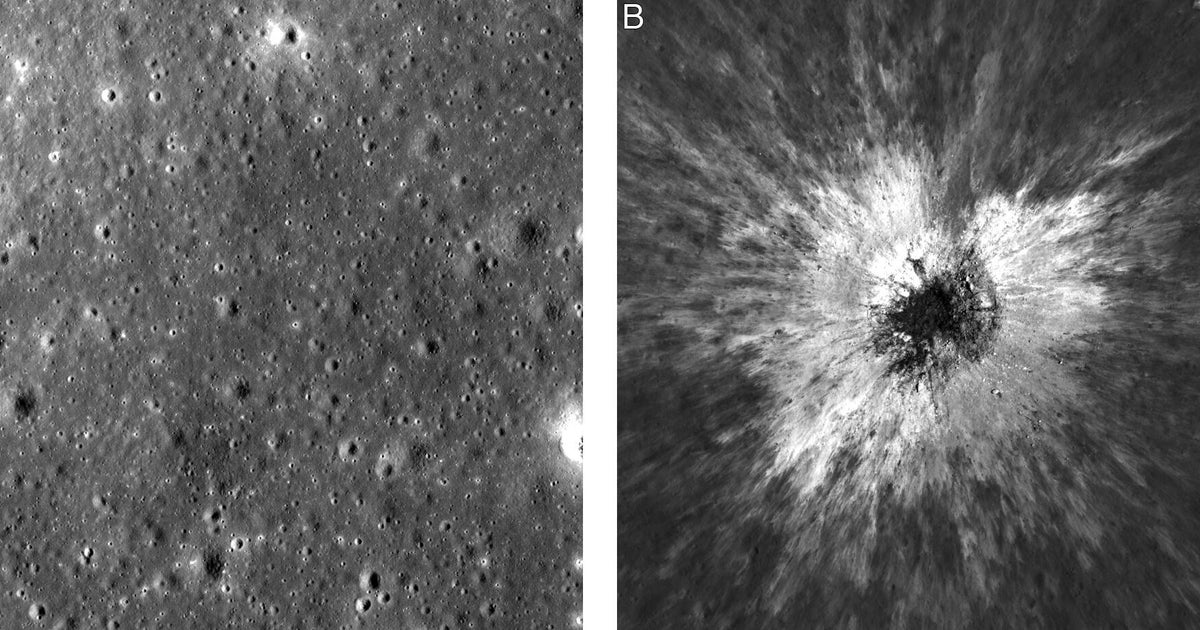
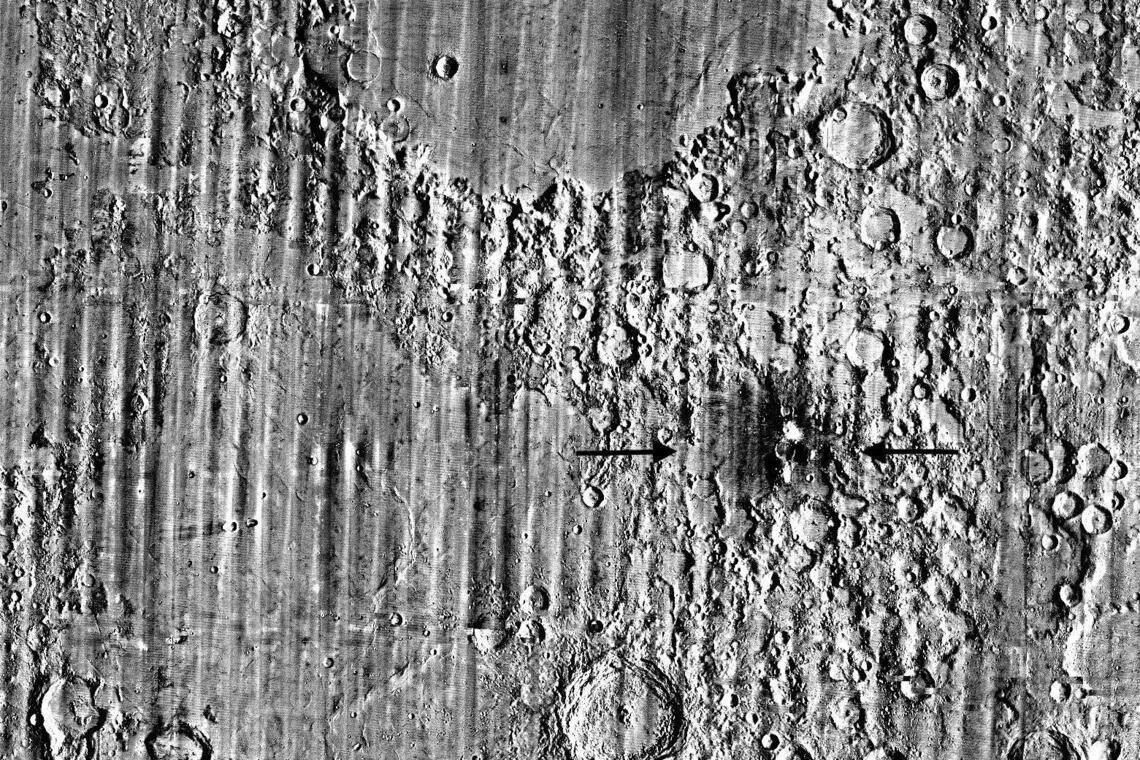
Photo via CBC News

NASA satellite discovers a new crater on the moon that's bigger than the Colosseum

Read the original at CBC News ↗
Cite

NASA satellite discovers a new crater on the moon that's bigger than the Colosseum. (2026, September 17). CBC News. https://www.cbc.ca/news/science/new-crater-moon-9.7348242?cmp=rss

Dated when The Aporia collected the article, usually within hours of publication. Check the original for its exact date and byline.

CBC News · collected 2026-09-17 · by CBC

Quick Summary

NASA scientists have discovered a new crater on the moon larger than Rome’s Colosseum, measuring 222 meters across and up to 43 meters deep, formed by an asteroid or comet impact two years ago. This rare event, which occurs approximately once every 132 years, was spotted by NASA's Lunar Reconnaissance Orbiter (LRO) in May 2024 and confirmed early this year. The crater, named after Thomas McGetchin, reveals that such impacts can significantly churn the lunar surface and affect its regolith, challenging previous beliefs about the stability of moon dust.
Written by AI on 2026-09-17, from this article's own text only (the story summary below draws on all the coverage).
See how they differ ↓

AI analysis

Story summary

NASA’s Lunar Reconnaissance Orbiter (LRO) discovered a massive crater on the moon's near side, larger than the Roman Colosseum, measuring about 728 feet across and up to 141 feet deep, in May 2024. The impact that formed this crater was caused by an asteroid or comet fragment roughly the size of a three- to six-story building. This event is estimated to occur only once every 132 years, making it a rare opportunity for researchers studying lunar geology and future moon missions. The crater was initially missed by Earth-based telescopes but spotted later in data analysis, providing valuable insights into the moon's surface changes as NASA plans to establish a base there.

Written for “Moon Crater Discovery” on 2026-11-22, grounded in this article and the 4 other(s) covering the same event.

How they differ

5 outlets covered “Moon Crater Discovery”.

What each outlet says

One AI summary per outlet of its latest article on this story, written from that article alone and checked against it. Open the article for the outlet's own words.

CBCThis outlet17 Sep

NASA scientists have discovered a new crater on the moon larger than Rome’s Colosseum, measuring 222 meters across and up to 43 meters deep, formed by an asteroid or comet impact two years ago. This rare event, which occurs approximately once every 132 years, was spotted by NASA's Lunar Reconnaissance Orbiter (LRO) in May 2024 and confirmed early this year. The crater, named after Thomas McGetchin, reveals that such…

NASA satellite discovers a new crater on the moon that's bigger than the Colosseum (this article)
CBS News16 Sep

NASA's Lunar Reconnaissance Orbiter discovered a massive crater on the moon, larger than the Roman Colosseum, which measures about 728 feet across and up to 141 feet deep. Formed by an asteroid or comet fragment two years ago, it is the largest impact crater created in recent times and occurs once every 132 years on average. The spacecraft first spotted the crater between April 11 and May 22, 2024, though detailed…

NASA spacecraft discovers moon crater bigger than Roman Colosseum →
The Straits Times17 Sep

A researcher at NASA discovered a recently formed crater on the Moon named McGetchin, measuring 222 meters wide, believed to have been caused by an asteroid or comet collision in spring 2024. Scientists consider impacts of this scale to be once-in-a-century events. The Lunar Reconnaissance Orbiter (LRO) detected the crater as a bright spot with a dark halo and it is noted as the largest newly discovered crater in…

NASA scan discovers new, ‘once in a century’ moon crater →
New York Post17 Sep

Scientists using NASA’s Lunar Reconnaissance Orbiter discovered a massive new crater on the moon in May 2024, which is larger than the Roman Colosseum and estimated to occur only once every 132 years. The crater, named after Thomas McGetchin, measures about 728 feet across and up to 141 feet deep, making it three times bigger than a similar discovery from a decade ago. The impact also ejected dust and rocky soil…

NASA spacecraft discovers huge new crater on the moon →
ABC News (AU)17 Sep

NASA scientist Robert Wagner discovered the largest newly formed crater on the Moon while examining data from the Lunar Reconnaissance Orbiter (LRO) in 2025. The McGetchin crater measures 222 meters across and 43 meters deep, larger than any previously recorded by LRO since its launch in 2009. Researchers believe it was formed between April and May 2024 from a comet or asteroid strike. This rare impact event occurs…

NASA scientist's chance Moon discovery reveals once-in-a-lifetime crater →

Where they agree and split

Framing

How the first headlines put it

Stated as fact4
The headlines (4)

NASA spacecraft discovers moon crater bigger than Roman Colosseum CBS News · stated as fact

NASA scan discovers new, ‘once in a century’ moon crater The Straits Times · stated as fact

NASA spacecraft discovers huge new crater on the moon New York Post · stated as fact

NASA scientist's chance Moon discovery reveals once-in-a-lifetime crater ABC News (Australia) · stated as fact

The full story: what happened, how it changed, and all 5 articles →

Compared with similar articles

This article reads unscored and hedges 18% of its claims. Each row says how that neighbour differs.
CBS News
Hedges 4 of 21 claims Outlet record 66/100
New York Post
Hedges 3 of 19 claims Outlet record 66/100
The Straits Times
Hedges 2 of 10 claims Outlet record 64/100
ABC News (AU)
Hedges 4 of 31 claims Outlet record 67/100

Story

Moon Crater Discovery
Science · 5 article(s) covering the same event. Compare every outlet's account →
How this article was measured signals, leaning charts, publisher record, byline, topics and claims

Signals How these are calculated →

Claims extracted
17
sentences that state something as happening or true
Uncertain
18%
3 of 17 hedged ("reportedly", "may", "according to")
Leaning
not political
takes no side on a contested political question
Publisher signals
70/100
CBC News's corrections and hedging, across everything collected from it. Not a measure of accuracy.
Outlets on this story
5
Science
Same framing elsewhere
1
articles that frame the event the way this one does
Analyzed 2026-09-17 · how these are computed

How this is being covered How these are calculated →

Article leaning vs. publisher reliability
Source leaning vs. consistency

Publisher

CBC News · 2437 article(s) · 7 correction(s) detected
Running correction rate · 7 correction(s)

Who wrote this

No reporter is named on this article, beyond the feed's “CBC”.

Topics

Houston LRO Lunar Reconnaissance Orbiter NASA Science Advances

Subjects

NASA ORG · 4× Robinson PERSON · 3× David Paige PERSON · 1× Houston ORG · 1× Intuitive Machines ORG · 1× Lunar and Planetary Institute ORG · 1× Mark Robinson PERSON · 1× Science Advances ORG · 1× SpaceX ORG · 1× Thomas McGetchin PERSON · 1×

Narrative

NASA satellite discovers a new crater on the moon that's bigger than the Colosseum 'This event constitutes a statistically rare, effectively once-in-a-lifetime observation,' scientists write Scientists have discovered a crater on the moon that's bigger than the Roman Colosseum and is the result of a powerful impact two years ago that initially went undetected. The steep-sided hole — 222 metres across and up to 43 metres deep — is the solar system's biggest known impact crater carved out in recent times. Such a large-scale event is estimated to occur only once every 132 years, researchers said, making this a treasure trove of information as NASA prepares to build a base for astronauts on the moon.
framing: assertive · carried by 1 article(s) · first seen 2026-09-17
NASA's Lunar Reconnaissance Orbiter (LRO) spotted the crater on the moon's near side in May 2024 soon after it was formed by an incoming fragment of an asteroid or comet.

Claims (17 extracted, 3 hedged)

NASA satellite discovers a new crater on the moon that's bigger than the Colosseum 'This event constitutes a statistically rare, effectively once-in-a-lifetime observation,' scientists write Scientists have discovered a crater on the moon that's bigger than the Roman Colosseum and is the result of a powerful impact two years ago that initially went undetected. The steep-sided hole — 222 metres across and up to 43 metres deep — is the solar system's biggest known impact crater carved out in recent times. Such a large-scale event is estimated to occur only once every 132 years, researchers said, making this a treasure trove of information as NASA prepares to build a base for astronauts on the moon. asserted
NASA → discover → moon
"This event constitutes a statistically rare, effectively once-in-a-lifetime observation," the scientists wrote in one of two studies appearing on the subject Wednesday in the journal Science Advances. asserted
scientists → constitute → journal
NASA's Lunar Reconnaissance Orbiter (LRO) spotted the crater on the moon's near side in May 2024 soon after it was formed by an incoming fragment of an asteroid or comet. uncertain
it → spot → asteroid
The moon strike escaped real-time detection by telescopes on Earth and in space. asserted
strike → escape → space
LRO's wide-angle images were not identified in the crush of data until August 2025. asserted
images → identify → August
The spacecraft gathered more detailed pictures last fall, followed by confirmation of the discovery early this year. asserted
spacecraft → gather → discovery
The crater is named for the late Thomas McGetchin, a former director of Houston's Lunar and Planetary Institute. asserted
crater → name → Institute
Like gardening Pockmarked since ancient times, the moon bears some of the solar system's largest impact craters, including one that stretches more than 2,400 kilometres across. asserted
that → bear → one
This latest impact churned the lunar surface for more than 100 kilometres. asserted
impact → churn → kilometres
Dust and rocky soil were hurled away at a higher angle than expected, according to Mark Robinson, chief scientist for the LRO's cameras who works at Intuitive Machines. uncertain
who → hurl → Machines
Here's the mark a SpaceX rocket crash left on the moon Astronauts' movement increased subsurface temperatures on the moon, study finds A separate study identified a seven-kilometre-wide cold spot around the new crater, consistent with a loosening of the moon's topsoil. asserted
study → leave → topsoil
Co-author David Paige of the University of California, Los Angeles, likens it to gardening. asserted
Paige → liken → gardening
"We're now thinking of impacts as a way to garden the regolith — churning the sediments and putting stuff above that's usually below the surface," Paige said in a statement. asserted
Paige → think → statement
The LRO's numerous crater discoveries since its launch in 2009 show that the moon's top two centimetres of soil is being overturned by ejected material every 80,000 years, faster than previously thought, according to Robinson. uncertain
centimetres → show → Robinson
Contrary to the popular belief that the Apollo moonwalkers' dusty lunar footprints will last forever, they will "definitely be long gone in that time frame," Robinson said in an email. asserted
Robinson → last → email
The next step is to calculate the risk of ejected crater material striking NASA's planned moon base, he added. asserted
he → calculate → base
"That information will help engineers harden structures so one won't have to worry about damage, or maybe worry less." asserted
one → help → damage
Give feedback · no sign-in needed

No sign-in needed for now. Your note is sent without a name, so it cannot be answered.

History Support