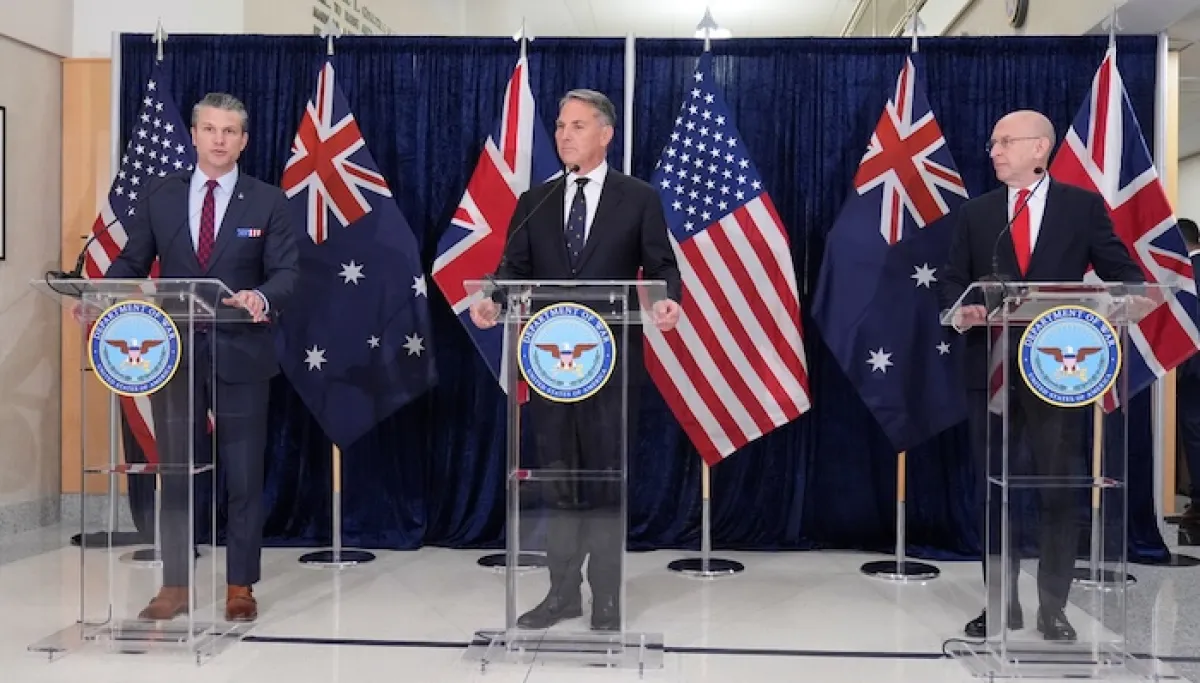
Photo via The Guardian

US warned supplying nuclear-powered submarines to Australia would diminish its own fleet for ‘many years’

Read the original at The Guardian ↗
Cite

York, B. D. i. N. (2026, November 20). US warned supplying nuclear-powered submarines to Australia would diminish its own fleet for ‘many years’. The Guardian. https://www.theguardian.com/world/2026/nov/20/aukus-defence-us-warned-supplying-nuclear-powered-submarines-to-australia-would-diminish-its-own-fleet-for-many-years

Dated from the outlet's own feed. Check the original for its byline.

The Guardian · collected 2026-11-20 · by Ben Doherty in New York

Quick Summary

A new Congressional Budget Office report warns that supplying nuclear-powered submarines to Australia under the Aukus agreement would reduce the US Navy’s fleet for many years. The report highlights that the US submarine industrial base is already struggling to meet the Navy’s demand and that increasing production to replace sold submarines would exacerbate existing challenges. It questions whether submarines transferred to Australia could be compelled to participate in a conflict with China, raising concerns about the strategic implications of the Aukus deal.
Written by AI on 2026-11-21, from this article's own text only (the story summary below draws on all the coverage).
See how they differ ↓

AI analysis

Story summary

The Congressional Budget Office (CBO) has warned that supplying nuclear submarines to Australia through the AUKUS deal could deplete the US Navy’s fleet for many years. The CBO’s recent analysis of the US Navy’s shipbuilding plans found that the transfer of Virginia-class submarines to Australia, as part of the AUKUS agreement signed in 2021, is not factored into current Navy forecasts. The report states that selling these submarines to Australia would reduce the number of attack submarines available to the US Navy for many years, increasing the challenges faced by the Navy and shipyards in meeting demand. The AUKUS deal involves the US selling between three and five Virginia-class submarines to Australia starting in 2032, while also helping to build up Australia’s defense industrial base for future submarine manufacturing.

Written for “Supplying Nuclear Subs to Australia Warning” on 2026-11-21, grounded in this article and the 1 other(s) covering the same event.
Why this leaning score
The article's own words the score was based on. Each is quoted verbatim and was checked against the article text before being stored, so you can find it in the original.
Reading Leans strongly right (beta estimate) Confidence high
Leaning: leans strongly right for article 166117 (high confidence, 1 verified quote) · logged 2026-11-21

How they differ

2 outlets covered “Supplying Nuclear Subs to Australia Warning”.

What each outlet says

One AI summary per outlet of its latest article on this story, written from that article alone and checked against it. Open the article for the outlet's own words.

The GuardianThis outlet20 Nov

A new Congressional Budget Office report warns that supplying nuclear-powered submarines to Australia under the Aukus agreement would reduce the US Navy’s fleet for many years. The report highlights that the US submarine industrial base is already struggling to meet the Navy’s demand and that increasing production to replace sold submarines would exacerbate existing challenges. It questions whether submarines…

US warned supplying nuclear-powered submarines to Australia would diminish its own fleet for ‘many years’ (this article)
Washington Examiner20 Nov

The Congressional Budget Office (CBO) released an analysis this month warning that supplying nuclear submarines to Australia under the AUKUS deal could severely deplete the U.S. Navy’s fleet for many years. The CBO’s report, which covers the U.S. Navy’s shipbuilding programs over the next three decades, dedicates two pages to the AUKUS agreement and its potential impact. The agreement, signed by President Biden in…

Supplying nuclear subs to Australia could deplete fleet for ‘many years,’ CBO warns →

Compared with similar articles

This article reads leans strongly right and hedges 22% of its claims. Each row says how that neighbour differs.
Washington Examiner
Leans left further left than this Hedges 1 of 4 claims Outlet record 67/100
The Guardian
Leans left further left than this Hedges 2 of 46 claims Outlet record 64/100
“The articles discuss different aspects of US naval strategy and costs, not the same specific incident.”

Story

Supplying Nuclear Subs to Australia Warning
Politics · 2 article(s) covering the same event. See how they differ ↑
How this article was measured signals, leaning charts, publisher record, byline, topics and claims

Signals How these are calculated →

Claims extracted
27
sentences that state something as happening or true
Uncertain
22%
6 of 27 hedged ("reportedly", "may", "according to")
Leaning
Leans strongly right
of the writing, not the subject · beta estimate
Publisher signals
64/100
The Guardian's corrections and hedging, across everything collected from it. Not a measure of accuracy.
Outlets on this story
2
Politics
Same framing elsewhere
1
articles that frame the event the way this one does
Analyzed 2026-11-21 · how these are computed

How this is being covered How these are calculated →

Article leaning vs. publisher reliability
Source leaning vs. consistency

Publisher

The Guardian · 3760 article(s) · 8 correction(s) detected
Running correction rate · 8 correction(s)

Who wrote this

Ben Doherty in New York
2 article(s) here · 1 carrying a prediction
Total shipbuilding costs would average $54bn annually (in 2026 dollars) over the next 30 years, the CBO found, about 18% more than navy estimates.
Providing nuclear-powered submarines to Australia would diminish the US navy’s own fleet for “many years”, a new report for the US Congress has cautioned, questioning whether Australian-flagged vessels could be compelled into service in a conflict with China.
Also by Ben Doherty in New York
Nothing else under this byline is closely related to this article, so these are simply their most recent.

Topics

Aukus Australia Australian China Navy

Subjects

Australia GPE · 16× Australian NORP · 5× China GPE · 5× Aukus ORG · 3× Navy ORG · 3× CBO ORG · 2× the United States GPE · 2× the Congressional Budget Office ORG · 1× the US Congress ORG · 1× the US Navy’s ORG · 1×

Narrative

In 2023, Australia’s defence minister, Richard Marles, said Australia would make no promises it would deploy its submarines in support of any US conflict with China, and that any future Australian submarines would be “under the complete control of the Australian government of the day”.
framing: mixed · carried by 1 article(s) · first seen 2026-11-21
Providing nuclear-powered submarines to Australia would diminish the US navy’s own fleet for “many years”, a new report for the US Congress has cautioned, questioning whether Australian-flagged vessels could be compelled into service in a conflict with China.

Claims (27 extracted, 6 hedged)

Providing nuclear-powered submarines to Australia would diminish the US navy’s own fleet for “many years”, a new report for the US Congress has cautioned, questioning whether Australian-flagged vessels could be compelled into service in a conflict with China. uncertain
vessels → provide → China
The US navy’s latest shipbuilding plan does not countenance the Aukus agreement in its forecasts at all, noting only in a footnote that the transfer of any Virginia-class submarine to Australia “has not been factored into the plan”, the report says. asserted
report → countenance → plan
But the Congressional Budget Office has evaluated the impact of Aukus, releasing detailed analysis on Friday morning, finding “the US submarine industrial base is currently struggling to meet the Navy’s demand for submarines”. asserted
base → evaluate → submarines
“Increasing production further to replace SSNs [attack submarines] sold to Australia would increase the challenges that the Navy and the shipyards are facing,” the report found. asserted
report → increase → that
“The sale of SSNs to Australia would reduce the number of attack submarines available to the Navy for many years.” asserted
sale → reduce → years
Under the so-called “Pillar One” of Aukus, the US has agreed to sell between three and five in-service Virginia-class submarines to Australia, beginning in 2032. asserted
US → call → 2032
The CBO analysis questioned whether any submarines transferred to Australia could be utilised in the event of a US conflict with China. uncertain
submarines → question → China
“Would China be less deterred if the United States reduced the number of its attack submarines to help Australia develop its own submarine force? asserted
Australia → deter → force
The report argued that because of the longstanding, and robust, alliance between the US and Australia, boosting the Australian navy’s submarine fleet could help offset the US Navy’s “potential loss of capability”. uncertain
boosting → argue → capability
“That loss might even be more than offset because the Australian submarines would be based in the Western Pacific region and therefore could respond more quickly to any conflict with China over Taiwan or other issues in the South China Sea uncertain
submarines → offset → Sea
“However, Australia would control its own submarines, and their participation in any particular conflict would not be guaranteed.” asserted
participation → control → conflict
In 2023, Australia’s defence minister, Richard Marles, said Australia would make no promises it would deploy its submarines in support of any US conflict with China, and that any future Australian submarines would be “under the complete control of the Australian government of the day”. asserted
submarines → say → day
The country’s shipyards are currently producing Virginia-class submarines at a rate of 1.13 a year: that rate needs to lift that to two submarines a year to service America’s own needs, and 2.33 a year to have additional boats to transfer to Australia. asserted
rate → produce → Australia
The CBO report said submarine-building rates had slowed over the past two decades, and Virginia-class submarines were delayed between 24 and 36 months. asserted
submarines → say → decades
“Building … submarines took five to six years in the 2000s but now takes an average of 10 to 11 years, according to current schedules.” uncertain
Building → build → schedules
The US legislation governing Aukus states that the president of the US can only transfer a submarine to Australia if losing that submarine from US service “will not degrade the United States undersea capabilities”. asserted
losing → govern → capabilities
The US can refuse to transfer any submarines to Australia without penalty, under the terms of the Aukus agreement. asserted
US → refuse → agreement
Critics of Aukus have said there is vanishingly little chance the US will have the capacity to sell any of its in-service submarines to Australia. asserted
US → say → Australia
The former foreign affairs minister Bob Carr told Guardian Australia both countries were “living a lie” in upholding the fiction that the submarine deal would happen. asserted
deal → tell → fiction
“It’s now conventional wisdom in Washington as well as in Canberra that we’re not going to get the subs. asserted
we → ’ → subs
But the deal has avowed, bipartisan broad political support across both the US and Australia. asserted
deal → have → US
Marles said earlier this month: “Aukus is happening, our alliance is happening, and all of that continues unimpeded.” asserted
all → say → that
Pete Hegseth, the US secretary of defense, affirmed his support for the Aukus agreement, and the two countries’ commitment “to advance the alliance and strengthen deterrence in the Pacific” at a meeting with Marles in September. asserted
Hegseth → affirm → September
The US Congressional Research Service has openly countenanced an “alternative division of labour” under which no Virginia-class submarines are ever transferred to Australian control. asserted
submarines → countenance → control
The research service’s latest report on Aukus, issued in January, considered a revision of the Aukus deal under which the submarines earmarked for sale to Australia were instead retained under US command to be sailed out of Australian bases. asserted
submarines → issue → bases
The report argued both for and against the US selling three Virginia-class submarines to Australia, beginning in 2032. asserted
US → argue → 2032
But it makes the case that, in the event of a “conflict or crisis” with China over Taiwan, submarines under Australian command could not be ordered into operation, whereas US-commanded vessels, operated out of Australian bases, could be immediately deployed. uncertain
vessels → make → bases
Give feedback · no sign-in needed

No sign-in needed for now. Your note is sent without a name, so it cannot be answered.

History Support