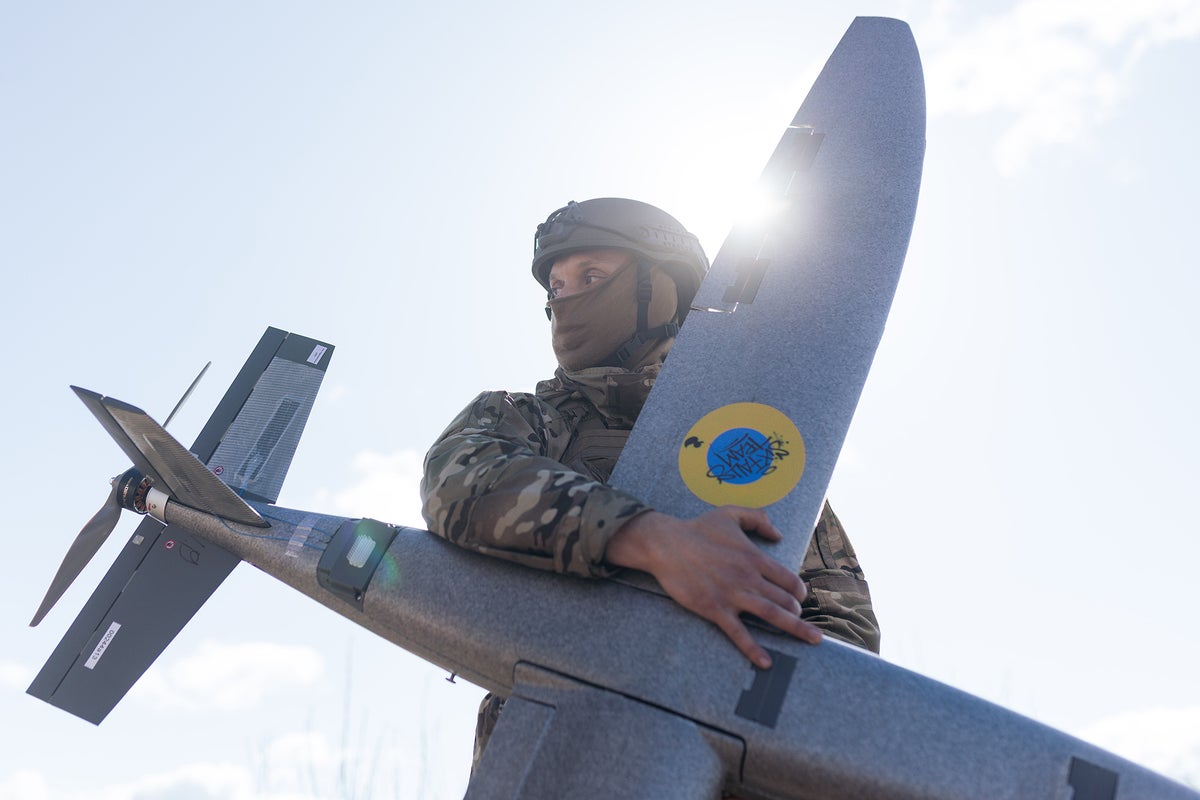
The lessons of Ukraine’s defence against Russian invasion and modern warfare means that almost half of all the infantry in the British army should be retrained as drone operators, according to a major new report.
uncertain
half → mean → report
The Royal United Services Institute (Rusi), Britain’s leading military think tank, has spelled out the need for a massive reorganisation of the modern armed forces to meet the new realities of war which have been developed by Ukraine - and Russia.
asserted
which → lead → Ukraine
“A British Light Infantry Battalion at full complement comprises 561 personnel.
asserted
Battalion → comprise → personnel
Were Ukrainian levels of UAV use to be adopted by the British Army, approximately 45% of the formation would make up the UAV enterprise,” the report says.
asserted
report → adopt → enterprise
The Rusi report is the most comprehensive analysis of how armies will have to change immediately or face disaster on the battlefield.
asserted
armies → change → battlefield
In Britain, army insiders complain that the numbers of specialist drone units are tiny and under resourced, with only a handful of drones to train on for dozens of men and women.
asserted
numbers → complain → men
But when they are deployed, they have been comprehensively devastating to traditional formations trained for the pre-drone era.
asserted
they → deploy → era
Ukraine’s innovations have been driven by systems that mean soldiers on the front line can order and help redesign combat drones, taking delivery times that in Europe could be years down to days.
uncertain
that → drive → days
They have also used trial and error to evolve drone units.
asserted
They → use → units
While they are global leaders, followed by Russia, in the new form of warfare, integrating the lessons of Ukraine's war into Nato armies is likely to run into friction as institutions change slowly.
asserted
institutions → follow → friction
Part of that friction could be removed, the report shows, by the fact that drone specialists will serve alongside, not entirely replace, the traditional weapons specialists using mortars, machine guns, anti-tank missiles.
uncertain
specialists → remove → mortars
“A mortar causes enemy troops to dive to the ground to minimise their exposure to shrapnel.
asserted
troops → cause → shrapnel
By contrast, a soldier attacked by FPVs is well advised to run into a treeline, forcing the FPV to slow down and then to fire at it,” the report suggests.
uncertain
report → attack → it
“Being upright, however, makes the soldier vulnerable to mortar fire.
asserted
soldier → make → fire
A devastating tactic, therefore, is to either pin infantry in open ground with a mortar and then kill them with FPVs, or, conversely, to achieve an initial hit with an FPV to force troops to run into a treeline that is pre-sighted for the mortar and then bracket [bomb] them with it.
asserted
that → pin → it
Every Ukrainian and Russian soldier knows they are visible almost all of the time to the enemy.
asserted
they → know → enemy
Drones have transformed the concept of hiding at all - the only place that drones cannot see is under ground.
asserted
drones → transform → ground
Front lines are now at least 10km deep on both sides: troops are dispersed into tiny groups, often buried in bunkers to hold ground, and supplied exclusively by drones.
asserted
troops → disperse → drones
Modern armies will now have to look to adapt to logistics being heavily dependent on unmanned vehicles on the ground and in the air.
asserted
logistics → have → air
“The most significant impact of uncrewed systems on the modern battlefield is that they allow it to be kept under persistent observation, which lends precision to commanders in their movement of troops and application of fire,” the report says.
asserted
report → allow → fire
Soldiers studying the war in Ukraine well know that this means vast areas of a blasted landscape, where infantry cling to survival in small numbers hunted from the air.
asserted
infantry → study → air
A battalion of about 600 personnel can expect to lose dozens, 20-60 multicopters a week.
asserted
battalion → expect → dozens
FPOV teams in Ukraine expect to fly 30-50 one-way drones every three days.
asserted
teams → expect → drones
They unusually can work for 48 hours periods before they need to be replaced and, as The Independent has seen on the font lines, the race into and out of front line locations is as dangerous and being there under fire.
asserted
race → work → fire
The British armed forces have no experience of this form of warfare that has become the new normal.
asserted
that → have → warfare
Infantry units who were most recently in Afghanistan and Iraq will now have to adjust every aspect of their training to survive.
asserted
who → have → training
Drone teams will need to learn how to run UAV logistics delivering every element needed to fight.
asserted
teams → need → element
Medics will need to learn to evacuate the wounded by air or land drones.
asserted
Medics → need → air
Others will need to be specialist “sniper” style teams working alongside traditional snipers with rifles, to attack with precision, while others will be bomber units using quadcopters and fixed wing drones to take on enemy units doing the same.
“To take a sample Ukrainian brigade that makes extensive use of UGVs, the force conducted 824 resupply missions in a month with loads between 100 and 150 kg light utility operations suffer from a high rate of attrition,” the report says.
asserted
report → need → attrition
“The slow and low flight profile of utility UAVs make them easy to shoot down.
asserted
them → make → UAVs
UAVs and UGVs, meanwhile, are a priority target for enemy interception because throttling logistics limits activity.
asserted
throttling → throttle → activity
Even with an 80% success rate on missions, a battalion may expect to lose 10–20 utility UAVs. UGVs per week.
uncertain
battalion → expect → week
It is generally assumed that 50% of platforms supporting offensive action will be lost over the course of the operation.”
asserted
% → assume → operation
 The Aporia