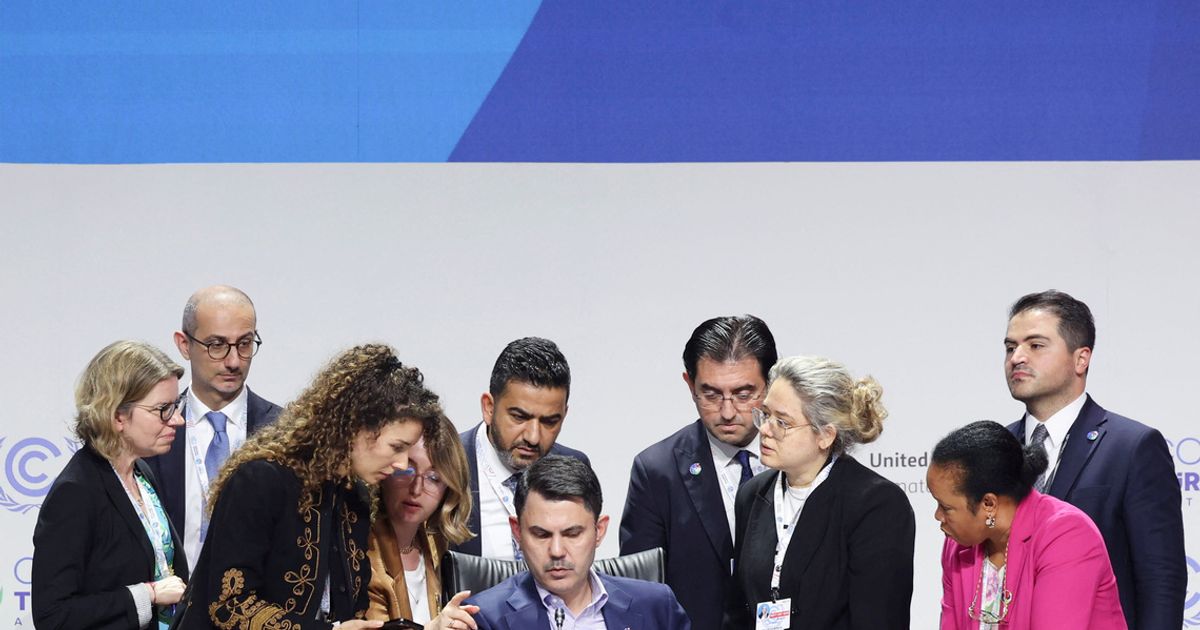
Photo via The Straits Times

AI being run in a ‘mediaeval’ way: UN

Read the original at The Straits Times ↗
Cite

The Straits Times. (2026, November 19). AI being run in a ‘mediaeval’ way: UN. The Straits Times. https://www.straitstimes.com/world/europe/ai-being-run-in-a-mediaeval-way-un

Dated from the outlet's own feed. Check the original for its byline.

The Straits Times · collected 2026-11-19 · by The Straits Times

Quick Summary

On November 19 at the RightsX summit in Geneva, UN High Commissioner for Human Rights Volker Turk warned that artificial intelligence is being governed in a way reminiscent of medieval times, with significant power concentrated among a few tech giants. Turk highlighted that five technology companies control over 70% of global AI computing capacity and emphasized the lack of democratic oversight and accountability in AI governance. He stressed the urgent need for regulation to prevent AI from disproportionately impacting human rights and called for technology companies to introduce safeguards before the technology’s potential harms become uncontrollable.
Written by AI on 2026-11-20, from this article's own text only (the story summary below draws on all the coverage).

AI analysis

Story summary

At the RightsX summit in Geneva on November 19, 2026, the UN rights chief Volker Turk warned that artificial intelligence is being governed in a way that mirrors medieval practices, with power concentrated in the hands of a few tech barons. Turk noted that five technology companies control over 70% of global AI computing capacity, highlighting a significant democratic deficit. He stressed that this concentration of power poses a risk to the rights and freedoms of ordinary people, as there are virtually no checks, balances, or accountability mechanisms in place. Turk reiterated his call for rights-centered AI regulation, emphasizing the increasing influence of AI on people's lives and the potential for subtle, insidious distortions of public debate.

Written for “UN Criticizes AI Governance” on 2026-11-22, grounded in this article and the 0 other(s) covering the same event.

Compared with similar articles

This article reads leans strongly left and hedges 24% of its claims. Each row says how that neighbour differs.
Toronto Star
Leans right further right than this Hedges 3 of 25 claims Outlet record 65/100
“The articles discuss different aspects of AI governance and do not describe the same specific event or incident.”
Semafor
Leans right further right than this Hedges 2 of 13 claims Outlet record 64/100
“The articles describe different events: one discusses a conference about AI and geopolitics, while the other reports on a UN rights chief's comments at a summit about AI governance.”
CBC News
Leans right further right than this Hedges 11 of 41 claims Outlet record 60/100
“The articles cover related topics but describe different specific events: one discusses a UN meeting about AI regulations in warfare, the other covers a speech by the UN rights chief about AI governance.”
NPR
Leans strongly left Hedges 2 of 30 claims Outlet record 60/100
“The articles discuss different aspects of AI governance and regulation at the UN, not the same specific event.”

Story

UN Criticizes AI Governance
Politics · 1 article(s) covering the same event.
How this article was measured signals, leaning charts, publisher record, byline, topics and claims

Signals How these are calculated →

Claims extracted
21
sentences that state something as happening or true
Uncertain
24%
5 of 21 hedged ("reportedly", "may", "according to")
Leaning
Leans strongly left
of the writing, not the subject · beta estimate
Publisher signals
64/100
The Straits Times's corrections and hedging, across everything collected from it. Not a measure of accuracy.
Outlets on this story
1
Politics
Same framing elsewhere
1
articles that frame the event the way this one does
Analyzed 2026-11-20 · how these are computed

How this is being covered How these are calculated →

Article leaning vs. publisher reliability
Source leaning vs. consistency

Publisher

The Straits Times · 5699 article(s) · 7 correction(s) detected
Running correction rate · 7 correction(s)

Who wrote this

The Straits Times
4005 article(s) here · 1 carrying a prediction
Annual inflation hit 11% in October and prices are expected to rise further this year, economists say, leaving many Ukrainians feeling the pinch and less able to spend on eating out.
While no one obtained everything they might have desired, everyone can find a place for themselves within this text—that is the very essence of consensus.
At least 14 people missing after Russian drone hit building in Kyiv region, Zelenskiy says KYIV, Nov 22 - At least 14 people may still be trapped under the rubble of a residential building that was struck by a Russian drone on Sunday morning in Ukraine's Kyiv region, President Volodymyr Zelenskiy said.
Ferguson said at a news conference that the ICE agents may have broken a state law limiting facial coverings for law enforcement, and that he was looking into how they accessed the jet bridge.
Before departing for his overseas trip, Trump told reporters that he might meet Kim in China.
The latest draft expressed “deep concern” that global warming would cross 1.5 deg C above pre-industrial levels in the next few years.
2026-11-22 · assertive framing · Fossil fuels still missing from latest COP31 draft deal
Mejia had also overstayed her visa, ICE said, adding that she would be charged with assaulting a federal officer.
She will be charged with assaulting a federal officer, according to ICE.
TEHRAN - Iran will impose rolling power cuts from Nov 22 as damage to key infrastructure during the Middle East war deepens an already severe energy crunch, state media reported.
2026-11-22 · assertive framing · Iran to ration electricity as war hits energy network
Party strategists anticipate that the field of 2028 aspirants could be far wider than what was expected at the start of the administration, when Trump joked about seeking a constitutionally-barred third term.
Also by The Straits Times
Nothing else under this byline is closely related to this article, so these are simply their most recent.
All 4005 articles by The Straits Times →

Topics

AFP GENEVA RightsX the Universal Declaration of Human Rights

Subjects

Turk PERSON · 5× GENEVA GPE · 2× AFP ORG · 1× RightsX ORG · 1× Volker Turk PERSON · 1×

Narrative

“We have the technology of the future governed in an almost mediaeval way: by a select few, with virtually no checks, no balances, no participation, and no accountability,” he said.
framing: mixed · carried by 1 article(s) · first seen 2026-11-20
And this, he warned, was often happening without their knowledge, and could distort public debate in “subtle, insidious ways”.
2026-11-20 · The Straits Times
AI being run in a ‘mediaeval’ way: UN · mixed framing

Claims (21 extracted, 5 hedged)

AI being run in a ‘mediaeval’ way: UN AI generated GENEVA – asserted
AI → run → way
Artificial intelligence is being governed in an almost mediaeval fashion, the UN rights chief warned on Nov 19, with power concentrated in the hands of a few tech barons. asserted
power → govern → barons
Speaking at the RightsX summit in Geneva, Volker Turk said that while the story of AI sounded futuristic, underneath it was an age-old narrative of power. asserted
narrative → speak → power
“A handful of men still control much of the world’s AI computing power, data and infrastructure. asserted
handful → control → power
And we still have no common rules to pace or steer AI development,” he said. asserted
he → have → development
Turk said there was a glaring democratic deficit when five technology companies owned more than 70% of global AI computing capacity. asserted
companies → say → capacity
“We have the technology of the future governed in an almost mediaeval way: by a select few, with virtually no checks, no balances, no participation, and no accountability,” he said. asserted
he → have → checks
“History has taught us: With this kind of power, the rights and freedoms of ordinary people are the first to suffer.” asserted
rights → teach → people
Reiterating his call for rights-centred AI regulation, the UN high commissioner for human rights said the technology was increasingly controlling people’s lives. asserted
technology → reiterate → lives
And this, he warned, was often happening without their knowledge, and could distort public debate in “subtle, insidious ways”. uncertain
he → warn → ways
Meanwhile, biased algorithms could reproduce injustice on an industrial scale, he cautioned. uncertain
he → bias → scale
“Our transport, food and healthcare are increasingly digitised. asserted
transport → digitise → ?
We may not be far from the day when AI can cut off the critical infrastructure of entire communities or countries, either on its own or in the wrong hands,” Turk warned. uncertain
Turk → cut → hands
“When people discuss the chances of civilisational collapse because of AI, we need to ask: who decides what chances we take?” asserted
we → discuss → chances
He voiced optimism that people would ultimately challenge unchecked power, with the democratic deficit turning into a deficit of trust. asserted
deficit → voice → trust
He cited young people already stepping offline to regain greater control of their lives. asserted
people → cite → lives
Turk said AI’s benefits should be shared equitably, which would require goodwill from technology companies, but also regulation and accountability. asserted
which → say → companies
He said he had written to frontier AI companies urging them to introduce effective safeguards “before it is too late”. asserted
it → say → safeguards
Turk noted that a bottle of milk could not make it to a shop without layers of testing, rules and regulations. uncertain
bottle → note → testing
So for AI, “it’s a no-brainer that you need some form of regulation”, given its potential for harm, Turk said. asserted
Turk → ’ → harm
As for how models are trained, he suggested giving the Universal Declaration of Human Rights “as the task to AI”. uncertain
he → train → AI

Give feedback · no sign-in needed

No sign-in needed for now. Your note is sent without a name, so it cannot be answered.

History Support